
What is missional church? A clear guide for seekers


Many people exploring church models assume a missional church is simply an evangelistic programme, a seeker-sensitive service, or the latest ministry trend to attract younger people. The reality cuts far deeper than that. Understanding what is missional church means grasping a fundamental shift in identity. Rather than a church that “has” a mission, a missional church is shaped by mission at its core. This guide unpacks the biblical foundation, the defining characteristics, and the practical outworking of missional church life so you can discern whether this model resonates with your own search for authentic Christian community.
Key takeaways
Point | Details |
Mission as identity | A missional church organises its entire life around God’s mission, not around programmes or attendance growth. |
Four defining characteristics | Missional congregations are contextual, communal, innovative, and visionary in how they engage their communities. |
Integral mission | Biblical mission holds together gospel proclamation and acts of compassion and justice as one inseparable calling. |
Gathered and scattered | Weekly gatherings refuel believers to minister in everyday life, not serve as the destination of mission itself. |
Rhythms over programmes | Missional community forms through relational rhythms practised consistently, not through launching new service events. |
Defining the missional church
The phrase “missional church” carries a specific theological weight that many casual uses miss entirely. At its heart, the definition of missional church revolves around what theologians call the missio Dei, a Latin phrase meaning “the mission of God.” God is, by nature, a sending God. He sent the Son; the Son sends the Spirit; together they send the Church into the world. The church does not own mission as one of its departments. Mission owns the church.
Writers like Timothy Keller and Alan Hirsch have shaped this conversation significantly. Mission organises church life around being an agent of God’s redemptive purposes rather than functioning as a service-provider or visitor attraction. This distinction matters enormously when you are comparing church models.
“The church does not have a mission; God’s mission has a church.”
That inversion is everything. A traditional attractional church asks, “How do we get people through the door?” A missional church asks, “How do we go to where people already are?” One model is centred on the building and the programme. The other is centred on the neighbourhood, the workplace, the university campus, the café.
This does not mean the missional model abandons Sunday gatherings or preaching. It means those practices serve the outward movement of God’s people into the world rather than existing as ends in themselves. Local church community remains the irreplaceable context for disciple-making. Missional church simply refuses to let the gathered meeting become the whole story.

Four marks of missional congregations
Understanding what makes a congregation truly missional rather than merely aspirational is where theory becomes practical. According to F. Douglas Powe, four characteristics define missional congregations: contextual, communal, innovative, and visionary.

Characteristic | What it means in practice |
Contextual | The congregation is genuinely present in local culture, listening before speaking, and engaging rather than extracting. |
Communal | Shared story and practices like baptism and communion form bonds that go far deeper than a weekly attendance habit. |
Innovative | The church remains open to new expressions of mission without discarding the wisdom embedded in tradition. |
Visionary | The community is guided by a godly vision that creates healthy tension between where they are and where they are called to be. |
The contextual marker deserves particular attention for anyone exploring church in a city like Canberra. A contextual congregation does not merely hold services near its community. It is shaped by its community, attentive to its questions, present in its sorrows, and embedded in its rhythms. This is the difference between a church that broadcasts into a neighbourhood and one that genuinely belongs to it.
The visionary marker is equally important and often misunderstood. Missional congregations live in productive tension between present realities and a future to which God is calling them. That tension is not a problem to be resolved by making peace with the status quo. It is a gift that prevents stagnation and keeps the community leaning forward.
Pro Tip: Innovation in a missional church is never change for its own sake. It is willingness to modify methods while remaining anchored in the gospel, so that mission effectiveness is never sacrificed on the altar of comfortable tradition.
Integral mission: word and deed together
One of the most theologically rich concepts within the missional church conversation is integral mission. This is the idea, deeply rooted in Scripture and championed by the Lausanne Movement, that gospel-centred mission cannot be reduced to either evangelism alone or social action alone. The two belong together.
What does integral mission look like in practice? Consider these expressions:
Verbal proclamation: Sharing the story of Jesus clearly, personally, and contextually in conversation and gathered settings.
Acts of compassion: Serving those experiencing poverty, isolation, grief, or illness as a direct expression of Christ’s love, not as a bait-and-switch for conversion.
Justice engagement: Advocating for the vulnerable, speaking against systemic wrongs, and working for the flourishing of the whole community.
Presence over programme: Simply being a consistent, trustworthy neighbour in your street, workplace, or social network.
The gospel integrates word and deed in a way that refuses the false choice many churches make. Reduce mission to evangelism only and you produce a church that speaks but does not serve. Reduce it to social justice only and you produce a church that serves but does not speak. Integral mission holds the prophetic and the practical in one hand, because Jesus always did.
For a community like Divergentchurch in Canberra, with its universities, public servants, and transient population, integral mission in practice means engaging questions of meaning and purpose with students while also showing up practically for those on the margins of the city’s social life.
From ‘come and see’ to ‘go and be’
Perhaps the most practical shift the missional church makes is in its basic posture. Most church models throughout the 20th century operated on a centripetal model: create compelling services, programmes, and facilities that draw people inward toward the centre. The missional model operates centrifugally: equip and release people outward into the world where they already live and work.
Research confirms this shift is producing real fruit. Scattered congregations are growing at a higher rate than gathered models, suggesting that people are responding to a church that meets them where they are rather than waiting for them to find their way through a door.
This does not mean the Sunday gathering is irrelevant. Here is how the rhythm typically works in a healthy missional community:
Gather for worship, teaching, prayer, and the sacraments. This is the refuelling station, the place where identity is reinforced and community is deepened.
Equip believers with a gospel framework for their Monday through Saturday lives. Preaching and teaching should connect theology to real contexts.
Scatter into everyday spheres of influence, workplaces, neighbourhoods, universities, and social networks, carrying the life of Christ into those spaces.
Repeat with intentionality, so that the rhythm becomes a way of life rather than an occasional burst of evangelistic energy.
The key insight here is that weekly gatherings serve mission rather than being the mission. Life and ministry happen primarily where people live, work, and play.
Pro Tip: Missional formation is relational and rhythmic. If your only expression of mission is attending a church service, you are not yet living missionally. The life of the kingdom is expressed in Tuesday conversations, Thursday meals, and Saturday service just as much as in Sunday worship.
Starting and living missionally
If this understanding of missional church resonates with you, the natural next question is practical. How do you begin? How do you move from attraction to engagement, from attendance to participation?
Starting a missional community does not begin with launching a new programme. Missional community forms through relational embedding and consistent rhythms that anyone can sustain. A few honest starting points:
Pray with geography in mind. Ask God to open your eyes to the people already in your orbit at work, in your street, at the gym, or at university. Missional living begins with attentiveness.
Build relationships before you have an agenda. Genuine neighbourly presence, the kind that shows up without expectation, is the seed from which missional community grows.
Adopt shared rhythms. Regular shared meals, community service, prayer walks, or neighbourhood clean-ups create the repetitive relational texture that community formation requires.
Practise whole-of-life witness. Examples of missional living include volunteering at a local school, advocating for a colleague experiencing injustice, or simply being the neighbour who remembers names and shows kindness consistently.
Connect to a local church body. Missional living is not a solo endeavour. Local churches remain indispensable for robust disciple formation; parachurch activity and personal effort need the anchoring community of a gathered congregation.
The most common pitfall when starting out is reverting to a services mindset: trying to create the right event or programme that will attract people to something. Defining missional living means letting go of that impulse and choosing instead the slower, more faithful work of genuine presence and relationship.
My honest take on what most people miss
I have seen what happens when a church deeply embodies missional identity, and I have watched communities that use the language without ever making the shift. The difference is not in their events calendar. It is in whether the people understand themselves as sent.
What most people miss when they first encounter the concept is that missional church is not a model you adopt. It is an identity you inhabit. When churches treat it as a programme, they add missional language to existing structures and wonder why nothing changes. The seeds never take root because the soil has not been turned.
In my experience, the fruit comes when ordinary people start to see their everyday lives as the primary location of their ministry. The teacher who prays for her students. The engineer who advocates for ethical practice in his firm. The student who creates genuine friendship across cultural lines. These are not secondary expressions of the church’s mission. They are the mission, scattered like seeds across the city.
I would encourage anyone exploring church models to resist the urge to evaluate a missional community purely by the quality of its Sunday service. Look instead at whether people in that community are being shaped into disciples who carry the life of the kingdom into every room they enter. That is the measure that matters.
— Josh
Explore missional community at Divergentchurch
If this picture of missional church has stirred something in you, Divergentchurch in Canberra has built its entire life around it. Whether you are brand new to faith or a seasoned follower of Jesus looking for a community that takes mission seriously, there are genuine on-ramps for you here.
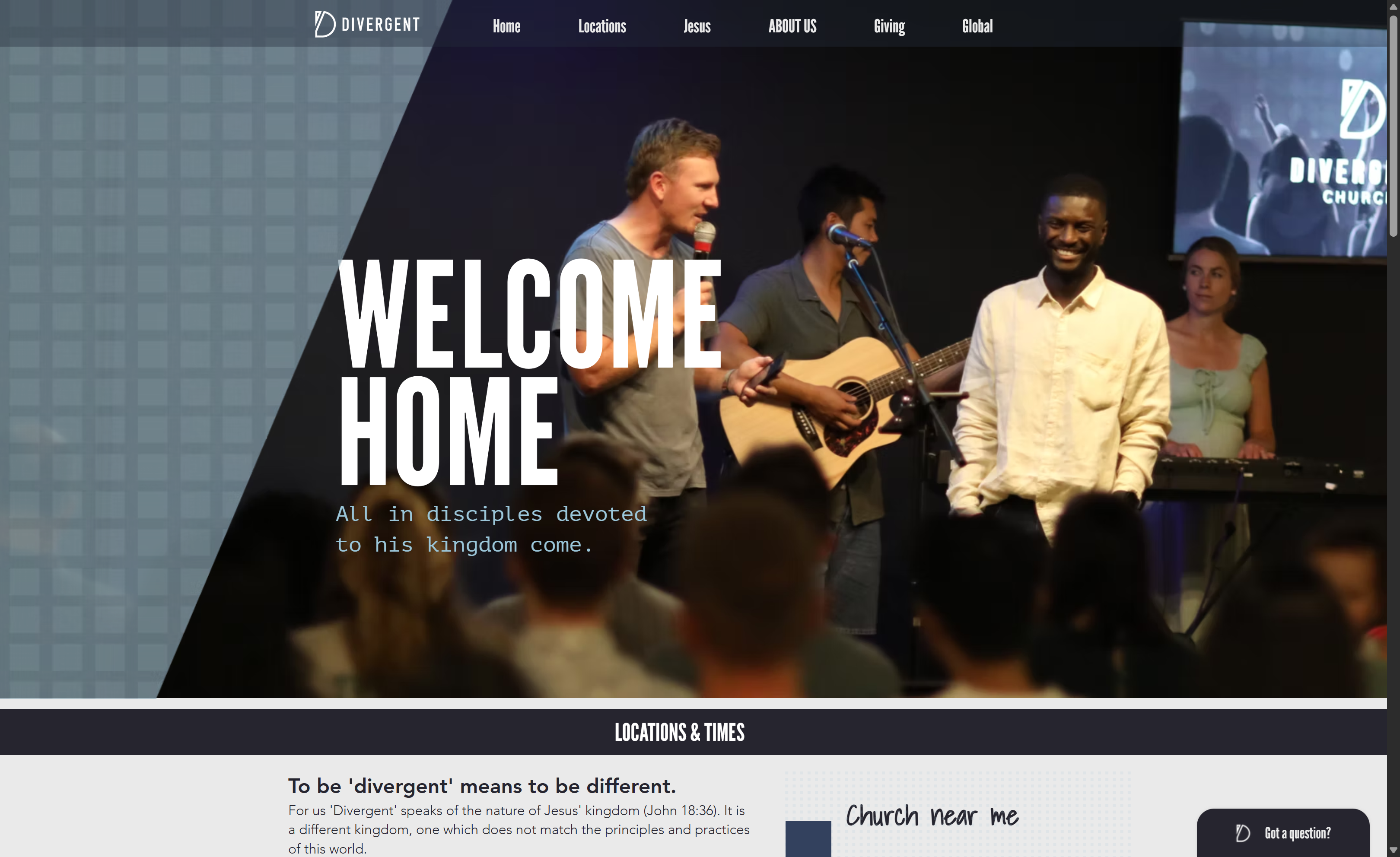
Begin with the Discipleship Hub, a central resource for learning, formation, and growing in your understanding of what it means to follow Jesus in everyday life. From there, explore life communities, Divergentchurch’s missional small groups rooted in the rhythms of Canberra life. If you are ready to grow in leadership and learn what it looks like to lead like Jesus, or simply want to take your first step and follow Jesus intentionally, Divergentchurch has a pathway for you. Come and see. Then go and be.
FAQ
What is the core definition of a missional church?
A missional church organises its entire identity and life around God’s mission to the world, the missio Dei, rather than functioning as a programme or service attraction. Mission is not one department of the church; it is the church’s defining purpose.
How is missional church different from a traditional church?
Traditional or attractional churches invite people to come in through compelling services and programmes. Missional churches send people out to minister in their everyday contexts, using the gathered meeting as a refuelling point rather than the destination.
What does missional living look like day to day?
Missional living includes practising neighbourly presence, building genuine relationships without an agenda, serving locally through volunteering or advocacy, and bearing witness to the gospel through word and consistent acts of love and justice.
Can one person start a missional community?
Yes, though it begins simply. Start with prayer, build relationships with people already around you, adopt shared rhythms like meals or service, and connect with a local church body for accountability and support. Missional community grows from relational roots, not programme launches.
What are the advantages of missional living?
Missional living integrates faith with the whole of life, creates genuine community across cultural and social boundaries, and produces disciples who are shaped by the gospel in every sphere. It replaces a passive consumer faith with an active, embodied one.
Recommended
Comments