
Communion in Christianity: 3 Scriptural Purposes and How to Receive

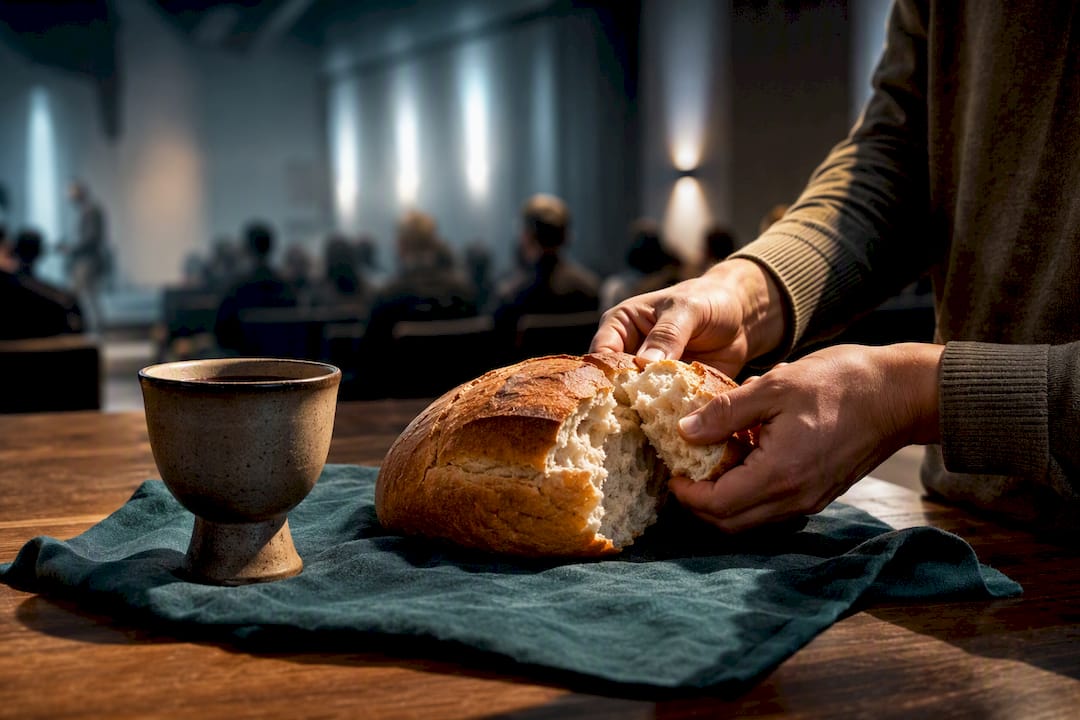
Communion, also called the Eucharist or the Lord’s Supper, is the Christian rite in which believers eat bread and drink wine to remember Christ’s sacrificial death. It exists for three reasons: to remember what Jesus did on the cross, to unite believers as one body through shared fellowship (koinonia), and to anticipate his promised return. Christians agree on this much. Where they differ, sometimes sharply, is on how Christ is actually present in the bread and the cup.
TL;DR:
Communion practices vary widely, with some churches using wine and others grape juice, and many offering gluten-free bread to accommodate dietary restrictions.
Theologically, Catholics and Orthodox believe in Christ’s real presence through transubstantiation or mystery, while many Protestants view it as memorial, symbolic, or spiritual.
The frequency of communion ranges from weekly in Catholic and Orthodox churches to monthly or less in many evangelical denominations, reflecting their different theological emphases.
The early church began celebrating communion as a weekly, liturgically structured practice rooted in Jesus’s words during the Last Supper, with debates over who can participate developing early on.
Disagreements over communion’s meaning and eligibility continue to influence church divisions and ecumenical efforts, emphasizing its importance as a marker of doctrinal unity and identity.
Table of Contents
What does communion mean in Christian terminology?
The word itself carries more weight than most people realise. “Eucharist” comes from the Greek eucharistia, meaning thanksgiving, a nod to the prayer of gratitude Jesus offered before breaking bread at the Last Supper. “Communion” draws from communio and its Greek cousin koinonia, words that speak of shared participation, of being bound together rather than simply gathered in the same room. “Lord’s Supper” leans on 1 Corinthians 11:20, where Paul names the meal directly. Each term highlights a different facet of the same act.
Denominations tend to gravitate toward the language that matches their theology. Catholic and Orthodox churches favour “Eucharist” because it foregrounds thanksgiving and sacrifice. Many Reformed and evangelical churches prefer “Lord’s Supper” or simply “communion,” terms that emphasise remembrance and fellowship over sacrificial language. Anglicans often use “Holy Communion” or “the Blessed Sacrament,” sitting somewhere between the two traditions. None of these labels is wrong. They are different lenses on the same central Christian rite, one instituted by Jesus, observed by the earliest church, and still practised weekly or monthly in congregations worldwide.
The physical elements vary more than newcomers expect. Consider what typically appears on the table:
Bread: unleavened wafers in Catholic and many liturgical settings, ordinary leavened loaves in most Protestant churches, and gluten-free wafers or bread now widely available for those with coeliac disease or gluten intolerance.
Wine: the historic default, still used in Catholic, Orthodox, and many Anglican and Lutheran services.
Grape juice: introduced widely in the 19th century and now standard in many Baptist, Pentecostal, and evangelical churches, partly for pastoral reasons around alcohol and recovery.
Water mixed with wine: retained in some Orthodox and Catholic liturgies as a symbolic echo of blood and water flowing from Christ’s side.
None of these substitutions changes the meaning of the act for the tradition using them. A church that serves grape juice in individual plastic cups is not doing something lesser than a church that shares wine from a common chalice. It is making a pastoral choice within its own theological framework, and understanding communion in Christianity) means recognising that diversity of practice sits alongside real unity of purpose.
Where does communion come from in the Bible?
Every account of communion traces back to one night: the night before Jesus died. The synoptic Gospels record it with striking consistency. Matthew, Mark, and Luke each describe Jesus taking bread during the Passover meal, giving thanks, breaking it, and telling his disciples, “This is my body.” He then took a cup of wine and identified it as “the blood of the covenant, poured out for many” (Mark 14:22–24). Luke adds the instruction that would echo through two thousand years of church history: “Do this in remembrance of me” (Luke 22:19).
Paul gives the fullest early written account, and it predates the Gospels as we have them. In 1 Corinthians 11:23–26, Paul explains that he received this teaching directly and passed it on to the church in Corinth, repeating Jesus’s words about the bread and the cup almost verbatim. Scholars generally date 1 Corinthians to around AD 55, which makes this passage the earliest detailed record of the practice anywhere in Christian writing, earlier even than the Gospel accounts themselves.
Here’s how the practice took shape in the decades and centuries that followed:
The Corinthian correction (c. AD 55). Paul wasn’t writing a neutral description. He was correcting abuse. Wealthier Corinthian Christians were eating ahead of poorer members and getting drunk while others went hungry (1 Corinthians 11:20–22). Communion, from its earliest documented moment, was already tangled up with questions of justice and unity within the church.
The Didache (late first or early second century). This early Christian manual includes prayers for the “broken bread” and describes communion as reserved for the baptised, an early hint at the open versus closed communion debate that continues today.
Ignatius of Antioch (early second century). Writing on his way to martyrdom, Ignatius calls the Eucharist “the medicine of immortality” and links it tightly to church unity under a bishop.
Justin Martyr (mid-second century). His First Apology gives one of the most detailed early descriptions of a Sunday Eucharistic service, including thanksgiving prayers and the distribution of bread and wine to those present and absent.
What strikes most readers encountering this history for the first time is how quickly communion became a weekly, structured, theologically loaded practice. Within a hundred years of the crucifixion, it already had liturgical form, moral seriousness, and disputes about who could participate. This wasn’t a symbolic gesture invented later by church councils. It was there from the beginning, rooted in Jesus’s own words and observed, according to Paul, “as often as you drink it” (1 Corinthians 11:25).
How do Christian traditions understand Christ’s presence in communion?
This is where agreement on the what gives way to real disagreement on the how. Christians across history have never doubted that communion matters. They have argued, sometimes for centuries and sometimes violently, over what actually happens when the bread and wine are consecrated.
Four views, one meal: transubstantiation, sacramental union, spiritual presence, and memorialism represent the major answers Christian traditions give to a single question: what happens to the bread and wine? The differences shape everything from who can receive communion in a given church to how the elements are handled after the service.
Transubstantiation is the Roman Catholic position, formally articulated by the Catechism. It teaches that by consecration, the substance of the bread and wine truly becomes the body and blood of Christ, even though the appearance, taste, and physical properties remain unchanged. The Catechism of the Catholic Church describes this as the “paschal banquet,” a term that ties the Eucharist directly back to the Passover meal Jesus shared with his disciples. This is also why Catholic teaching holds that receiving communion is not merely symbolic. It carries real sacramental weight, which is part of why the Church asks Catholics to receive at least once a year and to be in a state of grace when they do.
Eastern Orthodox churches affirm real presence just as strongly as Catholicism but resist pinning the mechanism down with Western philosophical categories like “substance” and “accident.” Orthodox theology tends to describe the change as a sacred mystery, something the church confesses without trying to explain the metaphysics. The emphasis falls on encounter and participation in divine life rather than on a precise technical formula.
Lutheran theology teaches sacramental union, sometimes called consubstantiation, though Lutherans themselves often avoid that term. The idea is that Christ’s body and blood are present “in, with, and under” the bread and wine, without the bread and wine ceasing to be bread and wine. It’s a real presence, but one that coexists with the elements rather than replacing their substance.
Reformed churches, following John Calvin, hold to a spiritual presence view. Christ is not present in the elements physically, but believers who receive communion in faith are truly, spiritually united with Christ by the work of the Holy Spirit. It’s neither pure symbolism nor bodily presence. It sits deliberately in between.
Memorialist views, common across many Baptist, Pentecostal, and non-denominational evangelical churches, treat communion primarily as a symbolic act of remembrance and obedience. The bread and wine represent Christ’s body and blood; they don’t become them in any metaphysical sense. This position draws heavily on Luke 22:19’s instruction to “do this in remembrance of me” and treats the act as proclamation rather than sacrament in the sacrificial sense.
These distinctions matter practically, not just academically:
A Catholic Mass reserves communion for baptised and confirmed Catholics in good standing, reflecting the seriousness the Church attaches to the sacrament.
Orthodox churches similarly restrict communion to Orthodox Christians who have prepared through confession and fasting.
Many Protestant and evangelical churches practise open communion, welcoming any baptised Christian, and sometimes any believer, regardless of denominational background.
Intercommunion between traditions holding different views of Christ’s presence remains a genuine point of division, not just historical trivia.
The disagreement over Christ’s presence has shaped church splits, ecumenical dialogue, and everyday pastoral decisions for centuries. It’s worth understanding not to win an argument, but because it explains why the same meal looks and feels so different from one church to the next.
How is communion practised across churches today?
Walk into a Catholic Mass on any given Sunday and you’ll find communion at the centre of the service, celebrated every single time the congregation gathers. Walk into many Baptist or evangelical churches and you might find it monthly, or quarterly, treated as a significant but less frequent observance. Anglican and Lutheran churches typically fall somewhere in between, often weekly but with more variation than Catholic practice.
Frequency isn’t arbitrary. It reflects theology. Churches that see communion as central to weekly worship and spiritual nourishment build it into every gathering. Churches that emphasise the seriousness and specialness of the meal, wanting to guard against it becoming routine, space it out further.
The setting varies just as much as the frequency:
The Mass: the full Catholic liturgical structure, with communion as its climactic act, preceded by extended prayers of consecration.
A Communion service: common in Anglican, Lutheran, and Presbyterian contexts, often shorter than a full Mass but still liturgically structured.
Shared bread and cup at a simple gathering: typical in many house churches, evangelical, and Pentecostal settings, sometimes passed hand to hand through the congregation with minimal ceremony.
Practical accommodations have become close to universal, even where theology hasn’t shifted. Grape juice sits alongside wine in many churches specifically to include people in recovery from alcohol dependence, pregnant women, and children. Gluten-free bread or wafers cater to coeliac and gluten-intolerant participants. Individual small cups have largely replaced the shared chalice in many congregations, partly for hygiene and partly for logistical ease with larger crowds.
Then there’s the open versus closed communion question, which trips up more first-time visitors than almost anything else in a church service. Open communion means any baptised Christian, sometimes any professing believer, is welcome to receive, regardless of which church they usually attend. Closed communion restricts the table to members of that specific denomination or congregation, usually because that church holds a particular view of what communion means and who is prepared to receive it rightly. Neither approach is a snub. Closed communion in Catholic or Orthodox contexts reflects real theological conviction about unity in belief, not exclusion for its own sake.
Pro Tip: If you’re visiting an unfamiliar church and you’re not sure whether communion is open to you, watch what the leader says just before it’s served. Most churches state their policy clearly right there, and if they don’t, it’s completely fine to stay seated and simply observe that round.
What does communion mean spiritually and communally for believers?
Two Greek words carry most of the theological weight here, and understanding them changes how the whole practice feels from the inside.
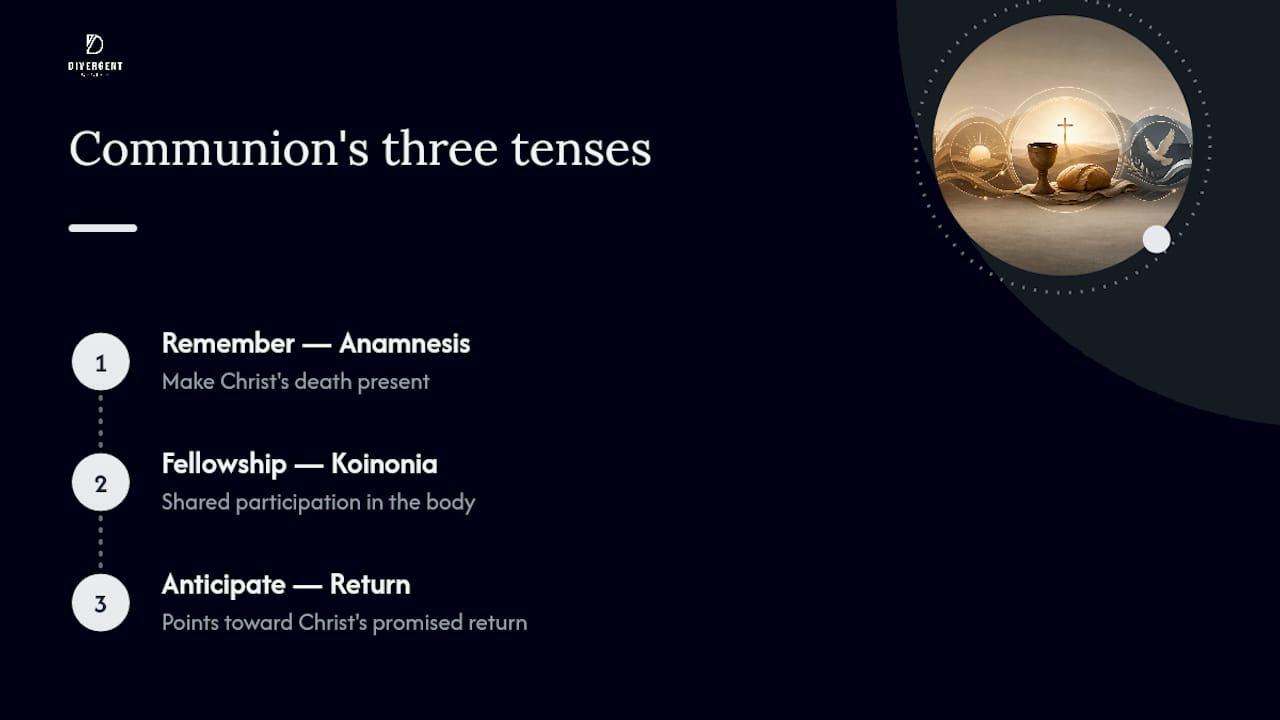
The first is koinonia, fellowship or shared participation. Paul draws this out explicitly in his letters to Corinth, asking, “Is not the bread that we break a participation in the body of Christ?” (1 Corinthians 10:16). Koinonia reframes communion as something done together, not a private transaction between an individual and God. You don’t commune alone. You commune as part of a body, and that body includes people you might never have chosen as friends, sitting in the same pew because they too belong to Christ.
The second is anamnesis, remembrance, though the English word undersells it badly. Anamnesis doesn’t mean simply recalling a past event the way you’d remember a birthday. It describes a kind of remembrance that makes the past event present again, drawing the congregation into participation with what Christ did on the cross without collapsing the distance of two thousand years. This is remembrance that reaches forward too, pointing toward Christ’s promised return even as it looks back at his death.
Communion holds three tenses in one act: it looks back to a death, engages a present fellowship, and leans forward to a promised return. Few practices in Christian life compress that much theology into something as simple as bread and a cup.
The fruit of this isn’t abstract. Believers who take communion seriously often describe a renewed sense of belonging, a fresh commitment to live differently, and a pointed reminder that faith isn’t private property. Paul’s original correction to the Corinthians was about neglecting the poor at the communion table, and that thread runs through the practice still. A meal that remembers Christ’s self-giving naturally confronts anyone who receives it with a call to generosity and compassion toward others.
How should you prepare for and receive communion?
If you’ve never taken communion before, or you’re stepping into an unfamiliar tradition, the process is simpler than it looks from the outside. Here’s a practical walk-through.
Do some honest self-examination beforehand. Paul’s instruction in 1 Corinthians 11:28, “let a person examine himself,” has been debated for centuries. Most pastoral teaching today treats this less as a checklist of sins to tally and more as an invitation to come with a sincere heart, aware of your need for grace rather than confident in your own worthiness.
Deal with anything weighing on your conscience. If something specific is troubling you, many traditions encourage confession, whether formally to a priest or informally in conversation with a minister or trusted friend, before receiving. This isn’t a requirement everywhere, but it’s a widely offered pastoral option.
Follow the posture and responses of those around you. Some congregations kneel, others stand, others remain seated and pass elements along the row. There’s no universal correct posture. Watching the people beside you for a moment is entirely acceptable.
Receive the elements as offered. In many churches this means bread placed in your open hands or on your tongue, followed by wine from a shared cup or an individual cup, or dipping the bread into the cup (intinction). In others, small cups and bread pieces are distributed together on a tray passed along the pew.
Take up any accommodations offered. Non-alcoholic grape juice and gluten-free bread are available in most churches today, usually without any need to explain yourself. Look for a separate tray or ask an usher quietly beforehand.
If you’re unsure whether to participate at all, don’t guess. Ask a minister or greeter before the service, or simply observe the first time and ask questions afterward. No church expects a visitor to already know its particular customs.
Pro Tip: Sitting out a communion service isn’t rude and it isn’t a spiritual failure. It’s actually the more respectful choice if you’re unsure whether you’re eligible or ready, and most ministers would rather you ask a question afterward than feel pressured into participating.
How has communion practice changed across denominations over time?
Communion looked remarkably uniform in the earliest centuries: a shared meal, weekly, tied closely to baptism and church discipline. That began shifting once Christianity became the Roman Empire’s dominant religion. Elaborate liturgies developed, church buildings were designed around altars, and by the medieval period in the West, the laity often received only the bread, with the cup reserved for clergy, a practice the Protestant Reformation would later challenge hard.
The Reformation of the 16th century is really where the major branching happened. Luther kept a strong view of real presence but rejected the Catholic explanation of transubstantiation. Calvin pushed further toward spiritual presence. Radical reformers, the forerunners of many modern Baptist and evangelical traditions, stripped the practice back to a memorial act, deliberately distancing themselves from anything resembling Catholic sacramental theology.
The 19th century brought the temperance movement, which is why grape juice entered many Protestant churches as an alternative to wine, a genuinely practical innovation rather than a theological one. Pentecostal and non-denominational movements in the 20th century often simplified communion further still, sometimes celebrating it in informal home settings with ordinary bread and juice, prioritising accessibility and spontaneity over liturgical form. What began as one shared table has become a spectrum of practice, unified in origin but remarkably varied in expression today.
What controversies surround communion practice and eligibility?
The sharpest disagreements cluster around one question: who gets to come to the table? Closed communion policies in Catholic and Orthodox churches strike some visitors as exclusionary, while those churches see it as guarding the seriousness of shared belief rather than gatekeeping for its own sake.
Intercommunion between denominations remains genuinely unresolved. A Catholic and a Reformed Christian who both take communion seriously still can’t share the same table in most Catholic parishes, precisely because their churches understand what’s happening on that table so differently. This has been a live ecumenical issue for decades, and documents like the World Council of Churches’ work on shared theological ground have narrowed the gap without closing it.
Paul’s warning about receiving communion “in an unworthy manner” (1 Corinthians 11:27–29) has also sparked real debate. Some traditions historically treated this as grounds for barring people in unresolved sin or conflict from the table. Most pastoral teaching today reads it less as a threat and more as a call to sincere self-examination and reconciliation with others before receiving. Debates over children’s participation, the minimum age for first communion, and whether unbaptised seekers should be welcomed at the table continue to vary widely from one congregation to the next.
Why does communion matter for growth in the Christian life?
Communion isn’t a ritual bolted onto Christian life from the outside. For most traditions, it’s one of the ordinary, repeated means by which faith is formed and sustained over years and decades, not just a single meaningful moment.
Each time believers gather at the table, they’re reminded of who they are: people brought near to God through Christ’s death, joined to others who share that same identity. That repetition matters more than it might seem. Sanctification, the gradual process of becoming more like Christ, rarely happens through one dramatic moment. It happens through habits practised again and again, and communion is one of the oldest and most consistent habits the church has kept.
It also keeps the gospel from becoming abstract. Sermons explain; communion enacts. Believers don’t just hear about Christ’s sacrifice, they physically take bread and cup, participating in the story with their bodies as well as their minds. That combination of remembrance, present fellowship, and future hope, repeated weekly or monthly across a lifetime, is part of why so many Christian traditions have refused to let communion become optional or occasional, regardless of how their theology of it might differ.
Divergent Church’s perspective: communion as discipleship
Communion has never sat well as a stand-alone ritual in my mind, something you attend and then set aside until next time. It only makes sense as part of a bigger story of becoming a disciple, and that’s really the lens worth bringing to it. Communion is understood as part of forming disciples within ordinary rhythms of life, not just as a Sunday gathering, with communion at the centre of that conviction. It’s a recurring act that keeps shaping people over years, not a box ticked once and forgotten.
Communion is taught and practised as an act of remembrance and unity, one that draws the community back, again and again, to what Christ has done and to each other. It’s not treated as a private moment lost in a crowd. It’s a shared table, deliberately communal, because discipleship was never meant to happen in isolation. If you’re exploring what that looks like in practice, the Discipleship Hub walks through how formation happens day to day, well beyond the Sunday service. For those wanting a smaller, more relational setting to work through questions like these, Life Communities offer that space, groups where the meaning of communion, and plenty else besides, gets talked through honestly rather than assumed.
What I’d want any reader to take from this article isn’t a theology exam answer. It’s an invitation to notice what’s actually happening the next time bread is broken and a cup is passed. That table has carried the weight of the gospel for two thousand years. It’s still doing that work now.
— Josh
Sources
Recommended
Comments