
Church Leaders: Ready Discipleship Pathway with 4, 5 and 7 Stage Models


A discipleship pathway is a sequenced, gospel-centred plan that moves people from new faith to reproducing disciples. It names the destination, marks the stages between here and there, and gives leaders and newcomers alike a shared sense of what comes next. Start small: identify the single next step for someone brand new to faith in your community, and build outward from there.
TL;DR:
A discipleship pathway provides a clear, shared framework that guides believers through defined stages of spiritual growth to produce reproducing disciples.
Building this pathway involves four steps: discovering biblical goals, assessing current realities, designing stages with attached practices, and piloting before full implementation.
The most effective pathways are simple, with each stage requiring both disciple and discipler actions, and should be tested through a six to twelve-week pilot.
Progress is best measured by combining attendance, engagement, serving, and stories of transformation, focusing on the transition from consumption to reproduction.
Leaders must model next steps openly and keep the pathway uncomplicated to prevent overprogramming and ensure sustainable, lasting growth.
Table of Contents
What is a discipleship pathway, and why does it matter?
A discipleship pathway is a structured plan for moving believers from one stage of spiritual growth to the next, aimed at producing mature, reproducing disciples rather than passive attendees. Discipleship frames it as the roadmap that helps ordinary church members become disciple-makers themselves, not just recipients of teaching. Without one, churches tend to drift. People attend for years without a clear sense of whether they’re actually growing, and leaders end up guessing what someone needs next instead of knowing.
A pathway solves this by giving everyone a common language for the journey. It removes the guesswork that quietly stalls spiritual formation in so many congregations.
A workable pathway should include:
A clear destination (what a mature, reproducing disciple looks like in your context)
Named stages between entry and maturity
Specific practices attached to each stage
Leaders assigned to walk people through each transition
Four, five, and seven stage models: which one fits your church?
Most discipleship pathways borrow from a handful of proven models, and the differences matter less than the discipline of choosing one and sticking to it. Four-stage models typically run entry, growth, service, and multiplication. Seven-stage frameworks break formation into finer increments, useful for larger churches wanting granular tracking.
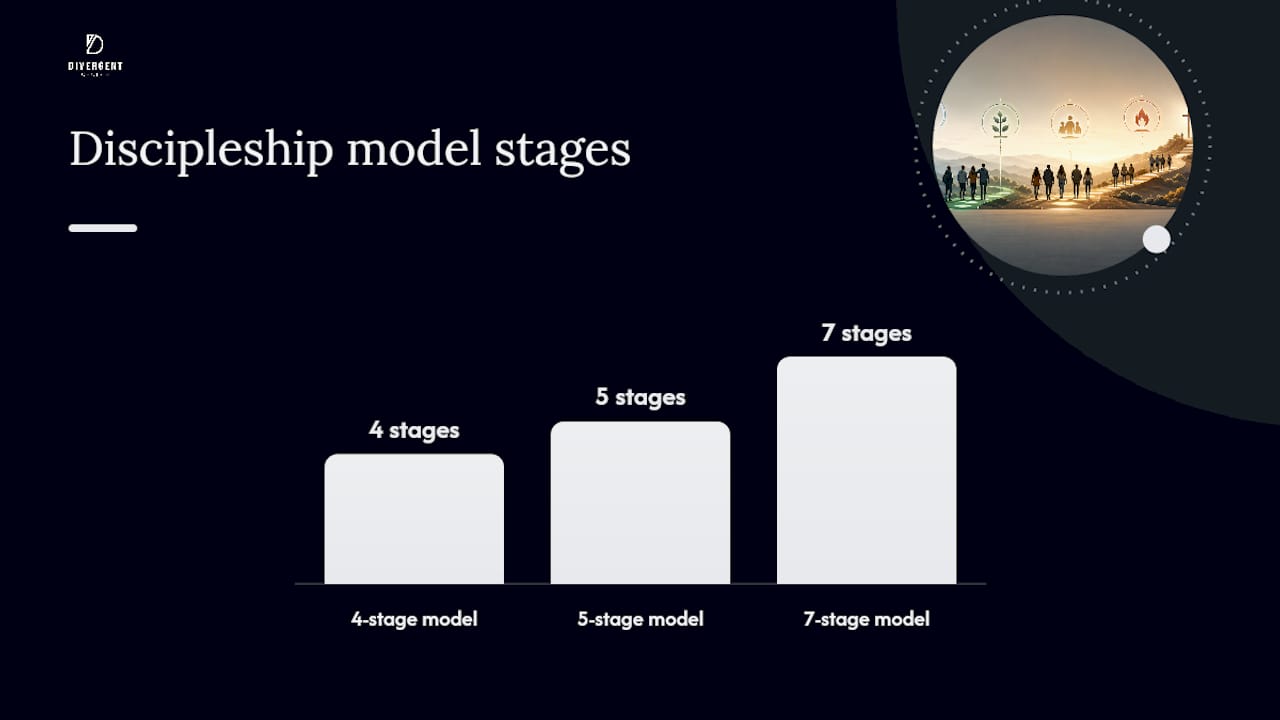
Discipleship.org maps Jesus’ own pattern across five phases: come and see, follow, deeper formation, commissioning, and reproduction. That model rewards patience over speed. Jesus spent several years with the Twelve, combining grace, truth, and repeated exposure rather than a short course.
Movement between stages shows up in observable habits, not just verbal profession:
Entry to growth: regular gathering attendance and joining a small group
Growth to service: initiating relationships and using time in Scripture without prompting
Service to multiplication: actively discipling someone else
Choose a four-stage model if your church is smaller and relational; choose five or seven if you need finer resolution for larger or multi-site tracking.
How do you build a discipleship pathway from scratch?
Lifeway Research outlines a four-step process for building or refreshing a discipleship plan for an established church: Discover, Discern, Design, Deploy. It maps cleanly onto a church’s normal planning rhythm, which is part of why it works.
Discover – Define your biblical destination. What does a mature, reproducing disciple look like in your context? Pin down the non-negotiables before anything else.
Discern – Audit current reality honestly. Look at attendance patterns, how many small groups actually function, and whether you have enough trained leaders to walk people through transitions.
Design – Set your stages, the milestones that mark movement between them, the practices attached to each stage, and who owns each leader role.
Deploy – Pilot the pathway with a small group first, train the leaders who’ll run it, communicate it clearly to the congregation, and embed it into your existing rhythms rather than bolting it on as an extra program.
Pro Tip: Run your pilot for six to eight weeks with one small group before rolling anything out church-wide. You’ll learn more from watching ten people move through it than from any amount of planning on paper.
The core components every pathway needs
A pathway lives or dies on how well its parts work together, not on how impressive any single component looks. The large gathering casts vision and teaches Scripture at scale, but it can’t transfer skills or hold anyone accountable. Small groups fill that gap: they’re where belonging forms and where someone notices if you’ve stopped showing up.
Discipleship groups and one-to-one relationships do the heavier lifting, transferring not just knowledge but the how of following Jesus: how to read the Bible for yourself, how to pray, how to have a hard conversation well. This is where Jesus’ long-term relational model becomes instructive for leaders. Time and repeated exposure matter more than any single course.
Service and mission close the loop, turning belief into formation milestones:
Serving inside the church builds ownership and reveals gifting
Local mission tests whether faith survives contact with discomfort
Global mission and cross-cultural exposure often mark the shift toward reproduction
Daily habits matter too. Resources like workplace discipleship practices help translate a Sunday sermon into a Tuesday decision, which is where most spiritual growth actually happens or quietly doesn’t.
A ready-made template for your pathway
Copy this structure and adapt the labels to your context. The value isn’t in the exact wording. It’s in forcing every stage to have both a disciple action and a discipler action attached to it.
Stage | Disciple action | Discipler action | Milestone |
Entry | Attends gathering, meets people | Extends invitation, follows up | Joins a small group |
Growth | Reads Scripture, prays regularly | Models habits, answers questions | Names a personal habit rhythm |
Formation | Serves, shares faith story | Provides feedback, gives responsibility | Leads a small part of a group |
Multiplication | Disciples someone new | Coaches and releases | Starts their own group |
Your implementation checklist should cover four things before launch: leader training (who’s ready to disciple others right now?), resource allocation (do groups have materials, space, and time?), a realistic timeline, and a communication plan so the whole church understands why this pathway exists.
A pilot of six to twelve weeks is a sensible minimum test. It’s long enough to see real movement and short enough to adjust before you’ve committed the whole church to something unproven.
How do you measure whether people are actually growing?
Spiritual growth resists a single tidy metric, but eight signposts give you a defensible read: gathering attendance, group engagement, serving involvement, willingness to share a faith story, personal spiritual habits, use of gifts, discipling someone else, and participation in mission.
Worth tracking closely: the shift from being served to serving, and from consuming teaching to reproducing it in someone else. That transition is the clearest signal a pathway is actually working, not just running.
Balance numbers with stories. Attendance and group counts tell you where people are; a testimony tells you what actually changed. Use both:
Track quantitative signposts monthly (attendance, group numbers, serving rosters)
Collect qualitative feedback each pilot cycle, including at least one testimony
Adjust stage definitions when the data and the stories disagree
If your numbers look healthy but nobody can tell you a story of change, the pathway needs a rework, not a bigger promotion.
Leadership habits that make a pathway stick
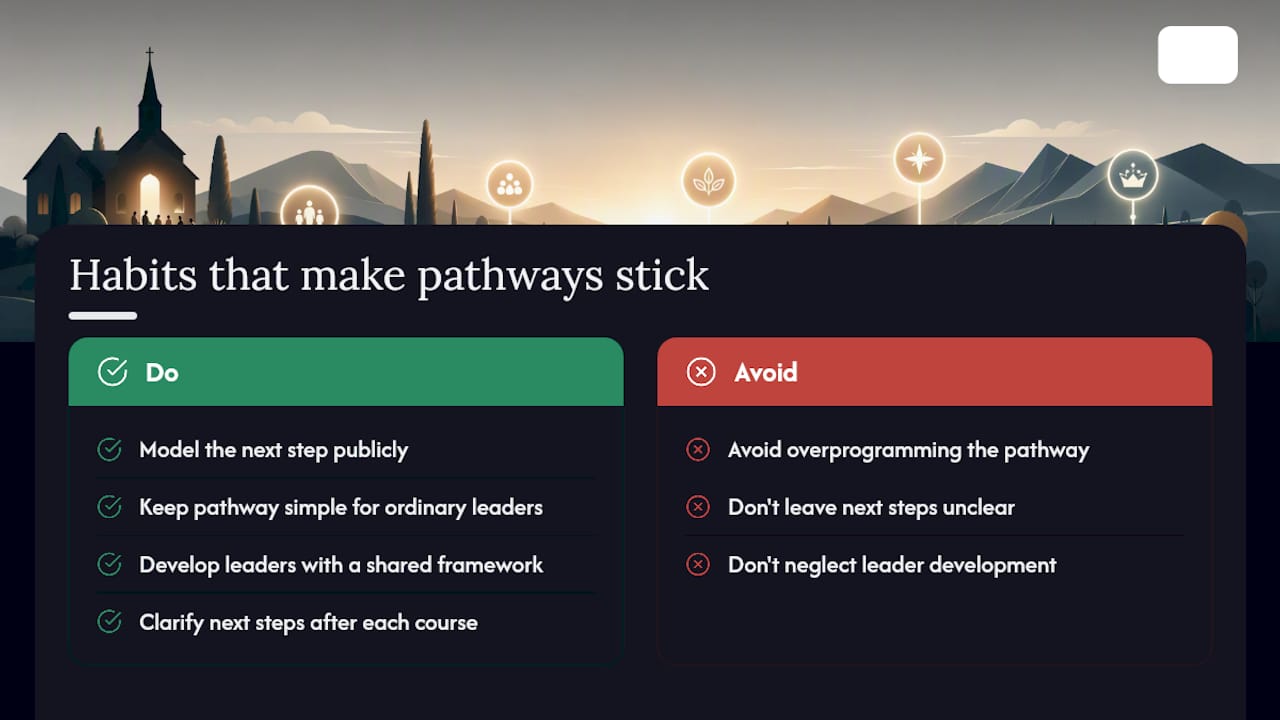
The most common failure isn’t a bad model. It’s overprogramming, where a church stacks so many activities onto the pathway that nobody can tell what actually matters. A close second is unclear next steps: people finish a course and have no idea what comes after it.
Weak leader development compounds both problems. A pathway is only as strong as the leaders walking people through it, and a lack of a clear, shared framework is a leading cause of stagnant growth in churches that otherwise have good intentions.
Pro Tip: Model the next step publicly yourself before you ask anyone else to take it. People follow what they see a leader actually do, not what a leader announces from the front.
Divergent Church in Canberra has leaned on this principle in its own Life Communities, keeping the pathway simple enough that ordinary members can lead it without a seminary degree.
Why the simplest pathway is usually the right one
The temptation for any church leader is to build something comprehensive on day one. Josh has watched that instinct backfire more often than it succeeds. A pathway with twelve stages and forty resources looks impressive on a whiteboard and collapses the moment someone tries to actually walk it. The single change that tends to yield the most growth is embarrassingly simple: name one clear next step for every person in the room, every single week.
Pilot that idea with one group before you build anything grander. If it doesn’t land in six weeks, you’ll have learned something worth knowing before you’ve spent a year on it.
— Josh
Ready to build yours? Start with the Discipleship Hub
You don’t have to design a pathway from a blank page. Divergent Church’s Discipleship Hub pairs the stage models and template covered above with a local-tested structure already running through Canberra’s Life Communities, so you’re adapting something proven rather than inventing one from scratch.
The Hub connects newcomers to a small group, gives existing leaders a framework for discipleship conversations (our 15 discipleship questions guide is a good starting point for those), and points anyone ready to lead others through Lead Like Jesus training. If you’re in Canberra or Queanbeyan and want to see what a lived-out pathway actually looks like rather than just reading about one, get in touch and we’ll help you find a Life Community to pilot your first next step in.
Sources
Recommended
Comments