
How to Find Community After Moving to Canberra


Finding community after a move is mostly a matter of showing up in the same few places, week after week, until strangers become familiar faces and familiar faces become friends. It is slower than people expect, and it is rarely your fault when it feels hard. In Canberra, where so many of us arrive for study, work or a posting and leave again, the people who settle fastest are usually the ones who choose a small number of recurring things and commit to them. This guide sets out where to start, how to turn a friendly nod into a real friendship, and how church can be one of those recurring places.
TL;DR
Choose two or three weekly, recurring activities rather than many one-off events. Repetition does the work.
Canberra has plenty on offer: interest groups, volunteering, team sport, university clubs, walking groups and faith communities.
Friendships usually form faster when someone local introduces you, so say yes to introductions and ask people to bring you along.
Church can be a genuine answer to isolation, especially a small group or community meal rather than only the Sunday gathering.
Give it months, not weeks, and start with one low-pressure invitation each week.
Table of Contents
Why it feels so hard after a move
Before the practical list, a word of reassurance. Feeling alone in a new city is not a sign that something is wrong with you. It is what happens when a web of relationships is cut and has to be rewoven.
Australian research on women who relocated to a seachange community found that friendships formed faster and more smoothly when an established local friend made the introductions, while newcomers without that local help faced a longer and harder road. The same work points out that the people who matter most to our wellbeing are often a small circle of friends, and that proximity shapes how often we actually talk to each other.
The workplace used to do a lot of this for us. Researchers at the University of British Columbia have noted that work is a major way adults meet people, yet many no longer work side by side with colleagues, which leaves newcomers asking where else connection will come from. Remote and hybrid work make that question sharper in a government town like Canberra, where many people arrive for a job and find their desk is half at home.
Students face a version of the same thing. A feature on international students in Brisbane describes social isolation as a significant barrier, even while the students themselves say they badly want to connect with the wider community.
The common thread is this: the desire is almost always there on both sides. What is missing is a shared place and a reason to return.

Start with one regular place
The most useful idea in nearly every guide to making friends in a new city is the regular spot. Pick something that happens at the same time each week, where the same people tend to turn up. Familiarity lowers the cost of the next conversation. By the fourth visit you are no longer a stranger, and people start to ask how your week went.
The ACT Government’s own roundup of ways to make friends in Canberra points to Meetup events, volunteering, team sports, university clubs and societies, walking groups, book clubs and other local interest groups. It notes that event listings are updated often, with activities ranging from board games to dance and language practice.
A useful way to choose is to sort the options by how much courage they ask of you:
Type of place | What it asks of you | Why it works |
Walking or running group | Very little: turn up and move | Side-by-side talking is easier than face-to-face |
Volunteering | A fixed shift | A shared task gives you something to talk about |
Social sport | A weekly commitment | Instant teammates and a standing time in the diary |
University club or society | Joining a list | Described as a high-density way to meet people |
Library or neighbourhood house activity | Showing up | Often free or low cost, and welcoming to new residents |
Church or faith community | Showing up on a Sunday or in a midweek group | Built around people returning to each other |
The notes on sport, parkrun and clubs come from a guide on where people actually meet in Australia, which also observes that community centres, libraries and neighbourhood houses often run free or low-cost activities such as craft clubs and conversation groups that explicitly welcome new residents.
You do not need all of these. Two or three that fit your week will do more than ten you attend once.
Use the digital bridges, then get offline
Apps and social media groups are good at one thing: showing you what is happening. Platforms such as Meetup, Eventbrite and Facebook Groups act as digital bridges to local interest-based hangouts and recurring gatherings. Relationships Australia Queensland also suggests that groups for new arrivals can help you find people at a similar life stage who are keen to build friendships.
The trap is staying on the screen. Treat the app as a diary of options, then choose the thing that repeats and go. The friendship happens at the second and third visit, not in the message thread.
Turning acquaintances into friends
Meeting people is the easy half. The harder half is the step from “friendly person at the thing” to “someone I would ring.” The ABC’s guide to making friends after moving to regional Australia lists the practical habits that help: start conversations, join groups or activities that genuinely interest you, and invite people to low-key catch-ups. Regular small contact, such as chatting with a neighbour over tea or walking dogs at the same time, adds up over time.
Here is a simple pattern that works for many newcomers.
Ask one follow-up question. When someone mentions a sibling, a trip or a job, remember it and ask about it next week.
Make the first invitation small. Coffee after the session, a walk around the lake, a shared lunch. Small invitations are easy to accept and easy to repeat.
Be the one who initiates. Most people are waiting to be asked. If you are new, you may have to go first, more than once.
Put it in the calendar. A fortnightly walk beats a vague “we should catch up.”
Bring people together. Introducing two people you have met to each other makes you a connector, and connectors are rarely lonely for long.
Beyond Blue’s list of ways to connect adds neighbourhood initiatives: introducing yourself to the people next door and joining community projects can build a sense of belonging over time. For more on how newcomers can find a sense of belonging, a guide on finding a sense of belonging covers the idea of leaning on local support in the early months of a big life change.
If your loneliness feels heavy or is not lifting, please talk to your GP or call Beyond Blue. That is not a failure. It is the same wisdom as asking a neighbour for help.
How long does it take?
Nobody can give you an honest fixed number. The research does suggest what shortens the road: local mediation. Newcomers who have established residents helping them navigate the new place tend to move into feeling a sense of belonging faster, while those without it can face a longer stretch.
That is practical news. You can create your own mediation by asking. Ask a colleague which suburb café they love. Ask the person who runs the volunteer shift who else is new. Ask, and say yes when someone offers to bring you along. Most people are glad to be asked, and a single introduction can save months.
A broader study of a regional Australian city also found that places hold on to newcomers better when they offer a mix of linking, bridging and bonding social capital through local organisations. In plain words: people settle when they have a few close ties, some wider connections across different groups, and a link to the organisations that make a place work. A good community will offer you all three.
Church as a place to belong
We would be dishonest if we pretended we had no stake here. We are a church, and we think church is one of the best answers to this very question. But we also know that a Sunday service alone does not create friendship. What does is the rest of the week.
Faith communities are widely recognised as places that offer more than spiritual life. Beyond Blue lists faith-based organisations among the ways to connect, because they offer social support alongside spiritual engagement.
What makes a church work for a newcomer is not the building. Research on church-based intercultural initiatives in Melbourne found that such communities can foster belonging through pastoral care, empathy, compassion, hospitality and listening, and that they do this best when volunteers are trained in empathetic, pastoral care practices. That matches what we have seen: welcome is a skill, and it takes practice.
How to make friends at church when you are new
If you are visiting a church for the first time, a few habits will help you more than any amount of nerve:
Go more than once. One visit tells you very little. Give a community a month of Sundays before you decide.
Stay for the part after the service. The conversations over a cup of tea are where relationships start.
Find the small group. Midweek groups, meals and serving teams are where people actually know one another.
Serve. Handing out coffee, setting up chairs or helping with a community event gives you a role and a reason to talk.
Say what you are looking for. “I’ve just moved here and I’m looking for friends” is a sentence people respond to warmly.
We have written more on this in our church newcomer guide and on finding your place in Canberra. If you are weighing different kinds of gatherings, types of Christian communities explains the options, and if you are in your twenties, church as a young adult speaks to that stage directly.
Our perspective
We meet people in Canberra every month who have arrived for a degree, a graduate year, a defence posting or a public service job, and who tell us the same thing in different words: “I don’t know anyone.” Canberra is a city of arrivals and departures, and its rhythms, the universities, the workplaces, the neighbourhoods, shape how people belong or fail to.
Our conviction is that the Christian life was never meant to be lived as a weekly appointment. The early believers shared meals, homes and burdens. When Scripture says that God sets the lonely in families (Psalm 68:6), we do not read it as a metaphor only. We read it as a calling for a local church to become a family for people who have none nearby.
So we try to be a community that is shaped by Scripture and centred on Jesus, but expressed in everyday life: a table, a walk, a conversation that goes a little longer than planned. We also try to make room for honest questions. You do not need to have your faith sorted to belong with us. You only need to be willing to turn up and be known.
If you are new, we would say: do not wait until you feel ready. Seeds are planted before the harvest is visible. One coffee, one invitation, one Sunday. Over time, those small seeds become a home.
— Josh
Where we can help
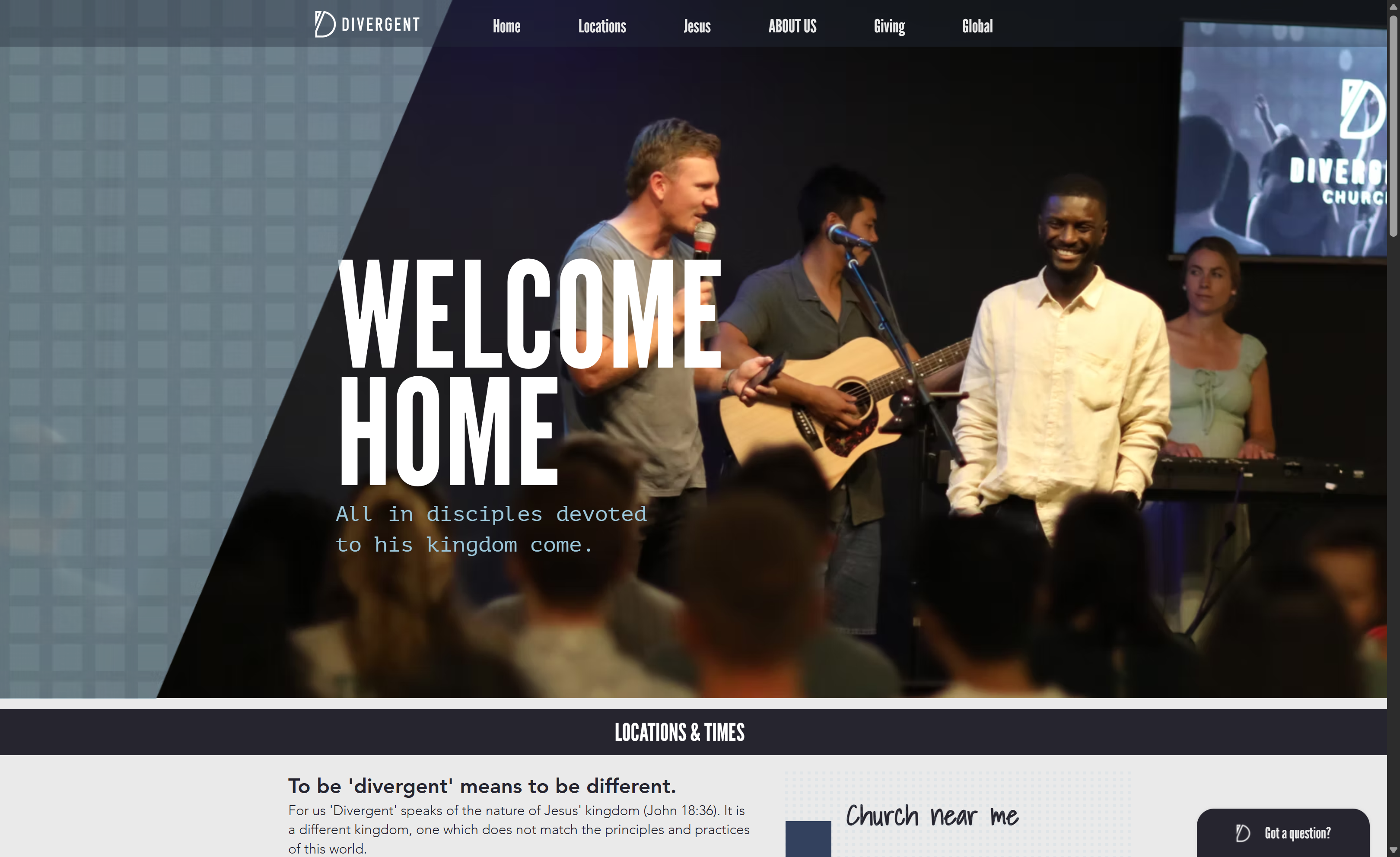
If you are in Canberra or Queanbeyan and looking for people, we would love to meet you. Our Grow page is the best place to see how to take a first step into community with us, and you can find the whole church at divergentchurch.com.
If you are organising your own gathering, whether a housewarming for new neighbours, a study group or a community event, our rooms are available to book online: the Auditorium is $70 per hour, the Seminar Room $50 per hour and the Board Room $25 per hour. Details and availability are on our room booking page.
A simple four-week plan
If you want something concrete to start this week, try this.
Week one. Pick two recurring activities: one social (a walking group, social sport, a club) and one purposeful (volunteering, a serving team, a class). Put both in your calendar for the next four weeks.
Week two. Go back to both. Introduce yourself again to anyone you met, and ask one follow-up question about something they told you.
Week three. Make one small invitation: a coffee after the session, or a walk. Do not worry if the answer is no. Ask someone else next week.
Week four. Review. Which of the two felt like home? Keep that one, add a second, and invite someone to bring a friend. If a church is one of your two, ask about a small group.
By the end of a month, you will not have a full circle of friends. You will have something better to build on: a rhythm, a few names and a few people who are glad to see you.

Common obstacles, and what to do about them
“I’m an introvert.” Choose activities with a built-in task, such as volunteering, a walking group or a serving team. You will have something to do with your hands and something to talk about.
“Everyone already has their friends.” Often true on the surface, but most adults have room for one more good friend, especially if the invitation is small. Canberra’s transient population also means plenty of other newcomers are looking too.
“I’m only here for a year or two.” That is a reason to start sooner, not later. Short stays still go better with people around you, and friendships made in a temporary season often last well beyond it.
“I’m not sure about church.” That is fair, and a good church will not rush you. Our guide to explaining Christian community is written for people who are curious without being committed.
FAQ
How do I make friends in a new city when I don’t know anyone?
Start with one or two activities that repeat weekly, such as a walking group, volunteering or a social sport team. Seeing the same faces builds familiarity, and familiarity makes conversation easier. Then make small invitations, like a coffee after the session, and keep making them.
How do I make friends at church?
Go several weeks in a row, stay for the conversation afterwards and join a small group or serving team. Those are the settings where people get to know one another beyond a Sunday greeting. Telling people you are new usually brings a warm response.
Where can I meet people in Canberra?
The ACT Government highlights Meetup events, volunteering, team sports, university clubs and societies, walking groups and book clubs. Libraries, community centres and faith communities are also good places to find regular gatherings. Choose the ones that repeat each week.
How long does it take to feel part of a community?
There is no fixed timeframe. Research suggests newcomers who are introduced by established locals tend to settle faster than those who go it alone. Plan on months rather than weeks, and ask people to bring you along.
Do I have to be a Christian to visit your church?
No. People come to us exploring faith, looking for friends or simply curious. You are welcome to ask honest questions and take your time.
Sources
Ben Harush, friendship formation in a seachange community (QUT)
How to Make Friends in Australia: Where People Actually Meet
How to meet people in a new city (Relationships Australia Queensland)
Tips for making friends after moving to regional Australia (ABC)
Making connections in a regional city: social capital (James Cook University)
Church-based intercultural initiatives in Melbourne (Ecclesial Futures)
Recommended
Comments