
What healthy family church signs actually look like


A spiritually healthy church shows itself in eight observable signs: gospel-centred worship, sound biblical teaching, servant-hearted leadership, grace-filled conflict resolution, intentional children’s discipleship, welcoming facilities with clear signage, an outward mission, and space for every generation. You will not find these things by asking a website “are you healthy?” You find them by watching what a congregation actually does on a Sunday and every ordinary day around it.
Worship points to Jesus, not performance. You will notice this in the first five minutes, in the songs and in whether children are ever mentioned from the front.
Teaching is biblically grounded. Sermons explain Scripture rather than recycle motivational one-liners.
Leaders serve rather than control. Watch for visible volunteer teams and pastors who are approachable, not distant.
Conflict is handled with grace. A church that owns its mistakes publicly, as Outreach magazine notes, is usually healthier than one that pretends nothing ever goes wrong.
Children’s discipleship is intentional, with secure check-in and screened volunteers, not an afterthought bolted onto Sunday mornings.
Hospitality shows up in the building itself, from staffed welcome desks to signage a five-year-old can read.
Mission looks outward, with regular partnerships in the community rather than one-off feel-good events.
Multiple generations mix freely, and nobody looks out of place at morning tea.
Academic ministry teaching frames these as the “vital signs” of a congregation: gathered worship, pastoral care, and spiritual vitality, according to a New Orleans Baptist Theological Seminary course on congregational health. Divergent Church in Canberra builds its own rhythms around the same markers, which is worth knowing before you visit any church cold.
Key Takeaways
A healthy church for families is recognisable through gospel-centred worship, servant leadership, grace-filled conflict handling, intentional discipleship, welcoming facilities, and outward mission, all working together.
Point | Details |
Worship and teaching | Look for gospel-centred preaching and worship that includes children, not vague moralism. |
Leadership style | Healthy leaders delegate ministry visibly and stay approachable rather than distant. |
Conflict handling | How a church admits and resolves problems reveals more health than the absence of conflict. |
Facilities and signage | Clear exterior identification and child-height interior wayfinding lower stress for new families. |
Multi-generational life | Genuine health shows up when different generations serve and worship together, not in separate silos. |
Divergent Church’s approach | Life Communities and the Discipleship Hub give families a structured, relational way to grow together. |
Table of Contents
Healthy family church signs start with gospel-centred worship
Outward mission that models discipleship for the whole family
Why biblical doctrine still matters for family spiritual health
Multi-generational engagement you can see with your own eyes
Divergent Church’s experience spotting family-friendly health
How Divergent Church supports families who want more than a Sunday service
Healthy family church signs start with gospel-centred worship
A church that is healthy for families centres its worship and teaching on the gospel, not on vague spiritual encouragement. Listen for whether the sermon actually opens the Bible and explains it, or whether it borrows a verse to prop up a motivational talk. Healthy preaching applies Scripture to real family life: marriage, parenting, work, suffering, not just abstract theology.
Worship habits either include children or quietly exclude them.
A short blessing or acknowledgement of kids during the service.
Language in songs and prayers that a ten-year-old can follow, not just adults.
Sermon illustrations that reference family and household life, not only career or personal ambition.
No pressure toward constant emotional highs with nothing underneath them.
Watch for red flags too: teaching that stays at the level of moral tips (“be kind,” “try harder”) without ever getting to the gospel that motivates and enables change, or a worship style so performance-driven that Sunday feels like a concert rather than a gathered family.
Servant-hearted leadership that equips others
Healthy churches are led by people who serve rather than hoard authority. You can often tell within a single visit whether leadership sees itself as a gatekeeper or a coach.
Volunteer teams are visible everywhere, not just the pastor doing all the work.
Communication about decisions, finances, and direction is transparent, not secretive.
Pastoral staff are approachable after a service, not surrounded by a protective ring.
Children’s ministry volunteers are visibly trained, not just recruited on the spot.
Divergent Church’s own leadership approach is built around raising up ordinary people for ministry rather than concentrating everything in a handful of staff. That is a pattern worth checking for wherever you visit: look at the church’s website or bulletin for leadership bios, and see whether volunteer roles are described as genuine ministry or just rostered jobs.
How a church handles conflict reveals its real health
How a congregation deals with problems tells you more about its health than how it behaves when everything is going well. Every church has conflict; a healthy one just does not hide it.
Confession and restoration are practised openly rather than swept under the rug.
Discipline, when it happens, is done humbly and privately before it is ever public.
Gossip is actively discouraged rather than tolerated as harmless chatter.
Aggrieved members are offered real pastoral care, not silence or avoidance.
Outreach magazine’s research into congregational growth found that problems handled openly and biblically are a stronger sign of health than the absence of problems altogether. A church that admits a rostering mistake with children’s ministry and apologises to the families affected is showing you exactly the kind of grace it will extend to your own family down the track. For more on how this works theologically, Divergent Church’s writing on forgiveness is worth a read.
Intentional discipleship for children and parents together
Curriculum is age-appropriate and consistent, not a rotating grab-bag of unrelated activities each week.
Check-in is secure, with name tags, matching pickup tags, and staff who actually check them.
Volunteers are screened, with a clear process families can ask about directly.
Parents get resources, not just a drop-off service, so faith formation continues at home.
Small groups exist for families, giving parents a place to be discipled alongside people at the same life stage.
Before you commit, ask staff directly how their safeguarding process works and what the children’s curriculum aims to teach over a year, not just this Sunday.
Hospitality, facilities, and church signage for families
The first five minutes of a visit decide whether a family comes back. Baptist News Global’s reporting on welcoming church spaces makes the point plainly: clearly marked entrances and directional signs lower stress for new families trying to find children’s areas, bathrooms, or the main hall.
Outside, look for family parking near the main entrance, visible service times, and campus or yard signage that tells a stranger exactly where to go before they even step out of the car. Inside, a staffed welcome desk matters more than a fancy foyer, alongside child-height signage, baby-change facilities, pram-friendly pathways, and classroom labels that a nervous seven-year-old can read without asking an adult.
Church signage vendors recommend starting with exterior identification before layering on interior wayfinding, since a family that cannot find the front door will never see the welcome desk anyway. Signage at child eye level fosters independence and confidence in kids finding their own classroom, and drop-off zones placed close to entrances reduce the handover stress every parent knows well.
Pro Tip: If you’re visiting a church for the first time, arrive ten minutes early and simply watch whether a stranger greets you before you have to ask for help. That single moment tells you more than any welcome brochure.
Affordable signage does not require a large budget; even basic vinyl banners and interior directional signs meaningfully reduce visitor confusion, according to the same signage guidance cited above.
Outward mission that models discipleship for the whole family
Healthy churches look outward, not just inward. A congregation that only ever talks about itself is training families toward comfort, not mission.
Family-friendly outreach events where kids can serve alongside parents, not just watch from the sidelines.
Ongoing partnerships with local charities or schools, renewed year after year rather than staged once for a photo.
Service opportunities scaled for different ages, so a six-year-old and a sixteen-year-old can both take part.
Regular mention of mission on the church calendar, not a single mission Sunday used to tick a box.
A healthy church’s mission calendar reads like a rhythm, not a stunt. If outreach only appears once a year, that is worth noticing.
Why biblical doctrine still matters for family spiritual health
Doctrine sounds like a word for theologians, but for a family choosing a church, it is the difference between a community that will actually form your children’s faith and one that will simply entertain them for an hour a week. A church’s alignment with Scripture determines what it teaches about identity, marriage, suffering, forgiveness, and hope, all of which shape how your family navigates real life, not just Sunday mornings.
Ask what a church actually believes about Jesus, the authority of Scripture, and the necessity of the gospel, because those answers cascade into everything else: how they disciple children, how they counsel couples, and how they define success. A church that is doctrinally vague can feel warm and welcoming for a season, but families eventually notice the teaching has no backbone when a real crisis hits.
This does not mean every church needs identical statements of faith on every secondary issue. It means the core, the person and work of Jesus, the reliability of Scripture, and salvation by grace, needs to be settled and clearly taught, not treated as optional. Divergent Church’s own material on what makes a church community healthy points to doctrinal clarity as inseparable from relational warmth. A church can be friendly without being doctrinally sound, but it cannot be genuinely healthy for the long haul without both.
Look for a church that can explain its beliefs plainly, without dodging hard questions or hiding behind vague spiritual language. That clarity is what will anchor your children when culture pulls them in a dozen directions at once.
How churches support and integrate parents in discipleship
Parents are the primary disciplers of their children. A healthy church knows this and structures itself to support parents rather than quietly replace them. That distinction matters more than most families realise when they are comparing children’s programs.

Look for churches that send resources home, not just entertain kids for an hour. Some provide simple discussion questions tied to what was taught in kids’ church, so dinner-table conversation can pick up where Sunday left off. Others run parenting-focused small groups or workshops that address discipleship at home directly, rather than assuming parents already know how to do it.
Integration also shows up in smaller, more personal ways. Does a pastor or children’s ministry leader ever check in with parents about how their child is going spiritually, not just behaviourally? Is there a clear channel for parents to ask questions about what their children are being taught? A church that treats parents as partners, rather than clients dropping kids off, is doing genuine family discipleship.
Resources on responsive, attentive parenting, such as this guide for new parents, reflect a similar principle outside church walls: children flourish when the adults around them are attentive and consistent, not just present. A healthy church backs that instinct rather than working against it, equipping parents with a theological framework alongside practical tools they can actually use at home.
Multi-generational engagement you can see with your own eyes
Walk through the foyer after a service and count the ages you see mixing freely. A healthy church does not sort people neatly into age silos and keep them there. Teenagers serve alongside retirees on a working bee. A young family sits at the same table as an older couple at a shared meal. Nobody looks like they are only tolerating the other generation until it is time to leave.

This matters for families specifically because children who only ever interact with their own age group miss out on mentors, on wisdom earned over decades, and on the simple reassurance that faith is not just a phase people grow out of. Watch whether older members are actively involved in children’s or youth ministry, not just attending morning services and going home. Watch whether young families are given real responsibility, not just tolerated as “the future of the church” while all the decisions are made by one generation.
Multi-generational health also shows up in how a church talks about itself. Does the language from the front only address one demographic, “young families” or “empty nesters,” or does it consistently speak to the whole room? A congregation that can host a baptism, a 90th birthday, and a youth camp announcement in the same service, without any of it feeling out of place, is showing you something real about its capacity to hold different generations together in one family.
Regular feedback loops in family ministry
A church that never asks how its family ministries are actually going is flying blind, no matter how good its intentions are. Healthy churches build in regular ways to hear from parents, volunteers, and even kids themselves about what is working and what needs to change.
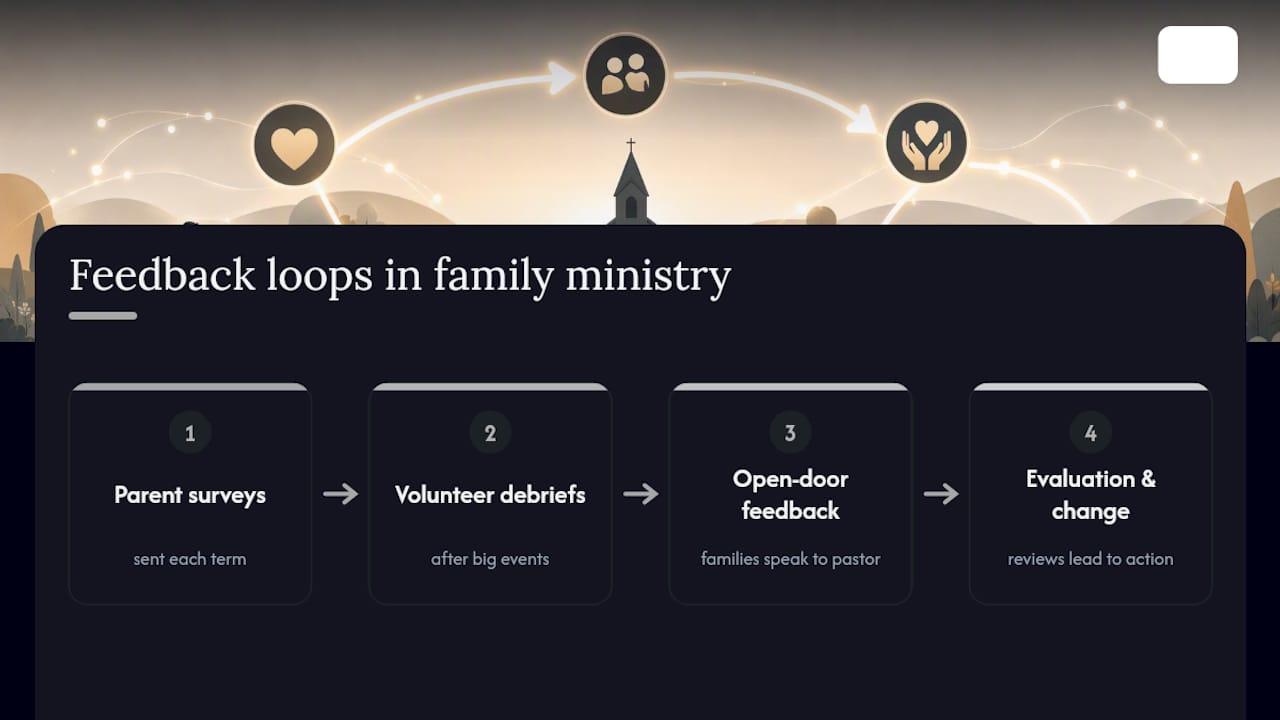
This might look like a simple survey sent to parents each term, a debrief with children’s ministry volunteers after a big event, or an open invitation for families to raise concerns directly with a pastor without it feeling like a formal complaint. The mechanism matters less than the habit: does feedback actually change anything, or does it disappear into a drawer?
Ask a church directly how it evaluates its children’s and family programs. A good answer will mention specific practices, volunteer training reviews, parent check-ins, safeguarding audits, rather than a vague assurance that “we’re always improving.” Continuous improvement in family ministry is less about grand strategy and more about a church being humble enough to notice when something is not working and willing to change it before families quietly drift away.
Divergent Church’s experience spotting family-friendly health
Divergent Church has watched what actually makes families stay, not just visit once. Small groups, run through the Life Communities model, give parents a place to be known beyond Sunday morning, while the Discipleship Hub gives structure to what growing in faith actually looks like week to week.
Visitors consistently mention the same three things when asked what mattered most in choosing to stay: whether the welcome felt genuine rather than scripted, whether childcare arrangements were clear before they even had to ask, and whether leadership felt warm rather than distant.
On a first visit, families can:
Ask a volunteer at the welcome point exactly how children’s check-in works before the service starts.
Request to meet the children’s ministry leader, not just drop kids off and go.
Ask a pastor directly what the church believes about a topic that matters to your family.
Notice whether anyone follows up after the first visit, and how quickly.
Pro Tip: Ask a staff member one specific question, “what happens if my child has an allergy or a meltdown during service?” A confident, practical answer tells you more about a church’s readiness for families than any glossy welcome pack.
An invitation from Divergent Church
Belonging rarely happens by accident. It happens because someone made room, and because a family decided to keep showing up even before everything felt familiar… What we have seen, again and again, is that families who lean into a small community, rather than staying anonymous in a crowd, find their faith and their household strengthened together.
If any part of what you have read here resonates, we would genuinely love to meet you. Come along to a Life Community and see what it feels like from the inside…
— Josh
How Divergent Church supports families who want more than a Sunday service
Plenty of churches can put on a good Sunday morning. Fewer build the kind of ongoing, relational discipleship that actually shapes a family over years, and that is the gap Divergent Church exists to close.
The Discipleship Hub gives parents a structured way to grow in their own faith, not just supervise their kids’ faith from a distance, while Life Communities put families into small groups where they are actually known by name, not just recognised by face. Both fit families who want more than attendance: people looking for a community that will pray with them through a hard season, celebrate a baptism, and show up when the washing machine breaks. There is no cost to try either, and no pressure to commit before you are ready.
If this sounds like what your family has been looking for, the simplest next step is to get in touch or check the next Life Community meeting time near you in Canberra or Queanbeyan.
Sources
Recommended
Comments