
Does God still speak, and how do you learn to hear him?


Yes. God speaks to his people today, most reliably through Scripture, the inward witness of the Holy Spirit, the peace of Christ, and the quiet providence of ordinary life. This is not a fringe claim. It’s the consistent testimony of the biblical story, from a boy named Samuel who mistook God’s voice for a priest’s, to a church in Acts that made major decisions “as it seemed good to the Holy Spirit.” What’s changed isn’t whether God speaks, but how well we’ve trained ourselves to notice.
The main channels look like this:
Scripture — the anchor and the test for everything else
The Spirit’s inward witness — impressions, conviction, and prompts that align with God’s character
Peace — a settledness that often confirms a right decision, or its absence that warns against a wrong one
Providence and people — circumstances, community, and wise counsel that confirm or correct
Most believers experience God’s voice as a quiet, testable impression rather than an audible sound. Expect subtlety, not spectacle, and expect it to be checked, not just felt.
TL;DR:
Most impressions from God are subtle, recurring thoughts that align with Scripture and are confirmed by peace, humility, and external validation.
Building daily routines like reading Scripture, brief prayer, and journaling fosters discernment and helps recognize God’s guiding signals over time.
Testing impressions against Scripture, assessing their fruit, seeking counsel, and looking for consistent confirmation prevents acting on wishful thinking.
Common pitfalls include mistaking emotion for divine voice, over-trusting fleeting thoughts, and trying to discern alone without community or external testing.
Regular practice within small groups, mentorship, and structured discipleship provides essential external checks that safeguard against self-deception.
Table of Contents
Understanding hearing God’s voice: what signs actually look like
Hearing God’s voice rarely resembles the dramatic scenes we picture. There’s no burning bush moment for most Christians, and that’s not a failure of faith. It’s the ordinary shape of divine communication across most of church history.
What it usually looks like is a recurring thought that won’t leave you alone, paired with a sense of peace when you move towards it, or unease when you don’t. Sometimes it’s a verse that surfaces unexpectedly during a hard week. Sometimes it’s a conviction about a relationship you’ve been avoiding fixing. Discernment resources note that God’s leading commonly looks like inner peace and alignment with Scripture rather than isolated, word-for-word directives dropped from nowhere.
Consider Elijah at Horeb. He expected God in the wind, the earthquake, and the fire. God showed up in “a still small voice” (1 Kings 19:12). That pattern repeats: Samuel needed three attempts before he recognised the voice calling his name (1 Samuel 3). Even biblical figures needed practice.
God’s ordinary means of speaking is not loud. It’s the whisper that requires a trained ear, not the shout that demands no discernment at all.
A modern illustration: a young professional feels an unshakeable nudge to reach out to an estranged sibling. No voice, no vision, just a persistent thought that grows more insistent during prayer, confirmed later by a conversation that seems to fall into place. That’s the typical texture of God’s communication: quiet, cumulative, and confirmed rather than commanded.
Watch for these recurring patterns:
Thoughts that align with Scripture rather than contradict it
A settled peace that outlasts the initial emotional spike
Conviction that produces humility, not self-righteousness
Confirmation that arrives through more than one source
How do you cultivate a habit of listening to God?
Listening to God is a skill built through repetition, not a talent some Christians simply have. Crossway’s teaching on prayer frames regular prayer and attentiveness as the practice that matures our ability to recognise God’s answers in the ordinary flow of life.
Here’s a sequence worth building into your week:
Read Scripture daily, even briefly. This is the primary channel God uses, and it calibrates everything else you think you’re hearing.
Build short prayer rhythms. A few minutes of silence in the morning, a check-in at night, and conversational prayer throughout the day beat one long weekly session.
Journal your impressions. Writing down what you sense forces clarity and gives you a record to test later.
Practise lectio divina. Slowly read a short passage, sit with a phrase that strikes you, and let it shape your prayer.
Schedule digital quiet. Even fifteen minutes without a phone in hand restores the attentiveness that constant notifications erode.
Review your day. A brief evening reflection on where you sensed God’s presence trains your memory to notice patterns.
Join a small group or find a mentor. Discernment sharpens in community, not isolation.
Pro Tip: Keep your listening practice to a short, repeatable rhythm most days. Sustained consistency will teach you more than occasional long retreats.
Practical, accessible methods like lectio divina and short daily silence consistently show up across pastoral teaching as the entry point for growth, precisely because they’re small enough to keep doing.

How do you know if what you heard was really God?
This is where good intentions go wrong most often, so a repeatable test matters more than a feeling of certainty.
Run any significant impression through this sequence before acting on it:
Test it against Scripture. Does it align with the whole counsel of the Bible, or only with a verse pulled out of context? Philip Cary’s critique argues that personal impressions must be checked against external, objective revelation, primarily Scripture, rather than trusted on their own authority.
Assess the fruit. Does the impression produce peace, humility, love, and perseverance, or does it produce anxiety, pride, and impatience?
Seek wise counsel. Bring it to people who know you and know Scripture before making a major decision on the strength of it alone.
Look for confirmation. Does providence line up? Do circumstances or repeated, low-pressure confirmations point the same direction over time?
A few markers that consistently separate genuine leading from wishful thinking:
Genuine impressions tend to survive scrutiny; manufactured ones often can’t withstand honest questions
Godly conviction humbles you; self-deception usually flatters you
Wise counsel that disagrees is a signal to slow down, not a hurdle to route around
Confirmation should build gradually, not appear only under pressure to decide fast
Faced with a fork in the road, pastoral guidance on major decisions can help you apply this test with someone walking alongside you rather than working it out alone at 1am.
What mistakes lead people astray when listening for God?
The most common error is mistaking a strong emotion for divine instruction. Wishful thinking dressed up in spiritual language still isn’t revelation, no matter how sincerely felt.
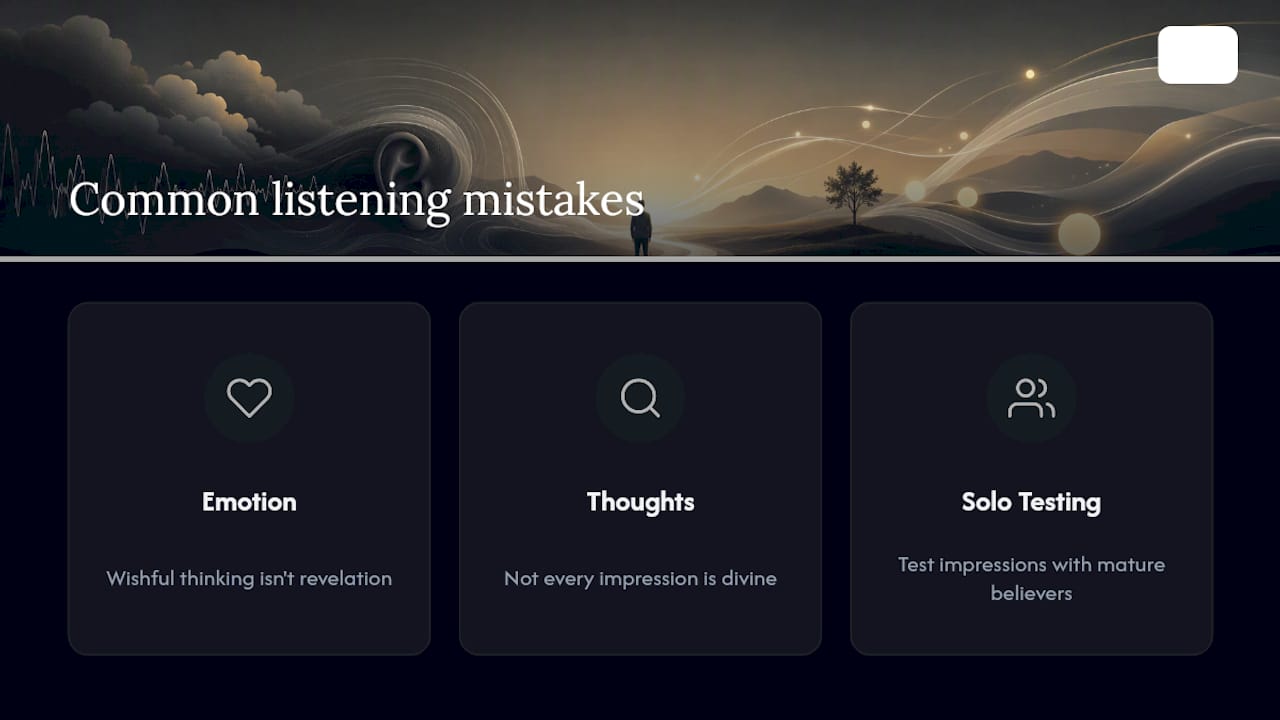
A second danger is treating every passing thought as a message from God. Not every impression carries divine weight, and constantly hunting for hidden meaning in ordinary life leads to exhaustion, not clarity. GotQuestions warns that practices built around “listening prayer” can bypass Scripture entirely and drift into self-delusion if the written Word isn’t kept as the priority.
Solo discernment, without any church testing, is a third trap. Pastoral resources on discernment consistently recommend testing impressions with mature believers rather than verifying alone, because self-deception is invisible to the person doing it.
If you realise you got it wrong, say so plainly to the people you involved, adjust course without shame, and treat the mistake as part of the training. Discernment matures through correction, not through pretending you’re always right.
A one-week rhythm to practise hearing God
Discernment grows through repetition over a set period, and a week is long enough to notice real patterns without overwhelming your schedule.
Three exercises, repeated daily:
Five minutes of morning silence. No requests, just attentive quiet before the day starts.
One paragraph of lectio divina. Read slowly, sit with a phrase, pray it back to God.
A two-minute evening review. Note anything that felt like conviction, peace, or a nudge worth testing.
Track what you notice each day in a simple journal, even just a few lines. Look for:
Recurring themes across the seven days
Whether peace or unease accompanied particular thoughts
Any impression confirmed by circumstance, Scripture, or another person
Reviewing impressions after a set period reveals patterns that a single day’s snapshot can’t show, and it guards against acting impulsively on one isolated feeling.
Why local church community matters for discernment
I write this as someone shaped by pastoral ministry at Divergent Church, where discipleship happens in the texture of ordinary relationships, not just Sunday gatherings. Discernment was never meant to be a solitary pursuit, and the New Testament pattern of testing prophecy and prompting within community still holds.
At Divergent Church, that looks like:
Life Communities — small groups where impressions get spoken aloud and tested gently
Discipleship Hub — structured pathways for growing in Scripture, prayer, and practical discernment
Mentoring relationships — where a more experienced believer walks alongside someone learning to listen
If you’re working through this alone right now, that’s the first thing worth changing. Testing what you sense with people who know you well isn’t a lack of faith. It’s how faith matures.
What actually matters most in learning to hear God
Most guidance on hearing God overcorrects in one of two directions. Either it promises a direct pipeline to divine instruction through techniques like listening prayer, treating every quiet impression as near-certain revelation, or it goes so cautious about discernment that it quietly implies God has gone silent since the closing of the canon.
Neither holds up. The biblical pattern is neither constant audible instruction nor total silence. It’s Scripture as the anchor, the Spirit’s ordinary confirming work, and a community that tests what individuals sense. Where the popular advice usually falls short is skipping that third piece. Journalling and silence are genuinely useful, but without wise counsel checking your conclusions, they just help you become more confident in whatever you already wanted to hear.
If you take one thing from this, prioritise the test over the technique. Learn to sit in Scripture and silence, yes, but build the habit of bringing what you sense to people who’ll ask hard questions before you act on it. That single habit prevents more harm than any prayer method ever will.
— Josh
Where to practise discernment with real support
Reading about discernment only takes you so far. At some point, you need people who’ll sit with you while you test what you’re sensing, ask the questions you’re avoiding, and pray alongside you when the answer isn’t obvious yet.
Divergent Church exists for exactly that. Our Discipleship Hub gives you structured pathways for growing in Scripture and prayer alongside people further along the road, so you’re not guessing your way through decisions on your own. If you’d rather start smaller, Life Communities are small groups where you can voice an impression and have it gently tested by people who actually know your life, not strangers online. For those already leading others, Lead Like Jesus builds discernment into the practice of leadership itself. Whichever fits where you’re at, the next step is simple: get in touch about joining a group or finding a mentor this month.
Key Takeaways
Hearing God’s voice reliably requires anchoring every impression in Scripture, testing it through peace and fruit, and confirming it with trusted community before acting.
Point | Details |
Scripture comes first | Treat the Bible as the primary test for any impression, not an afterthought once you’ve already decided. |
Expect subtlety, not spectacle | Most believers sense quiet impressions and peace rather than audible words or dramatic visions. |
Build small daily rhythms | Five minutes of silence, a short lectio passage, and an evening review sustain better than occasional long sessions. |
Never discern alone | Bring significant impressions to wise counsel before making major decisions on their strength. |
Practise it in community | Divergent Church’s Life Communities and Discipleship Hub give practical pathways for testing what you sense with mentors and small groups. |
Sources
Recommended
Comments