
Why the Order Doesn't Matter: Repentance and Faith for Christians


Repentance and faith are not two separate steps but two sides of the same turning to God, and Scripture treats them as inseparable in true conversion. Neither logically precedes the other in a way that should trouble anyone seeking Christ. What follows is the scriptural proof, the major theological positions, and what this means for how you live it out.
TL;DR:
Repentance and faith are inseparable and occur as a single turn toward God, with Scripture emphasizing their unity rather than strict order.
Theologians debate whether repentance or faith comes first, but Scripture supports their simultaneous or intertwined occurrence during genuine conversion.
True repentance and faith are characterized by life direction changes, trust shifting to Christ, and ongoing repentance rather than emotional feelings alone.
Conversion is an ongoing process of turning toward God, expressed through daily confession, reliance on grace, and growth in obedience.
The focus should not be on the sequence but on whether a person is actively turning in the right direction right now.
Table of Contents
What the Bible says about repentance and faith
Jesus opens His ministry with a single command that fuses both ideas: “The time is fulfilled, and the kingdom of God is at hand; repent and believe in the gospel” (Mark 1:15). He doesn’t present repentance and belief as sequential tasks. He presents them as one response to one announcement.
The book of Acts confirms this pattern again and again. Peter tells the crowd at Pentecost to “repent and be baptised” (Acts 2:38), while the Philippian jailer hears only “believe in the Lord Jesus Christ, and you will be saved” (Acts 16:31). Paul later summarises his whole ministry as “testifying to both Jews and Greeks about repentance toward God and faith in our Lord Jesus Christ” (Acts 20:21), and tells the Athenians simply that God “commands all people everywhere to repent” (Acts 17:30). Luke records the risen Christ commissioning the disciples to preach “repentance for the forgiveness of sins” (Luke 24:47), with no mention of faith at all.
This isn’t inconsistency. It’s shorthand. The New Testament writers use whichever word carries the weight needed for that moment, trusting the reader to understand the other is implied.
Mark 1:15 pairs the two as a single imperative tied to the kingdom’s arrival.
Acts 2:38 and Acts 20:21 show repentance and faith preached side by side or interchangeably.
Acts 16:31 highlights faith alone, because saving faith already includes turning from sin.
Acts 17:30 highlights repentance alone, because genuine repentance already includes trusting God.
Luke 24:47 uses repentance as shorthand for the whole gospel response.
The Ligonier Ministries treatment of this pairing calls repentance and faith “twin graces,” each word capable of standing in for the whole turn. Bible Proclaimer frames it as one turn with two aspects: turning from sin, and turning to God. Both descriptions point the same direction. You don’t choose one word over the other. You recognise both are present whenever a heart genuinely turns.
Three theological positions: simultaneous, faith-first, or repentance-first?
Theologians have argued over the logical order of repentance and faith for centuries, and the debate is worth understanding, even though it resolves more peacefully than most people expect.
The twin graces view holds that repentance and faith happen in the same moment, worked by the same grace, as two aspects of a single act of turning. Sinclair Ferguson, writing for Ligonier and referenced widely through Banner of Truth material, argues that separating them chronologically misunderstands what conversion actually is. You cannot genuinely trust Christ without turning from sin, and you cannot genuinely turn from sin without trusting Christ to receive you. The Gospel Coalition reinforces this by noting that Scripture expects repentance to produce “fruit in keeping with repentance”, meaning it’s never a bare mental adjustment sitting apart from faith.
The faith-first view argues there’s a logical, though not necessarily felt, order: you must first believe God’s promise before you can rightly turn from sin, because repentance without faith is just despair. Reformed writers in this camp, including strands of Calvin’s own commentary tradition, treat faith as the root from which repentance grows as fruit.
The repentance-first view takes the opposite logical tack: recognising your sin (repentance) must dawn before you can meaningfully grasp why you need a saviour (faith). Shedd and Berkhof both wrestle with this ordering in their systematic theologies, generally concluding that the two are inseparable in time even if distinguishable in logic.
Repentance and faith are like two sides of a single coin. You cannot hold one without the other, and asking which side you touched first misses the point of the coin altogether.
Scripture itself supports simultaneity over strict sequencing, and the Ligonier material on this notes that individual experience of conversion varies: some people feel conviction over sin first, others feel the relief of rescue first. Neither experience is more valid. The theology holds together either way.
How do you know if you’re truly repenting and believing?
The clearest test Scripture gives isn’t emotional intensity. It’s direction of life. Paul draws a sharp line between “godly grief” that “produces a repentance leading to salvation without regret” and “worldly grief” that merely “produces death” (2 Corinthians 7:10). Worldly grief is remorse: sorrow over consequences, often self-pitying, rarely leading anywhere. Godly grief is repentance: sorrow over sin itself, and it moves you.
Genuine repentance and faith together tend to produce a recognisable pattern.
Trust shifts away from yourself. You stop relying on your own performance and start resting in Christ’s finished work.
Desire changes before behaviour fully catches up. You want to obey, even while you’re still learning how.
Concrete life changes follow, not as proof you’ve earned forgiveness, but as evidence something real has happened.
You seek honest confession rather than avoiding it, because hiding no longer feels safer than being known.
You want community, because faith that stays private rarely stays healthy for long.
Pro Tip: If you’re unsure whether you’ve genuinely repented, don’t wait for a feeling. Pray honestly about what you actually believe and where you’re actually still holding back, then take one concrete step, whether that’s confessing something specific, opening Scripture, or talking to someone you trust.
This isn’t a one-off transaction you complete and file away. GotQuestions points out that repentance is commanded of believers throughout Scripture (Acts 17:30) and yet also described as something God grants (Acts 11:18), which means ongoing repentance is part of walking with God, not a hurdle you clear once. Daily confession, continual reliance on grace, and steady growth in obedience are the shape of a life still turning toward God, not evidence you got it wrong the first time.
Divergent Church’s approach to faith and repentance
Our church exists to form disciples, not just gather a crowd on Sunday. That means we treat repentance and faith the way Scripture does: as an ongoing turning, worked out in real relationships, not settled once and set aside.
Our Discipleship Hub exists for exactly this stage of the journey, whether you’re taking your first honest look at your own heart or you’ve walked with Christ for years and still feel the pull to grow. Our Life Communities give you a place to practise confession and accountability with people who won’t flinch at either. And if you’re wrestling with what genuine repentance looks like in your own life, the question of how you become a Christian is worth sitting with rather than rushing past.
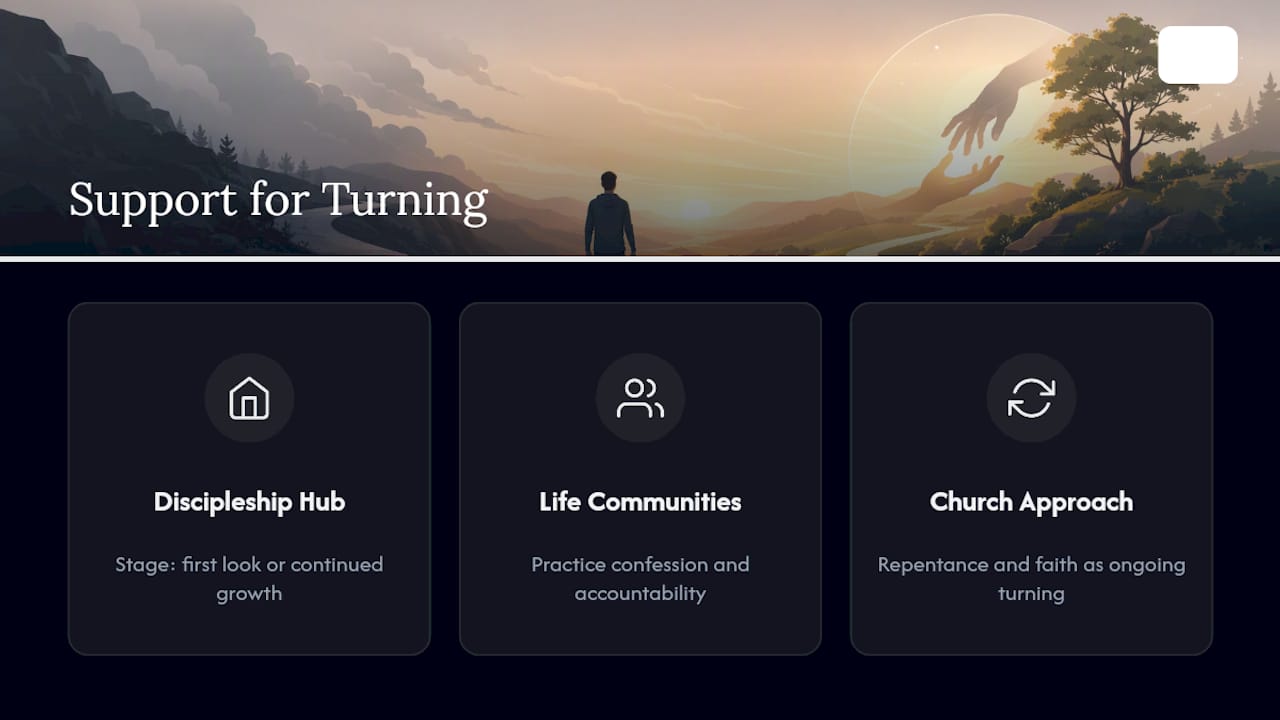
None of this requires certainty before you show up. Come as you’re turning.
Where to read more on repentance and faith
Faith and Repentance — Ligonier Ministries: the clearest treatment of repentance and faith as twin graces.
Gotquestions: a practical walk through Scripture’s commands on repentance.
7 Things You Should Know About Repentance — The Gospel Coalition: concise, citation-backed summary of repentance’s fruit.
For further devotional reading, GraceLight Press publishes accessible material on grace and conversion.
Why the “which comes first” question misses the point
The anxiety over sequencing repentance and faith usually comes from treating conversion like a checklist rather than a relationship. I think that instinct is understandable but misplaced. People want certainty they’ve done it “right”, so they hunt for the correct order of operations. Scripture never gives them one, because it isn’t offering a formula. It’s describing a turn, and a turn happens all at once even when you can talk about its parts separately.
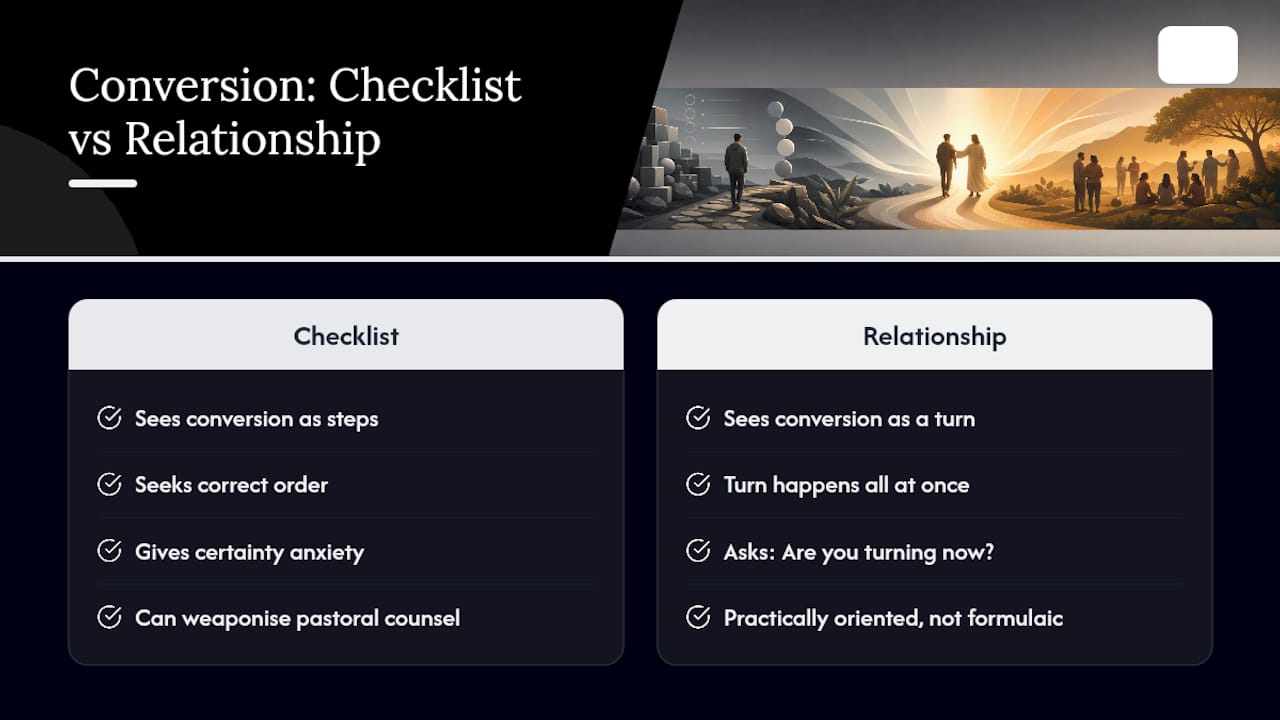
What troubles me more is how often this question gets weaponised pastorally, usually unintentionally. Someone feels overwhelming conviction over sin before they feel much confidence in Christ, and they’re told their repentance came “before” their faith, so something’s wrong. Or someone trusts Christ readily but struggles to feel deep sorrow over specific sins, and they’re told their faith is shallow because repentance hasn’t “caught up”. Both readings misuse good theology to manufacture doubt Scripture never asks for.
The more useful question isn’t which came first. It’s whether you’re actually turning, right now, today, in whatever specific direction your life still needs to move. That’s a question with a practical answer, not a theological puzzle.
— Josh
Sources
Recommended
Comments