
4 Ready to Say Spiritual Warfare Prayers with Scripture and Safe Steps

Spiritual warfare prayer is the practice of resisting evil forces through Christ’s authority using Scripture, declaration and petition rather than personal effort. Say this now: “In the name of Jesus, I take refuge under the shadow of the Almighty. I plead the blood of Christ over my mind, my home and my family, and I resist every scheme of the enemy.” This is not folk magic. It is prayer grounded in Ephesians 6 and Psalm 91, offered with humility, not spectacle.
TL;DR:
Spiritual warfare prayer is focused on resisting deception, fear, and oppression through Scripture and Christ’s authority, not through personal strength or rituals.
Short, Scripture-based prayers like pleading the blood, Psalm 91, and armor declarations are effective tools for immediate protection and mental renewal.
Command language should be carefully limited to your own sphere, while praying for others should involve asking God for His intervention rather than exercising authority over adults.
Community practices, regular Scripture reading, and accountability significantly enhance the sustainability and safety of warfare prayer.
Warning signs such as hallucinations or severe personality shifts indicate the need for pastoral or clinical support alongside prayer efforts.
Table of Contents
What is spiritual warfare prayer, exactly?
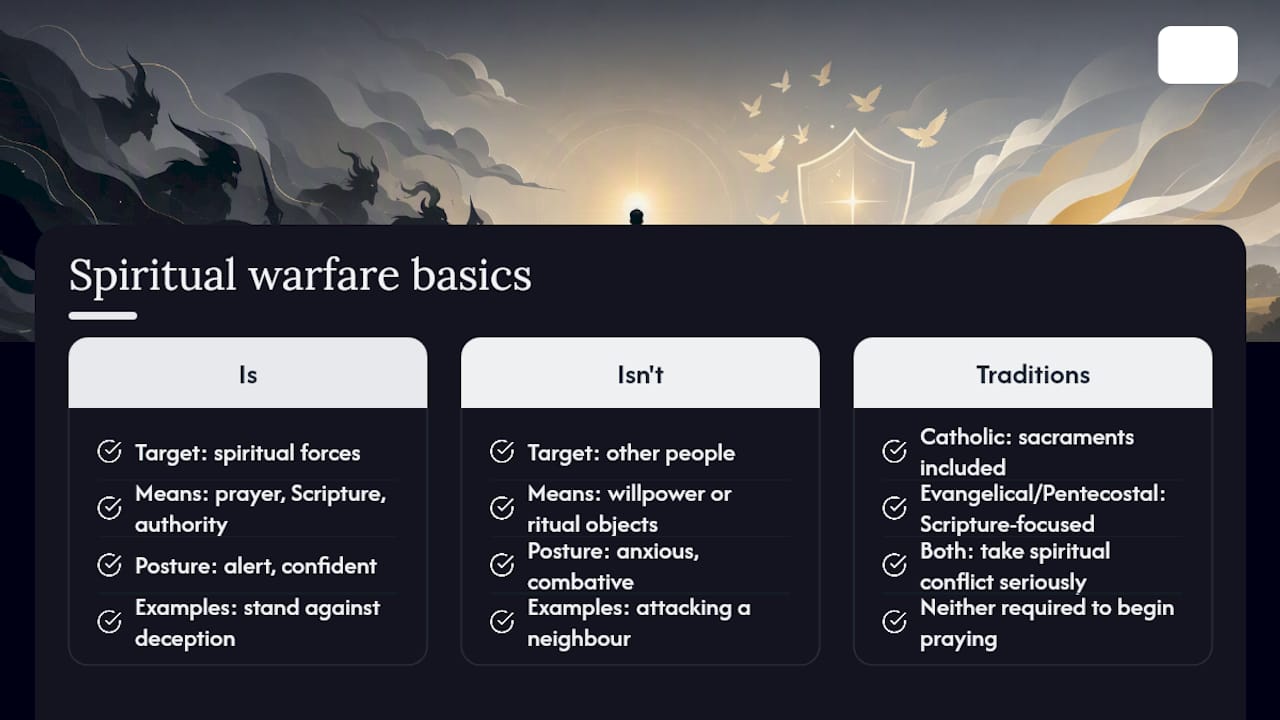
Spiritual warfare prayer is the practice of standing against evil influence through prayer, Scripture and the authority believers hold in Jesus Christ, rather than through willpower, ritual objects, or clever words. The apostle Paul frames it plainly in Ephesians 6:10–18: the fight isn’t against flesh and blood, but against spiritual forces, and the response is armor, not aggression.
This distinction matters more than most people realise. Christians frequently reach for warfare prayer when they’re anxious, exhausted, or facing conflict with another person, and end up praying against the wrong target. National Catholic Register’s commentary on spiritual warfare notes that confusing people with the spiritual forces behind temptation is one of the most common errors believers make. Warfare prayer isn’t a weapon against your difficult neighbour, your unfaithful ex, or a colleague who wronged you. It’s a stand against deception, fear, oppression and temptation, directed at the spiritual reality behind a struggle, not the human being caught up in it.
Christianity.com describes a “prayer warrior” not as someone with a special gift, but as any believer who recognises spiritual conflict and responds actively through prayer, Scripture and community, rather than passively enduring it. That’s the posture this whole practice rests on: alert, not anxious; confident, not combative.
Some traditions add another dimension. Catholic teaching places sacramental life at the centre of the battle. Confession, fasting, the Rosary and the Mass sit alongside prayer as central means of engaging spiritual warfare, where many evangelical and Pentecostal streams lean more heavily on Scripture-based declaration and petition. Both approaches take the reality of spiritual conflict seriously. Neither is required reading before you’re allowed to pray.
Prayers you can pray right now, by need
These are prayers to speak aloud, not silently rehearse. Say them slowly. Mean the words. You don’t need special training to pray them, and you don’t need to feel brave first.
Immediate protection: pleading the blood
This is the prayer to reach for the moment fear, dread or spiritual pressure hits.
Father, I come to You in the name of Jesus Christ. I plead the blood of Jesus over my life, my mind, my home and everyone in it. I resist every spirit of fear, confusion and oppression in Jesus’ name. You are my refuge and my fortress; in You I trust. Amen.
Scripture-based prayers built around the blood of Christ and Psalm 91 are common across Christian traditions as go-to protective prayers precisely because they’re short enough to remember under pressure and rich enough to anchor real theology.
Psalm 91 prayer and Armour of God declaration
Psalm 91 has functioned as a protective psalm for centuries, and it translates naturally into prayer form.
Lord, You are my refuge and my fortress, my God, in whom I trust. I will not fear the terror of night, nor the arrow that flies by day, nor the plague that stalks in darkness. You have commanded Your angels to guard me in all my ways. I dwell in Your shelter today, under the shadow of the Almighty.
Pair that with a direct declaration of the armour Paul describes in Ephesians 6:
“I put on the belt of truth around my waist, rejecting every lie the enemy speaks over me.”
“I put on the breastplate of righteousness, standing clean before God through Christ.”
“I put on the shoes of the gospel of peace, walking steady no matter what comes.”
“I take up the shield of faith, extinguishing every flaming arrow of doubt and accusation.”
“I put on the helmet of salvation, guarding my mind and my thoughts.”
“I take up the sword of the Spirit, the word of God, as my only offensive weapon.”
Notice what’s missing from that list: nothing about your own strength, cleverness or spiritual resume. The armour belongs to God. You’re simply putting it on.
Prayers for a peaceful, renewed mind
Paul writes in 2 Corinthians 10:4–5 that believers’ weapons “have divine power to demolish strongholds,” specifically strongholds of thought, arguments and every pretension that sets itself against the knowledge of God. That’s a mental health text as much as a spiritual one.
Lord, I take every anxious thought captive and bring it under the obedience of Christ. I reject every lie that tells me I’m not enough, not loved, or not safe. Renew my mind with Your truth. Let peace that surpasses understanding guard my heart and my thoughts, in Jesus’ name.
Use this prayer specifically when intrusive thoughts, spiralling worry or self-condemnation show up. It’s a demolition prayer for a demolition problem, aimed at the thought pattern, not at yourself.
Family and household prayers
Praying protection over people you love requires slightly different language than praying for yourself, because your spiritual authority as a lay believer covers your own life, your home and your minor children directly, and covers other adults only through petition rather than command.
Father, I dedicate this home to You. I ask You to set a hedge of protection around every person who lives here. Let no weapon formed against this household prosper. Fill every room with Your peace, and let this be a place where Your presence is welcome and evil has no foothold. I ask this over my children by name: [name], I speak Your covering and Your calling over their life.
For adult family members outside your household, shift from command to request:
Father, I lift up [name] to You. I ask You to draw near to them, to protect their mind and their steps, and to reveal Yourself to them in whatever way they need. I don’t command over their will, Lord. I ask You to work in them according to Your purposes.
Night prayers and prayers against anxious thoughts
Night is when spiritual pressure tends to feel heaviest, largely because the distractions of the day have gone quiet and the mind is left alone with its fears.
Lord, as I lie down tonight, I trust You to keep watch. I release every worry from today into Your hands. I plead the blood of Jesus over my sleep, my dreams and my home. Let no terror by night come near me. You give rest to those You love; I receive that rest now, in Jesus’ name. Amen.
If intrusive or racing thoughts return after you’ve prayed once, pray again. Repetition isn’t a sign the first prayer failed. Persistent prayer is expected, even encouraged, throughout Scripture.
Declare-and-decree statements
Short declarations work because they’re portable. Keep two or three memorised for moments you can’t stop to read a full prayer:
“No weapon formed against me will prosper.”
“Greater is He who is in me than he who is in the world.”
“I am not under a spirit of fear, but of power, love and a sound mind.”
“The Lord is my light and my salvation; whom shall I fear?”
These aren’t magic words. They’re Scripture spoken back to yourself, out loud, as a reminder of what’s actually true when your feelings are telling you something else.
How do you pray spiritual warfare prayer correctly?
The single most important habit isn’t a formula, a posture, or a time of day. It’s the combination of Scripture, prayer and faith held together consistently, rather than reached for only in crisis. Christianity.com’s guidance on prayer warriors emphasises that engagement, not passivity, defines effective practice: reading Scripture regularly, praying it back to God, and staying connected to other believers so warfare prayer doesn’t become an isolated, sensational habit.
Command language versus petition language
This distinction has real weight, and most guides skip it. When you pray with command or decree language (“I bind,” “I declare,” “I take authority”), you’re exercising spiritual authority. Scripture supports using that language over yourself, your minor children and property you’re responsible for. It does not support commanding over other adults, over a region, a nation, or a person who hasn’t invited your involvement. Guidance on imprecatory prayer recommends restricting commanding language to your own jurisdiction and switching to petition, simply asking God to act, when you’re praying for anyone else. That single distinction prevents most of the overreach that gives spiritual warfare prayer a bad reputation.
A step-by-step routine
Prepare. Quiet the space, physically and mentally. A minute of silence before you speak beats rushing straight into declarations.
Read Scripture first. Even one verse (Psalm 91:1 or Ephesians 6:11 work well) anchors the prayer in something outside your own emotional state.
Pray aloud where you’re able. Spoken prayer tends to sharpen focus and resist drifting thoughts better than silent prayer, particularly under pressure.
Declare, don’t negotiate. State the truth of who God is and what Christ has done. This isn’t persuading God; it’s aligning yourself with what’s already true.
Close with thanks, not just petitions. Gratitude closes the loop and steadies the heart.
Follow up. Keep reading Scripture through the day. Tell someone you trust what you prayed about. Isolation is where warfare prayer curdles into something unhealthy.
A short daily rhythm might look like: five minutes of Scripture in the morning, a one-line declaration before you leave the house, a protection prayer over your home at night, and a weekly check-in with a friend or small group about how it’s actually landing in your life.
Pro Tip: Keep a single index card or phone note with three prayers on it: one for mornings, one for anxious moments, one for night. When pressure hits, you won’t have to compose anything. You’ll just pray what’s already written.
Ephesians 6, Psalm 91 and 2 Corinthians 10 explained simply
Three passages carry most of the theological weight behind spiritual warfare prayer, and understanding them briefly changes how you pray them.
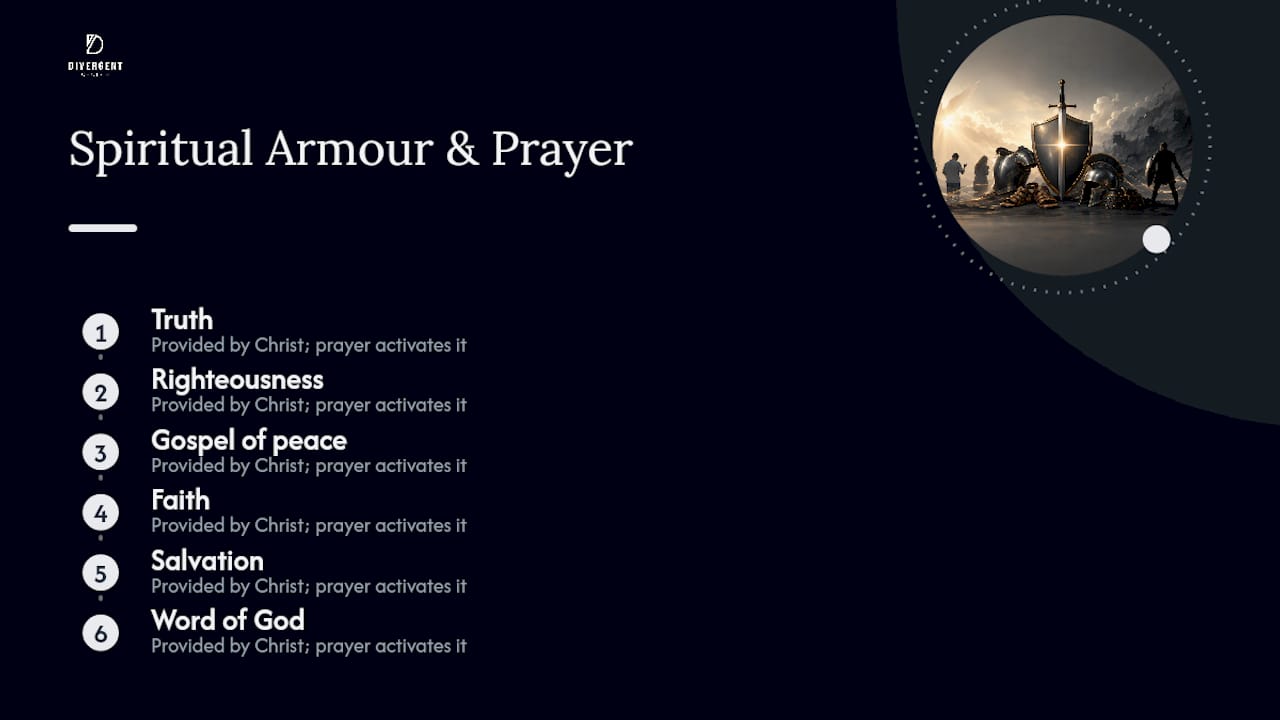
Ephesians 6:10–18 is the foundational text. Paul tells believers to “be strong in the Lord and in his mighty power,” then lists the armour: truth, righteousness, the gospel of peace, faith, salvation and the word of God, followed by an instruction to “pray in the Spirit on all occasions.” The structure itself is the theology: every piece of armour is something Christ has already provided, and prayer is what activates and sustains it, not what earns it.
Psalm 91 predates the New Testament by centuries, but Christians have used its imagery of refuge, shelter and divine protection as a template for protective prayer across generations. It doesn’t promise a life free of hardship. It promises presence and covering within hardship, which is a different and more durable promise.
2 Corinthians 10:4–5 shifts the battlefield into the mind. Paul writes that believers’ weapons “have divine power to demolish strongholds,” specifically arguments, pretensions and every thought that resists the knowledge of God. This verse is why so much spiritual warfare prayer focuses on mental and emotional patterns rather than external circumstances. The war Paul describes here is fought largely between your ears.
What “authority in Christ” actually means
Authority in spiritual warfare prayer isn’t personal power. It’s derivative, borrowed entirely from Christ’s finished work, exercised through faith rather than force of personality. “Weapons not carnal” (drawn from 2 Corinthians 10:4) means the tools are prayer, Scripture, faith and obedience, not manipulation, superstition or sheer intensity. “Binding and loosing,” a phrase drawn from Matthew 18, is often used loosely today to mean commanding something to stop, but in its original context it relates more closely to community decisions about sin and reconciliation than to combat against unseen forces. Use the phrase carefully, and don’t lean on it as a magic switch.
Where traditions differ
Catholic practice folds spiritual warfare into sacramental life. Confession, fasting, the Rosary and participation in Mass are treated as central to engaging the battle, alongside personal prayer. Many Protestant and evangelical streams place more weight on direct Scripture-based petition and verbal declaration, with less structured sacramental practice. Neither approach contradicts the other; they emphasise different tools within the same biblical framework. If your church tradition leans one way, there’s no need to import the other’s practices wholesale. Pray within the framework your community has taught you, and hold the differences with charity rather than suspicion.
When should you get outside help with spiritual warfare?
Lay prayer has real limits, and respecting them is part of praying wisely, not a lack of faith. Your spiritual authority as an individual believer extends clearly over yourself, your minor children and property you’re responsible for. It does not extend to commanding over other adults without invitation, over a region, or over someone else’s household. Manuals on deliverance draw this line explicitly, reserving formal exorcism and specialised deliverance ministry for authorised clergy while encouraging laypeople to use prayer, Scripture and sacramentals within their own sphere.
Some warning signs point toward a need for pastoral or clinical support rather than more warfare prayer alone. Watch for:
Hallucinations, or perceiving things others around you can’t confirm.
Thoughts of suicide or self-harm, at any intensity
Sudden, severe changes in personality, memory or behaviour
Compulsive fear that intensifies rather than eases after consistent, sustained prayer
None of these are shameful. They’re signals to bring in a pastor, a counsellor, or a doctor alongside your prayer life, not instead of it. Confession, honest accountability and pastoral oversight are protective, not restrictive. Sensationalising spiritual warfare, treating every hard season as demonic attack, or seeking out dramatic deliverance experiences rather than steady discipleship tends to do more harm than good.
Where to keep growing in warfare prayer
Sustained spiritual warfare prayer works better inside community than in isolation. Divergentchurch offers several ways to build that rhythm in Canberra and Queanbeyan.
21 Days of Prayer gives you a structured season to build the daily habit of Scripture and prayer together, rather than relying on willpower alone.
The Discipleship Hub walks believers through ongoing formation, connecting prayer practice to broader growth in faith and character.
Life Communities provide the accountability that keeps warfare prayer grounded and honest, people who’ll ask how you’re actually going, not just how your prayers sounded.
Christianity.com’s research on sustainable prayer habits backs this instinct: combining short scripted prayers with regular Scripture reading and community accountability makes the practice easier to maintain and far less likely to drift into isolation or sensationalism. If you want a simple starting routine before joining anything formal, the five minute ACTS prayer method is a solid daily anchor, and reading about the role of prayer in church life will help you see why praying alongside others changes the texture of the practice entirely.
For theological depth beyond this article, look into the biblical text of Ephesians 6 and Psalm 91 directly, alongside reputable commentary from established ministries. Reading widely across traditions, Catholic, Pentecostal and Reformed, gives a fuller picture than any single stream alone.
A pastoral reflection on steady prayer
The loudest voices in spiritual warfare teaching tend to promise the most dramatic results, and I think that’s exactly backwards. Scripture doesn’t describe warfare prayer as a performance. It describes it as armour you put on daily, the same pieces, the same posture, worn so consistently it becomes unremarkable. The believers who actually walk in freedom over time aren’t the ones chasing the next breakthrough encounter. They’re the ones who pray Psalm 91 on an ordinary Tuesday morning because that’s simply what they do.
Humility matters more here than most teaching admits. Command language over your own life is one thing; presuming to command over someone else’s will, or treating every hardship as a demonic assault, is a different posture entirely, one Scripture doesn’t actually support.
You were never meant to fight this alone. Bring your prayer life into a community that will pray alongside you, ask how you’re really doing, and gently correct you when you drift toward sensationalism. That’s not a lesser path than dramatic deliverance stories. It’s the sturdier one.
— Josh
Ready to build this into your week?
Reading a prayer once won’t build the habit. There are communities that help you pray these words alongside people who’ll actually notice if you stop, which can be a missing ingredient in many people’s spiritual warfare practice.
The Discipleship Hub walks you through structured spiritual formation, so warfare prayer becomes part of a wider rhythm of growth rather than a standalone panic response. If you’d rather start smaller, a Life Community gives you a handful of people to pray with weekly, people who’ll ask how last night’s prayer actually went, not just whether you said it. Both pathways exist in Canberra and Queanbeyan, built around ordinary weeks rather than dramatic moments.
If you’re not sure where to start, reach out through the contact page and someone from the pastoral team will point you toward the right group or gathering for where you’re at right now.
Sources
FAQ
What are some powerful prayers for spiritual warfare?
Short, Scripture-based prayers work best: a Psalm 91 refuge prayer, an Armour of God declaration from Ephesians 6, a mind-renewal prayer from 2 Corinthians 10, and a household protection prayer are the four most commonly used and are all included above.
What is the most powerful prayer to fight evil?
There’s no single “most powerful” formula, but pleading the blood of Christ combined with a direct declaration of Psalm 91 is one of the most widely used protective prayers across Christian traditions, precisely because it’s short enough to remember under pressure.
What is a spiritual warfare prayer for the mind?
Praying 2 Corinthians 10:4–5 directly, asking God to demolish anxious strongholds and take every thought captive to Christ, targets intrusive thinking and anxiety at its biblical root rather than just its symptoms.
What are good spiritual warfare prayers to say at night?
A short night prayer combining Psalm 91’s promise of protection from “the terror of night” with pleading the blood of Jesus over your sleep and home works well, and can be repeated as many times as needed if anxious thoughts return.
Can anyone pray spiritual warfare prayer, or is special training required?
Any believer can pray it. Command language should stay limited to yourself, your minor children and your property, while prayers for other adults or wider situations are better prayed as petitions asking God to act, not commands issued in your own authority.
Recommended
Comments