
Why Christian unity matters: a Bible-first guide


Christian unity matters because Jesus prayed that our visible oneness would help the world believe the Father sent him. That single request in John 17 ties the credibility of the gospel to how believers treat one another. Ephesians 4:3 calls Christians to “maintain the unity of the Spirit in the bond of peace,” and 1 Corinthians 12 shows why that unity holds diverse gifts together rather than flattening them into sameness.
The immediate effects show up fast wherever a church takes this seriously:
A more credible public witness, because a fractured church has little to say to a fractured world
Shared mission and mercy work that no single congregation could pull off alone
Deeper spiritual maturity, since unity forces believers to practise humility, forgiveness and patience with each other
Key Takeaways
Christian unity matters because Jesus tied the world’s belief in him directly to the visible oneness of his followers, making unity both a spiritual and missional necessity.
Point | Details |
Unity is rooted in John 17 | Jesus prayed that believers’ oneness would help the world believe the Father sent him. |
Diversity fuels unity, not division | 1 Corinthians 12’s body metaphor shows different gifts working together, not uniformity. |
Unity strengthens public witness | A divided church has a weaker message and less capacity for shared justice and mercy work. |
Unity has biblical limits | Matthew 18 and 1 Corinthians 5 show separation is appropriate for unrepentant sin or false teaching. |
Practice beats theory | Shared prayer, joint mission projects and honest conflict resolution build unity faster than good intentions. |
Table of Contents
Why Christian unity matters according to Scripture
The Bible does not treat unity as a nice group feeling. It treats it as a theological necessity that flows directly from who God is.
John 17:21 to 23 is the anchor text. Jesus prays that his followers would be “one” in the same way he and the Father are one, and he states the purpose plainly: “so that the world may know that you sent me.” That is a bold claim. Jesus links the world’s ability to recognise him to how his people treat each other. A divided church, on this reading, does not just look messy. It obscures the very thing it exists to announce.
Ephesians 4:1 to 3 pushes the same idea into daily practice. Paul urges believers to walk “with all humility and gentleness, with patience, bearing with one another in love, eager to maintain the unity of the Spirit in the bond of peace.” Notice the order: humility and patience come before unity, not after. You cannot skip straight to agreement without first doing the slower work of bearing with people who annoy or disappoint you. Romans 15:5 to 6 adds the goal: unity exists so believers “may with one voice glorify the God and Father of our Lord Jesus Christ.” Unity is not the end point. Worship is.
Then there is 1 Corinthians 12, which explains what unity actually looks like once you have it. Paul compares the church to a human body: eyes, hands, feet, all different, all necessary. GotQuestions’ summary of the passage notes that diverse spiritual gifts are not a threat to unity. They are the mechanism through which unity works itself out. A body with only eyes cannot walk. A church with only one kind of gift cannot function as Christ intended.
Two things follow from these texts:
Unity requires visible expression, not just private goodwill. Jesus prayed for something the world could observe.
Diversity of gifts, background and personality is built into the design. Unity was never meant to erase it.
The theological and practical case for pursuing unity
Three reasons carry the most weight, and each one shows up in ordinary church life long before it shows up in a theology textbook.
The theological reason comes first. When believers serve each other without rivalry, they reflect something of the Trinity itself. GotQuestions argues that the church’s unity mirrors the mutual love and cooperation within the Godhead, and that this reflection is part of what makes the church’s witness believable rather than hollow. This is not abstract. A congregation where people compete for status or hoard influence tells a different story about God than one where people genuinely prefer each other.

The missional reason is just as concrete. The World Council of Churches puts it bluntly: a divided church has a weaker message and less capacity to work for justice, reconciliation and peace. That is not a modern political point. It is a practical observation. Two churches that cooperate on a food relief program reach more people, build more trust and spend less energy managing turf than two churches that compete for the same suburb. Unity is often what lets small congregations punch above their weight.
The pastoral reason matters most for the person sitting in the pew on a hard Sunday. Unity is what makes mutual care possible. It is what lets a church absorb conflict without splintering, support a grieving family without factionalism, and disciple new believers without contradictory messages pulling them in different directions. Pastoral resources consistently link unity to spiritual growth, arguing that a church divided against itself struggles to finish the work Jesus gave it.
What does this look like in practice? A few patterns recur wherever churches take unity seriously:
Joint outreach projects where congregations pool volunteers and resources rather than duplicating effort
Shared mercy ministries, such as combined food pantries or crisis support networks
Reciprocal prayer gatherings that build relational trust before a crisis ever tests it
A divided church has no message to a divided world, as the WCC’s general secretary has put it in reflecting on the movement’s founding conviction.
None of this happens automatically. It takes churches choosing cooperation over competition, which is exactly where the next question becomes urgent: what does unity require you to give up, and what should it never ask of you?
What Christian unity is not
Unity gets misunderstood almost as often as it gets ignored, and the confusion usually runs in one of two directions.
The first misconception is that unity means uniformity. It does not. Nothing in 1 Corinthians 12 asks every believer to think, worship or serve identically. The passage’s entire argument depends on difference. A church that pressures everyone toward the same personality, worship style or political opinion has confused unity with conformity, and Paul’s body metaphor argues directly against that confusion.
The second misconception is more dangerous: using “unity” as a tool to silence dissent or avoid necessary correction. Baptist News Global warns that unity language can be weaponised this way, pressuring people to stay quiet about genuine problems for the sake of appearances. That is not biblical unity. It is institutional self-protection wearing unity’s name.
Scripture is equally clear that unity has limits. Matthew 18 outlines a process for confronting unrepentant sin. 1 Corinthians 5 describes removing someone from fellowship when persistent, unaddressed sin threatens the church’s integrity. These are not contradictions of unity. They are its guardrails.
Watch for these red flags:
Leaders who invoke “unity” whenever someone raises a legitimate concern about doctrine or conduct
Pressure to stay silent about harm rather than pursue the biblical discipline process
A church culture where disagreement is treated as disloyalty rather than as part of healthy community
Seven ways to grow and protect unity this week
Unity is built through repeated small choices, not one dramatic gesture. These practices work whether you are leading a congregation or simply trying to strengthen your own small group.
Prioritise gospel essentials. Get clear, as a group, on what actually requires agreement (the person and work of Jesus) versus what allows for difference (worship style, secondary doctrine).
Practise humble listening. Before responding to disagreement, restate the other person’s view accurately enough that they’d agree you understood it.
Pray together across lines of difference. Shared prayer with another congregation or life group builds trust that arguments alone never will.
Run a joint mission project. Partner with another church or ministry on one tangible task, such as a food drive or working bee, this quarter.
Resolve conflict early and directly. Address tension with the person involved rather than letting it calcify into gossip or factions.
Show up for fellowship beyond your own congregation. Attend another church’s event or invite their leaders to yours.
Exchange leaders occasionally. A guest speaker or reciprocal visit from another congregation’s leadership signals that unity is real, not rhetorical.
For a one-week starting point: pick one name from a church or ministry outside your usual circle, invite them for coffee, and ask what they’re working on. That single conversation often does more for unity than a year of stated good intentions.
Pro Tip: When a theological disagreement runs deep, separate the person from the position. You can tell someone plainly that you think they’re wrong about a secondary doctrine while still praying with them, eating with them and serving alongside them. Patient, honest conflict resolution preserves fellowship better than avoiding the topic ever does.
Doesn’t pursuing unity mean compromising the truth?
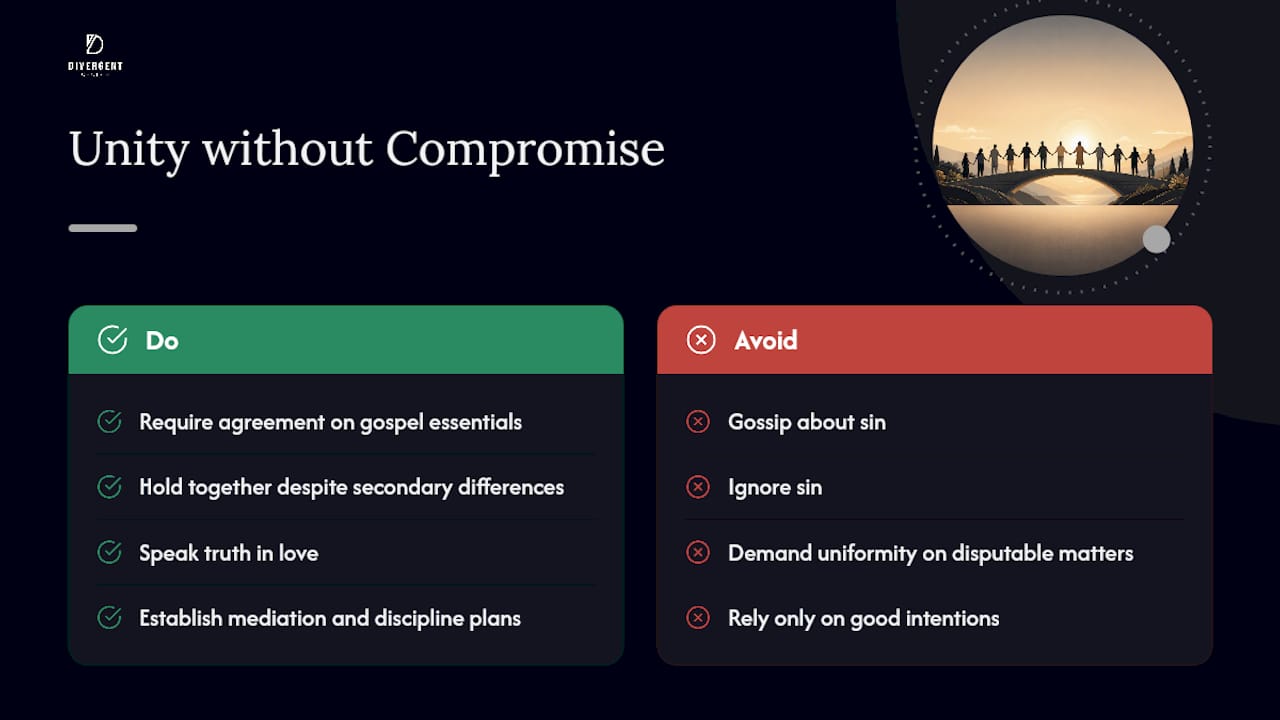
Not if you define fellowship boundaries carefully. Unity was never meant to erase disagreement over genuinely important matters. It was meant to hold believers together despite secondary differences while still requiring agreement on the gospel itself.
The pastoral path here involves patient truth-telling rather than avoidance. Ephesians 4:15 calls believers to speak “the truth in love,” not truth instead of love or love instead of truth. Matthew 18 gives a structured process for addressing sin directly rather than gossiping about it or ignoring it. Romans 14 to 15 shows Paul working hard to help believers with different convictions on disputable matters bear with one another without demanding uniformity.
True unity, as Baptist News Global frames it, bears with others while still upholding the gospel essentials that make the church the church.
Mediation and agreed processes for discipline matter more than good intentions here. A church that has no plan for handling disagreement will handle it badly when it arrives.
How Divergent Church puts unity into practice
Divergent Church in Canberra has worked at unity through its Life Communities, small discipleship groups that regularly partner with other local ministries rather than operating in isolation. Rather than duplicating every outreach effort internally, the church has looked for ways its groups can serve alongside other congregations and community partners on shared projects, from practical mercy work to combined events that bring people from different church backgrounds into the same room.
The pattern is straightforward enough for any church or small group to copy:
Identify one shared need in your local area that no single group can meet alone
Reach out to a nearby congregation or ministry already working on it
Commit to a fixed period of joint effort, then review what worked before committing further
Unity does not require merging identities. It requires enough humility to work alongside people who do church differently than you do.
This reflects Divergent Church’s broader approach: a Bible-first community shaped by discipleship, grounded in Canberra’s neighbourhoods and universities, rather than a Sunday-only gathering.
Take the next step toward real unity
Reading about unity and practising it are different things. If your own spiritual life or your church community feels more isolated than connected, the fastest way to change that is joining a group of people already doing the work of showing up for one another. Divergent Church’s Life Communities exist for exactly this: small groups where humility, forgiveness and shared mission get practised weekly, not just discussed.
If you lead a team or a ministry and want to grow gospel-shaped cooperation rather than competition, the LEAD LIKE JESUS programme works through what servant leadership looks like in practice. And if you are further back in the process, still working out what discipleship even means for your life, the Discipleship Hub is the place to start.
What the church keeps getting wrong about unity
Most churches treat unity as a feeling to protect rather than a practice to build. That is backwards, and it explains why so many congregations either avoid conflict entirely or split at the first sign of it. Real unity survives disagreement because it was never built on the absence of disagreement in the first place.
The conventional advice, “just get along,” undersells what Scripture actually asks for. John 17 does not ask for a pleasant atmosphere. It asks for a costly, visible oneness that outsiders notice. That requires humility most churches practise inconsistently at best.
If you take one thing from this, prioritise the relationships over the programs. Joint prayer with a congregation unlike your own will do more for your church’s unity than another internal strategy meeting ever will. Start there, not with a five-year plan.
Sources
FAQ
Why does Christian unity matter for the church’s witness? Jesus linked visible unity among believers directly to the world’s ability to believe the gospel in John 17:21. A fractured church undermines its own message before it says a word.
What is the biblical basis for Christian unity? The clearest texts are John 17:21 to 23, Ephesians 4:1 to 3, Romans 15:5 to 6 and 1 Corinthians 12, which together describe unity as both a gift from God and a responsibility believers must actively maintain.
Is Christian unity the same as uniformity? No. 1 Corinthians 12 explicitly builds unity out of difference, comparing the church to a body with distinct parts. Pressuring everyone toward sameness contradicts the passage’s own logic.
When is it biblically appropriate to separate rather than pursue unity? Matthew 18 and 1 Corinthians 5 describe situations involving unrepentant sin or persistent false teaching where separation protects the church’s integrity rather than undermining unity.
What role does the Holy Spirit play in Christian unity? Ephesians 4:3 describes unity as something the Spirit creates that believers are called to maintain, not something they manufacture through effort alone. The Spirit’s work through diverse gifts, as 1 Corinthians 12 describes, is what makes unity function in practice.
How can a local church start practising unity this month? Begin with one shared project alongside another congregation or ministry, whether that’s joint prayer, a mercy initiative, or a combined event, and commit to reviewing what worked before scaling further.
Recommended
Comments