
The Bible Storyline: An Overview from Genesis to Revelation


The Bible is one story told across many books: God creates a good world, human rebellion fractures it, God works through a chosen people and finally through Jesus to rescue it, and the story ends with creation renewed and God living among his people. Christians often name this movement creation, fall, redemption and restoration. This overview walks through it from Genesis to Revelation, so the famous stories you already know have a place to sit.
TL;DR
The Bible’s storyline is commonly summarised as creation, fall, redemption and restoration, with Jesus at the centre.
The Bible is a library of 66 books grouped by style of writing, so the order on the page is not always the order of events.
The story runs in stages: creation and fall, Abraham, Exodus and law, the kings, exile and the prophets, Jesus, the church, and the new creation.
Reading any passage against the big story, one chapter at a time, makes the Bible far easier to follow.
Table of Contents
How the Bible is put together
Before tracing the plot, it helps to know what you are holding. The Bible is a library in two sections, the Old Testament and the New Testament. A BBC overview of the Christian Bible counts 39 books in the Hebrew Bible and 27 in the New Testament.
The books are not stacked in the order things happened. The Bible Society’s course manual describes the Bible as a library rather than a one-volume chronological history, because the books are grouped by style of writing. That is why the Psalms sit in the middle and the prophets come near the end of the Old Testament, even though many of them spoke during the history told earlier.
One common grouping of the Old Testament, set out in a Bible Society UK guide to how the Bible is arranged, is Law, History, Poetry and Wisdom, and Prophets. The New Testament is grouped as the Gospels, Acts, Letters and Revelation. Keep these shelves in mind. Each one contributes to a single plot.
The story in four movements
The simplest way to hold the whole Bible in your head is four words. Christian Schools Australia’s God’s Big Story playbook uses exactly this framework, and The Gospel Coalition Australia describes the gospel as appearing in the same shape.
Creation. God makes an ordered, purposeful world, and humans bear his image.
Fall. Sin distorts and breaks what God made, and relationship with him is fractured.
Redemption. God acts to rescue, through covenant, through Israel and finally through Jesus.
Restoration. God renews all things and dwells with his people.
Almost every good story has a beginning, a crisis, a climax and a resolution. The Bible does too. The crisis arrives early, in Genesis 3, and the rest of the book is the answer to it.
From creation to the fall (Genesis 1 to 11)
The Bible opens with a good world. Genesis 1 presents God speaking an ordered creation into being, with humanity made in his image and placed in a garden to live in his presence and care for the earth. There is no threat in the opening pages, only generosity and purpose.
Then comes the break. In Genesis 3 the first humans doubt God’s word and take what he forbade. The consequences spread quickly: shame, blame, exile from the garden, then violence in Cain and Abel, and by Genesis 6 to 11 a world so corrupted that the flood and the scattering at Babel are needed to restrain it. The question hanging over the rest of Scripture is simple: how will God repair what has been broken?
Abraham, Moses and the shape of a promise (Genesis 12 to Deuteronomy)
God’s answer begins with one person. In Genesis 12 he calls Abraham and promises that his family will become a nation and that through them all peoples on earth will be blessed. This is the hinge of the Old Testament. Israel is not chosen to hoard God’s favour but to carry his blessing to the world.
The rest of the first five books follow the promise through danger. Abraham’s descendants end up enslaved in Egypt. In the Exodus, God rescues them, and the Passover becomes the pattern of rescue by sacrifice that the New Testament later picks up. At Sinai he gives the law and forms them into a covenant people, with the tabernacle as a sign that he intends to live among them again.
The Australian Bible Overview course from Ridley College frames this stage as Abraham, Moses, Exodus and law, which is a handy way to remember it.
Land, kings and the divided kingdom (Joshua to 2 Chronicles)
The books of history carry Israel into the promised land and through a turbulent era of judges. Then the people ask for a king. Saul fails, David is chosen, and God promises David a son whose kingdom will last forever. That promise matters enormously later, because the New Testament opens by presenting Jesus as David’s heir.
Solomon builds the temple, but after him the kingdom splits in two. King after king leads the people away from the God who rescued them. The same cycle repeats: idolatry, injustice, warning, and a failure to listen. The monarchy shows that even good human kings cannot fix the problem Genesis 3 introduced.
Exile and the prophets
The prophets speak into that failure. They call Israel back to covenant faithfulness, they announce judgment, and they also keep hope alive. Assyria and then Babylon overrun the land, the temple is destroyed and the people are carried into exile. It looks as though the story has collapsed.
Yet this is where the most hopeful promises appear. The prophets look ahead to a king from David’s line, a servant who suffers for others, a new covenant written on hearts, and eventually a new heaven and a new earth. Ridley’s course describes this stage as the divided kingdom and the prophets, and The Faith Homeschool course follows the same arc through exile and prophetic hope. The Old Testament ends unfinished on purpose. It leans forward, waiting.
Jesus at the centre (the Gospels)
The New Testament opens with the answer to that waiting. Matthew, Mark, Luke and John each announce that God’s reign has arrived in Jesus. According to BibleProject’s explanation of the Gospels, they weave in Old Testament Scripture and present his crucifixion and resurrection as the climax of the biblical narrative.
This is the turning point of the whole story. Jesus is the true image of God, the faithful Israelite, the promised king, the sacrifice that the Passover pointed to. In his death he takes on himself the consequences of the fall, and in his resurrection he shows that death does not have the last word. The Gospel Coalition Australia lists what the resurrection means: Jesus is Lord, God is just, God’s plan for history will succeed and death is defeated.
Vern Poythress, in a theological overview of how the Testaments relate, puts Christ’s coming at the centre of history: the Old Testament anticipates redemption, and the New explains his life, death, resurrection, ascension and reign. If you want to read one Gospel first, our overview of the Gospel of John explains its structure, themes and purpose.

The church and its mission (Acts and the Letters)
The story does not stop at the empty tomb. In Acts, the risen Jesus sends his Spirit, and a small group of believers begins carrying the good news from Jerusalem outward to Jews and Gentiles alike. This is the promise to Abraham coming true: blessing reaching all nations. We have written a summary of the Book of Acts and the early church’s mission if you want the detail.
The Letters, from Paul, Peter, John and others, are written to real congregations facing real problems. They explain what Jesus has done and how to live under his rule while waiting for the end. Ridley’s course calls this stage life under the King. Christian Schools Australia describes Christian life as lived between present brokenness and the future new creation, where healing and renewal are complete at Christ’s return. That is where we live now.
Revelation and the new creation
Revelation is the last book and the least understood, but its purpose in the storyline is clear. BibleProject’s reading of Revelation 21 to 22 sees the reunion of heaven and earth: God makes all things new, dwells with humanity, and restores the tree of life.
The ESV Global Study Bible shows how neatly the Bible is bookended. In its notes on the bookends of biblical theology, the enemies that entered the story in Genesis 3, Satan, death and evil, are removed in Revelation 20, and the closing chapters take creation beyond Eden to a world fully ordered and holy. A companion note on the global message of Revelation sets Genesis 1:1 beside Revelation 21:1 and Genesis 3:8 beside Revelation 21:3, to show Eden restored.
The passage most Christians return to is Revelation 21:3 to 4, where God dwells with humanity and wipes away every tear. The Gospel Coalition Australia notes that the Apostles’ Creed, like the Bible, begins with creation and ends with the world to come.

The same story, mapped by theme
The storyline is more than a sequence of events. Themes thread through it and tie the Testaments together. Alan Thompson of Sydney Missionary and Bible College identifies nine themes that unite the Old and New Testaments, and the table below sets them against the story you have just read.
Theme | Where it starts | Where it lands |
Creation | Genesis 1 to 2: a good world | Revelation 21 to 22: a new creation |
Covenant | God’s promise to Abraham | The new covenant in Christ |
Exodus | Rescue from Egypt | Rescue from sin and death through Jesus |
Law and wisdom | Sinai, Proverbs | Christ as the wisdom and fulfilment of the law |
Sacrifice | The Passover and the tabernacle | The cross |
Kingship | David and his promised heir | Jesus enthroned as King |
Prophetic hope | Isaiah, Jeremiah, Ezekiel | Fulfilment in Christ and his return |
Kingdom of God | God’s rule over his people | God’s rule over all things |
Holy city | Eden, Jerusalem, the temple | The New Jerusalem |
The same guide aims to help readers read the Old Testament in light of the New, and the New in light of the Old. We have a fuller reflection on the fifth-to-last row in explaining the kingdom of God. Followers of Jesus have long noticed how these themes recur across the books and across the centuries, and the same recurring themes across Scripture can be heard in the songs and lyrics that people write in response.
Our perspective
We read the Bible as one story that is still being lived, and that changes how we gather as a church. If the story is creation, fall, redemption and restoration, then a Christian community is not a Sunday event. It is a people formed by Scripture, centred on Jesus, and sent into the ordinary rhythms of a city. In Canberra that means universities, workplaces, neighbourhoods and a population that is always moving. Students arrive, public servants are posted, families come and go. We believe the big story is good news for each of them, and that it is best understood in honest conversation and shared life rather than in isolation. The bookends of Genesis and Revelation give us our hope. God began with people living in his presence, and he will finish the same way. In between, our task is to follow Jesus as disciples, to plant seeds, and to build the Church with patience. That is why we are as interested in how you live Monday to Saturday as in whether you attend on Sunday. Jay
Reading the Bible with the big story in mind
Knowing the storyline is useful only if it helps you read. A few habits make the difference.
Ask where you are in the story. For any passage, ask whether you are in creation, fall, redemption or restoration, and which stage of the story it belongs to.
Read in small, regular portions. One chapter a day adds up. Our guide to how to read the Bible for beginners suggests a place to begin.
Read the Old Testament through Jesus. The Old Testament makes more sense when you know where it is heading, and the New makes more sense when you know what it grew out of.
Read with others. A conversation around a table clears up what a private reading leaves puzzling. If you would like to host one, our practical guide to leading a Bible study is a good start.
Keep going into practice. The story invites a response. The Discipleship Hub gathers our material on following Jesus in everyday life, and our piece on the role of discipleship in church shows how reading and living fit together.
If you want to study the whole sweep in a structured way, Ridley College says its Bible Overview is designed to help learners grasp the big story and make better sense of Bible readings heard at church or read devotionally. Many Christians find that kind of study opens up the Sunday sermon and personal reading alike.
Join us in Canberra
We are a church in Canberra that wants to help you find real Christian community, ask honest questions and grow in faith, whether you have read the Bible for decades or have never opened one. Come and meet us through the Divergent Church home page.
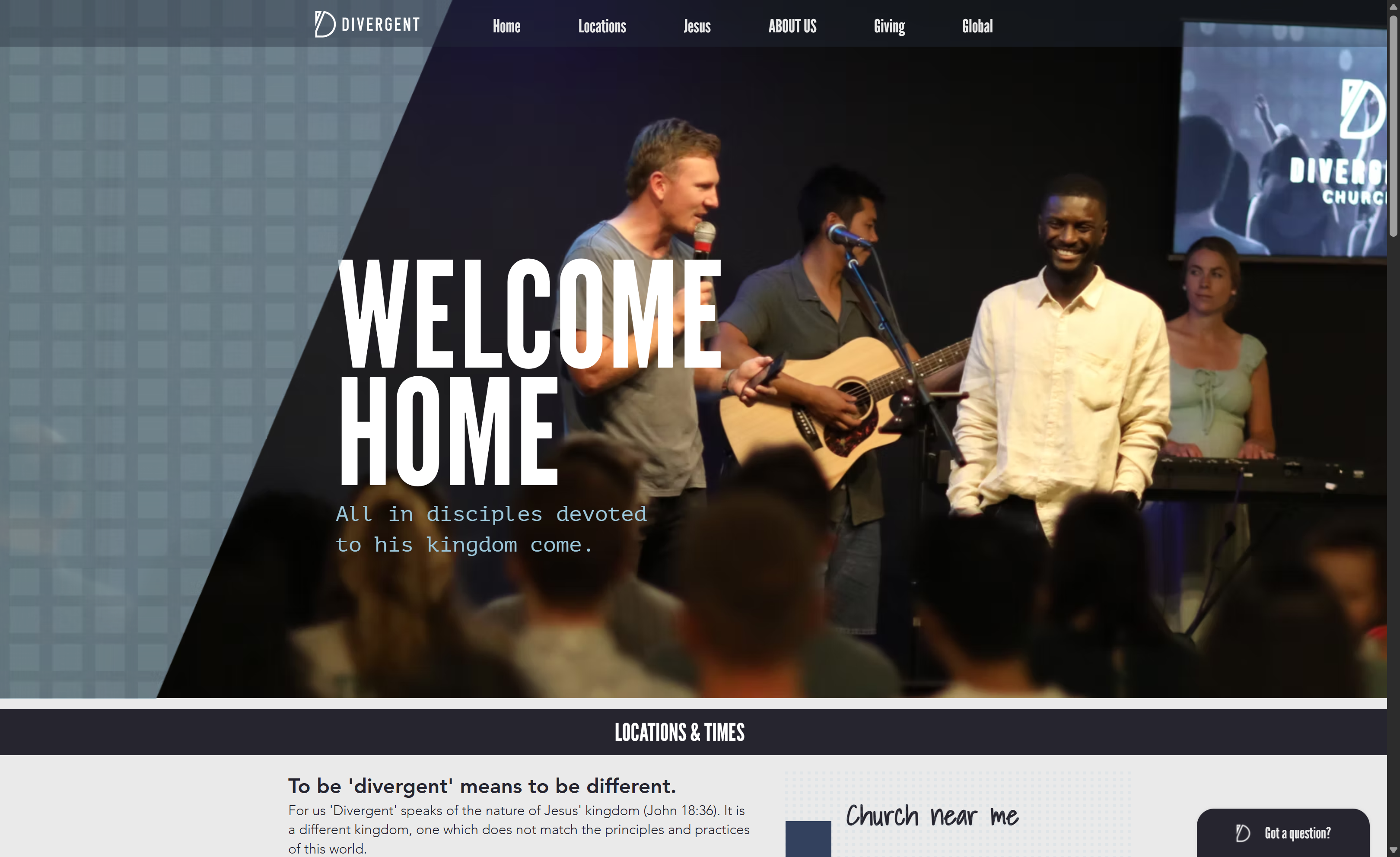
If you are gathering a Bible study group, seminar or community event in the city, our spaces are available to book. The Auditorium is $70 per hour, the Seminar Room is $50 per hour and the Board Room is $25 per hour. You can see the options and book a room online, or look at our function and events centre in Canberra City.
FAQ
What is the main storyline of the Bible?
The main storyline is God’s rescue of a broken world. Christians often summarise it as creation, fall, redemption and restoration. God makes a good world, sin spoils it, God redeems through Israel and supremely through Jesus, and Revelation ends with a renewed creation where God lives with his people.
What is the Bible’s metanarrative?
A metanarrative is the overarching story that gives the smaller stories their meaning. For the Bible, The Gospel Coalition Australia describes it as a single basic plot-line of God’s story of redemption, climaxing in Jesus Christ. The four movements above are the usual way to describe it.
Why isn’t the Bible in chronological order?
Because it is a library of books grouped by style of writing, not a single history. Poetry, wisdom, prophecy, Gospels and letters each sit together. That means the Psalms and the prophets have to be placed back into the historical timeline when you read for the story.
Where should I start if I have never read the Bible?
Many people begin with one of the Gospels, such as Mark or John, to meet Jesus first, and then work back into Genesis and forward into Acts. A steady habit of one chapter a day works better than trying to read long stretches. Reading with a friend or a small group helps too.
Sources
Recommended
Comments