
City on a Hill Meaning: What Jesus Meant in Matthew 5:14


When Jesus says a city on a hill cannot be hidden, he is describing his followers as a visible community. Together they show what God’s kingdom looks like and point people to God. It is not a boast and not a slogan. It is a description of what happens when people live as disciples in plain view of their neighbours.
The phrase has travelled a long way from a hillside in Galilee. It has been used in sermons, in political speeches and on t-shirts. Here we go back to the source, look at what the first listeners would have heard, and ask what it means for people trying to follow Jesus in a city like Canberra.
TL;DR
“A city set on a hill” is in Matthew 5:14, part of the Sermon on the Mount, straight after Jesus calls his followers “the light of the world”.
The image echoes the prophet Isaiah, where God’s light shines from Jerusalem to the nations. Jesus applies it to his disciples.
The “you” is plural. The picture is of a community living visibly, not only of individual believers.
Its purpose is to point people to God through good works, never to draw attention to ourselves.
It is not the same as John Winthrop’s 1630 use of the phrase for a colony, which shifted the emphasis.
Table of Contents
Where Jesus says it, and why the setting matters
The words appear in Matthew 5:14, in the translation used by the US Catholic bishops: “You are the light of the world. A city set on a mountain cannot be hidden.” Other translations say “hill”, which is the form most of us know.
This sits inside the Sermon on the Mount, which runs from Matthew 5 to 7. According to the Catholic Education Commission’s commentary on Matthew 5:13–16, the passage comes after the Beatitudes and sets out what it means to be a disciple, with the attitudes and actions that bring about the kingdom of God.
The order is worth noticing. Jesus does not begin with instructions. He begins with blessing: the poor in spirit, the merciful, the peacemakers. Then he turns to the same people and says, in effect, that they are salt and light. The identity comes first. The visibility follows from who they already are.
If you want to sit with the whole sermon rather than one verse, our own study prompts in Make the Sermon on the Mount change you are a good next step.
What the image meant to the first listeners
Jesus was speaking to ordinary people, many of them far from the capital. Yet every one of them knew what a hilltop city looked like. The commentary notes that Jerusalem sits on a high ridge, so anyone travelling there had to go up to enter it, and it could be seen from the surrounding valleys.
There is a practical layer too. Study Bible notes point out that cities in ancient Israel were often built on elevated ground for defence, which made them visible from a distance. Another historical note adds that first-century hilltop settlements such as Gamla, Safed and Nazareth glowed after sundown with the oil-lamps of homes and watch-towers.
So the picture is simple and physical. At night, a lit town on a ridge is unmistakable. You do not have to argue that it is there. Nobody lights a town and then tries to conceal it.
More than scenery
The image also carries the weight of the temple. The Bible Project explains that Jesus is pointing to God’s light and presence shining from its dwelling place in the temple in Jerusalem, a city on a hill. His audience was, in their own eyes, a ragtag group. Yet he tells them that they are God’s salt, light and city. They are the blessed ones, the new Jerusalem that will display God’s kingdom to the world.
That is a startling claim for a crowd on a hillside. It is also the heart of the verse.
How “city on a hill” and “light of the world” belong together
Many readers arrive here also asking what “light of the world” means, and the two phrases are really one thought. Jesus says both in the same breath.
The Catholic Education Commission notes that the light image comes from Isaiah 42:6, where Israel, as a covenant people, is called to be a light to the world. Disciples’ good works function like a lamp, revealing God and leading others to him.
The Bible Project adds that Jesus draws on Isaiah’s vision of God’s reign touching down in Jerusalem, high on a hill, with its light reaching the nations, who learn God’s ways and live in peace. By taking up these images, Jesus applies Isaiah’s prophecies to himself and to his followers.
The NIV Application Commentary puts it this way: the disciples are a living demonstration of the arrival of the kingdom of heaven. The light is not only carried by them. They are that light. It also suggests the city may well be Jerusalem on Mount Zion, since Israel was seen as a light to the world, with passages such as Isaiah 2:2–5 and 49:6 in the background.
One honest note: scholars are not unanimous. There is a fairly sudden shift from salt to city, and scholars are divided on whether this is a specific reference to a New Jerusalem. What every reading shares is the main point: God’s light is meant to be seen.

Is it about you, or about us?
It is natural to read this verse as a personal pep talk. Be bold, be visible, shine. There is truth in that. But the grammar pushes us further.
The “you” in Matthew 5:14 is plural. A historical-context study notes that this plural points to a corporate identity: the Messiah’s community is collectively called to radiate God’s truth to the nations. One commentator on the passage argues that the calling to visibility is first of all communal, addressed to a community of disciples rather than isolated individuals.
Think about the image again. A single lamp in a window is a good thing. A hilltop town is a different thing altogether: many homes, many lamps, one shared glow. No single household makes the city. The city is what they are together.
This does not erase personal responsibility. A commentary on the passage reminds us that the Spirit of the Light of the world lives in believers, and each of us still faces the daily choice of whether to shine or to shy away. Both are true. We shine as persons, and we are a city as a people.

For a closer look at what shared life actually involves, see our guide Explaining Christian community.
What it asks of us in daily life
Jesus is specific about how the light shows. In the verse that follows, he speaks of good works that lead others to glorify the Father. The Catholic Education Commission explains that discipleship is not meant to be a private belief: disciples are to act so their influence is felt in the world, with good works as practical expressions of the kingdom.
The same commentary says the three images of salt, light and city still speak today. Disciples are outward looking, and it is through living the Beatitudes that they become salt and light. They are not to retreat from the world but to be part of it, showing through their lives what the kingdom of God makes possible.
In practice, this looks unspectacular:
Honest work. Doing your job well, for the people in front of you and not only for the boss.
Open homes. Making a table available to a flatmate, a new colleague or a student far from family.
Mercy. Showing up for a neighbour in a hard season without making it a performance.
Peacemaking. Choosing the slower, humbler way in conflict.
Plain words about Jesus. Answering a sincere question with sincerity.
The USCCB study note makes the same point sharply: by their deeds the disciples are to influence the world for good, and they can no more escape notice than a city on a mountain.
Visibility without vanity
The aim is never self-promotion. A study Bible note observes that the visibility of believers is not for self-glorification but to draw others to God. The light is borrowed. The city does not make the sun rise.
That is why this verse brings humility and courage together. Humility, because the glory is God’s. Courage, because hiding the lamp is also disobedience. This outward turn is also the heart of Jesus’ final commission, which you can explore in this piece on the Great Commission meaning.
If you are asking how this grows over time, our posts on kingdom living and the role of discipleship in church walk through it step by step.
Winthrop, America and later uses of the phrase
Many people first met “a city on a hill” in politics, not Scripture. That is why one of the questions people ask is what John Winthrop meant.
Winthrop’s sermon “A Model of Christian Charity” was delivered in 1630, around the time the Arbella sailed from England to North America. He compared the colony to a city on a hill, referring to Matthew 5:14, and later uses of the image for the United States have almost always dropped its original meaning and context.
A historian writing for the Gospel Coalition observes that Winthrop emphasised the colony’s identity more than its mission and gave a warning about scrutiny and failure, rather than expounding the Sermon on the Mount.
The history is more tangled than most speeches suggest. Writing in Christianity Today, Abram Van Engen explains that in the 1600s it was Roman Catholics, not Puritans, who loved the phrase most, using Matthew 5:14 to argue that the Catholic Church was the only visible church. Protestants such as Winthrop countered that the image applied locally, wherever the light of the gospel shone. That is how it came to be reapplied to congregations, towns, cities and eventually a nation.
The lesson is a gentle one. When a phrase is attached to a nation, a movement or a brand, it can start to mean “look how special we are”. In Matthew, it means the opposite: look at God, whose light is shining through ordinary people.
What this looks like for a city like Canberra
Canberra is a city of universities, public service offices, embassies and neighbourhoods, with many people arriving and leaving within a few years. In a place like that, a “city on a hill” is not a building on Red Hill. It is a people scattered across suburbs and workplaces, recognisable by how they treat others.
That shapes how we think about church. Visibility is not a performance on Sunday mornings. It is whether the newcomer finds a table, whether the student finds a friend, whether the honest sceptic finds someone who will take the question seriously. Our post What is church supposed to be? explains the vision behind this.
Our perspective
We are asked often what it means to be a city on a hill, and our answer is always a little different from what people expect. We do not think it is about being impressive. We think it is about being present. Jesus spoke these words to a hillside crowd who were nobody by the world’s measure, and he called them the light of the world. That still moves us. The kingdom is not carried by the powerful. It is carried by disciples who have been blessed, and who then live out that blessing in public view, in the rhythms of work, study, family and friendship. This is why Divergent Church exists as more than a Sunday gathering. We are committed to forming disciples of Jesus and to building authentic, missional community in the life of Canberra and Queanbeyan. Our city is full of universities, workplaces, neighbourhoods and people who are new here. Those are the places where a lamp ought to be on a stand. A lit city is made of many homes, and so we put our energy into relationships, shared tables and honest conversation about Scripture and faith. We also believe the seeker belongs in this picture. You do not have to have it all worked out to ask what the light is for. If you are curious, doubtful or simply new, you are welcome among us to ask, to listen and to look at Jesus for yourself. The city on a hill is not our achievement. It is his light, shining through a people who have said yes to him. We would love to walk that road with you. Josh
Come and see for yourself
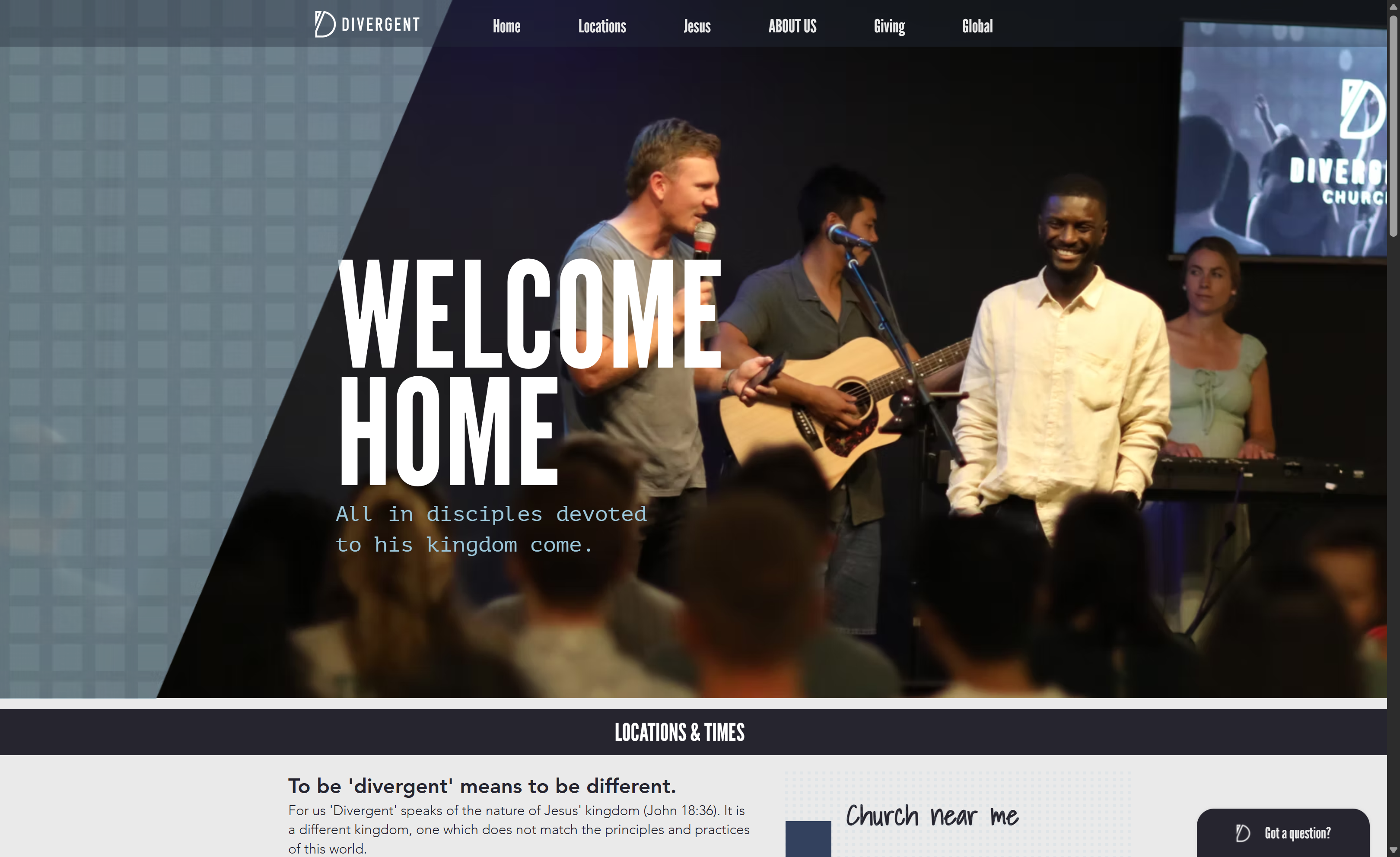
If this has stirred a question or a longing for real community, we would be glad to meet you. Start at Divergent Church to learn who we are and how to connect with us in Canberra.
We also open our spaces to the wider city. Our venue in Canberra City is available to book online, with the Auditorium at $70 per hour, the Seminar Room at $50 per hour and the Board Room at $25 per hour. You can see the options and book on our venue booking page, or read about the Function and Events Centre.
FAQ
What does “a city on a hill” mean in the Bible?
It appears in Matthew 5:14, where Jesus tells his followers that a city set on a hill cannot be hidden. It points to a community that lives out his teaching so visibly that others see God through it. The image draws on Jerusalem and on Isaiah’s picture of God’s light reaching the nations.
What does “light of the world” mean in this passage?
Jesus says it of his disciples in the same sentence as the city. It echoes Isaiah 42:6, where God’s people are called to be a light to the nations. Their good works act like a lamp that reveals God and leads others to him.
Is the city on a hill about one person or a whole church?
Both, but the emphasis is communal. The “you” in Matthew 5:14 is plural, so Jesus addresses a community of disciples. Each believer still chooses daily to shine, yet the picture is a city made of many lamps.
Did John Winthrop mean the same thing as Jesus?
Winthrop, in his 1630 sermon, used the phrase for a colony and its identity, and stressed that it would be watched and judged. Jesus was describing disciples and their witness to God. Later political uses of the phrase have mostly left the original context behind.
How can a Christian be a city on a hill without being proud?
By remembering the light is God’s, not ours. Jesus ties it to good works that lead people to glorify the Father. In everyday terms, that means honest work, hospitality, mercy and humble, sincere answers to people’s questions.
Sources
Recommended
Comments