
Anxious About Going to Church? Help for Your First Step


If your chest tightens at the thought of walking into a church, you are not broken and you are not faithless. Anxiety about church is common, it has understandable causes, and it can be met with prayer, practical preparation, honest community and, where it is affecting daily life, a visit to your doctor. You do not need to feel calm before you come. Christ invites the weary and the worried as they are.
We are Divergent Church in Canberra, and we write this for the person who has typed their fear into a search bar because they want to come, or want to come back, and cannot quite make themselves do it. This guide gives you the reasons it happens, a plan for the day itself, a way to think about faith and anxiety together, and the Australian support lines worth saving in your phone.
TL;DR
Feeling nervous about church is normal and is not a sign of weak faith. Scripture speaks plainly about fear and worry, and Jesus meets people in them.
The usual triggers are crowds, being watched, greeting strangers and not knowing what happens next. Each one can be softened with preparation.
Start small: check the church’s website, arrive early, sit where you feel safe, bring someone you trust, and let yourself leave if you need to.
If anxiety is affecting your sleep, work, study or relationships, see your GP. Lifeline (13 11 14) and Beyond Blue (1300 22 4636) are there at any hour.
A church worth belonging to is a community that walks with you across the week, not only a room you sit in on Sunday.
Table of Contents
Why church can feel frightening
Most people expect anxiety in a job interview or a crowded train. Fewer expect it in a place that is meant to be about welcome. Yet church asks a good deal of a nervous person all at once: walk into a room of people who seem to know each other, find a seat, sing in public, greet strangers, and perhaps be noticed as the new face.
Research on the barriers to church involvement points to the same thing. Writing in Outreach Magazine, Stephen Grcevich notes that people with social anxiety may fear being judged on what they say or how they look, and that full participation in church involves vulnerability and social risk. That describes the experience many Canberra newcomers have described to us in different words: Will I say the wrong thing? Will they see that I am struggling?
The triggers tend to fall into a few groups:
The room. Crowds, loud music, bright lights, microphones, not knowing where to sit or where the exits are.
The people. Small talk, a greeting time, questions about who you are and what brought you here.
The past. Some people carry memories of a church that was harsh, conditional or controlling. The body remembers, and it can react to a church building before the mind has decided anything.
The unknown. When you cannot picture what will happen, the mind fills the gap with worst cases.
A body that is bracing for danger will produce a racing heart, shaking, sweating and a sense of being trapped. These are the signs of a nervous system on alert. They are uncomfortable, and they are not a verdict on your character or your standing before God.
Anxiety is not the same as unbelief
Many Christians quietly add a second burden to the first: If my faith were stronger, I would not feel this. Scripture does not teach that. The Bible is full of people who were afraid, and the Lord’s response is consistently nearness, not rebuke.
“Do not fear, for I am with you,” God says through Isaiah (Isaiah 41:10). Paul writes, “Do not be anxious about anything, but in everything by prayer and supplication with thanksgiving let your requests be made known to God” (Philippians 4:6). Peter tells us to cast all our anxiety on Christ, “because he cares for you” (1 Peter 5:7). Notice what these verses assume: that we do have anxieties, and that they are to be brought to someone. The command is not to be fearless on our own strength. It is to bring the fear to the One who is able to carry it.
This matters for how you approach a Sunday. You are not required to arrive serene. You are invited to arrive honestly. The Christian life is not a performance of calm; it is a life of dependence on Jesus, and anxious people are as welcome in that life as anyone else.
There is also a gentle truth here about the body. God made us embodied, and the body can get stuck on high alert after stress, grief or hard experiences. Recognising that is not a lack of trust in God. It is the same honesty that leads a person to see a doctor for a broken arm and to pray for healing at the same time.
We would add one caution of our own. Prayer, Scripture and the fellowship of the church are not tools for managing your mood or improving yourself. They are how we come to know and follow Jesus, who is Lord of our fears. Peace is a fruit of that relationship, and sometimes it arrives slowly. In the meantime, you are held.

Before you go: preparing so the unknown shrinks
Uncertainty feeds anxiety, so the most useful thing you can do is make the visit more predictable. None of these steps is a test you must pass. Use what helps.
Learn what to expect
Look at the church’s website and social media. Find the service time, how long it runs, whether there is a children’s program, what people wear and where to park. A few minutes of reading can remove half the questions your mind would otherwise invent. If you are in Canberra and want to know what a first visit looks like with us, our church newcomer guide walks through it.
Tell someone you trust
A friend, flatmate or family member who knows you are nervous can sit beside you, or simply text you afterwards. If you have no one yet, that is common in a city like Canberra, where so many of us arrive for university, a posting or work and leave family behind. Say so when you arrive. Christian community exists precisely so that nobody has to do this alone.
Pray honestly
You do not need polished words. “Lord, I am afraid, and I want to be there. Help me” is a real prayer. Some people find a short sentence, repeated slowly with the breath, steadies them on the way in the door. Scripture itself gives us the sentence: “Cast all your anxiety on him.”
Decide your exit in advance
Tell yourself, and anyone with you, that it is fine to step outside for a few minutes, or to leave after the first half. Knowing the door is open often makes it easier to stay. Panic typically rises and passes; giving yourself permission to step out and breathe is not failure.
On the day: a gentle plan
Arrive a little early. Ten to fifteen minutes before the start lets you see the room while it is quiet, choose a seat and settle before it fills.
Sit where you feel safe. Near the back, on an aisle or close to a door is perfectly reasonable. Nobody is grading your seat.
Keep greetings simple. A smile and your first name is enough. You are not obliged to share your story or sign up for anything.
Let the body settle. Feel your feet on the floor, notice the temperature of the room, breathe out longer than you breathe in. If you are singing, follow the words on the screen and sing as quietly as you need to.
Listen for Jesus, not for yourself. The point of the gathering is to hear the word and to meet God together. When your attention turns to what others think of you, turn it again, gently, to Christ.
Stay for as long as you can, and no longer than that. Thirty minutes this week and the full service next week is a perfectly good beginning.
Reflect afterwards. What was easier than you feared? What was harder? Pray about both, and tell a trusted person.
If the whole service feels like too much, build up in steps. Some people begin by watching a service online, then come for part of a gathering, then stay for a cuppa, then speak to one person, then join a smaller group. Small groups are often where anxious people find it easiest to be known, because a living room is quieter than an auditorium. If this is the kind of step you are weighing, our step-by-step guide to church involvement in Canberra lays out how people move from first visit to belonging.
If you are an introvert, a young adult, or coming back after time away
Not every nervous person is nervous for the same reason, and a few situations deserve their own mention.
You are quiet by nature. Being an introvert is not a spiritual deficiency. The church is a body with many members, and quiet people hold it together in ways that rarely get applause. See our piece on church for introverts in Canberra.
You are a student or new to the city. Loneliness and anxiety often travel together at this stage of life. Our reflections on church as a young adult are written with that season in mind.
You have been away, or were hurt by a church. The fear of being judged for the gap, or of meeting the same harshness again, is real. Can I come back to church? answers it directly: yes, and here is how.
You are wrestling with doubt. Anxiety and unanswered questions often sit side by side. Doubt is not the end of faith; it can be the beginning of a deeper one, as we explain in our six-week plan for turning doubt into stronger faith.
When anxiety needs more than a good Sunday plan
Prayer and Christian community matter, and so does medical care. They are not rivals. If your anxiety is more than occasional nerves, please speak to a professional, and do so without guilt.
The Australian Government’s healthdirect service advises that if anxiety symptoms are affecting your everyday life, you should talk to your doctor or a mental health professional. It notes that treatment can include lifestyle changes, psychological therapy and, for some people, medicines. Signs that it is time include:
avoiding church, work, study or social events because of fear
panic attacks, or fear of having one
trouble sleeping, constant dread or physical symptoms that will not ease
anxiety that has lasted weeks or months and is getting worse
The Australian Mental Health Institute describes a range of approaches for social anxiety, including breathing and grounding skills, counselling such as cognitive behavioural therapy (CBT), gradual exposure to feared situations, and attention to sleep and regular social contact, with medication used alongside counselling or psychological support. CBT, which helps a person identify and challenge unhelpful patterns of thinking, is also described by Grcevich as the most common evidence-based treatment for anxiety disorders. A GP can assess you, and in Australia can prepare a mental health treatment plan that may make psychology sessions more affordable.
Numbers worth saving
Service | Who it is for | Contact |
Lifeline | Anyone, 24 hours, with text and chat options | 13 11 14 |
Beyond Blue | Anyone dealing with anxiety or depression | 1300 22 4636 |
Medicare Mental Health | Information on local services | 1800 595 212 |
Kids Helpline | Ages 5 to 25, 24/7 | 1800 551 800 |
headspace | Ages 12 to 25 | 1800 650 890 |
Emergency | Immediate danger | 000 |
The first three numbers appear on healthdirect’s anxiety page. The Queensland Government’s guide to getting help confirms Medicare Mental Health, GPs, psychologists, headspace and 000 as the main pathways, and the Royal Children’s Hospital lists the Kids Helpline and headspace details for young people. If you are in immediate danger or thinking of harming yourself, call 000 or go to the nearest emergency department.
If you are a parent of a teenager who is anxious about church or life more broadly, our post on youth mental health and Canberra churches and our guide to church and mental health speak to that.
Perspective: what a church owes an anxious person
We have sat with many people in Canberra who told us, quietly, that they had wanted to come for months. Some were students far from home. Some were new to the city. Some had been wounded in a church before. Almost all of them were afraid they would be seen as a problem. Here is what we believe. The church is not a venue and you are not an audience. The church is the family of God, gathered around Jesus, and a family does not ask you to be well before you sit at the table. Scripture tells us to bear one another’s burdens (Galatians 6:2), and that is not a slogan for Sundays only. It is the shape of a life together. That is why we do not think of discipleship as turning up to a service. We are a community shaped by Scripture, centred on Jesus and lived out in the ordinary rhythms of this city: its universities, workplaces and neighbourhoods. If anxiety makes a crowded room hard, we want to be the people you can meet over a coffee, in a home, in the middle of the week, where being known is possible. Mission and community are not optional extras for us. They are what the church is. We also hold, without apology, that Jesus Christ is the answer to the deepest fear the human heart carries: that we are alone and unloved. He is not alone with you in a lesser sense. He has promised to be with you always. You can come honestly, with your trembling, and we will walk the first steps with you. Josh
Come and meet us in Canberra
Divergent Church is a Christian church in Canberra and Queanbeyan, committed to forming disciples of Jesus and building genuine, relational community across the life of the city. We want people exploring faith, returning to it or simply nervous about walking in to find a place for honest questions and real friendship, without pressure to pretend.
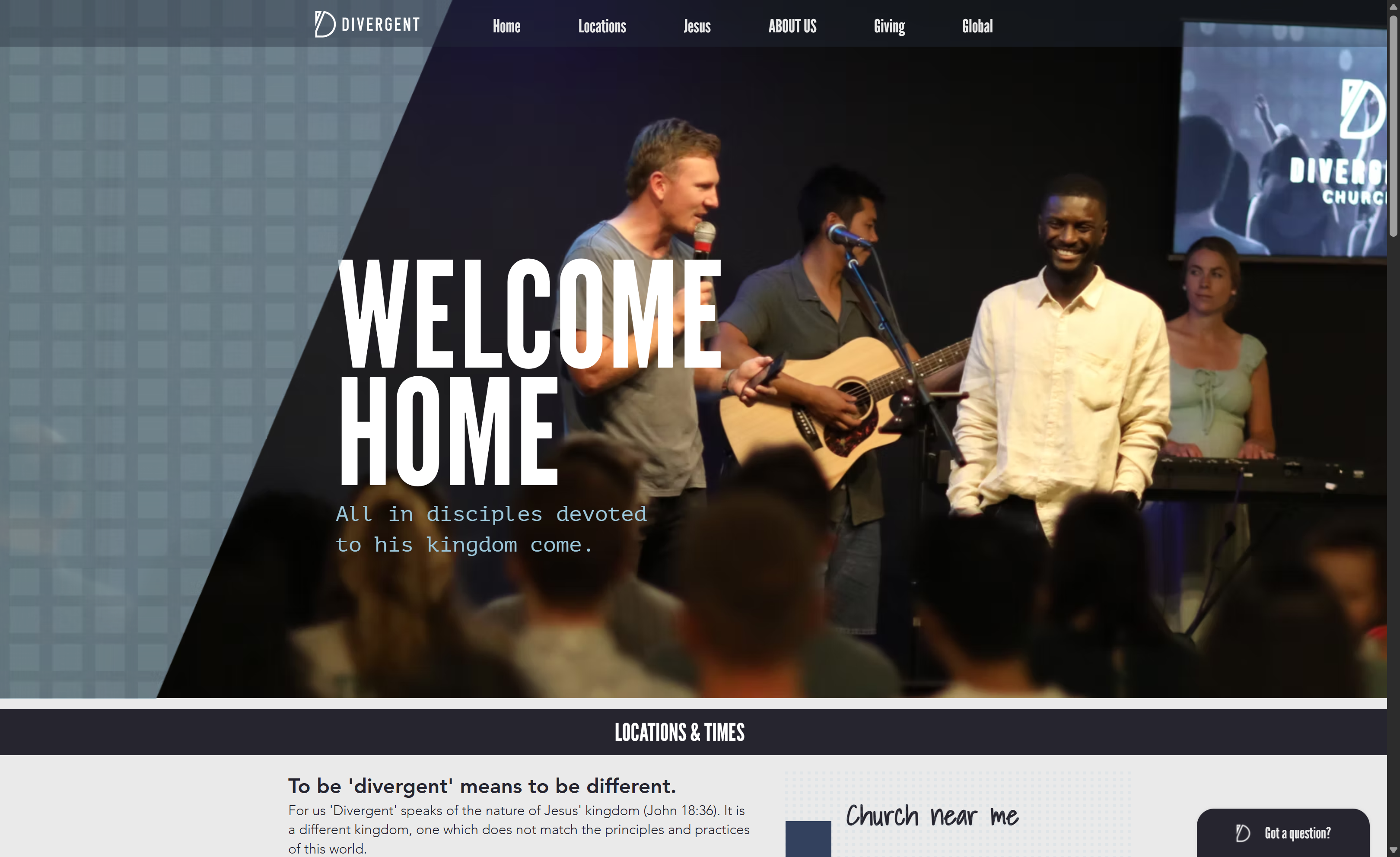
If you would like to take a first step, start at Divergent Church and see how we gather. If you would rather begin with someone to talk to, our guide to finding a supportive church community in Canberra explains what to look for, and our Grow page describes how people take their next steps in faith with us.
FAQ
Is it a sin or a lack of faith to feel anxious about going to church?
No. Scripture repeatedly acknowledges fear and worry, and God answers them with his presence rather than rebuke: “Do not fear, for I am with you” (Isaiah 41:10). Anxiety is a human experience of body and mind, not a verdict on your standing with God. Bring it to him in prayer and, where it is heavy, to your doctor as well.
What should I do if I panic during a service?
Step outside or to the back, slow your breathing by breathing out longer than in, and notice something physical such as your feet on the floor. A wave of panic usually rises and then passes. You can pray a short, honest prayer, return when you are ready, or go home and try again next week. If panics are frequent, see your GP.
Do I have to talk to anyone on my first visit?
No. A smile and your first name is plenty. You do not have to share your story, join anything or stay for tea. Many people find it easier to meet one person at a time in a smaller setting later, once the building itself feels familiar.
Should I see a doctor or speak to a pastor first?
You can do both, and they work well together. If anxiety is disrupting daily life, healthdirect advises talking to your doctor or a mental health professional. A pastor can pray with you, listen without judgement and walk with you in the life of the church. Neither replaces the other.
What if I am anxious because I was hurt by a church before?
That hurt is real, and it is reasonable for your body to be cautious. Begin slowly, perhaps with a conversation before a service. A church that follows Jesus does not require you to hide what happened or hurry your healing. Our post on coming back to church is written for exactly this.
Sources
Recommended
Comments