
Church unity: Building stronger faith communities in Canberra


Church unity is one of those phrases that sounds beautifully simple until you actually try to live it out in a real community. Many Christians assume it means everyone thinking the same thoughts, singing the same songs, and holding identical doctrinal positions. But that picture is both unbiblical and, honestly, a little exhausting. The real meaning of church unity runs far deeper, shaping how believers relate to one another, grow into spiritual maturity, and engage the city around them. For Christians in Canberra, where the population shifts constantly with students, public servants, and transient communities, understanding the substance of genuine unity could transform the way we do church altogether.
Table of Contents
Key Takeaways
Point | Details |
Unity isn’t uniformity | Church unity seeks maturity and shared purpose, not identical opinions or practices. |
Visible vs. invisible unity | True unity is spiritual and sometimes hidden, not limited to external belonging. |
Ecumenical collaboration matters | Churches can partner in prayer and service even with doctrinal differences. |
Unity shapes discipleship | Healthy unity fosters growth and maturity in Canberra faith communities. |
Journey, not destination | Unity is ongoing, requiring humility and discernment rather than just agreement. |
Defining church unity: Beyond agreement and uniformity
One of the most persistent misunderstandings in Christian circles is conflating unity with uniformity. Uniformity says everyone must look the same, think the same, and express faith in identical ways. Unity says something far more nuanced and far more powerful: we share a common foundation, a common Lord, and a common mission, even when our expressions, backgrounds, and secondary convictions differ.
Paul’s letter to the Ephesians gives us one of the clearest windows into what true church unity looks like. In Ephesians 4:11–13, Paul writes that Christ gave the church apostles, prophets, evangelists, pastors, and teachers “to equip his people for works of service, so that the body of Christ may be built up until we all reach unity in the faith and in the knowledge of the Son of God and become mature, attaining to the whole measure of the fullness of Christ.” Notice what Paul is pointing toward: unity is not a starting condition, it is a destination being built toward through intentional, Spirit-led community life.
“Church unity aims for maturity rather than instant uniformity, with the goal of the whole body reaching the full measure of Christ.”
This reframes everything. Unity is not about eliminating diversity. It is about directing diversity toward a shared goal. The Greek word used for “unity” in this passage is henotes, carrying the sense of oneness that is actively cultivated rather than passively inherited. It is a unity that requires effort, humility, and sustained relationship.
When we understand the meaning of church community through this lens, we stop asking “does everyone agree?” and start asking “are we growing together toward Christ?” The difference in those questions is enormous. The first question leads to gatekeeping; the second leads to discipleship.
Key marks of genuine unity in a local church include:
Shared purpose: Members are oriented around forming disciples and serving the city, not protecting institutional comfort
Mutual accountability: People speak truth into one another’s lives, gently and consistently
Diverse gifts, one body: Differences in gifting are celebrated as complementary rather than competitive
Commitment to one another: Relationship is maintained through difficulty, not abandoned when disagreement arises
Christ-centredness: Jesus, not a particular tradition or personality, holds the community together
For Canberra’s Christian communities, many of which include people from diverse denominational backgrounds and from across the globe, this kind of unity is both a challenge and a gift waiting to be received.
Visible and invisible unity: The church as seen and unseen
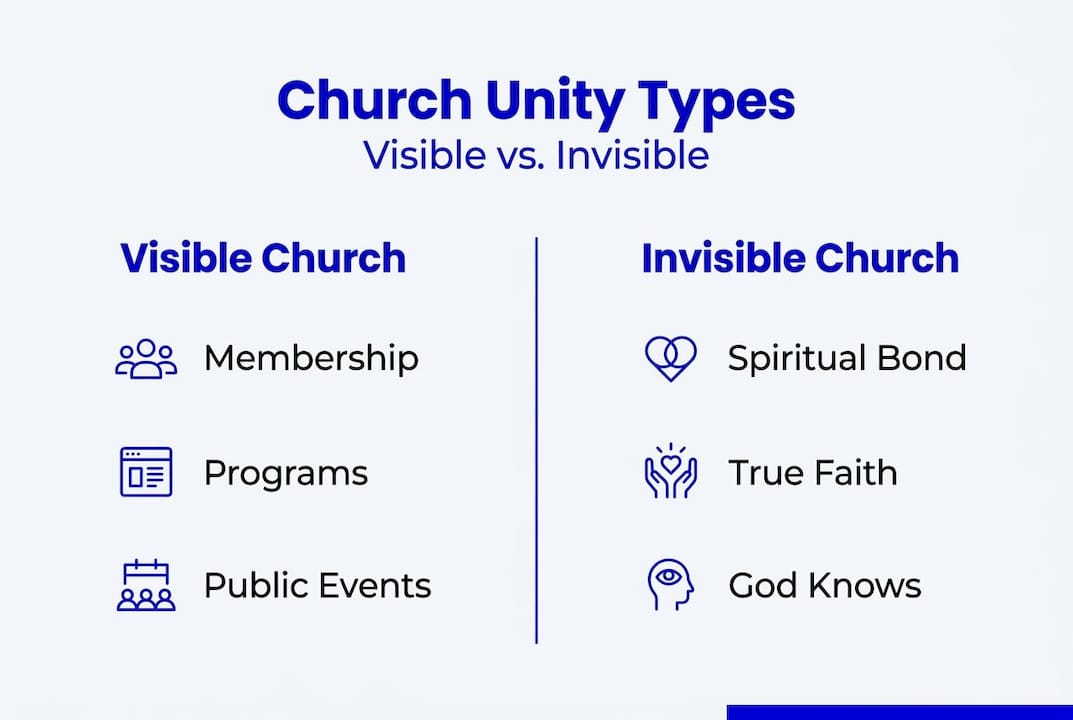
Theologians have long distinguished between two expressions of the church: the visible church and the invisible church. These are not competing ideas; they are complementary lenses that help us understand why unity is more complex than it first appears.
The invisible church refers to all those who are truly united to Christ, known fully only to God. This is the spiritual reality beneath every Sunday gathering. The visible church refers to the outward institution we see: gathered congregations, denominations, ordained ministers, and shared sacraments. Both are real, but they operate differently.
Dimension | Visible church | Invisible church |
Membership | All who profess and belong | Only those truly in Christ |
Unity | Expressed through shared practice | Grounded in God’s sovereign work |
Limits | Includes nominal members | No unregenerate members |
Our role | Build and steward | Trust and discern |
Canberra context | Congregations and networks | Kingdom reality beneath all |
As visible unity has limits because not everyone who professes faith is genuinely united to Christ, the visible church must hold its structures loosely while still taking them seriously. Westminster theology, which has shaped much of Reformed Christianity in Australia, emphasises that the church’s visible expressions are genuinely important but never the final word on who truly belongs to God.
This matters practically for Canberra Christians. Our city has a high proportion of educated, sceptical, and intellectually curious people. Many attend church for cultural or social reasons without a genuine personal faith. When we build unity programmes or discipleship pathways, we must be building toward invisible realities: genuine transformation, authentic belonging, and real encounter with Christ, not just external participation.
The spiritual distinction in church life reminds us that what sets God’s people apart is not their programmes or their polished Sunday gatherings but the tangible presence of the Spirit at work among them. That presence is the true ground of unity.
Pro Tip: When assessing the health of unity in your church community, look beyond attendance numbers and surface agreements. Ask whether people are experiencing genuine transformation, whether difficult conversations are happening with grace, and whether those on the margins feel truly included.
Ecumenism and collaboration: How churches work together
Ecumenism is a word that can trigger either excitement or suspicion depending on your theological heritage. At its core, it simply means the effort of different Christian traditions to understand one another, pray together, and where possible, work together in service of the gospel.
The history of ecumenical movements in Australia is long and layered. From the Australian Council of Churches to local city-wide prayer gatherings, Christians across traditions have found ways to collaborate even while holding theological distinctives. Canberra, as a city shaped by policy and public life, has been a particularly fertile ground for this kind of cross-denominational cooperation.
Church unity involves prayer, dialogue, and collaboration, not merely an internal sentiment shared by individuals. This is a crucial distinction. Unity that stays inside our hearts but never produces shared action is incomplete. It must bear fruit in real relationships, shared mission, and practical service to the city.
Here are some practical ways Canberra churches have fostered unity across traditions:
Collaborative initiative | Participating groups | Outcome |
City-wide prayer gatherings | Multiple denominations | Shared intercession, relationship building |
Joint social justice projects | Churches, charities, and missions | Practical care for vulnerable residents |
Alpha and discipleship courses | Evangelical and Catholic contexts | Shared tools for faith formation |
University campus ministry | Interdenominational chaplaincy teams | Reaching Canberra’s student population |
Steps to foster unity across traditions in your local context:
Start with prayer together: Shared intercession builds trust faster than any theological dialogue
Focus on shared mission, not shared doctrine: Find the overlap in serving the city and build from there
Pursue genuine relationship, not just events: Regular meals and informal gatherings across church lines matter more than formal ecumenical structures
Acknowledge differences honestly: Pretending disagreements do not exist creates fragile unity; naming them with respect builds resilient bonds
Celebrate what God is doing in other communities: Develop a generous posture toward what the Spirit is doing beyond your walls
For those exploring missional church partnerships, the ecumenical impulse is not a theological compromise. It is a recognition that the kingdom of God is bigger than any single congregation, and that Canberra will be reached not by one church doing everything but by many churches doing their part together, well.
Unity and discipleship: Fostering maturity in local churches
The connection between church unity and discipleship is often underappreciated. Many churches treat unity as a relational nicety and discipleship as a separate programme. But the New Testament holds them together as inseparable realities. You cannot truly form disciples apart from community, and you cannot sustain healthy community apart from an intentional commitment to unity.
Discipleship, understood biblically, is not primarily a curriculum. It is a way of life shaped in relationship. When a church community is genuinely unified, it creates the conditions in which disciples actually grow. People are accountable to one another. They carry one another’s burdens. They challenge one another toward obedience and maturity. Isolated individuals cannot do this for themselves.
How unity fosters discipleship growth:
Safe environments for honesty: When unity is real, people feel safe enough to confess sin, ask hard questions, and admit weakness
Shared wisdom across generations: A unified community brings together older and younger believers whose gifts and experiences complement one another
Missional momentum: Communities united around shared purpose are far more effective in their witness to the city than fragmented, internally divided ones
Resilience through difficulty: Disciples formed in the context of genuine community are better equipped to endure the pressures of life in a secular city like Canberra
Encouragingly, discipleship benchmarks are typically assessed qualitatively rather than through quantified metrics, which means the health of unity in a congregation is measured by the quality of its relationships, the depth of its spiritual formation, and the vitality of its outward mission. Numbers can tell part of the story; they rarely tell the whole one.
If you are looking for practical discipleship questions to use with your community, or if you are exploring what disciple-making in Canberra can genuinely look like in this city’s unique rhythms and culture, these are rich places to begin. The goal, as Ephesians 4 reminds us, is not simply getting people through a course. It is forming people into the full measure of Christ, together.
What most churches miss: Unity as a journey, not a finish line
Here is the perspective we feel needs saying more clearly: church unity is almost universally treated as a problem to be solved rather than a journey to be walked. Leaders announce unity initiatives, hold reconciliation services, and declare the issue resolved. Then the same fractures reappear six months later, often deeper than before.
The reason is that unity was never meant to be a destination you arrive at and then maintain. It is a living dynamic, shaped daily by the choices of humble, Spirit-dependent people choosing one another again and again. The moment a church stops actively working toward unity, it begins drifting away from it.
True unity cannot be reduced to external visibility; doctrinal discernment matters deeply alongside relational warmth. This is the nuance many miss. Unity does not mean abandoning convictions. A church that blurs every doctrinal boundary in the name of unity often ends up saying very little at all, and discipling no one in particular. Real unity holds conviction and humility in creative tension. It says, “I know what I believe, and I love you enough to remain in honest relationship with you even where we differ on secondary matters.”
Canberra church leaders we know speak of this tension regularly. The city’s transient population means communities are often rebuilding relationships from scratch every few years. Unity here is not a settled inheritance; it is a daily practice of welcome, investment, and intentional formation. What makes this sustainable is not extraordinary willpower. It is a shared understanding that leadership and unity are inseparable, and that the health of the whole community depends on leaders who model reconciliation, humility, and genuine care for every person in the room.
The most vibrant church communities we have witnessed are not the ones with the most polished programmes. They are the ones where people genuinely choose one another, imperfections and all, and keep showing up.
Connect and grow in unity: Canberra church pathways
If this article has stirred something in you, a longing for deeper community, a desire to pursue genuine discipleship alongside others, or a hunger to understand what church can really be, then we want you to know there are real, accessible pathways forward right here in Canberra.

At Divergent Church, we are not building a perfect institution. We are cultivating a community of people who want to follow Jesus together, honestly and wholeheartedly, in the middle of this city’s everyday life. Our discipleship hub offers structured resources for spiritual growth, grounded in Scripture and shaped for real people with real lives. Our life communities are where the theory of unity becomes lived reality: small groups meeting in homes, sharing meals, studying the Word, and carrying one another’s weight. Come and find your place with us.
Frequently asked questions
Does church unity mean everyone must agree on everything?
No, church unity is about maturity and shared purpose rather than absolute agreement or uniformity. As unity aims for maturity, not instant doctrinal consensus, healthy churches hold diversity within a framework of shared mission and Christ-centredness.
Can churches with different beliefs still work together?
Yes, churches regularly pray, dialogue, and collaborate across minor doctrinal differences, especially in ecumenical contexts. As unity involves collaboration rather than only inner sentiment, shared mission creates genuine bonds even where full theological alignment is absent.
Is church unity something measurable?
Unity is rarely quantified with precise metrics; it is typically assessed through relational health, community resilience, and discipleship vitality. Empirical benchmarks for unity are not commonly found in mainstream discipleship surveys, pointing to the qualitative nature of genuine community health.
What is the difference between visible and invisible church unity?
Visible unity refers to outward belonging, shared practices, and institutional membership, while invisible unity describes those genuinely united to Christ by the Spirit’s work. Visible unity has limits because not all who profess are truly united to Christ, making both dimensions important but distinct in how we understand the church’s identity and mission.
Recommended
Comments