
Why follow Jesus: A path to happiness and growth


There is a quiet assumption in modern life that faith is a private matter with little bearing on how well you actually live. But the evidence tells a different story. Spiritual well-being research involving over 3,000 participants found that religious practices measurably enhance happiness, resilience, forgiveness, and gratitude. For anyone in Canberra who has ever wondered whether following Jesus is genuinely worth it, this guide walks through what the research says, what Scripture reveals, and what it looks like to live as a disciple in a city like ours.
Table of Contents
Key Takeaways
Point | Details |
Well-being boost | Following Jesus enhances happiness, resilience, and gratitude according to global studies. |
Community connection | Faith and church involvement foster belonging and flourishing, especially in secular contexts like Canberra. |
Practical growth | Living out Christian principles improves real-world outcomes such as income and grit. |
Start locally | Begin with understanding Jesus’ teachings and joining a supportive faith community. |
How following Jesus shapes personal well-being
Faith is not simply a set of beliefs held in the mind. It is a way of living that shapes how you experience the world, how you respond to hardship, and how you relate to the people around you. The connection between following Jesus and genuine personal flourishing is not just a theological claim. It is increasingly supported by empirical research.
A study of 3,013 participants found that religious practice enhances well-being metrics including happiness, resilience, forgiveness, and gratitude. These are not abstract spiritual ideals. They are measurable psychological traits that shape the quality of everyday life. When you practise gratitude, you rewire how you perceive your circumstances. When you extend forgiveness, you release the weight of resentment that quietly erodes mental health. These are seeds planted through faith that bear fruit in real, tangible ways.
The benefits are not evenly distributed, either. Research shows that religiosity correlates with greater happiness particularly among people in lower income or lower education groups, where religious attendance, a sense of divine care, and secure attachment to God provide a foundation of meaning and support that other social structures often fail to offer. This is a profound insight. Faith levels the playing field in ways that few other forces in society can.
Well-being metric | Without regular faith practice | With regular faith practice |
Happiness | Moderate | Significantly higher |
Resilience | Variable | Consistently stronger |
Forgiveness | Situational | Practised and habitual |
Gratitude | Occasional | Regular and intentional |
Sense of purpose | Often unclear | Grounded and directional |
Isolation is one of the defining struggles of contemporary urban life, and Canberra is no exception. The city’s transient population, its university culture, and the pace of professional life can all contribute to a quiet disconnection. Following Jesus offers a direct counterpoint to that isolation, not through a programme or an event, but through the spirit-filled life that forms when a person is genuinely rooted in Christ and connected to others who share that commitment.
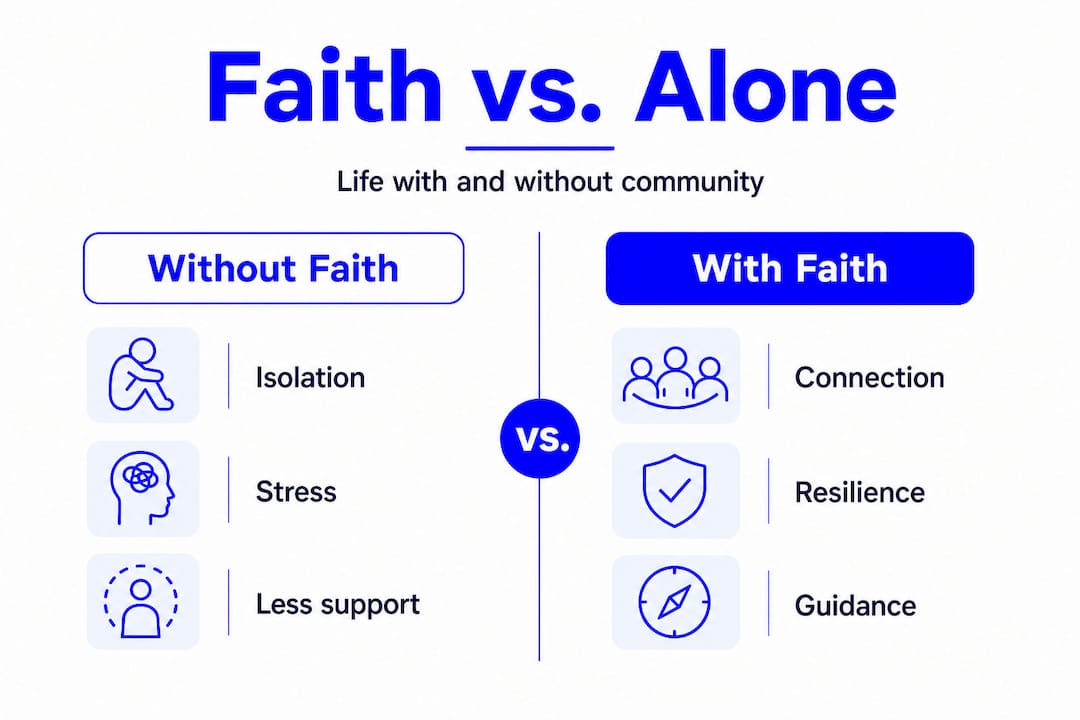
Understanding what spiritual growth outcomes look like in practice helps set realistic and hopeful expectations. Growth is rarely dramatic. It is more often a slow deepening, like roots going further into soil, that eventually produces stability and fruit.
Pro Tip: Start with two small daily practices: write down one thing you are grateful for each morning, and before bed, reflect on one moment where you could extend forgiveness. These simple habits, grounded in the teachings of Jesus, create measurable shifts in your emotional landscape over weeks, not years.
Faith and community: The power of connection
Personal faith does not exist in a vacuum. Jesus himself did not call isolated individuals to believe in private. He called people into community, into a shared life shaped by love, service, and mutual accountability. The New Testament word for church, ekklesia, literally means “the called-out ones,” a gathering of people drawn together by a common identity and purpose.
The research on communal faith practice is striking. The largest longitudinal study of human flourishing ever conducted found that religious service attendance correlates with higher flourishing across countries, and that this effect is strongest in secular nations. This is not a small footnote. It means that in places like Canberra, where religious identity is not the cultural default, the people who do choose to gather around faith experience some of the most significant benefits.
“In a city shaped by policy, politics, and professional identity, the local church offers something genuinely countercultural: a community where you are known not by your title or your output, but by your name, your story, and your belonging to Jesus.”
This is what we see at Divergent Church. People arrive in Canberra for a job, a degree, or a relationship, and they find themselves without roots. The church community becomes the place where those roots form. Not because the building is impressive or the programme is polished, but because genuine human connection, oriented around Christ, meets a need that nothing else in the city quite does.
Consider the difference between navigating life in isolation versus navigating it within a faith community:
Life dimension | Navigating alone | Navigating with faith community |
Grief and loss | Private, often unprocessed | Shared, supported, and held |
Major decisions | Driven by personal bias alone | Informed by wisdom and prayer |
Celebration | Muted or performative | Genuine and shared |
Purpose | Self-defined and shifting | Anchored in something larger |
Accountability | Absent | Present and loving |
The community events that build genuine connection are not about entertainment. They are about creating the conditions for real relationship. When people share a meal, study Scripture together, or serve side by side, something forms that cannot be manufactured through social media or professional networking. It is the kind of belonging that Jesus described when he said, “By this everyone will know that you are my disciples, if you love one another” (John 13:35).
Practical outcomes: Resilience and growth in real life
One of the most surprising findings in recent research is that following Jesus has measurable practical outcomes that extend beyond the spiritual and emotional. A study from Northwestern University found that a Protestant evangelism programme increased both income and grit among participants six months after the intervention. Grit, defined as perseverance and passion for long-term goals, is one of the strongest predictors of life success across nearly every domain.

This is not coincidental. The teachings of Jesus are deeply practical. They shape how you treat people, how you manage conflict, how you respond to failure, and how you persist through difficulty. Discipleship is not just a spiritual exercise. It is a formation process that produces people of character, and character has real-world consequences.
Here are practical steps for building resilience through faith:
Engage Scripture regularly. The Psalms alone are a masterclass in processing suffering, expressing lament, and arriving at hope. Reading them daily builds emotional vocabulary and theological grounding.
Join a small group. Accountability and encouragement from a consistent community of believers is one of the most reliable predictors of sustained faith and personal growth.
Serve others intentionally. Research consistently shows that acts of service reduce anxiety and increase a sense of purpose. Jesus modelled this and called his followers to the same posture.
Practise prayer as dialogue, not monologue. Prayer that includes listening, silence, and reflection develops patience and attentiveness, qualities that transfer directly into every area of life.
Embrace failure as formation. The gospel narrative is full of people who failed and were restored. This reframes setbacks not as disqualifications but as opportunities for growth and deeper dependence on God.
Pro Tip: If you are new to faith or returning after time away, do not try to overhaul your entire life at once. Choose one of the steps above and commit to it for thirty days. Sustainable growth is built through small, consistent choices, not dramatic overhauls.
The invitation to follow Jesus is not a call to perfection. It is a call to direction. And the practical outcomes of walking in that direction, including greater grit, stronger relationships, and a more grounded sense of identity, are not just spiritual promises. They are lived realities that research is beginning to document with increasing clarity. Exploring what a missional church looks like in practice helps clarify how following Jesus is meant to be expressed outward, not just inward. When you are ready to take concrete next steps, there is a clear path forward.
Faith foundations: What it means to follow Jesus
Before any of the practical benefits can be received, it helps to understand what following Jesus actually means. It is not primarily about religious performance, moral perfection, or cultural identity. At its core, it is a relational commitment to a person who claimed to be the way, the truth, and the life (John 14:6).
The core values that Jesus modelled and taught are worth naming clearly:
Compassion. Jesus consistently moved toward the marginalised, the broken, and the overlooked. Following him means cultivating the same orientation toward people in your own city and neighbourhood.
Forgiveness. The gospel is fundamentally a story of forgiveness, and disciples are called to extend what they have received. This is not weakness. It is one of the most demanding and transformative practices a human being can undertake.
Gratitude. A life shaped by the grace of God naturally produces thankfulness. Gratitude is not just a positive psychology technique. It is a theological response to the reality of what God has done.
Humility. Jesus, described in Philippians 2 as one who “did not consider equality with God something to be used to his own advantage,” modelled a posture of servant leadership that subverts every cultural script about power and success.
Justice. The prophets of the Old Testament and the ministry of Jesus both demonstrate a deep concern for the poor, the vulnerable, and the oppressed. Following Jesus means caring about what he cares about.
As religious practice boosts well-being metrics most strongly for vulnerable groups, it is worth noting that these values are not incidental. They are the mechanism. When a community genuinely practises compassion, forgiveness, and justice, it creates the conditions for human flourishing at every level.
Understanding Jesus’ role in faith is the essential starting point for anyone exploring Christianity in Canberra. It grounds everything else in a person, not a system.
Why the usual advice about following Jesus misses the mark
Most conversations about following Jesus in Australia default to one of two modes. Either they focus heavily on doctrinal correctness, getting the theology right, understanding the right terms, believing the right things, or they focus on moral improvement, becoming a better person, making better choices, living a cleaner life. Both of these have value. But neither is the heart of it, and neither is what people in Canberra are actually hungry for.
What we have seen, again and again, is that people do not primarily need more information about Jesus. They need an experience of belonging to a community that is genuinely shaped by Jesus. Doctrine without relationship produces knowledge that puffs up rather than builds up, to borrow Paul’s language from 1 Corinthians 8. Moral improvement without community produces exhaustion and shame, because no one can sustain transformation in isolation.
The uncomfortable truth is that the local church is not primarily a classroom or a self-improvement programme. It is a family. And families are messy, imperfect, and irreplaceable. The invitation to follow Jesus is, at the same time, an invitation to belong to his body, the community of people who are being formed together into his likeness.
In Canberra specifically, where so many people arrive without history, without family, and without roots, this matters enormously. The city is full of intelligent, capable, searching people who have tried every other form of meaning-making and found it wanting. What they often have not tried is genuine Christian community, not a performance, not a programme, but a real community of people committed to spiritual development together.
Our conviction at Divergent Church is that belonging comes before believing for many people. When someone experiences genuine love, acceptance, and purpose within a community shaped by Jesus, the theological questions begin to find their answers in the context of lived relationship, not just intellectual inquiry.
Ready to take the next step?
If something in this article has stirred a question, a longing, or a quiet sense that there might be more to life than you have yet discovered, we would love to walk that journey with you.

At Divergent Church, we exist for exactly this moment. Whether you are brand new to faith, returning after years away, or simply curious about what it means to follow Jesus in a city like Canberra, there is a place for you here. Explore our discipleship hub for resources that will help you grow at your own pace, or find a life community group near you where you can begin building the kind of genuine connection that changes everything. You do not have to have it all figured out. You just have to take the next step.
Frequently asked questions
Is following Jesus relevant for secular Australians?
Yes, research shows that flourishing benefits of faith are actually strongest in secular nations, meaning Australians in cities like Canberra stand to gain the most from engaging with faith and community.
Can following Jesus help with mental health?
Absolutely. Religious practices enhance measurable mental health outcomes including resilience, forgiveness, and gratitude, all of which are central to emotional and psychological wellbeing.
Does faith influence economic or life outcomes?
Yes, real-world studies show that faith-based programmes increase grit and income within months, suggesting that the character formation at the heart of discipleship has tangible practical consequences.
What are the first steps to follow Jesus in Canberra?
Begin by exploring the teachings of Jesus with an open mind, then connect with a local church community where you can ask questions, build relationships, and experience faith lived out in everyday life.
Recommended
Comments