
Understanding Jesus' role in Christianity and faith


Many people in Canberra encounter Jesus as a historical figure, a moral teacher, or perhaps a distant religious symbol. But Christianity makes a far bolder claim. Jesus is regarded as the Son of God, God the Son, and the second person of the Trinity, not simply a wise man who lived two thousand years ago. Understanding who Jesus actually is, and what his life, death, and resurrection mean, changes everything about how you approach faith, community, and purpose. This article unpacks that significance, step by step, for anyone genuinely curious about what it means to follow Jesus in a city like Canberra.
Table of Contents
Key Takeaways
Point | Details |
Jesus as the core of faith | Christianity centres on Jesus as divine, not just a wise teacher. |
Salvation through Jesus | Believers find forgiveness and new life through faith in Jesus’ death and resurrection. |
Faith shapes community | Following Jesus inspires vibrant Christian communities of worship, service, and belonging. |
Personal connection matters | An active relationship with Jesus leads to deeper spiritual growth and purpose. |
Jesus as the centre of Christian belief
To understand why Jesus is at the heart of Christianity, it helps to examine Christian doctrine and the ancient creeds that have shaped the faith for centuries.
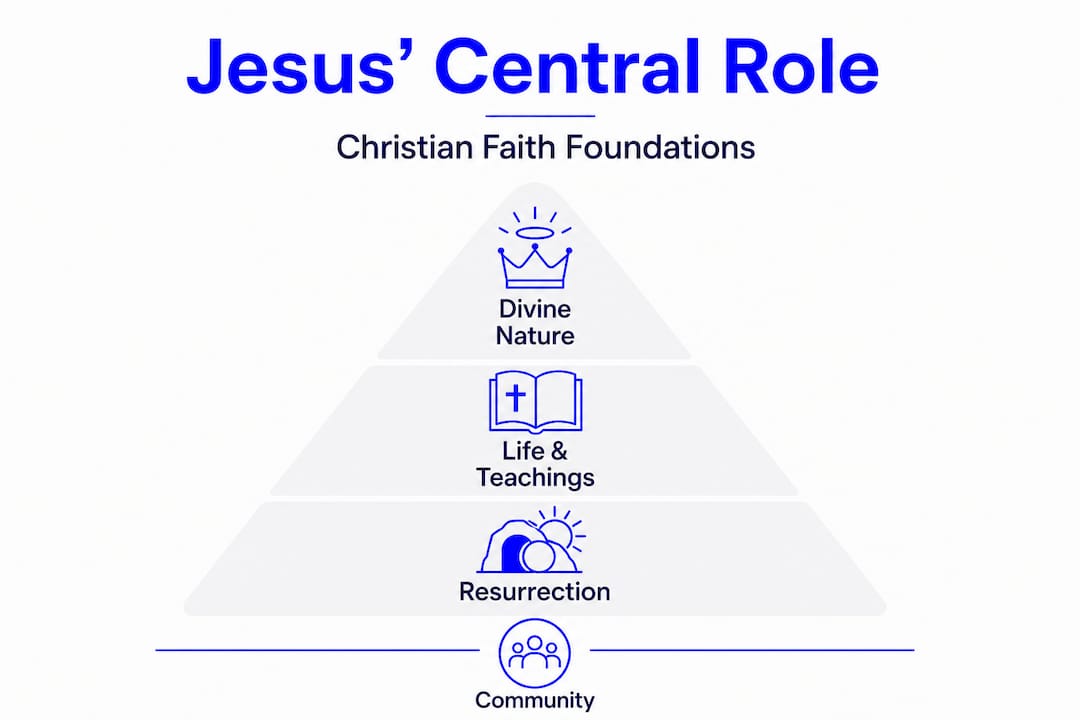
Christianity is not primarily a system of ethics or a collection of moral guidelines. At its core, it is a confession about a person. Jesus is the central figure of Christianity, regarded as the Son of God, God the Son, and the second person of the Trinity. That is a remarkable claim, and it is one that separates Christianity from every other world religion or philosophical tradition. Other faiths may honour Jesus as a prophet or teacher. Christianity insists he is far more.
The early church wrestled deeply with how to articulate this truth. The result was the Nicene Creed, formulated in 325 AD at the Council of Nicaea and refined in 381 AD. This creed remains one of the most significant theological documents in Christian history. The Nicene Creed affirms Jesus as the only-begotten Son of God, begotten not made, of one substance with the Father. These words were not chosen lightly. They were a direct response to theological debates about whether Jesus was truly divine or merely a created being. The creed settled the matter with clarity and conviction.
For those wanting to explore Nicene Creed insights more deeply, the doctrinal foundations are rich and worth sitting with carefully.
“I am the way, the truth, and the life. No one comes to the Father except through me.” — John 14:6
Understanding the Trinity is essential here. Christians believe in one God who exists as three co-equal persons: Father, Son, and Holy Spirit. Jesus, as the Son, is not a lesser deity or a secondary figure. He is fully God and fully human, a mystery theologians call the hypostatic union. If you want to explore the Trinity evidence from Scripture, the case is both ancient and compelling.
Aspect of Jesus’ identity | What Christianity affirms |
Divine nature | Fully God, second person of the Trinity |
Human nature | Fully human, born of Mary |
Relationship to the Father | One substance, eternally begotten |
Role in salvation | Redeemer, atoning sacrifice |
Role in the Church | Head and Lord of the body |
Jesus is not simply a model to imitate, though he is certainly that. He is the redeemer who makes a relationship with God possible, and the Lord to whom every area of life is surrendered.
Jesus’ life, death, and resurrection: The story that shapes faith
With Jesus proclaimed as divine, his life story and ultimate mission hold immense significance for faith and practice.
Jesus’ public ministry lasted approximately three years. During that time, he taught with extraordinary authority, healed the sick, cast out evil, raised the dead, and consistently proclaimed the Kingdom of God. The Greek word basileia, meaning kingdom or reign, captures what Jesus was announcing: that God’s rule was breaking into human history in a new and decisive way. His parables, his miracles, and his relationships with the marginalised all pointed toward a kingdom defined by grace, justice, and love.
Jesus is the Messiah prophesied in the Old Testament, who through his crucifixion and resurrection offers salvation and eternal life by atoning for sin. The crucifixion was not a tragedy that derailed his mission. It was the mission. Jesus willingly went to the cross as the fulfilment of centuries of prophetic anticipation, the sacrificial lamb who bore the weight of human sin so that reconciliation with God could be made possible.

The resurrection’s importance cannot be overstated. Without the resurrection, the cross is simply a brutal execution. With it, everything changes. The resurrection is Christianity’s central claim, the event that validates Jesus’ identity, defeats death, and opens the door to eternal life for all who trust in him.
Key events in Jesus’ ministry and their significance:
Baptism: Affirmed by the Father’s voice and the Spirit’s descent, marking the beginning of his public ministry
Sermon on the Mount: Redefining righteousness, mercy, and the shape of kingdom living
Feeding the five thousand: A sign of his divine provision and compassion for physical and spiritual need
Crucifixion: Atonement for sin, fulfilment of Old Testament prophecy, and the ultimate act of love
Resurrection: Victory over death, vindication of his divine identity, and the foundation of Christian hope
Ascension: Jesus returning to the Father, with the promise of the Spirit and his eventual return
For those wanting to reflect more on Easter’s deeper meaning, the resurrection is not merely a historical event to celebrate once a year. It is the heartbeat of Christian life every single day.
Event | Historical significance | Spiritual significance |
Crucifixion | Documented by Roman and Jewish historians | Atonement, forgiveness of sin |
Resurrection | Empty tomb, multiple eyewitness accounts | Victory over death, eternal hope |
Ascension | Recorded in Acts 1 | Jesus as reigning Lord and coming King |
Statistic worth noting: The Apostle Paul, writing around 55 AD in 1 Corinthians 15, listed more than 500 eyewitnesses who saw the risen Jesus, many of whom were still alive when he wrote. This was a verifiable, public claim made within living memory of the events themselves.
What Jesus’ role means for personal faith and spiritual growth
Beyond doctrine and history, Jesus’ role has direct impact on personal spiritual journeys and growth.
Theology that stays in the head never transforms the heart. The beauty of Christianity is that the truths about Jesus are meant to be lived, not merely believed in the abstract. Jesus’ role provides the path to salvation through faith, fostering spiritual growth via relationship with him as Lord and Saviour, and community in the Church as his body.
Here is how that plays out practically:
Receive salvation through faith. Trusting in Jesus means accepting that his death and resurrection have dealt with the barrier of sin between you and God. This is not earned through good works but received as a gift.
Follow his teachings daily. The Sermon on the Mount, the parables, and the example of Jesus’ own life offer a framework for how to live with integrity, generosity, and love toward others.
Engage in spiritual disciplines. Prayer, reading Scripture, fasting, and serving others are not religious obligations but pathways that deepen your relationship with Jesus over time.
Find your place in community. Following Jesus was never designed to be a solo pursuit. The New Testament consistently describes faith as something practised together, within the body of Christ.
Let Jesus shape your purpose. When Jesus is genuinely Lord, he reshapes how you think about your work, your relationships, your finances, and your future.
Understanding serving as discipleship is one of the most practical ways to grow in faith. Service is not an add-on to following Jesus. It is one of the primary ways his character is formed in us.
Pro Tip: If you are new to faith or just exploring, start with the Gospel of John. It is the most theologically rich of the four gospels and was written specifically so that readers would believe Jesus is the Son of God and find life in his name (John 20:31).
For those ready to move forward, taking next steps in faith is always better done in community than in isolation.
The role of Jesus in Christian community and worship
Living out faith isn’t a solo journey. Jesus’ role also profoundly shapes how Christians gather and relate to one another.
The New Testament uses a striking image for the Church: the body of Christ. Each believer is a member of that body, and Jesus is the head. This is not a metaphor for a loose association of like-minded people. It is a claim about organic, living connection. Community in the Church as his body means that when Christians gather, they are not simply attending an event. They are expressing something real about who Jesus is and what he is doing in the world.
Worship in the Christian tradition is centred entirely on Jesus. Songs, prayers, sermons, and the sacraments of baptism and communion all point back to him. Communion, in particular, is a regular reminder of his body broken and his blood poured out, an act of remembrance and proclamation until he returns.
What Jesus-centred community looks like in practice:
Gathering regularly to hear Scripture taught and applied to real life
Praying together for one another’s needs, struggles, and hopes
Sharing meals and ordinary life across the week, not just on Sundays
Serving the broader community as an expression of Jesus’ own compassion
Welcoming those who are new, searching, or on the margins
Understanding meaningful worship goes beyond singing songs in a building. It is a whole-life orientation toward Jesus as Lord, expressed in gathered moments and scattered daily living.
For anyone in Canberra who wants to know more, exploring more about Jesus is a natural starting point before stepping into community.
Pro Tip: Don’t wait until you have all your questions answered before connecting with a Christian community. The questions are often best explored in relationship, not in isolation. Most people find that belonging and believing grow together.
Why Jesus’ role challenges shallow faith or mere tradition
Here is something we have observed in Canberra and beyond: many people carry a version of Christianity that is really just cultural familiarity. Christmas services, Easter eggs, a vague sense that Jesus was a good person. And while none of that is harmful in itself, it is a long way from what the New Testament describes as following Jesus.
The challenge is this: if Jesus is truly who Christianity claims he is, then he cannot simply be admired from a distance. A God who became human, died for sin, and rose from the dead is not asking for polite acknowledgement. He is calling for genuine surrender and relationship. Nominal faith, faith that exists in name only, tends to collapse under the weight of real life. It offers no real transformation because it has never truly encountered the person at the centre of the faith.
What we find, again and again, is that people who move from knowing about Jesus to actually knowing Jesus experience something qualitatively different. Their relationships change. Their sense of purpose shifts. Their response to suffering deepens. This is not because they have adopted a new set of rules. It is because they are in relationship with a living person who is actively at work in their lives.
Canberra is a city full of intelligent, thoughtful people who are often sceptical of religion precisely because they have only ever seen its shallow forms. The invitation we extend is not to religion but to relationship. Not to tradition but to transformation. The faith-driven leadership at Divergent Church exists to help people encounter Jesus in exactly that way, honestly, deeply, and in the context of real community.
The uncomfortable truth is that a Christianity without a living, central Jesus is not really Christianity at all. It is a moral framework dressed in religious language. The good news is that the real thing, a genuine encounter with Jesus, is available to anyone willing to seek it.
Explore Jesus’ role for yourself in Canberra
If this article has stirred something in you, whether curiosity, resonance, or even honest scepticism, we would love to walk alongside you in exploring it further.

At Divergent Church, we exist within the rhythms of Canberra’s universities, workplaces, and neighbourhoods. We are not simply a Sunday gathering. We are a community shaped by Scripture, centred on Jesus, and expressed through everyday life. If you are ready to move from reading about Jesus to encountering him in community, there are clear pathways forward. You can start following Jesus with practical guidance, discover Jesus locally in a Canberra context, or join a life community to explore faith with others in a smaller, relational setting. The next step is always closer than it feels.
Frequently asked questions
Why do Christians call Jesus the Son of God?
Christians refer to Jesus as the Son of God because their core beliefs and ancient creeds affirm his divine origin and unique relationship with God the Father, describing him as God the Son and the second person of the Trinity.
What is meant by salvation through Jesus?
Salvation means being forgiven and reconciled to God, made possible through Jesus’ sacrificial death and resurrection, by which sin is atoned for and eternal life is offered to all who trust in him.
How does Jesus’ resurrection impact Christian faith?
The resurrection is the cornerstone of Christian hope because it confirms Jesus’ divine identity and demonstrates that death is defeated, giving believers confidence in eternal life.
What role does Jesus play in Christian community life?
Jesus is understood as the head of the Church, meaning that Christian community is not simply a social gathering but an expression of his living body, guided by his teachings and united in his mission.
Recommended
Comments