
Build a Lasting Daily Devotions Guide with a 21 Day Prayer Series


A daily devotions guide doesn’t need to be complicated. The most effective pattern is four steps, pray, read, reflect, respond, done in anywhere from five to twenty minutes. Short and consistent beats long and occasional every time. If you want a place to start today, Divergent Church’s resources, including the 21 Days of Prayer series, give you a ready-made rhythm rather than a blank page.
TL;DR:
Shorter, structured devotionals, such as the four-step prayer, read, reflect, respond plan, are more sustainable than lengthy sessions, especially during busy seasons.
Using pre-made plans like the seven-day micro cycle or 21 Days of Prayer helps eliminate decision fatigue and keeps consistency simple.
Personalizing reflection questions to your current life situation and adjusting the format to your personality ensures deeper engagement and lasting habit formation.
Tracking spiritual growth through monthly reflections and pattern recognition offers a more realistic measure of progress than relying solely on streaks.
Community support through church resources, group spaces, or shared devotionals can significantly enhance accountability and deepen your faith practice.
Table of Contents
What is a daily devotions guide, and how do you build one?
A daily devotions guide is simply a repeatable structure for meeting with God each day, not a rigid script. The pattern that works across seasons of busyness and rest is what some call the “spiritual sandwich”: prayer, Scripture, prayer, with a reflection tucked in the middle. Here’s the four-step version worth memorising.
Open with prayer. Something as short as “Lord, quiet my heart and show me what You want me to see today” is enough. The point isn’t eloquence, it’s turning your attention toward God before you turn it toward the page.
Read a short passage. Five to fifteen verses is plenty. A Psalm excerpt, a Gospel pericope, or a chapter from Proverbs all work well because they are self-contained and don’t demand deep background to understand.
Reflect with three simple questions. What does this say about God? What’s one truth to believe? What’s one action to take? Jot a single line in a journal, one sentence is enough to make the truth stick.
Respond in prayer. Name the one commitment you’re making, or simply ask for help to live it out. This is where the reading becomes personal rather than academic.
This basic structure lines up with a well-tested plan for daily devotions and with the quiet-time model many ministries teach, which both centre on the same rhythm: pray, read, reflect, respond.
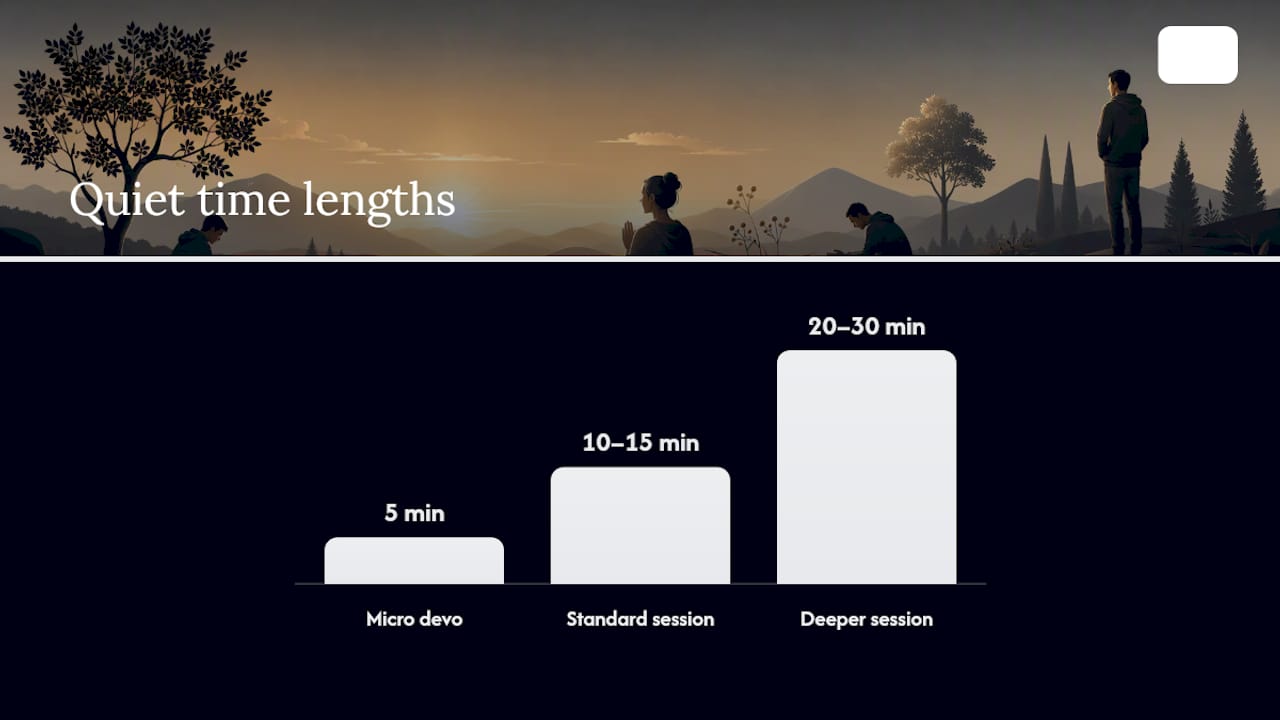
Timing is genuinely flexible. A 5-minute micro devo covers a single verse and one honest prayer. A 10 to 15 minute standard session gives you room for all four steps without rushing. A 20 to 30 minute deeper session suits a Saturday morning or a season where you have more space. A quiet time’s length should suit your season of life, not someone else’s ideal.
Pro Tip: Lay your Bible and journal on the kitchen table the night before, opened to tomorrow’s passage. Decision fatigue kills more devotional habits than busyness does.
If your mind wanders mid session, don’t fight it. Write the distracting thought on a scrap of paper to deal with later, then return to the text. A wandering mind isn’t a failed devotion, it’s just a Tuesday.
For a gentler entry point into reading Scripture itself, this beginner’s guide to reading the Bible walks through picking a starting book and pacing yourself.
Two simple plans you can start today
You don’t need to design your own reading plan to get moving. Below are two you can use immediately, one for a first week, one for a full month.
Seven-day micro plan (one passage, one question a day):
Day 1: Psalm 23. Where do I need the Shepherd’s guidance right now?
Day 2: Matthew 6:25 to 34. What am I anxious about that I haven’t handed over?
Day 3: Proverbs 3:5 to 6. Where am I leaning on my own understanding?
Day 4: John 15:1 to 5. What does it look like to “remain” today?
Day 5: Philippians 4:6 to 7. What’s one thing I can turn into a prayer instead of a worry?
Day 6: Colossians 3:12 to 14. Who do I need to extend patience to this week?
Day 7: Psalm 103:1 to 5. What’s one specific thing I’m thankful for right now?
For a longer rhythm, a 30-day pattern that cycles a short Gospel reading, a Psalm, and a Proverb every three days keeps things varied without becoming a research project.
Days | Reading focus | Why it works |
1 to 10 | Gospel of Mark, short sections | Fast-moving narrative, easy to follow daily |
5 to 20 | Psalms 1 to 10, one per day | Emotional honesty, prayers you can borrow |
21 to 30 | Proverbs 1 to 10, one chapter per day | Practical wisdom for daily decisions |
During Advent or Lent, swap in season-specific passages, an Advent plan might trace the prophecies leading to Christ’s birth, while Lent could follow Christ’s final week. Keep a simple notebook or the notes app on your phone for one-line reflections; you’ll want to look back on them later.
How do you actually stick with daily devotions?
Consistency has almost nothing to do with willpower and everything to do with friction. Practitioners recommend starting with as little as five to seven minutes daily, because a habit forms through repetition, not intensity.
Start tiny. Commit to five to seven minutes before you commit to anything longer. You can always extend a session that’s going well.
Prep the night before. Choose tomorrow’s passage and set your Bible and journal where you’ll see them.
Anchor it to an existing habit. Pair it with your first coffee, your commute, or the moment before you check your phone.
Handle missed days without guilt. Restart the next day rather than waiting for Monday or “a fresh start.” If a five-minute devotion feels too big after a rough week, drop to two minutes rather than skipping altogether.
Pro Tip: If you’ve missed a week, don’t try to “catch up” on the missed readings. Start where today’s plan says and keep moving forward. Guilt-driven catch-up sessions are one of the fastest ways to quit for good.
Ten Christian habits worth building covers several other low-friction practices that pair well with a devotional habit, gratitude journalling and Scripture memorisation among them.
What does a short family devotion actually look like?
Families don’t need a scaled-down sermon, they need something short enough that nobody’s checking the clock.
Welcome. A minute to settle everyone, maybe with a simple worship song.
Short reading. One passage, read aloud, no more than a few verses.
One simple question. “What’s one thing that stood out to you?” works for almost any age.
Group prayer. Even a sentence each is enough.
A family devotions outline suggests pairing readings with a simple hymn or a memory verse for the week, which gives younger children something concrete to hold onto. For young kids, a picture Bible story or a single memorised verse works better than an abstract discussion. Teens often respond better to open questions than to answers handed to them.
Try a weekly rhythm: a slightly longer Sunday reflection together, then a two-minute midweek check-in on the same theme. Faith practices for daily life has more ideas for building rhythms that fit a whole household, not just one person’s morning.
Which devotional formats and resources are worth your time?
Devotionals now come as email series, printable PDFs, mobile apps, and books, and the right pick depends on your attention span and season of life more than on any format being objectively “best.” Someone doing school pickups needs something skimmable on a phone; someone with a quiet morning might prefer a printed plan and a pen.
Divergent Church offers a few practical starting points:
21 Days of Prayer. A guided series that gives you a daily prompt so you’re never staring at a blank page, ideal if you’re new to a devotional rhythm or restarting after a gap.
10 Christian habits to strengthen your daily faith. A practical rundown of habits that extend beyond devotions into the rest of your week.
Faith practices for daily life. A set of everyday exercises for weaving faith into ordinary tasks, not just quiet mornings.
Combine any of these with a straightforward Bible reading plan, or bring the same passage to a small group once a week. Reading alone builds the habit; talking it through with others tends to be what makes it stick long term.
How do you meditate on Scripture and pray with purpose?
Meditation, in this context, isn’t emptying your mind, it’s filling it with one idea and turning it over slowly. Read the day’s passage twice: once for content, once slowly, pausing on whatever word or phrase catches your attention. A single “best verse” from the passage gives you something concrete to carry into the day rather than a vague impression of “something about faith.”
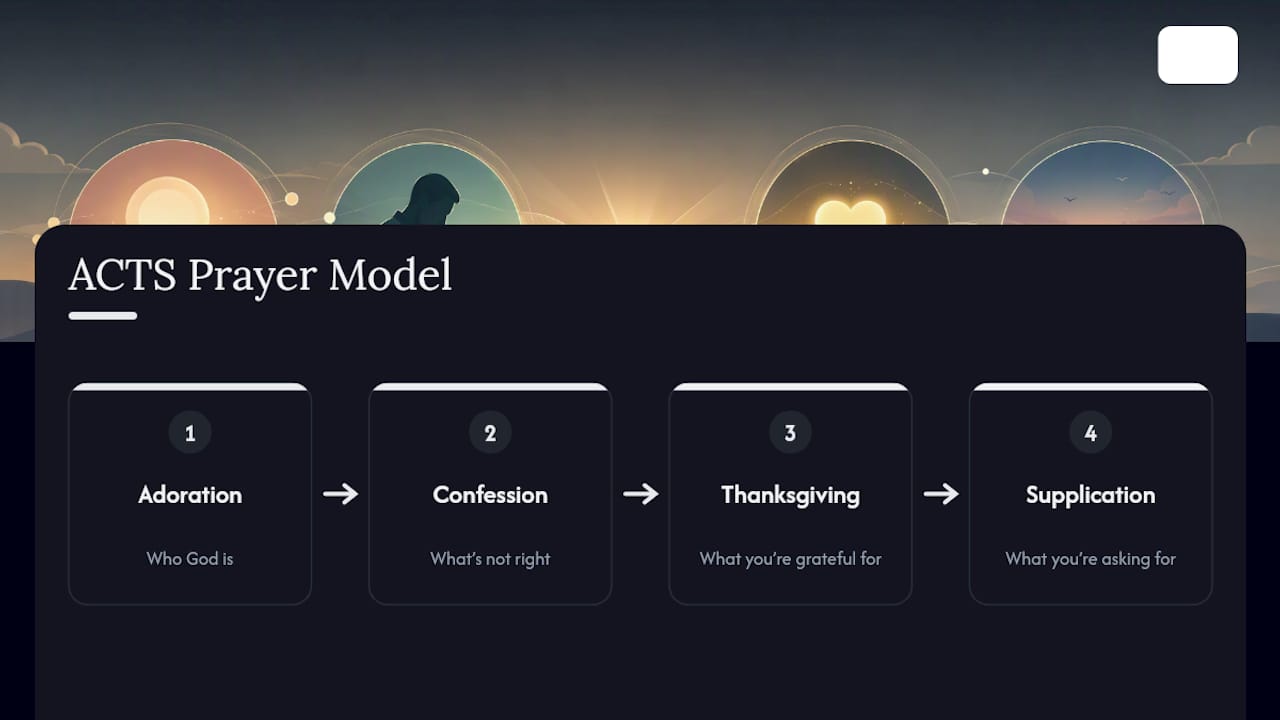
For prayer, the ACTS model gives a simple shape when you’re not sure what to say: Adoration (who God is), Confession (what’s not right), Thanksgiving (what you’re grateful for), Supplication (what you’re asking for). You don’t need all four every day, but having the acronym in your back pocket rescues a lot of sessions that would otherwise stall after “Dear God.”
Prayer prompts tied to the day’s reading work better than generic ones. If you read about God’s provision, pray specifically about a financial worry rather than a general “thank you for everything.” Specificity is what turns a devotional reading into an actual conversation.
Keep a short list of recurring prayer points, people, decisions, ongoing struggles, so you’re not reinventing your prayer life every morning. Five minutes of focused prayer on three named things beats fifteen minutes of vague good intentions.
How do you personalise a devotional to fit your own faith needs?
No single plan fits every season of life, and treating one like it should is a fast route to frustration. If you’re working through anxiety, choose passages that speak directly to worry and trust, Philippians 4, Matthew 6, Psalm 91, rather than whatever a generic plan assigns that week.
Match the format to your personality, not just your schedule. If you’re naturally reflective, a written plan with journalling prompts will suit you. If you process out loud, consider praying aloud or using a voice memo instead of writing.
Adjust the reflection questions to your actual life stage. A new parent might ask “what does this passage say about patience today?” while someone job hunting might ask “what does this say about provision and waiting?” The three core reflection questions, what does this say about God, what’s one truth, what’s one action, stay the same; only the application changes.
Rotate through different entry points too: some mornings, start with a worship song instead of silence; other days, start with a specific need instead of a set passage. None of this breaks the four-step structure, it just adapts it. Personalising doesn’t mean abandoning structure, it means bending the same structure to where you actually are.
What gets in the way of daily devotions, and what actually fixes it?
The most common obstacle isn’t lack of desire, it’s decision fatigue. Choosing a passage every morning from scratch is exhausting, which is exactly why a pre-set plan (like the seven-day micro plan above) removes the biggest point of friction.
The second obstacle is unrealistic expectations. Many people quit after missing a “perfect” thirty-minute session because they think anything shorter doesn’t count. It does. Short, structured plans with night-before preparation consistently outperform ambitious plans that collapse under real-life schedules.
Distraction during the reading itself is a third common snag, particularly for parents of young children or shift workers. Rather than chasing silence you may not have, try reading aloud in short bursts, or use audio Scripture during a commute.
Finally, there’s the guilt spiral: miss a day, feel bad, avoid the reminder of having missed it, miss another day. The fix isn’t more discipline, it’s lowering the bar the moment things slip. Two minutes and one verse still counts as showing up.
How do you track progress and notice spiritual growth?
Spiritual growth rarely announces itself in a single dramatic moment, it shows up in a slow shift you only notice looking backwards. A simple one-line journal entry each day, what struck you, what you prayed, becomes the record you didn’t know you needed three months from now.
Once a month, flip back through your notes and look for patterns rather than grading yourself on consistency. Are the same worries recurring? Has a particular truth started showing up in how you actually respond to situations, not just what you write down? That’s a more honest measure of growth than counting unbroken streaks.
Some people track a simple tally, days completed versus days missed, and that’s fine as a nudge. Just don’t let the tally become the goal. The aim of a devotional habit is a deepening relationship, not a perfect record.
Which thematic devotionals are worth trying?
Thematic devotionals give you a lens to read through for a set period, which can surface things a random daily passage might miss.
Gratitude: Spend two weeks in the Psalms of thanksgiving (Psalm 100, 103, 136), noting one specific thing daily rather than a general “thankful for family and health.”
Forgiveness: Work through Matthew 18:21 to 35, Colossians 3:13, and Ephesians 4:32, pairing each with the honest question of who you’re still holding something against.
Trust and anxiety: Cycle through Psalm 91, Matthew 6:25 to 34, and Philippians 4:6 to 7 during a stressful season, work stress, illness, transition.
Identity: Ephesians 1 to 2 and 1 Peter 2:9 to 10 work well for anyone wrestling with self-worth or comparison.
None of these need to run longer than two to three weeks. A theme gives your devotions a throughline without turning into a rigid syllabus you feel obligated to finish.
Showing up imperfectly still counts
Most guides to daily devotions quietly imply that missing a day is failure. It isn’t. The goal has always been relationship, not performance, and a devotional life that “watches expectantly” throughout the day matters more than a flawless morning streak. Grace covers the gaps far better than guilt ever motivated anyone. If you’re finding it hard to sustain alone, a small group or community can carry what solo discipline can’t.
— Josh
How Divergent Church can support your daily rhythm
A local church community can offer support to help everyday people, students, new residents, and busy parents keep faith practices going without needing a theology degree to start. The 21 Days of Prayer series gives you a guided daily prompt so you’re never staring at a blank page, and it pairs naturally with the four-step structure covered above.
If your household or small group wants to work through a devotional series together in person, Divergent Church’s spaces are available to hire for exactly that: the Auditorium at $70 per hour, the Seminar Room at $50 per hour, and the Board Room, a smaller space suited to a prayer group or study circle, at $25 per hour. Check dates and book a room online if you’d like a dedicated space for your group’s devotional rhythm this month.
Sources
FAQ
Which is the best daily devotional?
There’s no single “best” devotional, the right one is whichever short, repeatable plan you’ll actually finish. A four-step structure, prayer, reading, reflection, response, works across formats, and Divergent Church’s 21 Days of Prayer is a solid guided option if you want the daily prompt chosen for you.
What’s a good daily devotional for today?
A good devotional for any given day pairs a short passage (five to fifteen verses) with one honest reflection question, what does this say about God, and a specific prayer in response. If you need a starting point right now, Psalm 23 with the question “where do I need guidance today?” works well.
What are good daily devotionals?
Good devotionals share three traits: they’re short enough to finish most days, they include a reflection step rather than just reading, and they end in prayer rather than stopping at information. Email series, printable plans, apps, and books can all work equally well, the format matters less than the structure.
What is the best free daily devotional app?
There isn’t one universally “best” free app, since the right choice depends on whether you prefer audio, text, or guided prompts. Whatever app you choose, look for one that follows a similar four-step pattern, and consider pairing it with a community-based series like Divergent Church’s 21 Days of Prayer for extra accountability.
Recommended
Comments