
Explaining the kingdom of God: a guide for believers


The Kingdom of God sits at the very heart of Jesus’ message, yet it remains one of the most misunderstood concepts in Christianity. Ask ten believers what it means and you will likely receive ten different answers. Some picture a distant heavenly realm. Others think of it as a future political order. Still others reduce it to private spiritual feeling. Explaining the Kingdom of God properly means cutting through those misconceptions and arriving at something far richer: a present and future reality that reshapes how you live, love, and serve right now.
Table of Contents
Key takeaways
Point | Details |
Kingdom is here and coming | The Kingdom is both a present reality inaugurated by Jesus and a future hope awaiting full consummation. |
It is God’s reign, not a place | The Kingdom refers to God’s sovereign rule and authority, not a geographical location or institution. |
Rooted in Old Testament promise | Kingdom foundations begin with creation and the Davidic covenant, fulfilled in Christ. |
Lived out in daily life | Kingdom values of righteousness, peace, and joy are expressed through relationships, mission, and obedience. |
Not the same as the church | The church serves the Kingdom, but the Kingdom is larger than any single institution or gathering. |
Biblical foundations of God’s kingdom
Understanding God’s kingdom requires starting where the story begins: creation itself. From the first pages of Scripture, God is presented as the sovereign ruler of all things. He does not acquire authority. He simply is the authority. Israel’s theocracy under the Mosaic covenant was one of the earliest visible expressions of that rule. God was their King, governing his people through law, prophet, and priest.

The Davidic covenant deepens this story considerably. In 2 Samuel 7, God makes a remarkable promise to King David: that one of his descendants would sit on the throne forever. This was not merely a political arrangement. It was a prophetic declaration that an everlasting kingdom would come through David’s line, a promise that pointed forward to someone far greater than Solomon.
The prophets then carry this hope through Israel’s darkest seasons. Isaiah speaks of a servant-king who will establish justice (Isaiah 42). Daniel envisions a kingdom that crushes all others and stands forever (Daniel 2:44). Even when Israel falls to foreign empires, the prophets refuse to let the dream die. They keep planting seeds of expectation into the soil of suffering. The people of God wait, and the anticipation grows with every generation.
Pro Tip: When you read the Old Testament, notice how often kingship, covenant, and redemption appear together. These are not separate themes. They are threads of the same tapestry weaving toward Christ.
Jesus and the kingdom: present and growing
When Jesus steps onto the stage of history in Galilee, his first recorded sermon is a declaration: “The kingdom of God is at hand” (Mark 1:15). This is not a metaphor for someday. It is an announcement. The King has arrived. The kingdom has broken into human history in the person of Jesus himself.
Jesus’ teaching on the kingdom is extensive, and the parables of the kingdom of God in Matthew 13 are among the most instructive. Consider what he does with two small images. A mustard seed, the tiniest of seeds, grows into a tree large enough for birds to nest in. Yeast, hidden in flour, spreads through the whole batch. Jesus is saying something profound here: the kingdom does not arrive with fanfare and force. It grows from within. It permeates. It transforms from the inside out.
Here is how Jesus lays out kingdom reality across his teaching:
The kingdom is present. Where Jesus heals, forgives, and liberates, the kingdom is actively at work (Luke 11:20).
The kingdom is growing. Like a seed planted in good soil, it expands beyond its origin into the whole world (Matthew 13:31-33).
The kingdom requires response. Jesus consistently calls people to repent, believe, and enter the kingdom. It is not automatic.
The kingdom is surprising. It belongs to the poor in spirit, the meek, the merciful. It inverts every worldly power structure (Matthew 5:3-10).
One important terminological note worth understanding: kingdom of heaven and kingdom of God) are generally used interchangeably in the Gospels. Matthew, writing to a Jewish audience, uses “kingdom of heaven” out of reverence, avoiding the direct use of God’s name. Mark and Luke simply say “kingdom of God.” The meaning is the same.
“For the kingdom of God is not eating and drinking, but righteousness and peace and joy in the Holy Spirit.” — Romans 14:17
The nature of the kingdom: what it actually is
Many sincere believers struggle here because they are looking for something they can see or touch. They want the kingdom to be a country, a movement, or a church programme. But God’s sovereign rule is not confined to any of those categories.
The apostle Paul’s definition in Romans 14:17 is clarifying. The kingdom is characterised by righteousness, peace, and joy in the Holy Spirit. These are internal, transformative qualities. They show up in how you treat others, how you respond to injustice, and how you carry yourself when life is hard. They are fruit, not programmes.
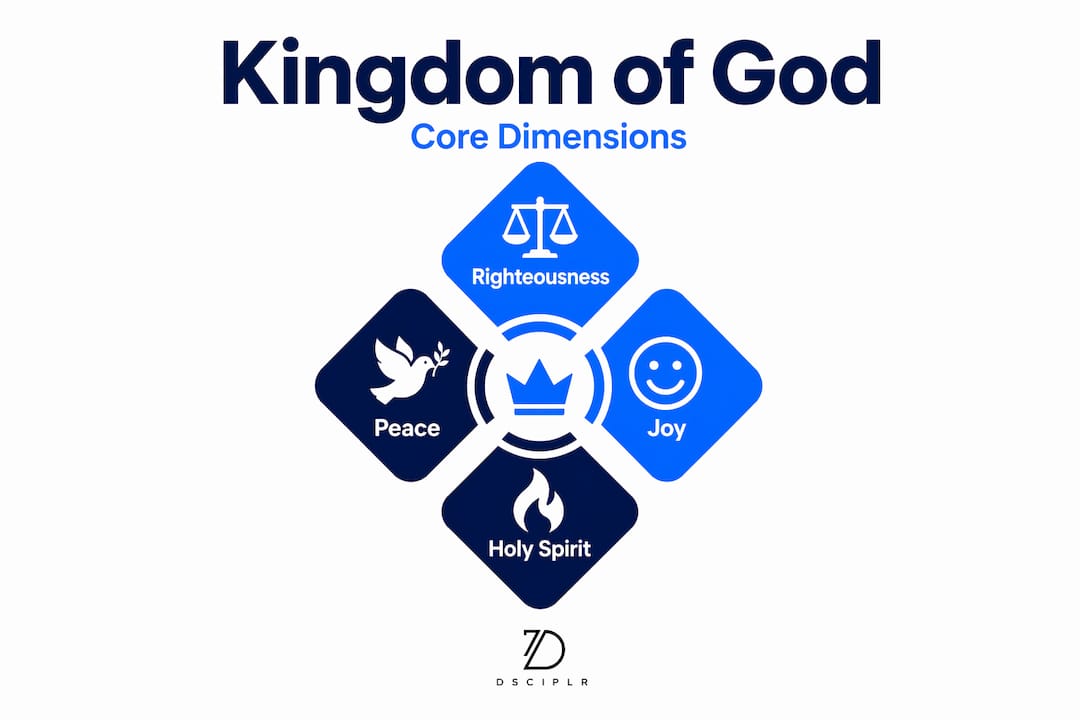
There is a helpful framework theologians call “kingdom spheres,” and it keeps all the dimensions in view:
Kingdom sphere | What it means | Where it operates |
Universal reign | God’s authority over all creation at all times | Every part of existence |
Saving reign | God’s redemptive rule in the hearts of believers | Within those who surrender to Christ |
Future manifestation | The visible, consummated kingdom at Christ’s return | The new heaven and new earth |
Recognising multiple dimensions of kingdom reality prevents two common errors. The first is reducing the kingdom to purely private spirituality, as if it only matters what happens in your heart. The second is reducing it to political or institutional power, as if building a Christian government is the same as building the kingdom. Neither captures the full picture.
Pro Tip: When you catch yourself asking “is this kingdom work?”, ask instead: does this reflect righteousness, peace, and joy in the Spirit? That question cuts through the confusion far more cleanly.
Living as kingdom citizens today
Knowing the theology is one thing. Living it is another. The kingdom of God in Christianity is never meant to stay in the realm of ideas. Jesus’ kingdom teaching always moves toward a call.
Here is what kingdom citizenship looks like in practice:
Righteousness in relationships. You pursue honesty, reconciliation, and justice in every personal interaction, not because it earns favour, but because the King’s character shapes yours.
Peace as a posture. Not passive withdrawal, but active peace-making. You become the person in your workplace, neighbourhood, or university who refuses to escalate and instead de-escalates.
Joy as witness. A joy that persists under pressure is one of the most compelling testimonies you can offer in a city like Canberra, where achievement culture often masks profound emptiness.
Mission as participation. Every act of genuine service, proclamation of the gospel, and care for the vulnerable is a participation in God’s redemptive work. The kingdom is not a programme you join. It is a reality you inhabit.
Community as expression. Kingdom life cannot be lived alone. When a group of people genuinely love one another, forgive one another, and serve together, they make the invisible kingdom visible. Church partnerships for mission are a tangible example of this principle in action.
The kingdom is both gift and call. You do not build it by effort alone, and you do not receive it passively. You enter it, you inhabit it, and you live under its rule.
The kingdom’s future: already, not yet
Here is where many believers feel tension, and it is honest tension worth sitting with. The kingdom is genuinely present. Jesus really did inaugurate it. And yet, looking at the world, we see injustice, suffering, and brokenness that clearly do not belong to a fully redeemed creation. How do we hold both truths?
Theologians describe this as the “already and not yet” dynamic. The kingdom as present and future reality is not a contradiction. It is the shape of redemptive history. The kingdom has broken in definitively with Christ’s resurrection. But its full, visible consummation awaits his return.
Dimension | Biblical basis | What it means for us now |
Already | Resurrection of Christ, outpouring of Spirit | We live in kingdom power today |
Not yet | New heaven and earth (Revelation 21) | We hope and press forward faithfully |
Both together | “Your kingdom come” (Matthew 6:10) | We pray and act as if both are true |
When Christ returns, every dimension of suffering, evil, and broken relationship will be finally and fully overturned. That is not wishful thinking. It is the anchor of Christian hope. And living between the “already” and “not yet” is not a waiting room. It is the most significant stretch of history you will ever participate in.
My perspective on explaining the kingdom
I have spent years sitting with this question, studying it, preaching it, and trying to live it, and I will tell you plainly: the thing that tripped me up for a long time was looking for the kingdom in the wrong places.
I wanted it to be big and visible. A movement. A moment. Something I could point to and say, “There, that is it.” But the more I sat with the Gospels, the more I realised that Jesus almost never talks about the kingdom in those terms. He talks about seeds. About yeast. About a father running down a road. Small things. Hidden things. Things that work from within.
What changed everything for me was understanding the kingdom as God’s sovereign rule becoming personally, practically real in my life. Not just a doctrine to affirm, but a reality to submit to every single day. When I started asking, “Am I actually living under the King’s authority right now, in this conversation, this decision, this relationship?”, everything shifted.
The transformation that follows is not dramatic overnight. It is seeds planted, slowly and faithfully. That, I have come to believe, is exactly the point.
— Josh
Grow in kingdom understanding with Divergentchurch
At Divergentchurch in Canberra, we believe that understanding the Kingdom of God is not just a theological exercise. It is the foundation for everything we do as a community shaped by Scripture and centred on Jesus. Whether you are just starting to explore what it means to follow Jesus or you are looking to go deeper in your discipleship, we have pathways built for that journey.
You can explore practical, kingdom-rooted leadership through Lead Like Jesus, or deepen your understanding of discipleship through the Discipleship Hub. If you want to take your first steps in following Jesus, Follow Jesus is a gentle, honest starting point. And if you are looking for genuine community in Canberra, our Life Communities are where kingdom life gets lived out in everyday relationships.
FAQ
What is the kingdom of God in simple terms?
The kingdom of God refers to God’s sovereign rule and reign. It is not a physical place but the active authority of God expressed in the world, in human hearts, and ultimately in the new creation.
Are the kingdom of God and kingdom of heaven the same thing?
Yes. Matthew uses “kingdom of heaven” out of Jewish reverence for God’s name, while Mark and Luke use “kingdom of God.” Both phrases) refer to the same reality.
Is the kingdom of God present now or only in the future?
Both. Theologians describe it as “already and not yet.” Jesus inaugurated the kingdom through his ministry and resurrection. Its full and visible consummation awaits Christ’s return and the new creation.
How do I experience the kingdom of God in daily life?
Romans 14:17 describes the kingdom as righteousness, peace, and joy in the Holy Spirit. You experience and express the kingdom when you live under God’s rule in your relationships, work, and community.
Is the church the same as the kingdom of God?
No. The church serves the kingdom, but the kingdom is not confined to the church as an institution. God’s sovereign reign extends over all creation and will one day encompass everything.
Recommended
Comments