
Everyday Christians: One Question That Reconciles Faith and Works


Salvation comes by faith alone, but the faith that saves is never alone. Scripture consistently teaches that trusting reliance on Christ is the root of salvation, while works are the fruit that inevitably grows from it, proving the root was alive all along. Paul and James approach this from different angles and against different problems, yet neither leaves room for a faith that changes nothing. What follows unpacks the scriptural detail, the historic denominational positions, and what a living faith looks like in the ordinary rhythms of a week.
TL;DR:
Faith is relational trust in Christ, while works can mean either ritual law observance or acts of mercy, depending on the context.
Paul emphasizes that justification is by faith as a gift, not earned through rituals or moral effort, with works following as a natural outcome of grace.
James argues that genuine faith must be demonstrated through observable deeds, warning that faith without works is spiritually “dead.”
The apparent contradiction between Paul and James dissolves when recognizing they address different audiences and types of “works,” and focus on justification versus evidence.
Authentic faith is reflected in everyday actions like forgiveness, giving, and accountability, which help believers demonstrate grace in daily life.
Table of Contents
What do “faith” and “works” actually mean in the New Testament?
Before Paul and James can be reconciled, their vocabulary needs sorting out, because both writers use the same English word “works” to mean quite different things.
Faith, in John’s Gospel and in Hebrews, describes trusting reliance on Christ rather than mere intellectual agreement. John writes that “whoever believes in him should not perish but have eternal life” (John 3:16), and Hebrews 11 defines faith as “the assurance of things hoped for, the conviction of things not seen.” This is relational trust, closer to leaning your full weight on someone than to ticking a doctrinal box.
Works carries at least two distinct senses across the New Testament, and missing this distinction is where most confusion about faith and works begins.
Works of the law: Paul’s technical phrase for ritual and identity markers under the Mosaic law, particularly circumcision, food laws, and Sabbath observance, which some in the early church demanded of Gentile converts.
General good works: James’ sense, meaning concrete acts of mercy, obedience, and neighbourly love, the kind of practical charity that costs something.
Deeds/actions broadly: how both writers use the term when addressing moral behaviour rather than ceremonial law.
Paul is almost always arguing against the first category. James is almost entirely concerned with the second. Once you see that, the supposed contradiction between them starts to dissolve before you even reach the harmonisation.
Paul’s case: justified by faith, not by works of the law
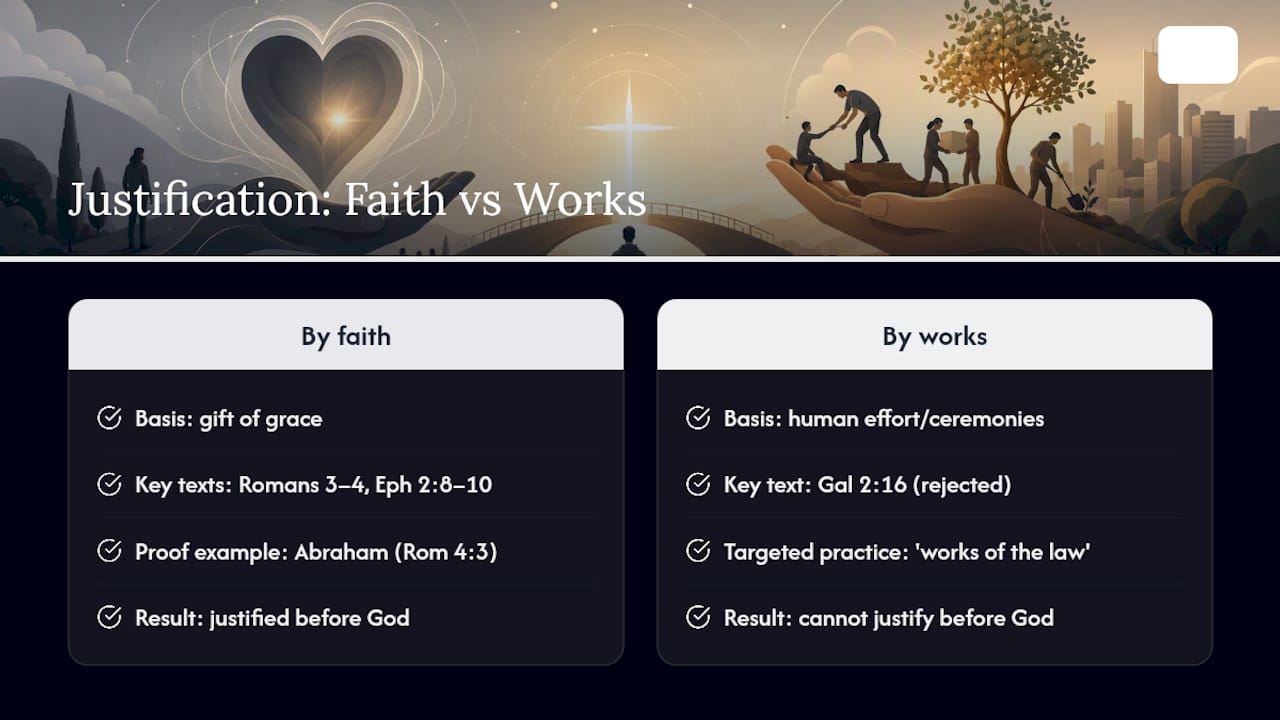
Paul’s letters make one thing unmistakable: no one is justified before God by human effort. Romans 3 and 4 build the argument methodically, culminating in the declaration that God “justifies the one who has faith in Jesus” (Romans 3:26), and pointing to Abraham as the proof text, since Abraham “believed God, and it was counted to him as righteousness” (Romans 4:3) before he had done anything to earn it.
Galatians sharpens the point further. Paul tells Peter directly that “a person is not justified by works of the law but through faith in Jesus Christ” (Galatians 2:16), a rebuke aimed squarely at the pressure to adopt Jewish ceremonial identity as a condition of belonging to God’s people. Ephesians 2:8-9 states it with the clearest economy in the New Testament: “For by grace you have been saved through faith. And this is not your own doing; it is the gift of God, not a result of works, so that no one may boast.”
Salvation, for Paul, is never a wage earned but a gift received, and Ephesians 2:10 immediately adds that believers are “created in Christ Jesus for good works,” which God “prepared beforehand.” Grace comes first; the works follow as its intended outcome, not its price.
Paul’s target was never charity or moral effort itself. He was protecting the gospel from a specific corruption: the idea that ethnic or ceremonial markers, “works of the law,” could add to or substitute for grace. His pastoral aim was to keep salvation a gift, because a gift you can earn stops being a gift.
James’ case: faith without works is dead
James writes to a very different problem. His readers were not tempted to earn salvation through ritual observance; some of them were claiming faith while their lives showed nothing of it. His question in James 2:14 is rhetorical and cutting: “What good is it, my brothers, if someone says he has faith but does not have works? Can that faith save him?” The Greek grammar expects the answer no.
James pushes the point with an image most readers find uncomfortable: a bare assertion of belief, he says, is no better than the demons’ faith, since “even the demons believe, and shudder” (James 2:19). Intellectual assent without transformed living is not the faith Scripture commends; it is closer to an acknowledgment of facts than a relationship of trust.
He then reaches for two examples that do real argumentative work rather than serving as mere illustration.
Abraham, whose willingness to offer Isaac on the altar demonstrated a faith that was “completed” by action (James 2:22), not created by it.
Rahab, the Canaanite woman who sheltered Israel’s spies, whose faith was “justified by works” (James 2:25) when she risked her life on what she believed to be true.
James 2:26 delivers the verdict that gives the passage its enduring force: “For as the body apart from the spirit is dead, so also faith apart from works is dead.” As BibleProject explains, James is not describing two paths to salvation. He is warning that a faith producing no observable fruit was never alive in the first place, and his examples exist to prove that authentic faith always shows itself.
Harmonising Paul and James: why they don’t actually contradict each other
Read side by side, Paul and James can sound like they are arguing past each other. Read in context, they are answering different questions from different pastoral emergencies, and the tension resolves along four clear lines.
Different audiences. Paul writes largely to Gentile churches under pressure from Judaizers demanding law observance; James writes to Jewish Christian communities where a nominal, inactive faith had taken root.
Different senses of “works.” Paul means ritual and identity markers under the Mosaic law; James means everyday deeds of mercy and obedience.
Different timing. Paul speaks of justification’s declaration, the moment God counts a believer righteous by faith; James speaks of justification’s demonstration, the ongoing evidence that the declaration was real.
Different rhetorical purpose. Paul is defending grace against legalism; James is defending genuine faith against empty profession.
As scholarship on the Paul-James relationship notes, the two writers “address different issues” entirely, which is why their vocabulary overlaps while their targets do not.
The oldest and simplest picture remains the most useful: faith is the root, works are the fruit. Nobody expects an apple tree to produce apples by trying harder; the fruit simply follows from what the tree already is. Catholic and Protestant readers alike find this image does more explanatory work than a formula ever could, because it replaces “which one counts?” with “what does a living thing naturally do?”
Pro Tip: When you’re unsure whether your own faith is “dead” or “living,” don’t interrogate your feelings. Ask what has actually changed in how you treat people, spend money, and use your time over the last twelve months.
Use this short checklist to tell the two apart:
Living faith produces fruit slowly but genuinely, even through failure and repentance.
Dead faith produces explanations for why fruit hasn’t appeared yet.
Living faith welcomes correction; dead faith gets defensive when works are questioned.
What the major Christian traditions teach about faith and works
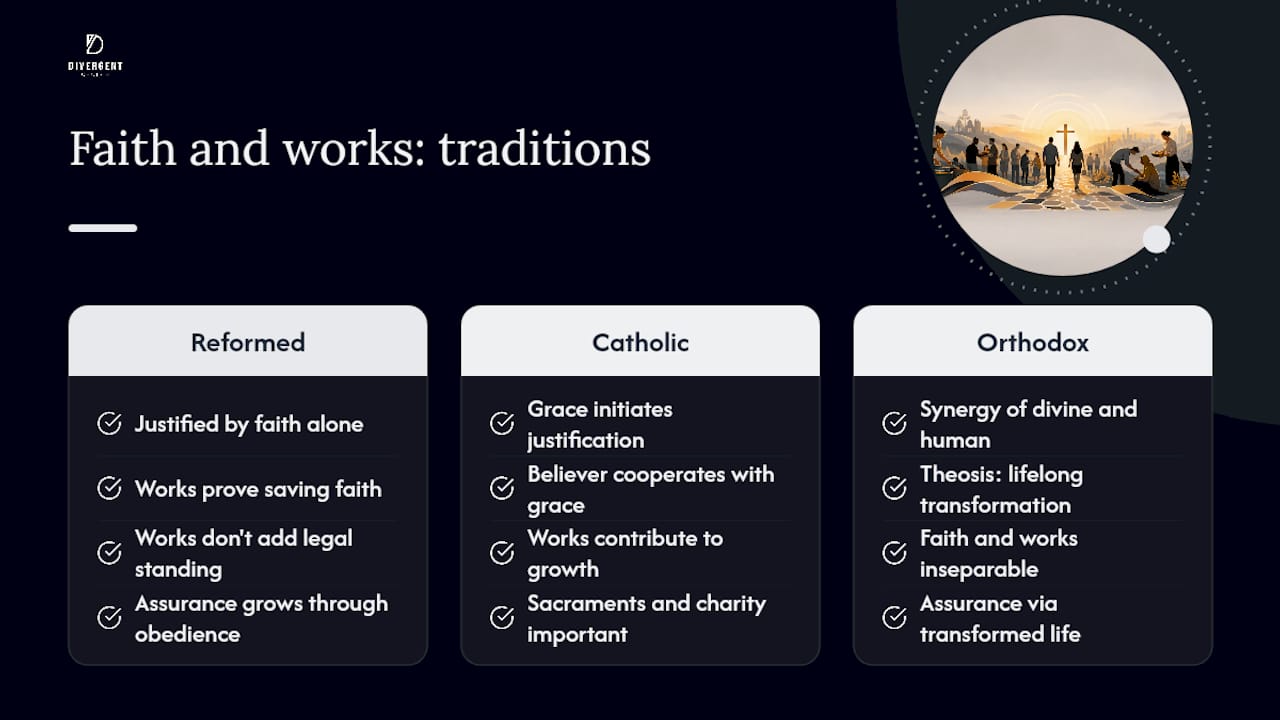
Every major branch of the church affirms that authentic faith and works belong together, though each frames the relationship with its own emphasis and vocabulary.
Reformed and Protestant tradition holds to justification by faith alone (sola fide), insisting that works add nothing to a believer’s legal standing before God but are the necessary and inevitable evidence that saving faith is present. The Gospel Coalition frames it plainly: salvation comes through faith in Christ alone, and good works are what that faith produces, never what earns it.
Roman Catholic teaching, clarified at the Council of Trent, distinguishes between the grace that initiates justification, which is entirely unmerited, and the ongoing cooperation of the believer with that grace through a life of charity and the sacraments. Works are not the cause of initial justification but are understood as genuinely contributing to the believer’s growth in righteousness.
Orthodox theology speaks in terms of synergy, the divine and human working together, and theosis, the lifelong process of being transformed into Christ’s likeness. Faith and works are treated as two inseparable sides of the same transformation rather than as sequential steps.
The practical consequence matters more than the technical labels: traditions differ on how to describe the mechanics, but none permit a “faith” that produces no visible change, and all treat assurance as something that grows through a lived pattern of obedience, not a one-off decision detached from daily life.
What authentic faith looks like in daily life
Doctrine that never reaches Tuesday afternoon isn’t doctrine anyone has actually understood. Authentic faith shows up in concrete, sometimes unglamorous ways: forgiving someone who hasn’t apologised, giving money that will be missed, showing up for a friend’s crisis at an inconvenient hour, admitting fault before being caught.
None of this earns anything. It simply reveals what grace has already begun. That distinction protects believers from two opposite dangers: legalism, where works become a scoreboard for earning God’s favour, and licentiousness, where “faith alone” becomes an excuse for a life indistinguishable from unbelief.
Certain disciplines consistently help faith become visible without turning it into a checklist:
Regular Scripture reading that shapes conscience, not just knowledge.
Serving within a local church community, where accountability is relational rather than abstract.
Practising generous, sacrificial giving as an act of trust rather than obligation.
Honest confession within small-group community, where sin is named rather than hidden.
Practising repentance as a rhythm, not a one-time event.
What dead faith looks like | What living faith looks like |
Belief stated but never tested | Belief that shapes daily decisions |
Avoids accountability | Welcomes correction from community |
Generosity postponed indefinitely | Generosity practised even when costly |
Confession avoided or minimised | Confession treated as normal and safe |
How Divergent Church helps faith become action
Divergentchurch exists precisely at this point where belief meets behaviour. Our Discipleship Hub walks people through a structured pathway that moves faith from private conviction into shared practice, and our Life Communities give that pathway a weekly, relational shape rather than leaving it as an abstract intention.
We’ve watched what actually helps faith become visible, and it’s rarely a sermon alone. It’s smaller and more consistent than that.
A Life Community member choosing to reconcile with a family member after months of silence.
A workplace conversation about faith that started because someone noticed consistent honesty, not because of a rehearsed pitch.
A group deciding together to fund a need in their neighbourhood rather than debating theology about it.
Our Lead Like Jesus pathway builds on the same conviction: leadership formed by service, not status, because that is what James was describing all along.
What the church often gets wrong about this debate
Most churches don’t actually disagree on the theology here. Ask any pastor across the Protestant, Catholic, or Orthodox spectrum whether works save you apart from grace, and you’ll get the same answer. Where the debate breaks down is pastoral, not doctrinal: churches tend to overcorrect in one direction depending on which error they’re most afraid of.
Congregations burned by legalism drift toward a faith so private it stops asking anything of anyone, quietly recreating the very “faith” James dismissed as dead. Congregations burned by works-focused guilt drift the other way, treating any mention of obedience as a threat to grace. Both overcorrections borrow half of the biblical picture and call it the whole thing.
The reader’s actual priority should be simpler than either camp makes it sound: stop asking “does this action save me?” and start asking “does my life currently show any evidence that grace has taken hold?” That question doesn’t require theological sophistication. It requires honesty, and usually a community close enough to answer it for you when you can’t see yourself clearly.
— Josh
Ready to put faith into practice with a community?
Reading about faith and works is one thing. Practising it week after week, inside a community that notices when your life doesn’t match your words, is another. Divergentchurch’s Discipleship Hub exists for exactly this gap: a structured pathway, not a vague suggestion to “try harder,” that helps you move from private belief into visible, shared obedience alongside people who will actually ask how it’s going.

If you’re weighing up whether to join a small group or navigate this on your own, the honest answer from Scripture is that faith was never designed to grow in isolation. Our Life Communities give you that weekly rhythm of accountability, service, and honest conversation that turns a theological conviction into an actual pattern of life. If reading devotional material alongside a group appeals to you, resources like those from GraceLight Press pair well with that rhythm. The next step is straightforward: get in touch and join a Life Community this month.
Sources
Recommended
Comments