
16 Chapters That Force a Choice in the Gospel of Mark for Discipleship


The Gospel of Mark presents Jesus as the suffering Messiah and Son of God in a short, fast-moving narrative that calls readers to costly discipleship. Mark tells this story in just 16 chapters, moving from Galilee to Jerusalem to the cross with almost no pause for reflection. The earliest manuscripts end abruptly at Mark 16:8, though later copies add a longer ending. Every scene builds toward one question: will you follow, or will you flee?
TL;DR:
Mark’s fast-paced narrative emphasizes miracles and action over lengthy teachings, using the word “immediately” to maintain momentum throughout the story.
The gospel was likely written between the 50s and 60s A.D. by John Mark, based on Peter’s recollections, with a probable audience of persecuted Gentile believers in Rome.
Its three-act structure traces Jesus’ ministry from Galilee to Jerusalem and culminates in his crucifixion, highlighting themes of suffering, kingship, and discipleship.
Most early manuscripts end abruptly at Mark 16:8, with the longer ending considered a later addition, leaving the original text open to interpretation about followers’ responses.
Studying Mark in small groups or with guided resources encourages a deeper understanding of its call to costly discipleship and authentic faith.
Table of Contents
What is the gospel of Mark? An overview of its content and scope
Mark is the shortest of the four gospels, and it reads that way. There is no birth narrative, no genealogy, no extended discourse on the mountain. Mark opens with a grown man at a river, and within a chapter Jesus is already casting out demons, healing the sick, and drawing crowds he cannot shake.
That pace is deliberate. Mark uses the Greek adverb euthus, meaning “immediately,” many times to keep the narrative moving at breathless speed. Events stack on top of each other rather than unfolding slowly, which gives the book a documentary urgency the other gospels don’t share in quite the same way.
Mark also packs in a high number of miracle accounts relative to its length compared with the other synoptics. That density tells you what Mark thinks matters: not lengthy teaching blocks, but demonstrated authority.
The opening line sets the whole agenda. Mark 1:1 reads: “The beginning of the gospel of Jesus Christ, the Son of God.” Everything that follows, every healing, every confrontation with religious leaders, every closed-door conversation with the disciples, exists to answer the question that sentence raises.
Sixteen chapters, the shortest of the four gospels
A miracle-heavy narrative built around action rather than extended discourse
Mark 1:1 names Jesus as Messiah and Son of God before a single scene plays out
Frequent use of “immediately” to create narrative momentum
Who wrote Mark and when was it written?
Early church tradition, recorded by writers drawing on the testimony of Papias, identifies the author as John Mark, a companion of the apostle Peter. That tradition holds that Mark wrote down Peter’s recollections of Jesus’ ministry rather than composing an eyewitness account of his own.
This matters for how you read the book. If Mark is substantially Peter’s memory filtered through a scribe, the plain, unpolished style and the focus on action over theology start to make sense.
Most scholars place the writing somewhere between the mid 50s and mid 60s A.D., which would make Mark the earliest of the four gospels. The ESV Global Study Bible suggests a Roman audience, possibly written during a period of persecution. This would explain why Mark leans so hard into suffering and endurance as themes.
Author: traditionally John Mark, associate of Peter
Primary source: Peter’s eyewitness recollections, according to early tradition
Likely date: mid-50s to mid-60s A.D.
Likely audience: Gentile believers, possibly in Rome, facing hardship
Mark’s three-act structure: from Galilee to the cross
Commentators including BibleProject describe Mark as a carefully built three-act drama rather than a loose collection of stories. Each act shifts location and raises the stakes on the same underlying question: who is this man?
Act one (chapters 1 to 8): Galilee and the ministry of authority. Jesus teaches, heals, casts out demons, and calms storms. Crowds are amazed, but nobody quite understands what they’re looking at.
Act two (chapters 8 to 10): the road to Jerusalem. The pace slows. Jesus turns south and starts teaching plainly about suffering and death. Mark 8:27-31 records Peter’s confession, “You are the Christ,” followed immediately by Jesus predicting his own execution.
Act three (chapters 11 to 16): Jerusalem, trial, and the cross. Jesus enters the city, clashes with religious leaders, is arrested, tried, and crucified. The narrative ends at 16:8 with the women fleeing the empty tomb in fear, though most modern Bibles print a longer ending (16:9-20) as well.
That structure isn’t accidental. Mark builds toward the cross the way a play builds toward its final act, and everything before Jerusalem exists to set up the collision that happens there.
The themes that hold Mark together
Mark’s theology comes through the way the story is arranged, not through long speeches. You learn who Jesus is by watching him act, not by hearing him explain himself at length.
Messiah and Son of God. Mark 1:1 opens with the claim, and a Roman centurion confirms it at the cross in Mark 15:39, framing the whole gospel between those two declarations.
The suffering servant. Mark 10:45 states the mission outright: “For even the Son of Man came not to be served but to serve, and to give his life as a ransom for many.”
The kingdom breaking in. Jesus announces the kingdom of God has arrived, not as a future hope but as a present reality pressing into ordinary life.
Costly discipleship. Following Jesus means taking up a cross, not adopting a set of ethical rules. Mark frames it as relational and demanding rather than abstract.
Narrative urgency and the messianic secret. Jesus repeatedly tells demons and healed people to stay quiet about his identity, building tension that only resolves at the crucifixion.
Pro Tip: If you want to feel Mark’s urgency for yourself, read chapters 1 to 3 in one sitting and count how many times something happens “immediately.” It changes how you hear the rest of the book.
Can you trust the text? Manuscripts and the longer ending
Early manuscript fragments, including portions of P45, show that Mark was circulating and being copied well before the close of the first century. That’s a strong signal the text we read today wasn’t cobbled together centuries after the events it describes.
The trickier question is how Mark ends. The earliest and most reliable manuscripts stop at 16:8, with the women fleeing the tomb in fear and saying nothing to anyone. Later manuscript traditions add verses 9 to 20, including resurrection appearances and a commissioning scene.
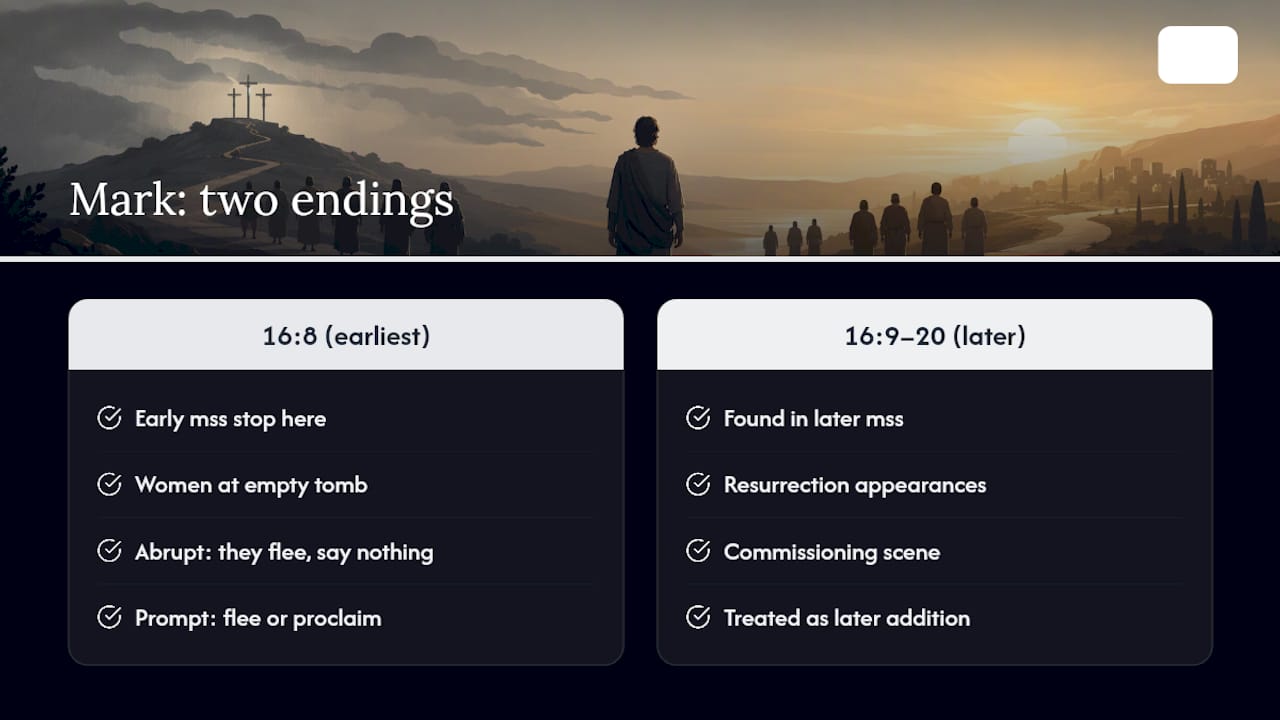
Most textual scholars treat 16:9-20 as a later addition rather than part of Mark’s original composition, and modern study Bibles typically flag this in a footnote rather than hiding it.
That abrupt original ending isn’t a flaw to explain away. It functions as a prompt: the women fled in fear, so will you flee too, or will you become the one who tells the story? For study and preaching, the practical move is simple: read 16:1-8 as Mark’s intended close, then treat 16:9-20 as a separate, later tradition worth noting rather than ignoring.
A simple way to start reading Mark
You don’t need a semester of theological training to get into Mark. A short, focused plan works better than trying to read it cover to cover in one go.
Session one: Read Mark 1:1-13 and ask who Mark says Jesus is before he does anything.
Session two: Read Mark 8:27-38 and sit with Peter’s confession and Jesus’ hard words about the cross.
Session three: Read Mark 11:1-11 and 14:32-42, tracing the shift from triumphal entry to Gethsemane.
Session four: Read Mark 15:33-39 and 16:1-8, ending where the earliest manuscripts end.
Compare two translations as you go, keep a study Bible’s footnotes handy, and don’t rush. Mark rewards a slow, repeated read more than a fast single pass.
Why Divergent Church leans on Mark for discipleship
Mark’s insistence that following Jesus costs something shapes how this church approaches discipleship. We don’t read Mark as a historical curiosity. We read it as a script for the kind of costly, relational faith it describes, worked out in small groups, everyday relationships, and the ordinary rhythms of city life. If you want a next step for guided study, our discipleship resources walk through exactly the kind of questions Mark raises.
— Josh
Study Mark with a group, not just a highlighter
Reading Mark alone gets you a summary. Reading it with people who’ll ask you the hard question Peter got asked at Caesarea Philippi gets you something closer to what Mark was written for.
Divergentchurch’s Discipleship Hub exists for exactly this kind of study: structured, guided sessions that walk through books like Mark with people committed to more than a Sunday hour. If a weekly rhythm suits you better than a course, our Life Communities groups meet across Canberra and Queanbeyan to work through Scripture together and put it into practice in ordinary weeks. Both options exist because Mark’s call to discipleship was never meant to be worked out solo. If you’re ready to find a group or a study track that fits where you’re at, get in touch with us and we’ll help you find the right starting point.
Sources
FAQ
What is the full summary of the Gospel of Mark?
Mark tells the story of Jesus as the suffering Messiah and Son of God in three acts: a Galilean ministry of miracles and teaching, a journey toward Jerusalem centred on identity and discipleship, and a final week culminating in the crucifixion and resurrection.
What are the main points in the Gospel of Mark?
The main points are Jesus’ identity as Messiah and Son of God, his role as a suffering servant who gives his life as a ransom, the arrival of the kingdom of God, and the demand for costly discipleship from anyone who follows him.
What is the main message of the Gospel of Mark?
Mark’s central message is that Jesus is the Son of God who came to serve and suffer rather than to rule with power, and that following him means being willing to take up a cross rather than seek comfort.
Why is the Gospel of Mark different from the other gospels?
Mark is shorter and faster paced than Matthew, Luke, and John, favouring action and miracle accounts over extended teaching discourse, and it lacks the birth narratives found in Matthew and Luke, opening instead with Jesus already an adult at his baptism.
Recommended
Comments