
Pray in 5 Minutes: ACTS, a One Line Script and Daily Habits

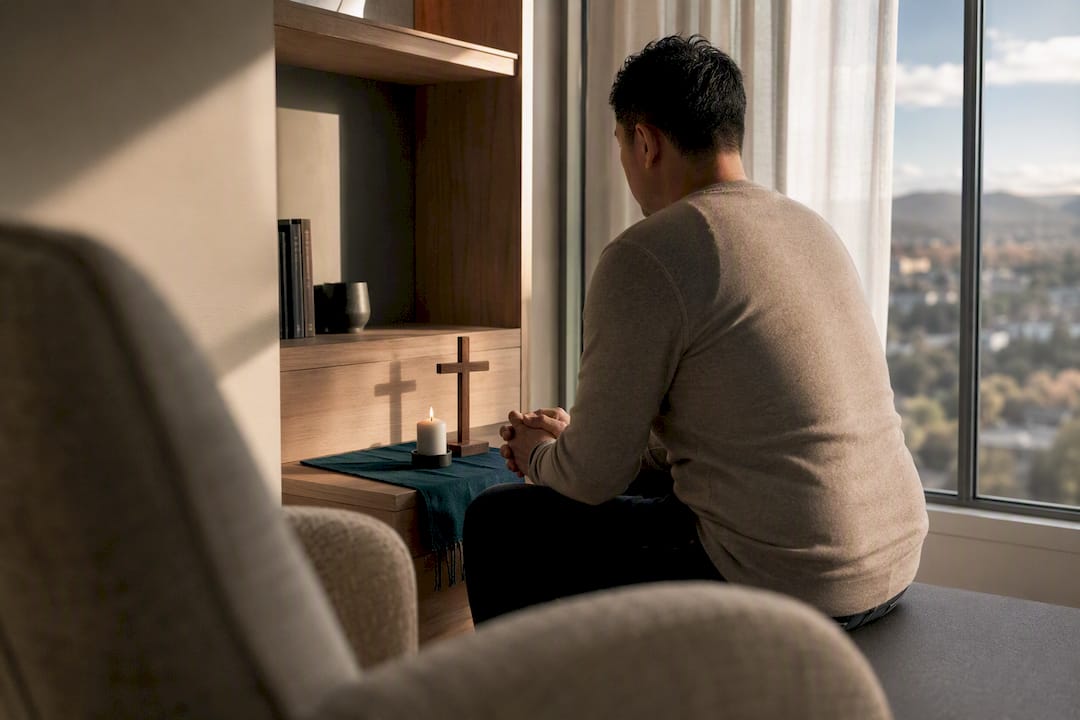
Prayer is simply talking with God, and you can start right now, in whatever state you’re in. Try this: “God, I don’t fully know what I’m doing, but thank you for today, I’m sorry for [name one thing], and I need help with [name one thing]. Amen.” That’s it. No polished words, no correct posture, no theological degree required, just honesty and a willingness to keep showing up.
TL;DR:
Regular prayer benefits from simple frameworks like ACTS or the Lord’s Prayer, which help structure honest and manageable conversations with God.
Connecting prayer to daily routines and using short, frequent “arrow prayers” increases consistency and makes prayer a sustainable habit.
Praying aloud, using physical anchors, or incorporating written prayers and prayer beads can improve focus and turn prayer into a practical, accessible practice.
Group prayer fosters community, accountability, and the repetition needed for prayer to become a lasting part of life rather than an occasional act.
Building a flexible, forgiving routine with brief, repeated practices means prayer becomes resilient to busy schedules and setbacks.
Table of Contents
What is the simplest framework for how to pray?
You don’t need to invent your own words every time you pray. Two patterns have carried Christians through two thousand years of practice, and both still work for a Tuesday morning in 2026.
The first is ACTS, a four-part shape that keeps your prayers from becoming a shopping list of requests:
Adoration — telling God who he is. “You made the mountains. You’re patient with me.”
Confession — naming what’s gone wrong, without dressing it up. “I lost my temper with my kids today.”
Thanksgiving — naming what’s gone right, however small. “Thank you for the coffee that actually tasted good this morning.”
Supplication — asking, for yourself and others. “Please help me sleep tonight. Please help my brother find work.”
The second is the Lord’s Prayer, given by Jesus in Matthew 6 as a pattern to shape prayer, not a script to recite word for word every time. It moves through the same territory as ACTS: honouring God (“hallowed be your name”), surrendering to his plans (“your will be done”), asking for provision (“give us today our daily bread”), and seeking forgiveness (“forgive us our debts”). Praying it slowly, phrase by phrase, and pausing to add your own words to each line, turns a memorised verse into something personal.
Here are two you can copy today:
Morning version: “God, you’re good even on hard days. Sorry for how I spoke to my flatmate last night. Thanks for this new day. Please give me patience at work.”
Stress version: “God, I’m overwhelmed right now. I know you’re bigger than this. Forgive me for trying to control everything. Help me take the next right step.”
Both patterns exist so you never have to stare at a blank page wondering what to say. ACTS is a widely used framework precisely because it stops requests from crowding out gratitude and honesty.
Where and how should you pray?
You don’t need a chapel or a special posture. You need a spot and a rhythm you’ll actually stick to.
Pick a place first, a chair by a window, your car before you turn the ignition, the edge of your bed. Attach prayer to something you already do daily: brushing your teeth, the first sip of coffee, the walk to the bus stop. The Church of England’s guidance on learning to pray points out that structure and rhythm matter more than the exact ritual you choose.
Posture is genuinely flexible:
Kneeling suits confession and moments of surrender.
Standing with open hands works for adoration and thanksgiving.
Sitting quietly suits listening and reflection.
Walking suits working through a problem while you pray.
Praying out loud helps some people stay focused and stops the mind wandering; praying silently suits a crowded train or a shared office. Neither is more valid than the other, and God isn’t grading your posture.
Pro Tip: If distraction keeps pulling you away, try praying with your eyes open on a fixed point, like a candle or a cross on the wall. It sounds unusual, but the small physical anchor gives a wandering mind less room to drift.
A short scripture reading before you pray, even a single Psalm verse, gives your mind something to settle on before you start speaking.
How do you build prayer into a daily habit?
Occasional prayer rarely survives a busy week. What survives is small, repeated practice, and this is where beginners often go wrong: they wait for a long, uninterrupted block of time that never actually arrives.
Fractional prayers (sometimes called “arrow prayers”) solve that. These are one-line prayers fired off mid-task:
Before a hard meeting: “God, give me clear words.”
While a toddler is mid-tantrum: “God, patience, please.”
Stuck in traffic: “God, slow my heart down.”
Short, frequent prayers like these build a habit of turning to God throughout the day rather than saving him for a single scheduled slot.
A prayer journal adds structure without much effort. Three columns work well: what you prayed for, the date, and what happened. Reviewing it a month later, seeing how many entries have an answer beside them, is often the moment prayer stops feeling abstract.

Praying Scripture means taking a verse, like Psalm 23:1, and turning it into a direct address: “Lord, you are my shepherd. I don’t need to be anxious about what I lack today.” Combining a memorised framework with scripture-based phrasing gives your prayers both structure and theological grounding.
Finally, build in silence. Pray for two minutes, then stop talking and sit quietly for sixty seconds. Prayer is a two-way conversation, and that pause is where listening happens. Practical tools like a timer or a written plan make this easier to sustain than relying on memory alone.
What does praying with others look like?
Praying alongside others does something solo prayer can’t: it makes faith feel shared rather than private and fragile. It also teaches you patterns you’ll reuse on your own.
A few basics make group prayer work smoothly:
Keep individual prayers short, ten to twenty seconds, so everyone gets a turn.
If you’re leading, open with a simple invitation (“Let’s each share one thing, out loud or silently”) rather than a long introduction.
Silence between people praying is normal, not awkward. Let it sit.
When someone shares a need, write it down. Praying for someone once and forgetting by Thursday is common; a small list changes that.
Follow up during the week with a text: “Still praying for that job interview.”
Intercession, praying for someone else’s specific situation, works best when it’s concrete. “Bless my friend” is vague. “Give Sarah calm before her surgery on Thursday” gives you and the group something real to hold onto and check back on.
What Divergent Church has learned about building a prayer habit
Some churches have observed that people rarely fail at prayer because they lack sincerity, but rather because they never build a rhythm. That is the thinking behind practices like 21 Days of Prayer, a short, structured push designed to help a habit take root before motivation fades. It pairs well with the daily rhythms outlined in our Christian habits guide. If you want a low-pressure way to test one new practice this week, start with a single fractional prayer at the same moment each day and see what shifts.
Has prayer always looked the same?
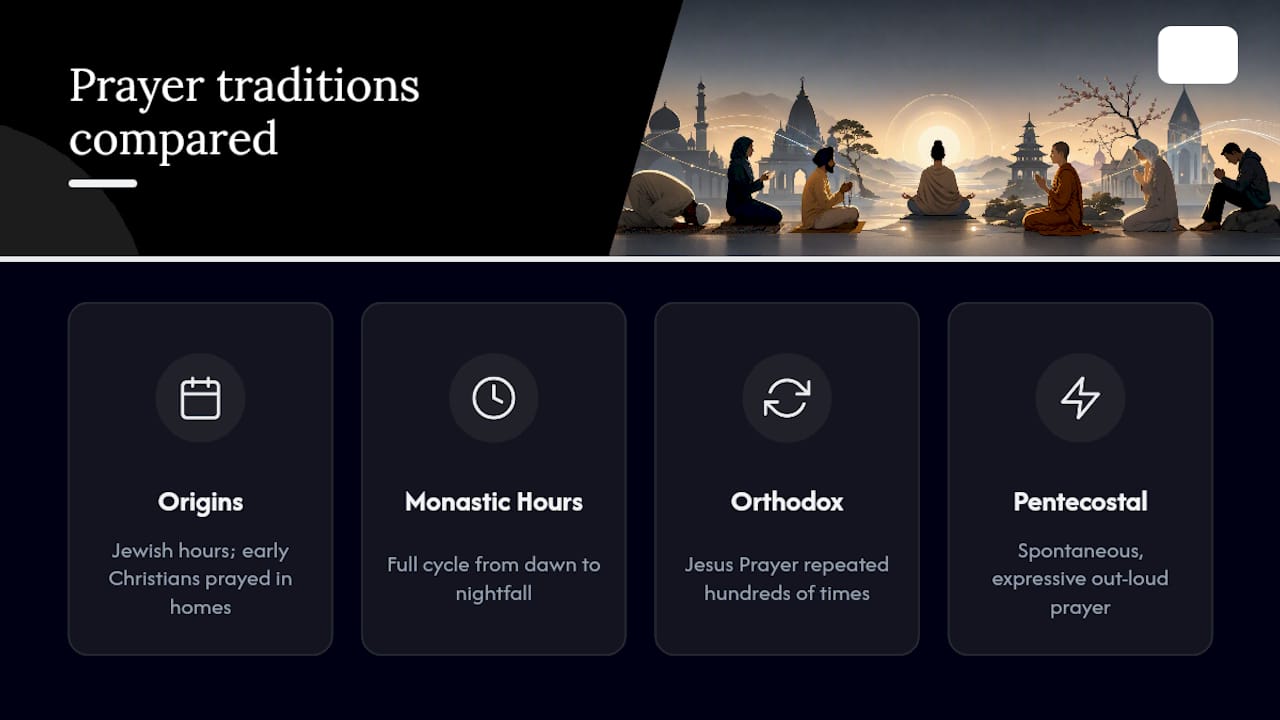
Not remotely. Jewish prayer in Jesus’s time followed fixed daily hours, morning, afternoon, and evening, often facing Jerusalem. Early Christians inherited that rhythm and added their own, gathering in homes to pray together before formal church buildings existed.
Monastic communities from the fourth century onward developed the “hours,” a full daily cycle of set prayers sung or spoken at intervals from before dawn to nightfall. That structure still shapes the Anglican and Catholic traditions of set liturgical prayer today.
Orthodox Christian practice leans heavily on repetition, the Jesus Prayer (“Lord Jesus Christ, Son of God, have mercy on me”) repeated quietly, sometimes hundreds of times, as a form of meditation. Pentecostal and charismatic traditions, by contrast, often favour spontaneous, expressive, out-loud prayer with less fixed structure.
None of these traditions is the single correct one. What they share is more instructive than what separates them: regular rhythm, honest address to God, and a mix of set words with personal, spontaneous ones. A beginner today drawing on ACTS and the Lord’s Prayer is standing in a very long line of people who needed the same scaffolding to keep going.
Does consistent prayer actually change anything?
People who pray regularly, rather than only in a crisis, tend to describe a different relationship with anxiety. It’s not that problems disappear. It’s that a habit of naming a fear out loud, to someone, on a schedule, seems to loosen its grip somewhat.
Confession as a regular practice does something specific: it keeps small resentments and guilt from quietly accumulating over weeks. Thanksgiving, prayed consistently, retrains attention toward what’s already good, which is easy to miss when you’re running on autopilot.
There’s also a community effect. People who pray for specific others, by name, tend to stay more engaged with those relationships. A prayer list isn’t just a spiritual exercise, it’s a memory aid for who actually needs you this week.
None of this happens from a single powerful prayer session. It comes from the unglamorous repetition of showing up most days, saying honest things, and staying open to the possibility that God is listening back.
Can prayer beads and written prayers help?
Yes, and they’re not a shortcut, they’re scaffolding, the same way training wheels help before you can ride unassisted.
Prayer beads, whether an Anglican prayer bracelet, a Catholic rosary, or another counted set, give your hands something to do while your mind stays on the words. Each bead marks a phrase or a name, which stops a wandering mind from drifting entirely off-topic during longer prayer.
Written prayers, whether copied from a prayer book, a psalm, or a card kept in your wallet, solve the “I don’t know what to say” problem instantly. Reading someone else’s honest words on a hard day isn’t cheating. It’s borrowing language until you find your own. Many people move fluidly between written prayers and spontaneous ones depending on the day, using structure when they’re depleted and free speech when words come easily.
A simple written prayer, kept on your phone or a sticky note, can be as helpful as using prayer beads. The tool matters far less than whether you actually pick it up.
A simple routine that actually holds up
A workable rhythm looks something like this: five minutes with ACTS over coffee in the morning, one fractional prayer fired off mid-afternoon when stress spikes, and two lines in a journal before bed, one thing you’re grateful for, one thing you’re still carrying. On a chaotic day, that shrinks to a single sentence prayed in the car. The goal isn’t a flawless streak, it’s returning to the habit after you inevitably miss a day. Growth in prayer looks less like a straight line and more like a slow, forgiving spiral back to the same few honest habits.
— Josh
How Divergent Church can help you build a prayer life
Reading about prayer gets you started; praying alongside other people is usually what makes it last. That’s the gap Divergent Church exists to close for anyone in Canberra and Queanbeyan who wants company on this, not another set of rules to follow.
Our Discipleship Hub is designed for this stage, providing structured but flexible pathways for those who want to grow beyond solo routines, with people checking in regularly. Our Life Communities are small groups where members pray for each other by name and follow up weekly, fostering relationship-based prayer learning. Neither is required to have a meaningful prayer life. Plenty of people pray well entirely on their own. But if you’re the kind of person who does better with a bit of accountability and shared honesty, get in touch and we’ll point you toward a group that fits where you’re at right now.
Sources
For deeper reading on the frameworks covered here, the Church of England’s guidance on learning to pray and Cru’s step-by-step introduction both offer practical grounding. For habit-building tools, see Crossway’s four practical tools. To explore prayer within community, visit Divergent Church.
Recommended
Comments