
How to volunteer at church: meaningful service in Canberra


Wanting to serve your church community is one of the most quietly courageous things a person can do. You sense a pull toward something greater than yourself, a desire to contribute, to be part of building something that matters. But for many people in Canberra, that desire gets tangled up in uncertainty: Where do I start? What do they actually need? Will I fit in? This guide walks you through every practical step of volunteering in a local church setting, from understanding legal requirements to discovering the role that genuinely suits you, so you can move from wondering to serving with confidence.
Table of Contents
Key Takeaways
Point | Details |
Know local compliance | You may need a WWVP card or other checks before volunteering in Canberra churches. |
Take it step by step | Start by connecting with leadership, completing onboarding, and finding the right fit for your skills. |
Support makes it easier | Churches with clear processes and support help volunteers thrive and stay committed. |
Trial periods are wise | Trying out a role helps you and the church ensure it’s the right match before you commit long term. |
What to know before you volunteer
Before you show up ready to serve, there are a few important things to understand. Church volunteering in Canberra is deeply rewarding, but it also carries real responsibilities, particularly when it comes to safeguarding the people your church serves.
Legal requirements in the ACT
For faith communities serving children or vulnerable people in the ACT, volunteer screening requirements can apply, including the Working With Vulnerable People (WWVP) scheme for regulated activities. This is not bureaucratic red tape. It is a meaningful expression of the church’s commitment to care, dignity, and protection for every person who walks through its doors.
Not every volunteer role requires a WWVP card. If you are helping with general hospitality, setting up chairs, or supporting administration, you may not need one. But if your role involves direct contact with children or vulnerable adults, a WWVP registration is mandatory before you begin.
“Protecting the vulnerable is not separate from the mission of the Church. It is woven into it. To serve faithfully is to serve safely.”
What churches typically expect
Beyond legal requirements, most churches will ask you to attend an orientation session, complete a short application or expression of interest form, and have a brief conversation with a volunteer coordinator or pastor. Some churches, including those committed to building a strong church community, will also ask you to participate in regular gatherings before stepping into a serving role, so that you are already part of the community you are serving.
Here is a summary of what you can typically expect:
Prerequisite | Required for all roles? | Notes |
WWVP registration | No, only regulated roles | Mandatory for children/vulnerable people contact |
Expression of interest form | Usually yes | Helps coordinators match you to the right role |
Orientation or induction | Usually yes | Covers values, expectations, and safety |
Reference check | Sometimes | Especially for leadership-adjacent roles |
Trial or shadow period | Recommended | Helps both parties assess fit |
Questions to ask before you begin
Before committing to a role, it is worth asking a few honest questions:
Does this role require a WWVP card, and how do I apply for one?
What is the time commitment per week or month?
Is there a formal onboarding process?
Who will I report to or connect with as a volunteer?
What support is available if I feel uncertain or overwhelmed?
These questions are not signs of hesitation. They are signs of wisdom. A church that welcomes them is a church worth serving in.
How to get started: step-by-step process
Once you understand the prerequisites, it is time to follow the concrete steps to get involved. The path from curiosity to active service is more straightforward than it might feel.
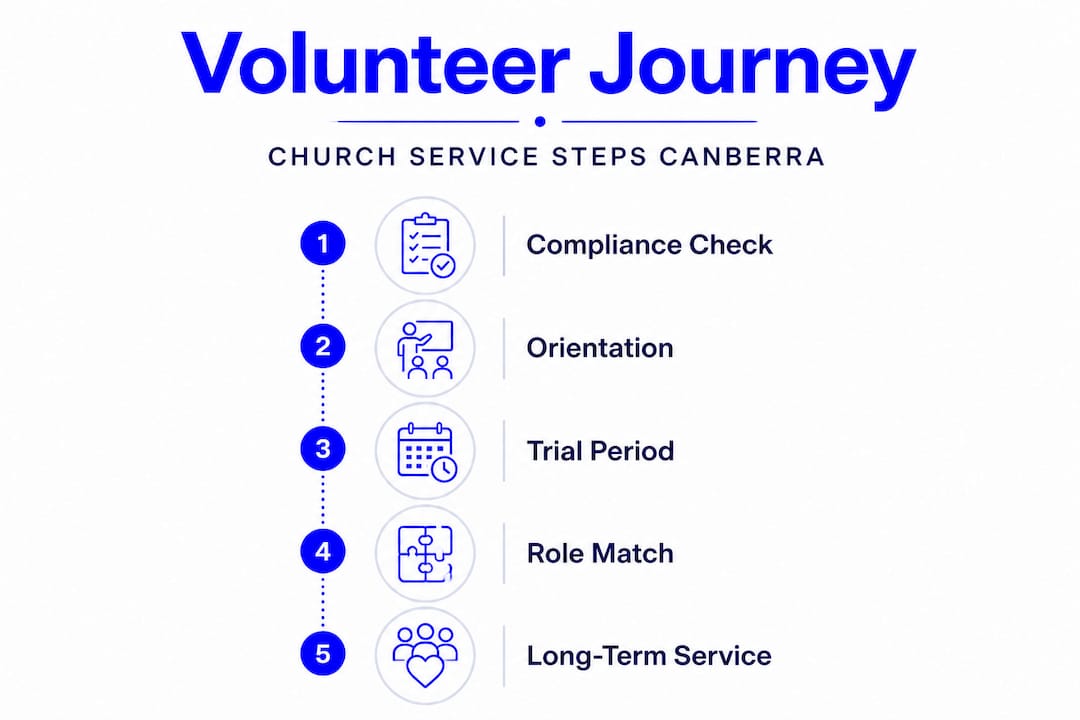
To volunteer in a church, start by expressing interest to a pastor or volunteer coordinator, then complete any required orientation and screening before beginning a defined role. Here is how that looks in practice:
Pray and reflect. Before anything else, spend time asking what kind of service aligns with your gifts, your season of life, and your sense of calling. This is not a step to rush.
Attend gatherings regularly. Get to know the community first. Volunteering from within a relationship is far more sustainable than volunteering as a stranger.
Express your interest. Speak directly with a pastor, ministry leader, or volunteer coordinator. A simple, honest conversation is all it takes. You do not need a polished pitch.
Complete the application process. Fill in any forms, provide references if requested, and begin any required screening such as your WWVP registration.
Attend orientation. Most churches run a short induction to help you understand the vision, values, and expectations of serving in that community.
Shadow an existing volunteer. Before leading or taking full responsibility for a role, spend a few sessions exploring next steps alongside someone already in that position.
Begin your defined role. Start with clear expectations, a point of contact, and an agreed timeframe for review.
Comparing entry points for new volunteers
Entry type | Time commitment | Best for |
Short-term serving | One-off or seasonal | First-timers testing the waters |
General support | Flexible, as needed | Those with open schedules |
Specialised roles | Regular, structured | People with specific skills or experience |
If you are new to church volunteering or finding a new church home, starting with a short-term or general support role is a genuinely wise move. It allows you to experience the culture, build relationships, and discern whether the role and community are a good fit before making a longer commitment.
Pro Tip: Commit to a trial period of four to six weeks before agreeing to an ongoing role. This protects both you and the church, and it creates space for an honest conversation about whether the fit is right.
Compliance made easy: understanding screening and legal checks
Since compliance is a key step for many volunteer roles, it is important to tackle legal checks with confidence rather than anxiety.

It is an offence to work or volunteer in a regulated activity without a WWVP registration. That is a serious statement, but it should not frighten you. The process of obtaining a WWVP card is straightforward, and most churches will guide you through it.
What to expect during screening
You will need to create an account through the Access Canberra portal
A background check is conducted as part of the registration process
You will receive a registration number that the church can verify
Registrations are typically valid for three years before renewal is required
The church may also conduct its own internal safeguarding induction
“Safeguarding processes are necessary, but can create administrative workload that some volunteers perceive as burdensome.” This is a real tension. The answer is not to minimise compliance, but to ensure churches provide clear, practical support from church leadership to help volunteers navigate it without feeling alone in the process.
The spiritual dimension of compliance is worth naming. When you obtain a WWVP card and complete safeguarding training, you are not just ticking boxes. You are declaring that the people in your care matter. That is a profoundly kingdom-shaped act.
Pro Tip: Gather your identity documents (passport or driver’s licence, Medicare card) before starting the WWVP application. Having them ready reduces the process to under thirty minutes for most people.
Finding your fit: matching your strengths with church needs
Now that compliance is sorted, it is time to discover where you can contribute best within the church. This is one of the most life-giving parts of the whole process.
Identifying your strengths and schedule, then asking leadership what is currently needed, is the most effective starting point. It sounds simple, but many people skip one half of that equation. They either focus only on what they want to do, or they simply ask what the church needs without reflecting on what they genuinely have to offer. Both matter.
Common volunteer roles in church communities
Church volunteering is far more varied than most people realise. Roles include:
Music and worship: Playing instruments, singing, running sound or visuals
Children’s and youth ministry: Teaching, mentoring, running activities
Hospitality: Welcoming newcomers, serving meals, organising events
Technology: Live streaming, presentation software, website support
Pastoral support: Visiting, praying with people, following up on newcomers
Administration: Coordinating rosters, managing communications, data entry
Community outreach: Serving at local initiatives, food programmes, neighbourhood events
Each of these areas reflects a different expression of the same calling: to love people well and build community in Canberra in ways that point toward Jesus.
Five questions to ask yourself before choosing a role
What do I genuinely enjoy doing, even when it is tiring?
Where have others told me I add value or bring encouragement?
What is my realistic availability each week or month?
Am I energised by working with people, or do I prefer behind-the-scenes tasks?
Is there a ministry area I feel spiritually drawn to, even if I am not yet experienced in it?
Answering these honestly, and then sharing your reflections with a ministry leader, will open a much richer conversation than simply saying “I want to help.” It also signals to leadership that you are approaching service with intentionality, which is exactly the kind of volunteer every church community needs.
Our take: the real heart (and hurdles) of church volunteering
Having covered the practicalities, it is worth stepping back to reflect on what really shapes the church volunteering experience, and what we have seen make the difference between a volunteer who thrives and one who quietly fades away.
Here is something that does not get said enough: the greatest barrier to sustained volunteering is rarely a lack of willing people. It is a lack of clear pathways and genuine relational investment from the church itself. When volunteers feel like they are filling a roster gap rather than joining a mission, they disengage. And honestly, that is on us as much as it is on them.
The most meaningful volunteering we have witnessed happens when someone feels genuinely known by the people they serve alongside. Not just rostered. Known. When a volunteer coordinator remembers that someone is navigating a difficult season at work, or celebrates when a volunteer nails a new skill, something shifts. Service becomes community. And community is exactly what keeping church life engaging is really about.
There is also a temptation, particularly in busy urban churches like those in Canberra, to treat compliance and administration as the primary gatekeeping process. Screening matters deeply, as we have established. But it should never replace the relational welcome that tells a new volunteer: you belong here, and what you carry matters to this community.
Our encouragement to you is this: do not wait until you feel fully ready. Seeds planted in uncertain soil still grow. Show up, ask questions, stay humble, and trust that God uses ordinary people in extraordinary ways when they simply make themselves available.
Ready to make a difference?
If this guide has stirred something in you, and you are sensing that now might be the season to step into service, we would love to walk alongside you.

At Divergent Church in Canberra, we have built a simple, relational process for helping people serve at Divergent Church in ways that genuinely fit their gifts and availability. Whether you are brand new to church or returning after a long break, our team is ready to have an honest, no-pressure conversation about where you might belong. You can also explore our next steps at Divergent Church to understand how we walk with people from first visit to active community membership. And if you are looking for deeper connection beyond a serving role, consider joining one of our Life Community groups, where faith is lived out in the everyday rhythms of Canberra life.
Frequently asked questions
Do I need a WWVP card to volunteer in all church roles in Canberra?
A WWVP card is required for volunteering in regulated activities involving children or vulnerable people, but not for all roles. General support roles like hospitality or administration typically do not require one.
Can I start volunteering before my screening or checks are complete?
No. It is an offence to volunteer without WWVP registration in regulated activities, so all required screening must be completed before you begin in those roles.
What types of volunteer roles are available in churches?
Roles can range from music, hospitality, and tech to children’s programmes, community outreach, and administration, meaning there is genuinely something for almost every gift set and schedule.
How can I make sure volunteering is a good fit for me?
Start with a trial period, reflect on your interests and schedule, and communicate openly with church leadership. A trial period and self-reflection are both recognised as key steps in finding the right volunteer role.
Recommended
Comments