
Kingdom living: Essential principles for authentic discipleship


Many Christians carry a quiet, nagging feeling that they are not quite doing enough. They attend church, read their Bible occasionally, avoid obvious sins, and still wonder why their faith feels hollow. The confusion often runs deeper than personal discipline. It stems from a fundamental misunderstanding of what kingdom living actually is. Kingdom living is not simply following a checklist, but a Spirit-empowered life shaped by Jesus’ lordship, and that distinction changes everything. This article unpacks the biblical foundations, practical habits, and transformative vision that make kingdom living the heartbeat of authentic discipleship.
Table of Contents
Key Takeaways
Point | Details |
Kingdom living is transformation | The heart of kingdom living is letting Jesus’ lordship reshape your life from the inside out. |
Not rule-based | Kingdom living rejects checklist Christianity in favour of Spirit-led flexibility and grace. |
A present reality | Kingdom living isn’t just future-focused; it starts now in daily choices and actions. |
Observable fruit | Genuine kingdom living produces joy, peace, and goodness in daily life. |
Practical next steps | Developing kingdom living habits means practicing prayer, Scripture, and community discipleship. |
What is kingdom living: Defining the concept
With the confusion addressed, let’s break down what kingdom living actually means.
The word “kingdom” in the New Testament comes from the Greek basileia, meaning reign or rule. When Jesus announced “the kingdom of God is at hand” in Mark 1:15, he was not describing a geographic location. He was proclaiming the active, present reign of God breaking into human life. Kingdom living, then, is the daily practice of submitting every part of your existence to that reign.
Living in the kingdom means aligning daily life with God’s reign, letting it shape every part of life, from your morning decisions to your workplace relationships, from how you spend money to how you treat your neighbours. This is not a passive posture. It is an active, ongoing orientation of the whole self toward Jesus as Lord.
“Seek first his kingdom and his righteousness, and all these things will be given to you as well.” — Matthew 6:33
Kingdom living stands apart from mere religious performance because it is rooted in relationship, not compliance. Here is what it actually involves:
Yielding authority to Jesus over habits, ambitions, and relationships
Allowing Scripture to shape your moral imagination, not just inform your opinions
Pursuing community as a kingdom expression, not just a social preference
Acting with justice and mercy in ordinary, everyday situations
Remaining open to the Spirit’s prompting in real-time decisions
For those exploring spiritual development, kingdom living is not the destination. It is the road itself. It is the mode of travelling that shapes you while you go. And for followers of Jesus who want to understand what Spirit-filled discipleship looks like in practice, this concept is the foundational starting point.
Kingdom living is also inherently communal. Jesus never modelled solo faith. He gathered twelve, sent out seventy, and built a community of practice. For us in Canberra, this means our everyday rhythms at work, at university, in our neighbourhoods, and in our households are all potential expressions of the kingdom.
The difference: Kingdom living vs religious rule-keeping
With the definition clarified, it is vital to explore what kingdom living is not.
One of the most persistent distortions of Christian faith is legalism. Legalism is the belief, often unconscious, that spiritual standing before God depends on correct behaviour, rule adherence, or moral performance. It reduces the rich, relational life of the gospel to a scorecard. And it quietly suffocates genuine transformation.
Kingdom living is transformative, operating from the inside out and empowered by the Spirit, rather than functioning as a checklist or a new rule-set layered over the old one. The apostle Paul was emphatic about this in Galatians 3:3, asking, “Are you so foolish? After beginning by means of the Spirit, are you now trying to finish by means of the flesh?”
Here is a direct comparison to make the distinction concrete:
Religious rule-keeping | Kingdom living |
Motivated by fear or duty | Motivated by love and gratitude |
Focused on external behaviour | Focused on heart transformation |
Self-powered effort | Spirit-empowered response |
Produces guilt when failing | Produces repentance and restoration |
Concerned with appearances | Concerned with Christ-likeness |
Isolated, individual pursuit | Expressed in community and mission |
Understanding this distinction practically changes how you approach your faith. Here are three common pitfalls to watch for:
The checklist mentality: Measuring your spiritual health by how many boxes you tick rather than how deeply you know and love Jesus.
Self-salvation thinking: Believing that your spiritual effort earns God’s favour rather than responding to grace already freely given.
Performance for others: Shaping your visible Christian behaviour around social approval rather than genuine inner conviction.
Pro Tip: When you catch yourself feeling spiritually anxious because you have missed quiet time or forgotten to pray, pause and ask: “Am I relating to God as Father or as a performance assessor?” That question alone can redirect your heart from legalism back to relationship.
Engaging with your experience of the Holy Spirit is central to breaking free from legalism. The Spirit does not give you a new set of rules to follow. He gives you a new nature from which obedience flows naturally and joyfully. Reflecting on discipleship growth questions can help you identify where legalism may have crept in without your noticing.
A helpful spirituality resource can also provide a broader perspective on inner transformation and Spirit-led growth. And for those ready to go deeper, exploring a Spirit and truth worship practice reorients your whole approach to God from performance to presence.
Kingdom living as a present reality
Now that the dangers of legalism are clear, let’s step into kingdom living as something practical and present.
A common misunderstanding is that the fullness of the kingdom belongs entirely to the future, that it is something Christians wait for rather than something they inhabit right now. Scripture tells a more urgent and exciting story. Jesus’ rule means Christians live as kingdom citizens now, not only in some distant eschatological future.

This has enormous implications for daily life in Canberra. You do not need to wait until heaven to practise generosity. You do not need to wait for a mountaintop moment to act with justice. You do not need to be in a church building to express the kingdom. The kingdom is wherever King Jesus reigns, and his reign extends into your lunch break, your difficult conversation with a colleague, and your decision about how to spend Saturday morning.
Here is how kingdom citizenship looks in practical terms across everyday contexts:
Life context | Kingdom expression | Biblical basis |
Workplace | Integrity, excellence, servant leadership | Colossians 3:23 |
Family home | Forgiveness, patience, hospitality | Ephesians 4:32 |
Friendships | Truthfulness, loyalty, encouragement | Proverbs 27:17 |
Neighbourhood | Generosity, presence, care for others | Luke 10:27 |
Church community | Mutual accountability, discipleship | Hebrews 10:24-25 |
Consider what it looks like to embrace a new life mindset that takes the present reality of the kingdom seriously. It means making Spirit-led decisions in real time, not just reflecting on faith as a Sunday activity.
Research consistently shows that Christians who integrate their faith into everyday contexts, rather than compartmentalising it to religious activities, report deeper satisfaction, stronger community bonds, and more lasting character transformation. The kingdom is not a compartment. It is the whole of life, reordered under Jesus.
For families in Canberra, understanding the church at home helps translate kingdom principles into the rhythms of household life. For those sensing a call to engage their surroundings more deeply, exploring what it means to be an outward-facing church opens up what kingdom citizenship looks like in mission.
Key markers of present kingdom living:
Making decisions by asking “What does Jesus’ reign require here?” rather than “What do I prefer?”
Choosing repentance over self-justification when you fall short
Actively serving others without expectation of recognition
Prioritising community formation over personal spiritual comfort
Practical foundations: Habits and fruit of kingdom living
With kingdom living embedded in real life, let’s get practical about habits and observable fruit.
Character is not formed in moments of crisis. It is formed in the quiet, repeated choices of ordinary days. Kingdom living requires intentional habits that shape the inner life so that Spirit-led responses become natural. The apostle Paul described this as “training yourself to be godly” in 1 Timothy 4:7, using the Greek gymnazo, the same root as our word “gymnasium.” Discipleship involves genuine spiritual exercise.
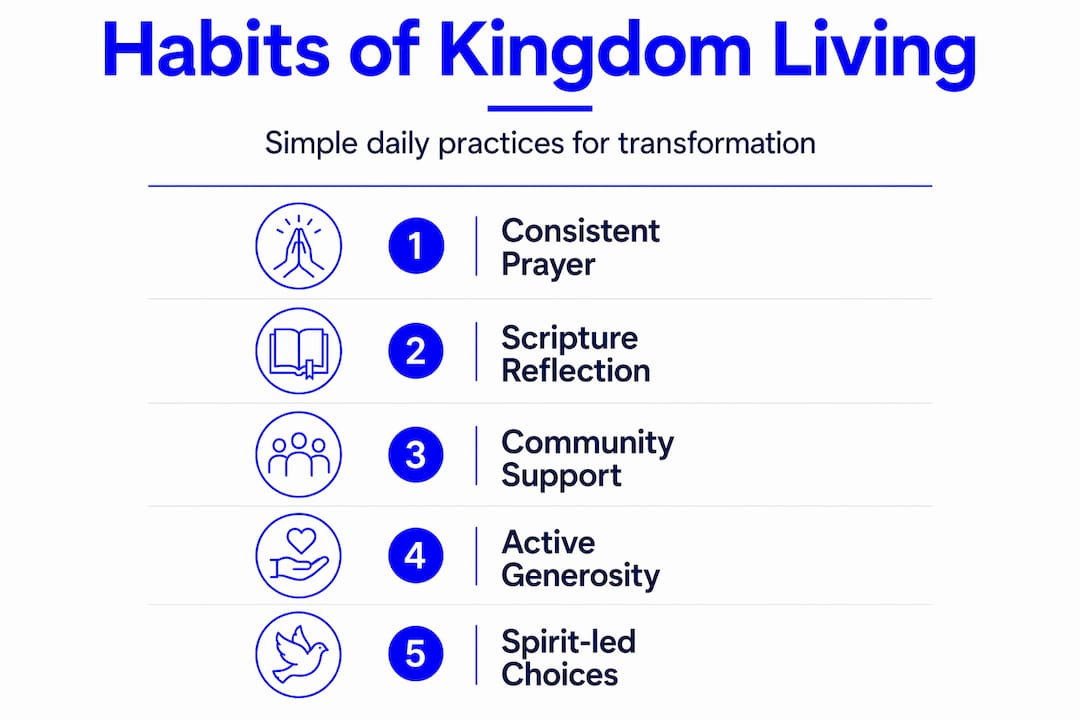
Kingdom fruit includes goodness, peace, and joy in the Holy Spirit as direct outcomes of a life genuinely oriented toward God’s reign. These are not manufactured emotions or performed spiritual states. They are the natural overflow of a life increasingly surrendered to Jesus. And continual transformation of habits and character marks kingdom living as a sustained, progressive journey rather than a single decisive moment.
Here are four foundational habits that anchor kingdom living:
Prayer as dialogue, not monologue: Regular, honest communication with God that includes listening, not just speaking. Kingdom prayer aligns your desires with God’s purposes rather than simply requesting outcomes.
Scripture as formation, not information: Reading the Bible to be shaped by it, not merely to accumulate knowledge. Ask “What is God forming in me through this passage?” rather than “What does this passage teach?”
Repentance as a rhythm, not a crisis: Practising regular, honest acknowledgement of where you have fallen short, followed by genuine turning. This keeps the heart tender and the relationship with God current.
Community as accountability and belonging: Committing to people who know you well enough to speak truth into your life. Isolated discipleship is fragile discipleship.
Pro Tip: Don’t wait until you feel spiritually motivated to establish habits. Start small and consistent. Five minutes of genuine prayer every morning shapes more character over six months than an occasional hour of spiritual intensity.
For those wanting to go deeper in alignment with kingdom values, exploring fasting and prayer offers a powerful, often overlooked practice that sharpens spiritual focus and breaks the grip of self-reliance. Fasting is not about earning favour. It is about declaring with your body what your heart believes: that Jesus is Lord, not appetite or comfort.
Joining Life Communities, the small groups at Divergent Church, is one of the most tangible steps you can take toward grounded, accountable kingdom living in Canberra. Kingdom fruit grows best in community soil.
Observable signs of kingdom fruit in everyday life:
A growing capacity to forgive without being asked
Genuine joy that persists through difficulty, not despite life being easy
An increasing desire to serve others rather than accumulate comfort
Peace that holds steady when circumstances are uncertain
Integrity that does not shift based on who is watching
These are not aspirational states for a few spiritually elite believers. They are the natural, expected outcomes of a life oriented toward Jesus’ reign, watered by habit, rooted in Scripture, and expressed in community.
Why kingdom living matters more than ever
Here is a perspective that cuts through common misconceptions, because this conversation has real stakes.
We live in a cultural moment that is suspicious of institutional religion and hungry for authentic transformation. Canberra, with its transient population of students, government workers, and professionals, is full of people who have walked away from forms of Christianity that felt like performance. And honestly? We understand why. A faith that reduces to rules and appearances offers very little that secular self-improvement cannot also deliver.
But kingdom living is something altogether different. It is the missing link between sincere belief and lasting transformation. When Christians in Canberra live from the inside out, shaped by the Spirit and rooted in community, the difference becomes visible. Not in polished programmes or impressive buildings, but in the quality of relationships, the texture of generosity, and the steadiness of character under pressure.
The uncomfortable truth is this: many people are not struggling with intellectual doubts about Christianity. They are exhausted by a version of faith that demands performance without offering power. Kingdom living, properly understood and genuinely practised, addresses exactly that exhaustion. It says: you are not the engine of your transformation. Jesus is. Your role is to yield, to practise, to remain.
Legalism breeds frustration because it makes you responsible for what only the Spirit can accomplish. Spirit-empowered living, by contrast, produces rest alongside growth, because the burden belongs to Jesus. That is not a passive spirituality. It is a deeply active cooperation with what God is already doing in you and around you.
We believe Canberra’s Christian community has an extraordinary opportunity to demonstrate kingdom living in a city that desperately needs to see it. Not as an argument or a campaign, but as a way of being. If you are ready to explore what this looks like in community, we warmly invite you to participate and discover what authentic kingdom living looks like among people genuinely pursuing it together.
Explore kingdom living with Divergent Church
At Divergent Church, we are not interested in adding more religious activity to your already full life. We are committed to something more foundational: forming disciples of Jesus who live from the inside out, shaped by his reign, expressed in real relationships, and rooted in the rhythms of Canberra.
Whether you are just beginning to explore Christian faith or you are a seasoned believer hungry for more than Sunday religion, we have pathways designed to meet you where you are. Visit our Discipleship Hub to explore resources, teachings, and formation tools built around kingdom principles. If you are ready to take your next step with Jesus, explore what it means to follow Jesus with us. And to experience kingdom living in community, our Life Communities in Canberra are a natural, welcoming next step.
Frequently asked questions
Is kingdom living possible for ordinary Christians in Canberra?
Yes, kingdom living is about daily alignment with Jesus’ values and can be practised regardless of your background or experience. Shaping every part of life with God’s reign is something available to every believer, not just those with formal theological training.
How does kingdom living differ from just following church rules?
Kingdom living is inner transformation led by the Holy Spirit, not simply ticking off rules or religious checklists. Kingdom living is not the same as religious rule-keeping because it operates from a renewed heart, not external obligation.
What are signs of authentic kingdom living?
Kingdom fruit like goodness, peace, and joy in the Holy Spirit are strong indicators of genuine kingdom living. Peace and joy in the Holy Spirit are not manufactured emotions but the natural overflow of a life surrendered to Jesus.
How can I develop kingdom living habits?
Start with prayer, reading Scripture, and joining a Christian community focused on discipleship and Spirit-led living. Christian habits like prayer and community support kingdom living by shaping the inner life consistently over time.
Recommended
Comments