
Why believe in God? Purpose, meaning, and mental health


Belief in God sits at the intersection of the most profound questions a human being can ask. Who am I? Why am I here? Does any of this matter? Across 35 countries, 83% of people report believing in God or a higher power, a figure that may surprise those watching declining church attendance in Western cities. Here in Canberra, the picture is layered. Religious affiliation is falling, yet spiritual curiosity is very much alive, particularly among students, young professionals, and those navigating major life transitions. This article cuts through the noise and offers clear, honest reasoning about why people believe, what the evidence shows, and how you might begin your own exploration.
Table of Contents
Key Takeaways
Point | Details |
Multiple reasons for belief | People believe in God for philosophical, psychological, and existential reasons. |
Benefits for well-being | Faith often leads to better mental health, more social support, and greater life purpose. |
Doubts are normal | Questioning and scepticism are part of an authentic spiritual journey. |
Canberra’s open pathways | Local resources and communities make it easy to explore faith at your own pace. |
What are the main reasons people believe in God?
People arrive at belief through vastly different paths. Some begin with a philosophical question they cannot shake. Others encounter a moment of grief, wonder, or gratitude that opens something inside them. And for many, it is simply the experience of living alongside people of deep faith, watching how belief shapes a life with integrity and warmth. Understanding the main currents of reasoning helps you locate your own starting point.
Philosophical arguments that endure
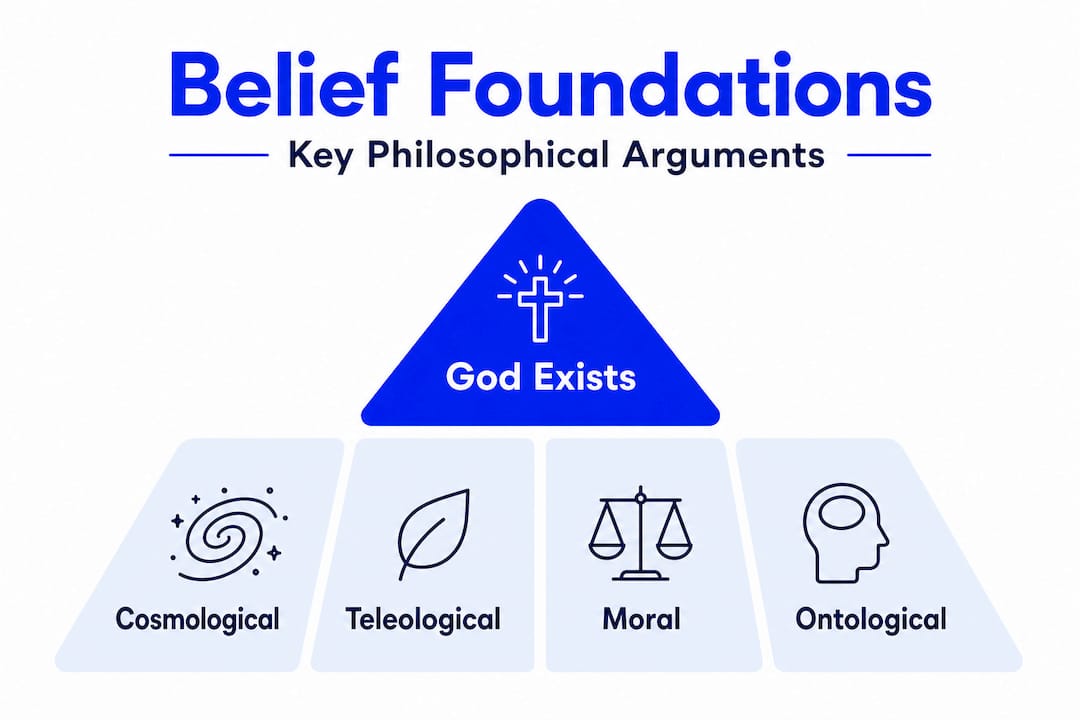
Philosophers and theologians have spent millennia constructing careful arguments for the existence of God. Cosmological, teleological, ontological, and moral arguments form the backbone of this reasoning. The cosmological argument asks: why is there something rather than nothing? If everything that exists has a cause, what caused the universe itself? The teleological argument points to the ordered complexity of nature, from the precise constants of physics to the intricate machinery of a human cell, as evidence of intentional design. The ontological argument approaches God from the concept of perfection itself. The moral argument suggests that objective moral truth, which most people instinctively affirm, requires a grounding beyond human opinion.
None of these arguments forces belief. But each one opens a door worth stepping through. Here is a brief comparison of what each argument contributes:
Argument | Core claim | What it invites you to consider |
Cosmological | Everything has a cause; the universe needs one | The origin and contingency of existence |
Teleological | Design implies a designer | Order, complexity, and purpose in the universe |
Ontological | God is the greatest conceivable being | The logic of perfection and necessary existence |
Moral | Objective morality requires a moral grounding | Where human rights and dignity ultimately come from |
Psychological and existential motivations
Beyond philosophy, people believe because belief works in the deepest human sense. Faith addresses questions that no career success, no relationship, and no amount of entertainment can fully resolve. Questions like: Am I loved? Does my suffering mean anything? What happens when I die?
Key psychological reasons people are drawn to belief include:
Hope in adversity: Faith offers a framework for enduring suffering without despair.
Resilience: Believing in a God who is present in hardship strengthens the capacity to recover.
Moral formation: A God-centred life gives people a compelling reason to pursue virtue rather than convenience.
Transcendence: Humans are wired for wonder. Belief names and responds to that hunger.
“You have made us for yourself, O Lord, and our heart is restless until it rests in you.” — Augustine of Hippo, Confessions
This restlessness is not a design flaw. It is an invitation.
Global and Canberra perspectives: Trends in belief and spirituality
With the main reasons outlined, it is useful to see how belief plays out worldwide and here in Canberra.

Globally, 83% of people across 35 countries affirm belief in God or a spiritual power. This figure rises above 90% in sub-Saharan Africa and Latin America, while parts of Western Europe and East Asia show considerably lower rates. The pattern reveals that belief is not simply a relic of pre-modern ignorance but a persistent and widespread human response to existence.
Region | Approximate belief rate | Notable characteristic |
Sub-Saharan Africa | 90%+ | Strong integration of faith and daily life |
Latin America | 90%+ | High Catholic and Protestant presence |
North America | ~70-75% | Diversity of expressions; growing spiritual but not religious |
Western Europe | ~50-60% | Declining affiliation; persistent personal spirituality |
East Asia | ~30-50% | Strong secular traditions alongside folk religion |
In Australia, the picture is shifting. The religiously unaffiliated are growing while those identifying as Christian are shrinking, yet belief in something beyond the natural world remains remarkably common. Canberra reflects this tension particularly well. As a city shaped by government, academia, and a transient population drawn from across the country and world, Canberra hosts genuine spiritual diversity. Students at the Australian National University wrestle with ultimate questions in philosophy tutorials. Public servants sit with grief and purpose in their commutes. Young families wonder what they want to pass on to their children.
This is exactly the kind of city where finding faith and community in Canberra matters most, and where genuine conversations about God can take root.
What motivates ongoing spiritual interest in Canberra?
The presence of universities fostering intellectual openness
A culturally diverse population bringing varied religious backgrounds
Rising rates of loneliness driving people toward community and meaning
A growing hunger for something more substantive than consumerism
The increasing accessibility of faith conversations through groups, podcasts, and online resources
If you are in Canberra and find yourself drawn to questions about God, you are far from alone. And building community in Canberra around shared faith and honest inquiry is something many people are actively pursuing.
The benefits of belief: Mental health, community, and finding meaning
Understanding trends sets the stage. Now, let us see what the evidence says about how belief shapes well-being.
The relationship between faith and mental health is one of the most well-researched areas in psychology and public health. Faith provides purpose, hope, and structure for existential questions, with documented mental health benefits including reduced rates of depression and anxiety. Importantly, these benefits are strongest for people who experience a secure and loving relationship with God, as opposed to those who relate to God through fear or shame.
“Faith communities offer something that many modern institutions cannot: a shared story, a practised hope, and relationships that outlast circumstances.”
Five evidence-backed benefits of belief
Reduced depression and anxiety: People with active faith report lower rates of clinical depression and anxiety disorders, even when controlling for other social factors.
Greater life satisfaction: A sense of ultimate meaning and purpose correlates strongly with subjective well-being and satisfaction with life.
Community and belonging: Faith communities in Canberra offer relational depth that is increasingly rare in a fragmented, digital society.
Moral framework: Having clear values reduces the psychological burden of endless choice and moral relativism.
Resilience in grief: People of faith consistently show greater capacity to process loss, not by avoiding pain, but by placing it within a larger story.
Pro Tip: If you are not ready to commit to a church but want to experience the benefits of community, start by attending a single event at a local church in Canberra. No obligation. No pressure. Just an honest look at what the community is like.
These benefits are not confined to abstract theology. They are lived out in the everyday rhythms of a strong community church in Canberra. Whether it is a shared meal, a small group discussion, or attending church events designed to welcome newcomers, the practical fruits of faith are tangible and accessible.
Why people doubt: Challenges and thoughtful responses
Belief is not automatic. Many people face honest and important doubts, and these deserve to be taken seriously rather than dismissed.
The problem of evil and divine hiddenness are widely regarded as the strongest intellectual challenges to belief in God. The problem of evil asks: if God is all-powerful, all-knowing, and perfectly good, why does suffering exist? Divine hiddenness asks: if God wants a relationship with us, why does God seem so absent for so many people? These are not shallow questions. Philosophers, theologians, and believers have wrestled with them for centuries.
Other common forms of doubt include:
Scientific accounts of the universe: Some people feel that evolution, cosmology, or neuroscience make God unnecessary.
Religious diversity: The existence of many religions raises the question of whether any single tradition can be true.
Personal disappointment: Unanswered prayers or painful experiences within religious communities can wound faith deeply.
Intellectual reflex: Reflective, analytical thinkers sometimes find that the more they examine claims, the harder belief becomes.
What is important to recognise is that doubt is not the opposite of faith. It is often the beginning of a deeper, more honest faith. Many of the most thoughtful believers in history, from Thomas in the Gospels to C.S. Lewis to modern Christian philosophers, arrived at conviction through sustained questioning, not by bypassing it.
Pro Tip: Rather than trying to resolve every doubt before engaging with a faith community, bring your questions into the community. The best faith environments welcome intellectual honesty and are not threatened by hard questions.
The journey from scepticism to spiritual renewal is a well-worn path. You do not need to resolve everything before you begin.
Exploring faith in Canberra: Practical steps and resources
After exploring doubts, here are concrete ways you can test the waters or deepen your spiritual search in Canberra.
Community groups like churches offer structured, relational spaces for people at every stage of spiritual exploration, from the entirely sceptical to the actively committed. You do not need a theological degree or a clean spiritual track record to show up.
Here is a practical sequence for getting started:
Attend a single gathering: Visit a church service in Canberra with no expectations. Observe. Listen. Notice how people relate to one another and to the content.
Try a community group: Smaller groups are where real conversations happen. Church events that build connection are specifically designed for people exploring faith in an accessible, low-pressure way.
Read and research: Start with the Gospel of Mark, the shortest and most action-driven of the four Gospels. It takes about ninety minutes to read and gives you a direct encounter with Jesus on his own terms.
Ask questions openly: Find someone you trust, a pastor, a chaplain, or a thoughtful believer, and bring your real questions. A faith worth holding stands up to honest scrutiny.
Connect with other believers your age: Meeting Christians in Canberra who share your context, whether at university, in the workplace, or raising a family, makes the journey far less abstract.
The goal is not to achieve certainty in a single afternoon. It is to begin a genuine, sustained engagement with the most important questions of your life.
Our perspective: What most people miss about belief in God today
Stepping back, something becomes clear that most of the public conversation around belief misses entirely. The debate tends to get stuck in the binary of proof versus disproof, as if faith were purely an intellectual puzzle to solve before anything real can happen.
But genuine belief rarely works that way. Seeds of faith are planted not just in lecture theatres or library stacks, but in the quiet conversations between friends, in acts of unexpected grace, in the recognition that you are known and loved by someone at the table with you. The kingdom of God, as Jesus described it, is less like a solved equation and more like a seed growing in secret, breaking ground before anyone quite expected it.
What most people miss is this: doubt and curiosity are not the enemies of faith. In Canberra especially, where intellectual rigour is a badge of honour, people sometimes treat belief as something that must be fully justified before it can be practised. But the opposite is often true. You practise trust, you enter into community, you show up for the liturgy or the conversation or the meal, and then understanding deepens. Meaning is not found in the abstract argument. It is found in the lived relationship, in the friendship, in the belonging.
Loneliness is one of the defining crises of our time. And faith communities, at their best, offer something that almost nothing else can: a group of people who are genuinely committed to one another across difference, across time, across the ordinary and the devastating alike. Authentic conversations about faith in Canberra are not happening in the abstract. They are happening around tables, in lounge rooms, and in communities shaped by a conviction that every person carries extraordinary worth.
That is what we think the world is missing. Not more arguments. More embodied community.
Connect, explore, or take next steps in your faith
Whether you are arriving at this article from a place of deep scepticism or quiet longing, the invitation is the same: do not let the search stall in your head. The questions that brought you here are worth pursuing in the company of others who take them seriously.

At Divergent Church, we exist in the rhythms of Canberra’s life, its universities, workplaces, and neighbourhoods, and we genuinely welcome people at every stage of the journey. If you are curious about discovering Jesus in Canberra, want to grow through discipleship resources, or are simply looking to join a community group where honest questions are welcomed, there is a place for you here. Come as you are. Stay as long as you need. The door is genuinely open.
Frequently asked questions
Is belief in God declining in Canberra?
While religious identity is falling, many Canberrans retain spiritual beliefs or explore new ways of finding meaning, since the religiously unaffiliated are growing across Australia without necessarily abandoning all spiritual interest.
Does religion actually improve mental health?
Yes, evidence consistently shows that faith reduces depression and anxiety and increases a sense of purpose, with the strongest benefits appearing when belief is accompanied by a supportive community and a secure relationship with God.
Can I explore belief without joining a church?
Absolutely. You can attend community events, join open discussion groups, or simply read and ask questions without any formal commitment, making exploration accessible at your own pace.
What are the philosophical arguments for and against belief?
Major arguments for belief include the cosmological, teleological, ontological, and moral arguments, while the strongest challenges are the problem of evil and divine hiddenness, both of which serious thinkers continue to engage with today.
Does belonging to a faith group help if I feel isolated?
Yes. Religious people are less lonely on average, and belonging to a faith community provides meaningful support networks that buffer against the well-documented health risks of isolation.
Recommended
Comments