
Live What Lent Means: Six Weeks of Prayer, Fasting and Giving


Lent is the season of penitence and preparation Christians observe in the lead up to Easter, built around three disciplines: prayer, fasting and almsgiving. It begins on Ash Wednesday and traditionally lasts 40 days, echoing the 40 days Jesus spent fasting in the wilderness. At its heart, Lent is not about giving something up for its own sake. It is about making room for God.
TL;DR:
The 40 days of Lent exclude Sundays, which are treated as small Easters, resulting in a 46-day span from Ash Wednesday to Easter Saturday.
Modern Western Lent emphasizes flexible, sustainable fasting practices that exempt vulnerable groups and focus on prayer, renewal, and charity instead of severity.
Lent’s timing shifts annually based on Easter, which depends on lunar calculations, making the start date vary from early February to early March.
The season encourages small, consistent practices like daily prayer, minor fasting, and weekly acts of charity rather than intense, short-lived austerity.
Observance methods vary across Christian traditions, with Western churches following Ash Wednesday and Holy Week, while Eastern Orthodox practices often involve stricter, longer fasting periods.
Table of Contents
What is Lent? Meaning and spiritual significance
Lent is a season of inner conversion, not a performance for anyone watching. That distinction shapes everything else about how Christians are meant to observe it. The Church of England describes Lent as a time of self-examination, penitence and self-denial, oriented entirely toward preparing for Easter. It is not a self-improvement program that happens to have a Christian flavour. It is a rhythm the Church has kept for centuries to help believers turn back toward Jesus with fresh attention.
The word “conversion” gets used a lot in Lenten teaching, and it is worth sitting with. It does not mean converting from one religion to another. It means the ongoing turning of a heart that has drifted, distracted itself, or grown comfortable, back toward the posture of a disciple. Lent gives structure to that turning. Rather than waiting for a crisis to shake us into seriousness about faith, the Church built a whole season into the calendar that asks the question directly: what needs to change in me before I can properly celebrate the resurrection?
There is also a baptismal dimension to Lent that many people miss. Historically, Lent developed alongside the early Church’s practice of preparing new converts, called catechumens, for baptism at the Easter Vigil. Those weeks of fasting and instruction were not optional extras. They were the final stretch of a long journey toward becoming a Christian. Even today, when most people observing Lent were baptised long ago, the season still carries that flavour of renewal. Lent asks every believer to revisit their baptismal vows, as though they were standing at the font again for the first time.
This is also where the paschal mystery comes in, the theological term for the death and resurrection of Jesus considered together as one saving event. Lent exists because Easter exists. Every fast, every extra prayer, every act of charity during these weeks points forward to the empty tomb. Strip Lent of that connection and it becomes an arbitrary 40 days of self-denial. Keep the connection intact and every small discipline becomes a rehearsal for resurrection, a way of practising death to self so that new life has somewhere to land.
In practice, this plays out in a few recognisable spiritual aims:
Repentance — honestly naming sin and habits that have pulled attention away from God, rather than vaguely feeling bad about things in general.
Renewal — refreshing prayer life, Scripture reading and worship habits that may have gone stale.
Simplicity — deliberately stripping back comfort, noise or excess to notice what has been crowding out what matters.
Solidarity — standing with the poor and marginalised through almsgiving, so that self-denial is never purely inward-facing.
None of this requires theatrics. As the USCCB frames it, Lent’s three practices, prayer, fasting and almsgiving, exist to prepare hearts for the Resurrection, not to win admiration for how disciplined someone appears. A quiet, faithful Lent kept largely unseen by others is doing exactly what the season was designed to do.
Where does the word “Lent” come from?
“Lent” has nothing to do with borrowing or lending. It comes from the Old English word “lencten,” meaning “spring,” a reference to the lengthening of daylight hours as the Northern Hemisphere moves out of winter. English is unusual here: most other languages name this season after the Latin quadragesima, meaning “fortieth,” which is why French has carême and Italian has quaresima. English took the seasonal route instead, tying the word to the natural rhythm of the year rather than the count of days.
The 40-day structure itself, however, is far older than the English word describing it. Its roots reach into the earliest centuries of the Church, and the way it was kept has shifted considerably over time.
Early centuries: Fasting before Easter existed from the Church’s earliest days, though the length and intensity varied by region. Some communities fasted for a single day before Easter, others for a full week.
The Black Fast: One of the most demanding historical practices was the so called Black Fast, involving a single meal after sundown, often without meat, dairy, eggs or wine, sustained across most of the season. This severity has largely disappeared from Western practice, though elements of it persist in some Eastern traditions today.
Medieval variation: By the medieval period, Lenten rules had multiplied into a patchwork of regional customs, with different dioceses setting their own fasting calendars and exemptions.
Modern standardisation: The twentieth century saw most Western denominations soften and simplify these rules considerably, shifting emphasis from strict physical deprivation toward a broader, more flexible framework of prayer, fasting and almsgiving that individuals and families could actually sustain.
That last shift matters for how Lent gets discussed today. When someone asks what Lent means now, they are usually asking about a gentler, more personalised version of a discipline that was once far more physically severe. The bones of the practice, repentance, renewal, preparation, are the same. The intensity has been recalibrated for a very different world.
When is Lent, and how are the 40 days counted?
Lent begins on Ash Wednesday in Western Christianity, a moveable date that shifts every year because it is tied to Easter, and Easter itself moves according to an old astronomical rule. In Eastern Orthodox and Oriental Orthodox traditions, the season begins two days earlier on what is often called Clean Monday, marking the start of what is known as Great Lent.
Here is how the counting actually works:
Easter’s date is set first. Western Easter falls on the first Sunday after the first full moon occurring on or after the March equinox, a rule dating back to the Council of Nicaea in 325 AD. Everything else in the Lenten calendar is calculated backward from that date.
Ash Wednesday is counted back from Easter. Once Easter’s date is fixed for the year, Ash Wednesday falls 46 calendar days earlier.
The “40 days” excludes Sundays. This is where a lot of confusion creeps in. The Western calendar spans 46 days from Ash Wednesday to Holy Saturday, but Sundays during Lent are traditionally treated as “little Easters,” small weekly celebrations of the resurrection that fall outside the fasting count. Subtract the six Sundays from 46 days and you land on the traditional 40.
Holy Week closes the season. The final week before Easter, beginning with Palm Sunday, includes Maundy Thursday, Good Friday and Holy Saturday, the most solemn days of the entire liturgical year, before Lent formally gives way to Easter joy.
This is also why Lent never falls on the same dates two years running. Because it is anchored to a lunar calculation rather than a fixed date, Ash Wednesday can land anywhere from early February to early March, and the entire season shifts accordingly. Anyone checking “when does Lent start this year” is really asking when the paschal full moon falls, even if they have never heard that phrase before.
The three pillars of Lent: prayer, fasting and almsgiving
These three disciplines are not separate options to choose between. They are meant to work together, each one correcting a different kind of self-focus. Prayer reorients attention toward God. Fasting disciplines the body and appetite. Almsgiving turns the heart outward toward others. A Lent built on only one of the three tends to become either overly private, overly harsh, or overly detached from the people it is supposed to serve.
Prayer during Lent can take many shapes, from quiet personal devotion to structured communal liturgy. Some churches hold the Stations of the Cross on Fridays throughout the season, walking through fourteen moments of Jesus’ journey to the cross. Others build a daily rhythm around short Scripture readings, written prayers, or simply extended silence. What matters is consistency over intensity. A five-minute prayer kept every day for six weeks will usually do more spiritual work than a single hour-long vigil that never gets repeated.
Fasting is the most misunderstood of the three pillars, largely because people assume it means one rigid thing. In practice, it covers a spectrum:
Abstaining from meat on Fridays, still one of the most widely kept Lenten customs across denominations.
Giving up a specific comfort, chocolate, alcohol, social media, or another habit that has quietly taken up too much space.
Partial fasting, such as one full meal and two smaller ones on designated fast days.
Fasting from a behaviour rather than a food, gossip, complaining, or excessive screen time, for those for whom food-based fasting carries health risks.
Pastoral flexibility matters here. The historic Black Fast mentioned earlier was genuinely severe, and modern Church guidance has moved well away from it precisely because rigid fasting rules can do real harm to people managing pregnancy, illness, eating disorders, diabetes or age related frailty. Most denominations explicitly exempt children, the elderly, the sick and pregnant women from strict fasting requirements. Anyone unsure whether a fasting plan is safe for their circumstances should talk to both a pastor and a doctor before committing to it.
Almsgiving is the pillar most often forgotten once Ash Wednesday excitement fades, yet it is arguably the one Scripture emphasises most directly. It can look like:
A direct financial gift to a cause or organisation supporting people in genuine need.
Volunteering time at a shelter, food bank or community service.
Practical acts of service for a neighbour, an elderly relative, or someone going through a hard season.
A family project, packing care boxes together, or setting aside loose change all Lent for a specific cause.
Pro Tip: Pick one pillar to lead with this year instead of trying to overhaul prayer, food and generosity all at once. A single, sustained discipline kept faithfully for six weeks builds more spiritual muscle than three ambitious ones abandoned by week two.
Practical rhythms tend to outlast dramatic ones. Consistent small practices, a daily Scripture reading, a short prayer, one concrete act of service a week, are more sustainable and spiritually fruitful than an intense but short-lived burst of austerity that collapses under its own weight by the second week of March.
How different Christian traditions observe Lent
Every major Christian tradition keeps some version of Lent, but the details, timing, and expectations vary more than most people realise. Understanding these differences matters if you are visiting a church outside your usual tradition, or simply trying to make sense of why a friend’s Lent looks nothing like yours.
Western churches (Catholic, Anglican, and many Protestant denominations) follow the pattern most familiar to English speakers: Lent begins on Ash Wednesday, with ashes marked on the forehead as a sign of mortality and repentance, and runs through Holy Week to Easter Sunday. Friday abstinence from meat remains widespread, particularly in Catholic practice, and many parishes hold weekly Stations of the Cross services throughout the season. Anglican and Protestant observance tends to be somewhat less prescriptive about specific fasting rules, placing greater emphasis on individually chosen disciplines and Lenten study groups.
Eastern Orthodox and Oriental Orthodox traditions observe what is called Great Lent, which begins on Clean Monday rather than Ash Wednesday, typically a couple of days earlier than the Western start. Orthodox fasting rules are historically stricter and more continuous than most Western practice today, often involving abstention from meat, dairy, eggs, fish, wine and oil for extended stretches, though specific requirements vary by jurisdiction and are usually adapted pastorally for individual circumstances.
A few practical differences worth knowing:
Orthodox Easter often falls on a different date to Western Easter, sometimes weeks apart, because Eastern churches calculate the date using the Julian calendar rather than the Gregorian calendar most Western churches use.
Ash Wednesday itself is a distinctly Western custom. Orthodox Christians do not receive ashes at the start of Great Lent.
Some Protestant traditions, particularly those from more low-church or evangelical backgrounds, do not observe Lent at all, viewing fixed liturgical seasons as optional rather than required, while others have embraced Lenten practice more warmly in recent decades as a way of adding intentional rhythm to the year.
Pastoral dispensations are common across nearly every tradition. Priests and pastors can and do adjust fasting expectations for health reasons, travel, or significant personal circumstances.
The common thread across all of this variation, as Wikipedia’s summary of the season notes, is that Lent everywhere functions as a period of penitence and preparation for Easter, even when the specific fasting calendar or start date shifts from one tradition to the next. The theology holds steady. The calendar mechanics flex.
How to observe Lent today: a practical guide
Lent does not require a theology degree to keep well. It requires a plan simple enough to actually follow for six weeks, and honest enough to address something real in your life. A useful way to build that plan is the give up, take up, give out framework, one decision in each of the three areas.
Give something up. This is the classic Lenten discipline: alcohol, social media, sugar, streaming shows, whatever has quietly become a low-level idol. The goal is not punishment. It is creating a small daily gap where that habit used to sit, a gap you can fill with attention toward God instead.
Take something up. Pair the giving up with an addition: five minutes of Scripture each morning, a short prayer at lunch, a weekly check-in with a friend about how the season is going. Addition without subtraction tends to get crowded out. Subtraction without addition tends to leave an empty space that nothing meaningful fills.
Give something out. Choose one concrete act of generosity to sustain across the whole season, a weekly volunteering slot, a set financial gift, a specific person you commit to serving. This is the pillar that stops Lent from becoming entirely about you.
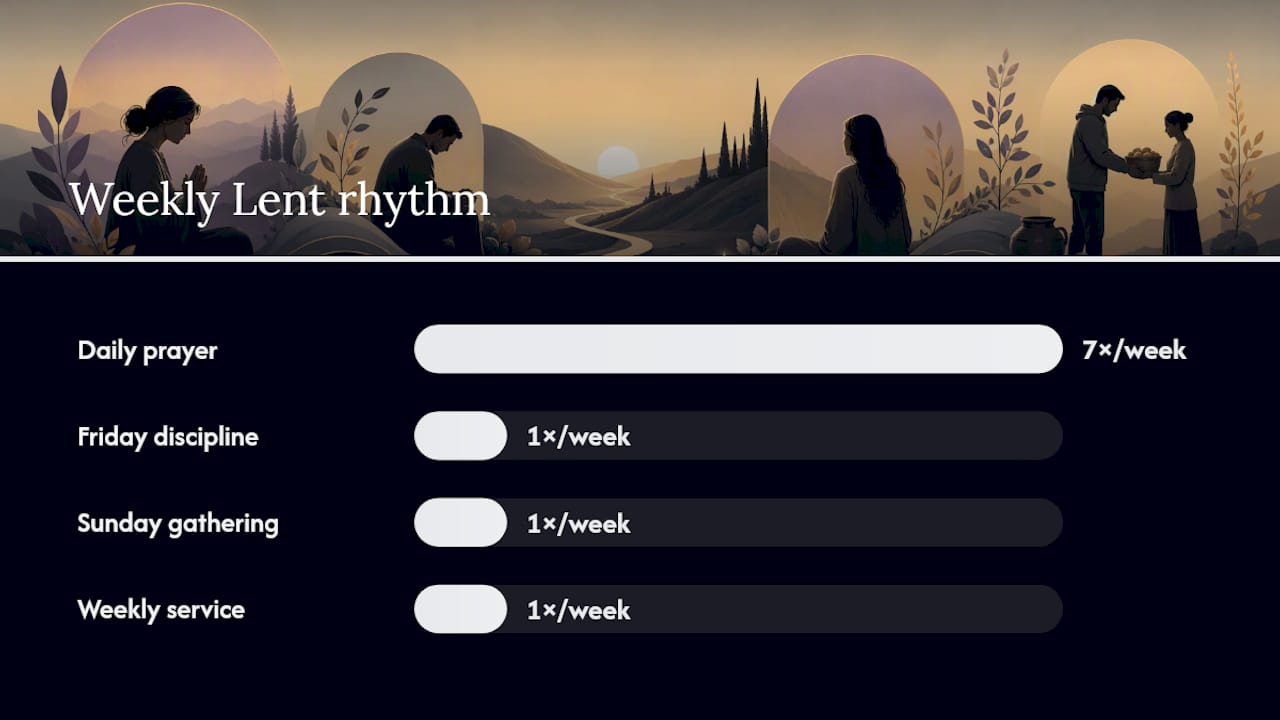
A workable weekly rhythm might look like this: a short daily prayer kept at the same time each day, one Friday discipline (abstaining from meat, or another chosen fast), a Sunday gathering with others to reflect on the week, and one act of service woven in somewhere across the seven days. None of this needs to be elaborate. The Church of England’s own approach to Lenten study leans toward exactly this kind of simple, repeatable structure over ambitious but unsustainable programs.
For those wanting to build a daily practice into an existing routine, a resource like 10 Christian habits to strengthen your daily faith offers a useful starting menu that adapts well to a Lenten season, even though it was not written specifically for Lent.
Running a small-group Lenten series works best when it resists the urge to pile on multiple heavy disciplines at once. A six-week format built around one weekly theme, a short Scripture passage, a couple of prompts for prayer, and one shared act of service for the group, tends to hold people’s attention and commitment far better than an ambitious curriculum that assumes everyone has hours of spare time. Groups that try to do everything at once, deep Bible study, strict fasting, daily accountability calls, and a service project, usually see attendance and follow-through collapse by week three. Groups that pick one focus a week and keep it light enough to actually finish tend to reach Easter with something to show for it.
If you are building a personal Lenten calendar rather than a group series, keep it visible. A printed page on the fridge or a recurring phone reminder does more for consistency than a plan that only exists in your head on Ash Wednesday and is forgotten by the second week of Lent.
Divergent Church’s approach to teaching and practising Lent
Fasting and prayer sit at the centre of how Divergentchurch teaches Christian discipleship, not as isolated Lenten add-ons but as ongoing rhythms meant to shape everyday faith. The church’s teaching on fasting as a way of aligning our loves with God and his Kingdom frames the discipline exactly the way historic Lenten practice does: not deprivation for its own sake, but a deliberate reordering of appetite so that God, not comfort, sits at the centre of attention. That same teaching pairs naturally with Lent’s own emphasis on repentance and renewal.
Some communities run 21 Days of Prayer, a structured season of sustained prayer that mirrors the kind of consistent, daily rhythm Lent asks for, useful as a model even outside its usual calendar slot. Alongside this sits teaching on consecration fasting and prayer, which explores fasting as a set apart practice rather than a one off event, a helpful frame for anyone treating Lent as a genuine season rather than a single Ash Wednesday gesture.
Beyond specific teaching content, broader church community structures can help these disciplines stick past week one:
Discipleship Hub offers structured pathways for growing in faith beyond a Sunday service.
Life communities provide a small-group setting where a shared Lenten series, prayer rhythm, or accountability conversation can actually happen week to week.
Local teaching content on fasting and consecration provides language and biblical grounding to disciplines that can otherwise feel vague or arbitrary.
A community-based approach reflects a conviction that faith is lived out through relationships and everyday life in the city, not just through individual willpower.
None of this requires attending every offering at once. Even engaging with one teaching resource, or joining one life community conversation about what Lent means this year, gives the season more traction than trying to keep it entirely alone.
Why Lent matters more than a list of rules suggests
Lent gets reduced, too often, to a trivia question: what are you giving up this year? That framing misses almost everything the season is actually for. The real question Lent asks is harder and more personal: what has quietly taken God’s place in your attention, and are you willing to notice it?
What strikes me most about Lent’s history is how consistently the Church has resisted turning it into either empty ritual or crushing austerity. The Black Fast came and mostly went. Regional rules multiplied and were later simplified. Through all of that adjustment, the core has stayed remarkably stable: prayer, fasting, almsgiving, oriented toward Easter. That stability across sixteen centuries of changing customs tells you something. The disciplines themselves are not the point. The reorientation they produce is.
I think the biggest mistake people make with Lent is treating it as an individual sprint. Six weeks of white-knuckling a habit alone is exhausting and rarely changes much beyond March. Lent was never designed to be kept solo. It grew up inside communities preparing candidates for baptism together, and it still works best held the same way, in a small group, a family, a conversation with someone who checks in on how the fast is going. If this season is going to mean something more than a temporary inconvenience, find a life community or a couple of people willing to walk it with you, and build a simple calendar you can actually stick to rather than an ambitious one you will quietly abandon by the second Sunday.
— Josh
Sources
Recommended
Comments