
Settle Your Heart: 5 Scripture Rooted Prayers for Decisions


Pray for wisdom and a settled peace, then act on it. Ask God plainly to show you what’s wise, and trust him to give it, as James 1:5 promises he will. Speak one short prayer below, then pause to listen. If nothing settles, take that next step: talk with someone you trust.
TL;DR:
Prayer is most effective when repeated regularly over several days, as clarity tends to develop gradually rather than appearing instantly.
Naming the decision and associated fears in longer, honest prayers can provide deeper insight and peace compared to brief, superficial requests.
Guided discernment practices like the ACTS pattern and Ignatian listening help identify inner peace or unrest with different options, informing faithful action.
Specific Bible verses such as James 1:5 and Psalm 32:8 highlight God’s willingness to give wisdom and guidance when asked sincerely.
Ongoing prayer support from communities like Divergent Church offers structured, long-term spiritual encouragement for difficult decision-making moments.
Table of Contents
A short prayer for decisions you can pray in under a minute
You don’t need a polished paragraph to bring a decision to God. Some of the most honest praying happens in fifteen seconds flat, whispered before a meeting or half asleep at midnight. Short prayers work because they’re usable in the exact moment your mind is spinning, and because returning to the same brief script repeatedly tends to settle the heart faster than one long, anxious plea.
Try one of these, matched to the moment:
For clarity, before a meeting or conversation: “Lord, show me what’s true here. Quiet my noise and give me your wisdom.”
For settled peace, last thing at night: “Father, I hand you this decision. Let your peace, not my worry, guard my heart tonight.”
For courage, before you make the call: “God, give me the courage to act on what you’ve already shown me.”
For surrender, when you’re overthinking it: “I trust your plans over mine. Have your way in this.”
On a commute or a walk: “Lord, order my steps. Close what should close, open what should open.”
Pick one. Repeat it, slowly, until something in you settles. That repetition is not a lack of faith. It is the practice.
Longer prayers for sustained seeking
Some decisions need more than a passing line. They need you to sit down, name the thing honestly, and stay in the room with God for a while.
A prayer that names the decision: “Father, I bring you [name the decision] honestly. I don’t fully see the outcome, but you do. Give me your perspective, not just my fears. Where I’m anxious, give me your peace. Where I’m avoiding truth, give me courage. Let my heart follow, not lead, this choice. In Jesus’ name.”
A prayer for reordered desires: “Lord, I confess I want this to go a certain way. Search my motives. If my wants are out of step with your wisdom, reorder them. Give me the freedom to want what you want, even before I know what that is.”
A prayer for communal discernment, prayed with a small group or trusted friend: “God, we bring this decision together. Speak through each other’s honesty. Let your Spirit confirm truth through more than one voice, and give us the humility to hear it.”

These longer prayers borrow their shape from the devotional tradition of decision-making peace, which reframes the goal away from a perfect answer and toward trusting the right person.
How do you pray about a decision step by step?
Prayer works best as a practice, not a mood. Here’s a method that moves you from spiritual longing to an actual next step.
Try the ACTS pattern on one decision:
Adoration. Start by praising God for who he is, not what he’ll give you. This resets your posture before you ask for anything.
Confession. Name any fear, pride, or manipulation tangled up in the decision. Confession clears the fog.
Thanksgiving. Thank God for what’s already true. Even an unresolved decision sits inside a life full of things worth thanking him for.
Supplication. Now ask, specifically. Name the decision and ask for wisdom, courage, and peace.
Or use Ignatian listening, a discernment approach that asks you to imagine yourself living out each option, then notice where you feel settled peace and where you feel unrest. Ignatian discernment practices treat that unrest as data worth taking seriously, not something to pray away.
A simple weekly routine that combines both:
Name the decision out loud or in writing.
Pray, using ACTS or a short script.
Sit in silence for 10 to 30 minutes. Resist the urge to fill it.
Journal whatever surfaced, even if it feels small.
Take it to someone who knows you well.
Pro Tip: Settled peace doesn’t mean the absence of nerves. It means the absence of inner conflict. If you can pray about an option and feel calm even imagining it going wrong, that’s usually your signal to move.
Which Bible verses help when you’re seeking guidance?
Certain passages come up again and again in prayer for decisions, not because they’re magic formulas, but because they speak directly to a mind stuck between options.
James 1:5 — God gives wisdom generously to anyone who asks.
Proverbs 3:5–6 — Trust God rather than leaning on your own understanding.
Psalm 32:8 — God promises to instruct and counsel you, watching over you as you go.
Psalm 119:105 — His word is a lamp for the next step, not a floodlight for the whole path.
Psalm 23 — A reminder that God leads, even through valleys, not just open fields.
Isaiah 30:21 — A quiet, internal sense of “this is the way” when you’re tempted to wander.
Read one slowly. Ask what it says about each option in front of you, then journal what comes up. One practical exercise pairs well with this: picture yourself a year after each choice, and notice which future you can genuinely thank God for. That imagination test is a longstanding discernment tool, not a gimmick.
When and how often should you pray about a big decision?
Pray before you decide, not just after you’re stuck. Big decisions deserve repeated prayer across several days rather than one dramatic moment, because clarity tends to build rather than strike.
Set a decision window. Give yourself a defined number of days, not an open-ended search for certainty.
Journal daily. Track what settles and what still unsettles you.
Run a simple checklist: does this align with your values, what are the likely consequences, and what has trusted counsel said?
When the window closes, act on the most immediate faithful step, even if the whole path isn’t clear.
Waiting for more signs past your window usually signals fear, not faithfulness.
How Divergent Church supports people through decisions
Josh, part of Divergent Church’s ministry team, has walked alongside people wrestling with career changes, relationship decisions, and harder crossroads, using prayer as a practical discipline rather than a last resort.
The church builds decision-making prayer into its everyday rhythms:
Pray in 5, a short ACTS-based practice anyone can use daily, detailed in Pray in 5 Minutes.
Small-group discernment, where decisions are prayed over communally rather than carried alone.
Pastoral counsel is offered for those needing a wiser, outside voice.
Discipleship pathways aim to build habits supporting ongoing prayer for decisions beyond the immediate choice.
These practices sit inside Divergent Church’s wider Life Communities, where ongoing prayer support isn’t a one off event.
What makes it hard to pray about decisions, and how do you push through?
The most common obstacle isn’t disbelief. It’s noise. A racing mind, a looming deadline, or pressure from other people can drown out the quiet needed to actually listen.
Fear of hearing “no” is another one. Some people avoid praying seriously about a decision because they suspect God’s answer won’t match their preference, so silence feels safer than an honest ask. Naming that fear out loud, even to yourself, usually breaks its grip.
Impatience shows up constantly too. Prayer for decisions rarely delivers instant certainty, and when nothing seems to happen after a day or two, it’s tempting to conclude prayer “isn’t working.” The practical counsel to keep praying over several days rather than expecting one dramatic answer exists precisely because clarity is usually gradual.
Overanalysis is the quieter trap. Endless research, endless pro and con lists, endless conversations, none of it replaces the stillness prayer asks for. At some point, more information stops helping and starts stalling.
The fix for most of these obstacles is the same: set a decision window, protect real silence within it, and bring your fear into the prayer itself rather than around it. “God, I’m scared of what you might say” is a perfectly honest way to start.
What does answered prayer for decisions actually look like?
Answered prayer rarely arrives as a voice from the sky. More often it looks like a growing sense of peace about one option and a persistent unease about another, building over days of prayer rather than a single dramatic moment.
Someone facing a job change might pray each morning for a week, noticing that one path keeps bringing a quiet steadiness while the other keeps producing a knot in the stomach that won’t loosen. That pattern, tracked through journalling, becomes its own kind of answer.
Others describe clarity showing up through people. A conversation with a trusted friend surfaces exactly the concern they’d been avoiding, or a piece of counsel lands with unusual weight. That’s consistent with the widespread advice to pair prayer with honest counsel from people who know you well, since God often speaks through community rather than isolation.
And sometimes the answer is simply peace to proceed, without a guarantee of the outcome. That’s not a lesser answer. It’s often the only one available before a genuinely uncertain choice, and it’s enough to move on.
How do you personalise a prayer for career, relationship, or health decisions?
A career prayer should name specifics: the actual role, the actual fear (money, identity, failure), and ask God for wisdom about fit, not just opportunity. Something like, “Lord, show me if this role uses what you’ve built in me, or if I’m chasing status.”
A relationship decision, whether it’s about a friendship, a dating relationship, or a marriage, calls for prayer that asks about character and direction rather than feeling alone. “God, show me who this person actually is over time, not just how they make me feel today.”
Health decisions carry a different weight, often involving fear of the body or fear of loss. Prayer here can lean harder into surrender: “Father, I don’t control this outcome. Give the medical team wisdom, and give me peace that isn’t dependent on the result.”
The shape stays the same across all three: name the real fear underneath the decision, then ask God to address that fear directly rather than praying in vague generalities. A generic prayer for “wisdom” is fine as a starting point, but a prayer that names your actual anxiety usually goes deeper and settles faster.
Why does trust matter more than getting the decision right?
Prayer for decisions can quietly turn into a performance, where the goal becomes extracting the correct answer from God rather than trusting the person of God. That shift matters more than it sounds.
Faith doesn’t promise you’ll always choose correctly. It promises you’re not choosing alone, and that a wrong choice made in good faith and honest prayer is still held by grace, not punished by it. That distinction changes how a decision feels while you’re inside it. Instead of hunting for a guarantee, you’re leaning on a relationship that holds steady regardless of which door you walk through.
This is really the theological engine behind the decision-making peace many devotional writers describe: less about praying until certainty arrives, more about trusting the character of the one you’re praying to. Certainty is rarely on offer. Peace, even amid genuine uncertainty, usually is.
How do you combine prayer with practical steps?
Prayer isn’t a substitute for research, counsel, or common sense. It’s the frame those things sit inside. Pray first, then gather information, talk to people, and weigh consequences, bringing each piece back into prayer rather than treating prayer and practicality as separate tracks.
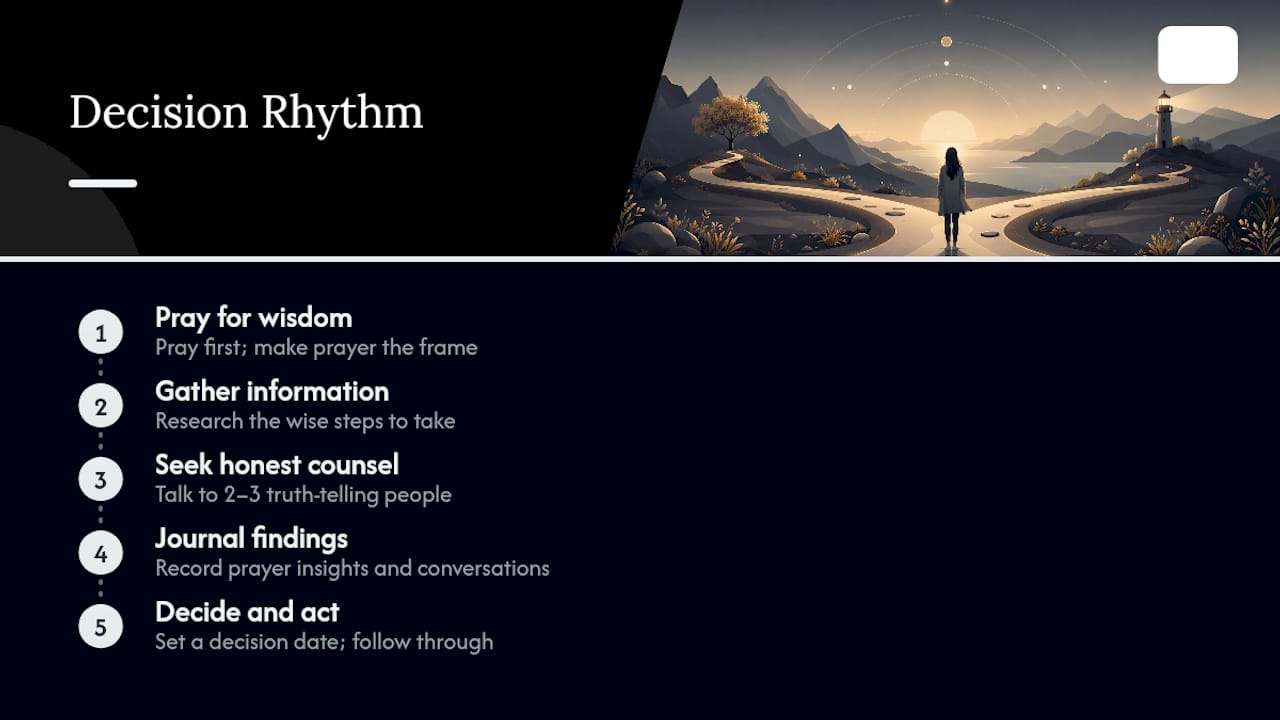
A workable rhythm looks like this: pray for wisdom, then do the research a wise person would do anyway. Talk to two or three people who know you well and will tell you the truth. Journal what surfaces from both the prayer and the conversations. Then set a date to decide, and treat that date as real.
The point of this rhythm isn’t to remove faith from the equation. It’s to stop faith and diligence from competing, so that showing up prepared to a decision is itself part of taking prayer seriously. A repeatable routine, praying, listening, journalling, seeking counsel, then acting, turns spiritual conviction into forward motion instead of leaving it stuck as a feeling.
A short reflection on choosing with faith
Quiet doesn’t always mean uncertain. Sometimes it just means it’s time to move. Waiting endlessly for a feeling of total certainty can become its own kind of avoidance, and God tends to meet honest seekers in the walking, not just the waiting. A decision made in good faith that turns out wrong is still met with grace, not condemnation. If you’re stuck, don’t go it alone. Bring it to people who’ll pray honestly with you.
— Josh
Where to find ongoing prayer support for your decision
Divergent Church exists for exactly this moment, when a decision feels too heavy to carry alone and too important to rush. Rather than leaving you with a few scripts and a “good luck,” the Discipleship Hub connects you with people who’ll pray through a decision with you over weeks, not minutes, and pastoral counsel that goes beyond a single conversation.
Life Communities offer the same support in a smaller, steadier setting: a handful of people who know your situation well enough to ask the right follow up question, not just the polite one. If you’re facing a decision right now and want someone praying alongside you rather than a script to read alone, reach out through the contact page and ask for prayer. That’s a genuine next step, not a form to fill in and forget.
Sources
FAQ
What is a good prayer for someone experiencing indecision?
A simple, honest one works best: “Lord, I don’t know which way to go. Give me your wisdom, settle my heart, and show me the next faithful step, even if I can’t see the whole path yet.”
How do you ask God to help you make the right decision?
Ask directly and specifically, naming the actual decision and your real fear, then give yourself space, days rather than minutes, to notice which option brings settled peace over time.
Which psalm is best for making the right decision?
Psalm 32:8, where God promises to instruct and counsel and watch over you, and Psalm 119:105, which describes his word as a lamp for the next step, are both widely used for decision-making prayer.
How often should I pray about a big decision?
Pray daily within a set decision window rather than once, since clarity for most people builds gradually over several days of prayer, journalling, and honest counsel rather than arriving in one moment.
What does the Bible say about generations passing away?
Ecclesiastes 1:4 notes that “generations come and generations go, but the earth remains forever,” a verse about human transience rather than decision-making, though it’s sometimes searched alongside guidance passages.
Recommended
Comments