
Generosity in church: worship, mission and community


Generosity is a central act of Christian worship that forms character, funds mission and builds resilient communities. In 2 Corinthians 9:7, Paul writes that “God loves a cheerful giver” — not a reluctant one, not a coerced one, but someone whose giving flows from a transformed heart. James 1:17 reminds us that every good gift comes from above, grounding generosity in the character of God rather than the needs of a budget. The role of generosity in church life is therefore threefold: it is an act of worship, a discipline of discipleship, and the practical engine of mission. King, Duffy & Steensland (2024) found that spiritual practices beyond attendance are independently linked to higher giving and volunteering. At Divergentchurch in Canberra, this conviction shapes how the community gives, serves and grows together.
Key takeaways
Generosity in the church is first a spiritual discipline and act of worship, and second the practical means by which mission, community care and discipleship are sustained.
Point | Details |
Generosity is worship | Giving flows from grace received, not obligation — 2 Corinthians 9:7 frames it as cheerful and freely chosen. |
Spiritual practices drive giving | King, Duffy & Steensland (2024) found prayer and reflection independently predict higher giving and volunteering, beyond attendance alone. |
Culture is built year-round | Consistent preaching, impact storytelling and youth formation create lasting generosity cultures, not one-off campaigns. |
Australian churches need transparency | ACNC registration, clear reporting and DGR status build donor trust and meet community expectations. |
Divergentchurch offers a local pathway | The Discipleship Hub and Life Communities in Canberra provide structured, relational formation in generosity as whole-life discipleship. |
Table of Contents
What does the Bible say about generosity in church?
Scripture does not treat generosity as a financial transaction. It frames giving as a response to divine abundance — a posture of the heart before it is a movement of the wallet.
Genesis 12 establishes the pattern: God blesses Abraham so that he will be a blessing to others. Generosity flows outward from received grace. James 1:17 deepens this, locating every good gift in the Father of lights. Then 2 Corinthians 8–9 gives the fullest New Testament theology of giving: Paul holds up the Macedonian churches, who gave “beyond their ability” out of joy, not obligation (2 Cor. 8:3). The pinnacle is 2 Corinthians 8:9 — Christ himself “became poor, so that you through his poverty might become rich.” Generosity is Christological. It imitates the self-giving of Jesus.
The Baylor IFL paper on generosity of spirit argues that genuine generosity is a formed character trait rooted in a biblical narrative of divine abundance. It is not primarily about amounts; it is about the worldview that shapes a person’s relationship to possessions, time and community.
Focus on the Family frames giving as an act of trust: we give because we believe God is the true owner of all things, and because Christ’s generosity toward us demands a response. Pulpit Matters draws on pastoral tradition to show how the corporate offering in gathered worship is itself a liturgical act — not a pause in the service, but part of it.
Key scriptural anchors:
Genesis 12:2 — Blessing received is blessing meant to flow outward.
James 1:17 — Every good gift originates in God’s character.
2 Corinthians 8:9 — Christ’s self-giving is the model and motivation.
2 Corinthians 9:7 — God loves a cheerful, freely-chosen giver.
How generosity shapes church life, mission and care for the poor
Theology becomes practice when a congregation decides what generosity actually funds and forms. The Christianity Today analysis makes a point worth holding: devotion and outward service are not in competition. A community shaped by worship and fellowship tends to serve the marginalised more, not less.
Generosity in a local church sustains:
Worship and pastoral care — staff, music, teaching and the infrastructure of gathered community.
Local compassion — food relief, financial counselling, support for families in crisis.
Mission partnerships — local and global, including support for urban ministry partners like NYSUM’s non-traditional giving pathways.
Children and youth formation — the next generation of disciples learning to give and serve.
Capital needs — buildings, equipment and the physical spaces where community happens.
Beyond funding, generosity changes congregational culture. When a church gives freely, it tends to receive freely — hospitality deepens, mutual aid becomes normal, and the community’s identity shifts from consumers of services to participants in a shared mission. Barna research shows this virtuous cycle clearly: generosity spreads when people both give and receive it.
What does research say about religion and generosity?
The honest answer: religious practice and generosity are linked, but the relationship is more nuanced than popular accounts suggest.
Large-survey data from the Hoover Institution shows that religiously active people give and volunteer at substantially higher rates than their secular counterparts. The gap in donation likelihood across surveys has been documented at around 25 percentage points. But surveys measure correlation, not cause.
A causal-inference study reported by PsyPost using New Zealand data found that increasing regular attendance does produce a statistically detectable rise in donations and volunteering at population level — though the effect is modest. This matters: attendance alone is not a magic lever.
Statistic: The PsyPost causal analysis found that if everyone attended religious services regularly, donations and volunteering would rise at population level — but the per-person effect is modest, not transformative on its own.
King, Duffy & Steensland (2024) add the crucial nuance: spiritual practices beyond attendance — personal prayer, reflection, Scripture reading — are independently associated with higher giving and volunteering. Showing up on Sunday helps. Praying and reading Scripture through the week helps more.
Methodological caution is warranted. Surveys cannot fully separate the effects of religious identity, community belonging, and specific theological beliefs. The evidence is consistent and encouraging, but not a simple formula.
How can churches grow a lasting culture of generosity?
Culture is built slowly, through repeated practices and consistent teaching. Church Leadership’s seven strategies and Barna’s research on giving cultures converge on a clear picture.
Seven practical strategies:
Preach generosity year-round, not only during stewardship campaigns — one or two sermons a year rarely shifts culture.
Tell stories of impact — show the congregation what their giving actually does, in specific, human terms.
Build gratitude systems — thank givers personally, publicly acknowledge milestones, and celebrate generosity as a community value.
Teach children and youth — formation begins early; involve young people in giving decisions and service projects.
Connect gifts to mission outcomes — people give more consistently when they can trace their contribution to a tangible result.
Create multiple giving pathways — regular tithes, one-off gifts, volunteer hours, legacy giving, and non-cash contributions all count.
Make financial transparency normal — publish clear, accessible reports on how funds are used.
Pro Tip: *Don’t focus only on your top givers. Research suggests a small share of donors fund a large share of most church budgets.
Different giver types respond to different approaches. Younger members often want a clear connection to mission rather than a duty narrative. Planned givers need practical tools. Habitual givers need affirmation and vision. Tailor your teaching accordingly.
How can you grow personally in generosity?
Generosity is a learned posture, shaped by repeated spiritual habits and deliberate choices over time. King, Duffy & Steensland (2024) found that personal spiritual practices are among the strongest predictors of giving — which means the path to greater generosity runs through your devotional life as much as your bank account.
A simple practice plan:
Pray about your giving — ask God what faithful generosity looks like in your current season.
Reflect on received grace — spend time with 2 Corinthians 8:9 and James 1:17 before making giving decisions.
Set a giving baseline — tithing (10%) is a historic starting point, but any intentional, proportionate commitment is a beginning.
Automate where possible — regular, planned giving reduces decision fatigue and builds the habit.
Volunteer your time — serving in Canberra is generosity in action, not just a supplement to financial giving.
Practise neighbourhood generosity — small acts of hospitality and care extend the spirit of giving into everyday life.
A pastoral note: seasons of financial hardship are real. Generosity in those seasons may look more like time, prayer and presence than money. The spirit of giving matters more than the amount.
Explore daily faith practices that support this kind of formation.
Common concerns about church giving and pastoral responses
“Isn’t giving just paying the church’s bills?” Theologically, no. The offering is an act of worship — an expression of trust in God’s provision and gratitude for Christ’s self-giving. Focus on the Family frames it clearly: giving is a response to grace, not a subscription fee. That said, it does fund real ministry, and there is no shame in that.
“Churches pressure people to give.” Coercion is a pastoral failure, not a biblical model. Paul’s instruction in 2 Corinthians 9:7 is explicit: giving must be “not reluctantly or under compulsion.” Safeguards include transparent reporting, no-pressure teaching, and multiple giving options. See how Divergentchurch handles finance for a practical example of accountability.
“Tithing is Old Testament legalism.” The tithe is a starting point, not a ceiling or a law. Most pastoral traditions treat it as a helpful baseline for proportionate giving rather than a binding legal requirement. The New Testament emphasis is on cheerful, Spirit-led generosity rather than a fixed percentage.
“I can’t afford to give.” Generosity includes time, skill and presence. Financial giving in seasons of hardship is not required. The question is always: what can I offer freely, from what I have?
“Does church giving actually help anyone?” Research consistently links religious giving to tangible community outcomes — local food relief, crisis support, youth programmes and global mission. The Hoover Institution survey data shows religiously active people are substantially more likely to give to both religious and secular causes.
Practical notes for Australian churches and donors
Australia’s charity and tax framework shapes how churches give and report.
For churches:
Register with the Australian Charities and Not-for-profits Commission (ACNC) and maintain current charity status.
Publish an annual report accessible to your congregation — transparency builds trust.
Communicate clearly how gifts are allocated across ministry, mission and care.
Pursue Deductible Gift Recipient (DGR) status for any public benevolent activities, so donors can claim tax deductions where eligible.
Adopt culturally inclusive giving practices that respect the diverse backgrounds of Australian congregations. Church diversity shapes how generosity is understood and expressed.
For donors:
Ask your church how gifts are used and request an annual giving statement for tax purposes.
Consider non-cash generosity: volunteer time, skills and in-kind contributions are significant.
Explore legacy giving options — gifts in wills and non-traditional giving pathways like those offered by NYSUM show what creative generosity can look like.
Confirm your church’s ACNC registration at Acnc before making significant gifts.
This is general information, not legal or financial advice. Consult a qualified adviser or the ATO for guidance specific to your situation.
How do you measure the impact of generosity in a church?
Measurement matters because what gets named gets noticed. Churches that track generosity outcomes tend to cultivate stronger giving cultures over time.
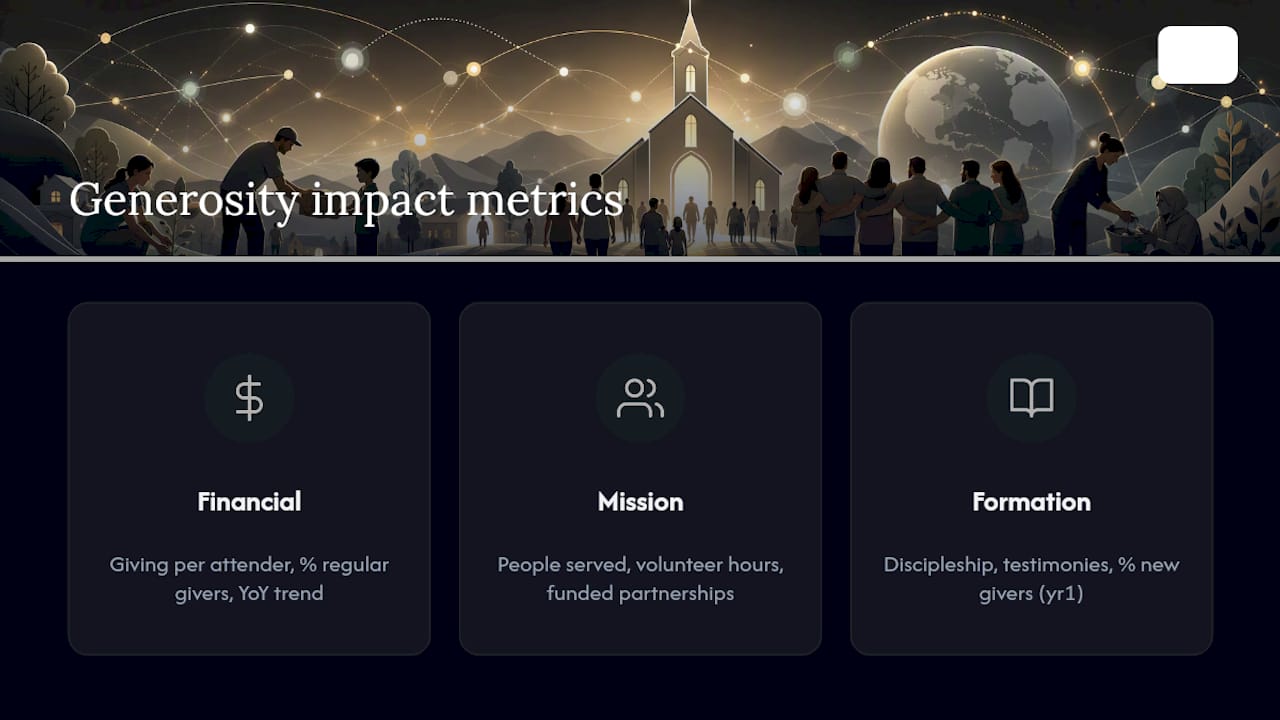
Useful metrics fall into three categories. Financial indicators include total giving per attender, percentage of regular givers, and year-on-year giving trends. Mission indicators cover the number of people served through community programmes, volunteer hours contributed, and mission partnerships funded. Formation indicators are harder to quantify but no less real: participation in discipleship pathways, testimonies of changed attitudes toward money, and the proportion of new members who begin giving within their first year.
The key is connecting data to story. A number on a spreadsheet rarely moves anyone. The same number attached to a family housed, a young person discipled, or a community fed carries weight. Barna’s research consistently shows that storytelling about impact is one of the most effective tools for sustaining and growing a giving culture.
Avoid measuring generosity only in dollars. Volunteer hours, in-kind contributions and acts of neighbourly care are all expressions of the same spirit. A church that tracks only financial giving misses a significant part of what God is doing through its people.
Generosity at Divergentchurch in Canberra
At Divergentchurch, generosity is understood as discipleship, not fundraising. The conviction is simple: you cannot follow Jesus and hold everything tightly. Giving — of money, time and presence — is one of the clearest signs that the kingdom of God is taking root in a person’s life.
In practice, this means Life Communities (small groups) are a primary space where generosity is both taught and practised. Members share meals, support one another in crisis, and make collective decisions about serving their neighbourhoods. Financial giving is taught as part of whole-life discipleship, not isolated to a stewardship season. The church publishes clear information about how it handles finance, because transparency is itself a form of trust-building.

Canberra’s transient population — students, public servants, diplomats — means the church regularly welcomes people at the beginning of their generosity journey. The approach is formational rather than transactional: the goal is disciples who give freely because they have been captured by the grace of Jesus, not members who tithe to stay in good standing.
If you are exploring what generosity looks like in your own life, the question worth sitting with is this: what would it look like to hold everything I have as a gift, given for others?
Generosity as formation, not just finance
Generosity at Divergentchurch is an invitation into a way of life shaped by the kingdom of God. Whether you are new to faith or leading a congregation, the Discipleship Hub offers structured pathways for growing in stewardship, service and giving. Life Communities are the practical, relational space where these habits take root — in real friendships, shared meals and mutual care across Canberra.
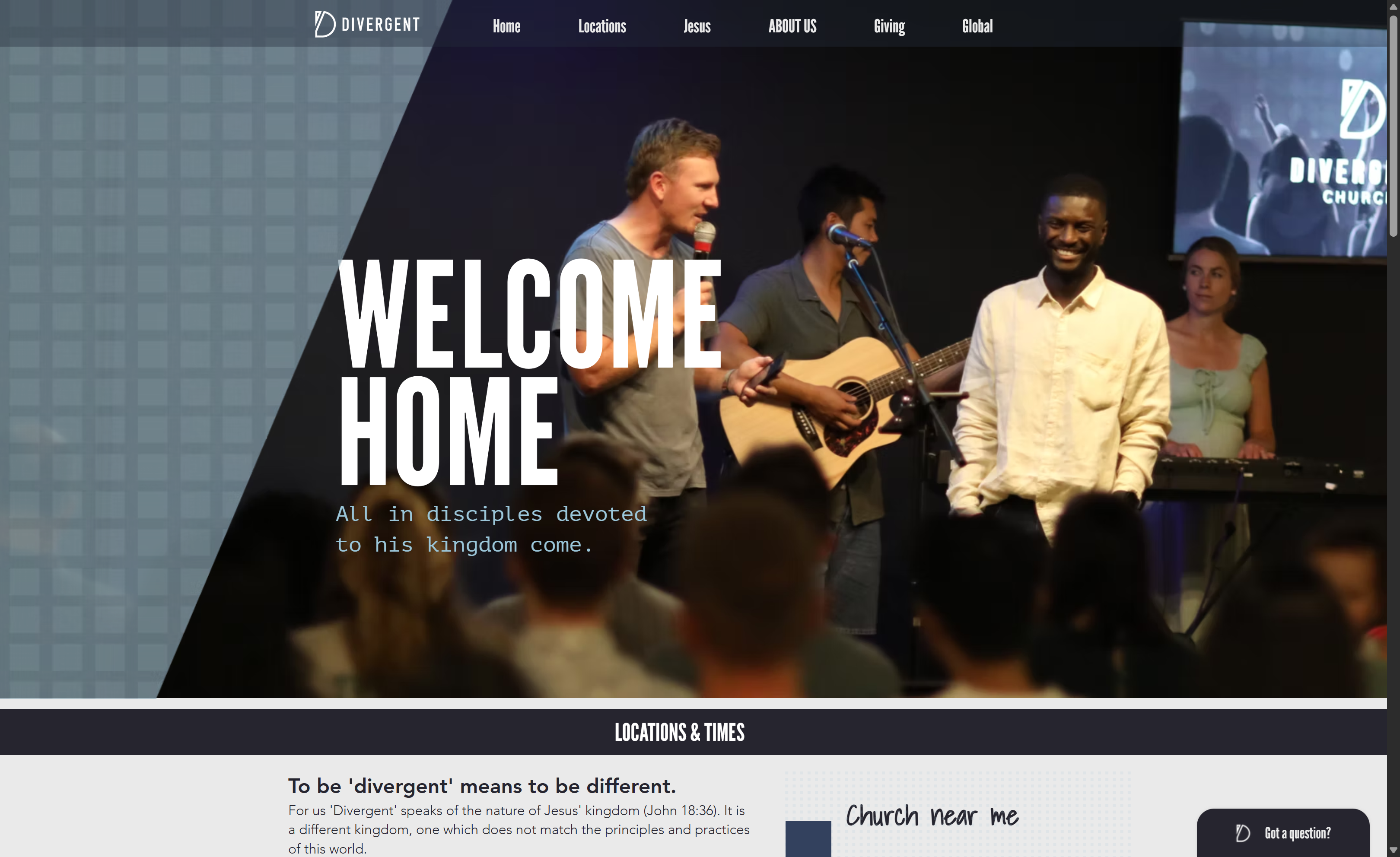
If you want to take a concrete next step, explore giving at Divergentchurch or find your next steps into community. The door is open.
What generosity in church is really asking of us
Most conversations about church giving circle around the question of money. How much? How often? Is tithing still relevant? Those are fair questions, but they miss the deeper one: what kind of person do you want to become?
The research is consistent — spiritual practices shape giving behaviour, and giving shapes the person who gives. But the most honest thing you can say about generosity is that it is a test of what you actually believe. A person who genuinely trusts that God is the source of all good things, and that Christ gave everything for them, will eventually give freely. Not because they have to. Because it would feel strange not to.
What I find underappreciated in most pastoral conversations is the formation that happens in the receiver as much as the giver. Churches that create cultures where people both give and receive — where vulnerability and mutual aid are normal — tend to produce more generous communities than those that only teach giving as a duty. The direction of grace matters. When a congregation experiences generosity, it tends to extend it.
The practical implication for church leaders is this: don’t build your generosity culture around your top donors. Build it around the middle. The budget will follow.
Sources
The following sources informed this article. Theological and empirical resources are listed separately for readers who want to go deeper.
Theological and pastoral:
Empirical and practical:
Recommended
Comments