
Gospel mission explained: a biblically grounded guide


Gospel mission is God’s sending of his people to proclaim and embody the good news of Jesus Christ in words and deeds, rooted in Christ’s own sending and expressed through every believer’s life. Two texts anchor this definition immediately: in Matthew 28:18–20, the risen Jesus commissions his disciples to “make disciples of all nations,” and in John 20:21 he says, “As the Father has sent me, even so I am sending you.” The Lausanne Movement frames this as Missio Dei, Latin for “the mission of God,” a theological term that repositions the church not as the originator of mission but as a participant in what God is already doing in the world. Understanding gospel mission, then, begins here: it is identity before it is activity.
Key takeaways
Gospel mission is God’s sending of his people to proclaim and embody the good news of Jesus in words and deeds, and every believer is called to participate in it through their everyday life and local church.
Point | Details |
Sent identity, not just activity | Gospel mission is who you are as a believer, not merely a programme your church runs. |
Three-legged biblical pattern | Evangelism, discipleship, and church formation together constitute the apostolic shape of mission from Acts onwards. |
Words and deeds belong together | Proclamation is the hub; compassionate action is the wheel — both are necessary, but verbal witness cannot be replaced. |
Guard against mission drift | Regularly ask whether your activities create pathways to gospel proclamation and measurable discipleship outcomes. |
Divergentchurch as a local pathway | Life Communities and the Discipleship Hub in Canberra offer structured, relational ways to join gospel mission today. |
Table of Contents
What does the Bible say about gospel mission?
The Great Commission in Matthew 28:18–20 is the clearest single statement of gospel mission in the New Testament. The main verb is not “go” but “make disciples.” Going, baptising, and teaching are all participles that describe how disciple-making happens. Jesus grounds the command in his own authority (“all authority in heaven and on earth has been given to me”) and seals it with a promise of presence (“I am with you always, to the end of the age”). Crossway’s exegesis of this passage notes that the scope is panta ta ethne, all the peoples of the earth, which means mission is never merely local or parochial.
John 20:21 adds a different but equally important dimension. Jesus does not simply instruct his disciples; he draws a direct line between his own sending by the Father and their sending by him. The shape of Jesus’ mission becomes the shape of theirs: incarnational, costly, and Spirit-empowered. The very next verse records Jesus breathing on them and saying, “Receive the Holy Spirit.” Sentness and Spirit-dependence are inseparable from the beginning.
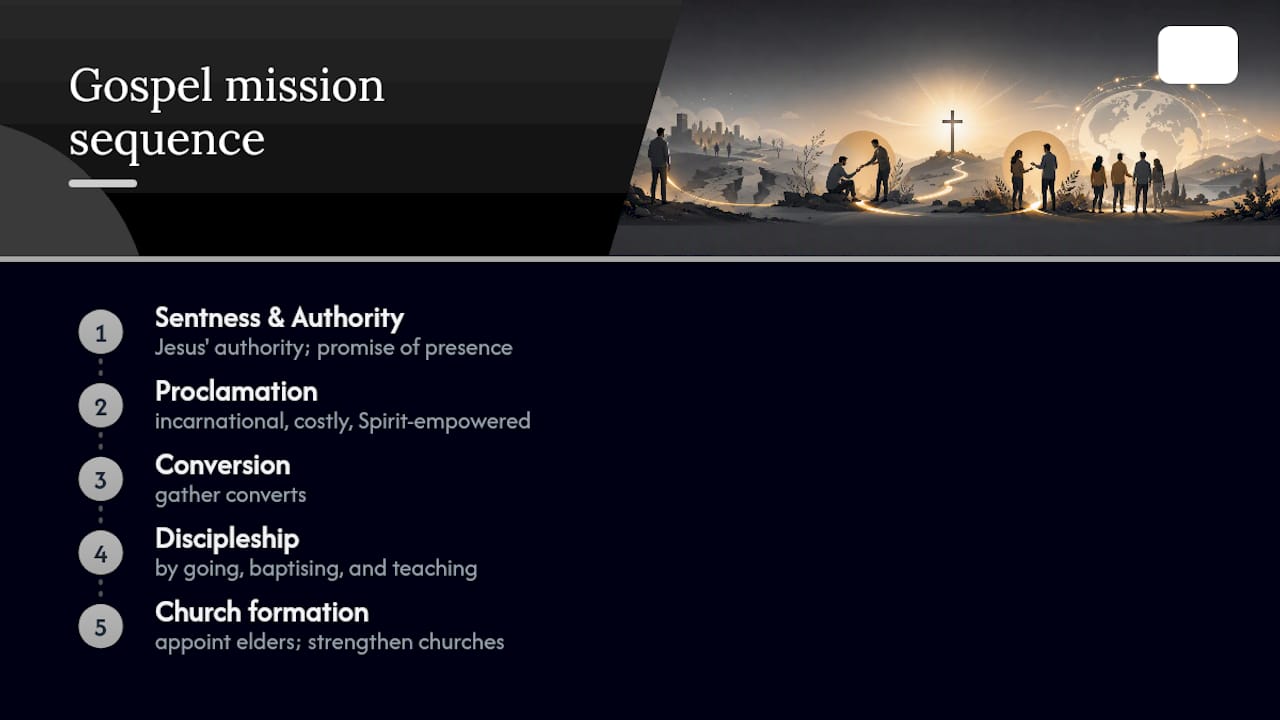
Acts fills out what this looks like in practice. Paul and Barnabas in Acts 13–14 preach in synagogues, gather converts, appoint elders, and return to strengthen the churches they planted. The pattern is consistent: proclamation leads to conversion, conversion leads to discipleship, discipleship leads to church formation. Themelios describes this as the New Testament presenting mission as the continuing work of Jesus by his Spirit, with the church as his instrument. Charles Spurgeon captured the same instinct in the nineteenth century: the gospel must be spoken, not merely demonstrated.
How does theology help you grasp gospel mission?
Missio Dei: God’s mission, not ours
The term Missio Dei was developed formally in twentieth-century missiology, most influentially by David Bosch in Transforming Mission (1991). The concept is simple but reorienting: mission originates in the nature of God himself, a sending God who sends the Son, the Son who sends the Spirit, and the Spirit who sends the church. The church does not have a mission programme; the church is a missionary people called to participate in what God is already doing. This matters practically because it shifts the question from “what should our church do?” to “where is God at work, and how do we join him?”
Mission as identity, not just activity
Mission drift often begins when a church treats mission as one programme among many rather than as the defining shape of its life. If sentness is identity, then every believer is a missionary in their neighbourhood, workplace, and household. The OSCAR resource on evangelism and mission makes the helpful point that mission is “glocal”: it applies at home just as much as abroad, and treating it as the preserve of specialists creates a two-tier church where most members feel exempt.
Mission vs evangelism: what’s the difference?
These two words are often used interchangeably, but they describe different things. Evangelism is the verbal proclamation of the gospel, the specific act of announcing the good news of Jesus and calling people to repentance and faith. Mission is broader: it encompasses everything the church does as a sent people, including acts of mercy, justice, hospitality, and church planting, all of which are governed and given meaning by the gospel.
Mission | Evangelism | |
Agent | The whole church as a sent community | Any believer in a specific gospel conversation |
Scope | All of life: words, deeds, presence | Verbal proclamation of the gospel |
Primary verb | Be sent | Announce |
Typical activities | Discipleship, mercy, justice, church planting, hospitality | Sharing the gospel, gospel conversations, invitations |
The Lausanne Movement insists that integral or holistic mission holds proclamation and demonstration together: the gospel integrates words and deeds rather than separating them. Compassion without proclamation is social work; proclamation without compassion lacks credibility. Both belong together under the banner of gospel mission.
What does gospel mission look like in everyday life?
Proclamation
Verbal proclamation remains the irreplaceable centre. Baptist Press offers a vivid metaphor: gospel words are the hub; gospel-shaped actions are the wheel. Both are necessary, but a wheel without a hub collapses. Actions can open doors and demonstrate love, but they cannot by themselves communicate who Jesus is, what he has done, or why it matters. Someone has to say his name.
Discipleship and church formation
Kevin DeYoung, writing for The Gospel Coalition, summarises the apostolic pattern as a threefold goal: evangelism, discipleship, and incorporation into local churches. Winning converts who are never discipled and never connected to a local church is, in his framing, an incomplete mission. Churches that embed clear disciple-making steps, including baptism, teaching pathways, and life communities, avoid orphaning new believers.
Hospitality and acts of mercy
In Australian cities, where social isolation is common and trust in institutions is low, hospitality is a genuinely missional act. Opening your home, sharing a meal, and being present in your street or apartment block are not peripheral to mission; they are the soil in which gospel conversations grow. Acts of mercy, visiting the sick, supporting refugees, serving the homeless, demonstrate that the kingdom of God has practical consequences for human dignity.

Two Australian examples
A church in an inner-city Sydney neighbourhood runs a weekly community dinner that draws in residents who would never attend a Sunday service. Over time, relationships form, questions arise, and gospel conversations happen naturally. The dinner is not a bait-and-switch; it is genuine hospitality that creates space for genuine witness.
In Canberra, where a large transient population of students and public servants moves through the city every few years, campus and workplace ministry takes on particular significance. Short-term residents need to be reached quickly and connected deeply, which is why church partnerships for lasting mission impact matter so much in that context.
How can you participate in gospel mission today?
Gospel mission is not reserved for ordained ministers or overseas workers. Every believer is sent. Here are five sequential steps to begin:
Pray and depend on the Holy Spirit. Before any strategy, ask God to open your eyes to the people around you and to give you courage and words. Mission runs on prayer, not programme.
Learn a short gospel presentation. You do not need a theology degree. A clear, simple summary of who Jesus is, what he has done, and what response he calls for is enough to start a conversation. Resources like Two Ways to Live or the Three Circles are widely used in Australian church contexts.
Notice your “sent” opportunities. Your workplace, your street, your university campus, your gym: these are your mission field. Pay attention to the people God has placed around you.
Invite and disciple. Invite someone to church, to a meal, or to read the Bible with you. Discipleship begins in relationship, not in a classroom.
Plug into local church life. Baptism, teaching pathways, and discipleship in the local church are not optional extras. They are the structure through which mission becomes sustainable.
Pro Tip: The most effective missional step you can take this week is not attending another training event. It is praying for three people by name and then finding a reason to be with them.
Mission can be exhausting, especially for leaders carrying the weight of a community’s outreach. If you are in a leadership role, strategies for preventing ministry burnout are worth building into your rhythm before you need them.
How do you keep the gospel central and avoid mission drift?
Mission drift is what happens when the good things a church does gradually displace the main thing. A food pantry becomes the church’s identity. A justice campaign absorbs the energy that once went into evangelism. Social credibility becomes more important than gospel clarity. None of these activities are wrong; the drift happens when they are no longer governed by the gospel aim of conversion and discipleship.
Before launching any new initiative, a church leadership team might ask:
Does this activity create natural pathways toward gospel proclamation, or does it function as a substitute for it?
Are we measuring discipleship outcomes, not just participation numbers?
Can the people we serve name Jesus as the reason we serve them?
Are our volunteers trained to share the gospel, or only to deliver a service?
Pastoral accountability matters here. Scripture-centred planning, where every programme is evaluated against the Great Commission rather than against community approval, keeps the mission honest. Linking evangelism and discipleship metrics, rather than tracking them separately, helps leaders see whether outreach is producing fruit that lasts.
Getting involved locally: Divergent Church and Australian pathways
Divergentchurch in Canberra is a concrete example of a church that frames its entire life around sentness. Rather than treating mission as a department, Divergentchurch structures its community around Life Communities, small groups that meet in homes and neighbourhoods throughout the city. These groups are not primarily Bible studies, though Scripture is central; they are communities of sent people learning to live the gospel together in their particular corner of Canberra. The church’s transient population, students, public servants, and young professionals, means that discipleship pathways need to be clear and accessible from the moment someone walks through the door. The Divergentchurch mission page outlines how local and global priorities connect.
Beyond Divergentchurch, several Australian pathways are worth knowing:
The Uniting Church in Australia (UCA) provides denominational mission resources and local church networks across NSW and the ACT, with particular strength in community service and social justice contexts.
Campus ministry organisations operating on Australian university campuses offer structured entry points for students wanting to engage in peer-to-peer gospel witness.
Local mission partnerships between churches in the same suburb or city allow smaller congregations to pool resources for outreach without duplicating effort.
Practically, the best way to start is to identify your gifting, whether that is hospitality, teaching, mercy, or evangelism, and then find a community where that gifting can be expressed in service of others. Ask your church for a mission mentor. Attend a mission training night. Join a life community and let the relationships do what programmes cannot.
A pastoral word on faithful small steps
There is a temptation to wait until you feel ready, until you know enough, until your life is tidy enough to invite someone in. The gospel does not wait for readiness. It moves through ordinary people in ordinary moments, a conversation on a bus, a meal shared with a neighbour, a question asked with genuine curiosity. The Spirit goes before you. Your job is to show up, speak honestly, and trust that the seeds you plant are in God’s hands.
If you are wondering where to begin, the simplest next step is to connect with Divergentchurch and ask how you can get involved in what God is already doing in Canberra.
Divergentchurch: join the mission in Canberra
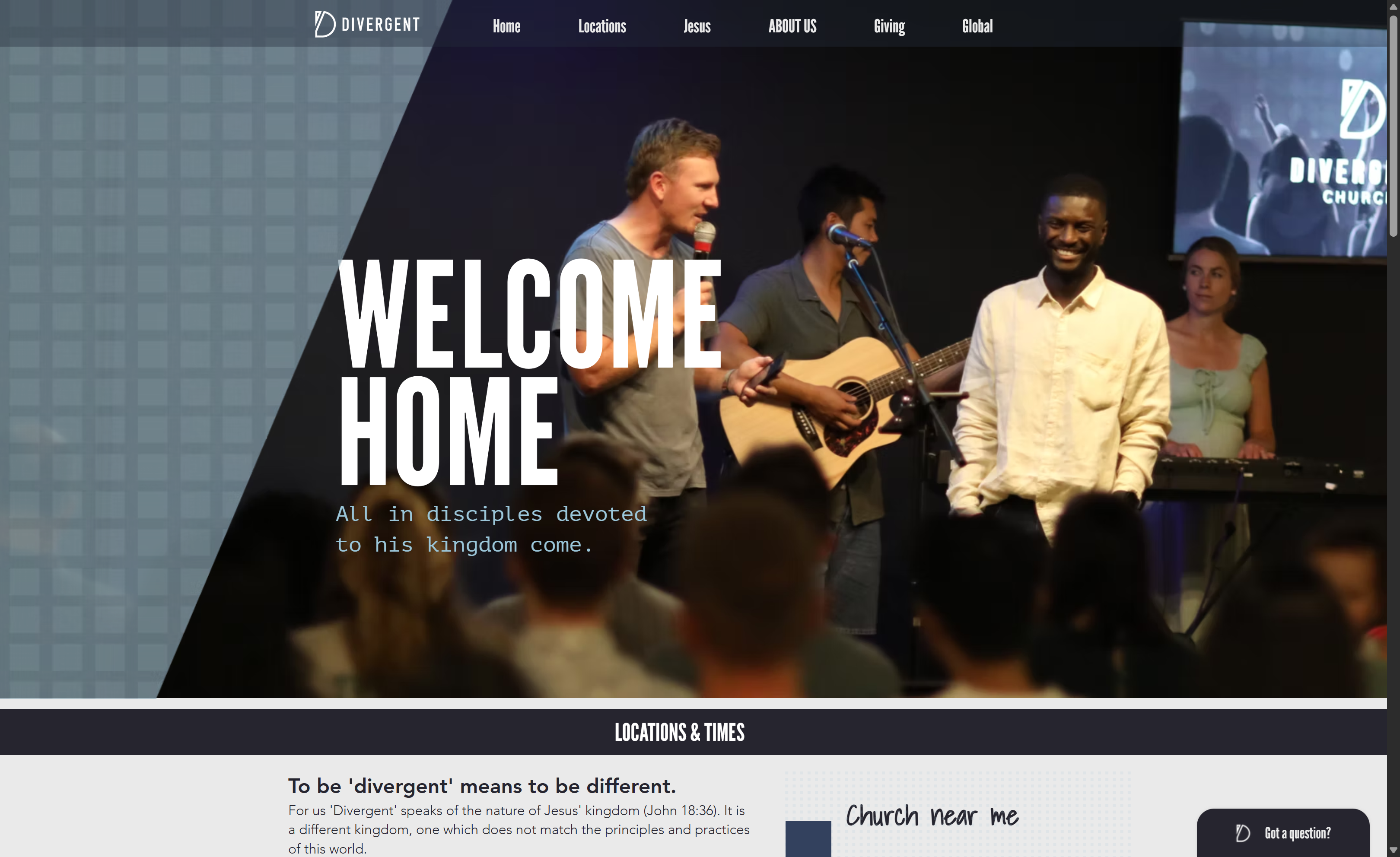
Divergentchurch runs three practical entry points for anyone wanting to live out gospel mission in Canberra. The Discipleship Hub offers structured formation pathways that move you from first steps in faith through to confident gospel witness. Life Communities are neighbourhood-based small groups where mission happens in the rhythm of everyday relationships rather than in a programme. Mission nights and training events run throughout the year for those who want to go deeper.
If you are new to Canberra, exploring faith, or simply ready to stop spectating and start participating, the next step is straightforward: visit the Discipleship Hub and find the pathway that fits where you are right now.
Sources
The following resources were drawn on throughout this guide and are worth exploring for deeper study:
For local resources in Canberra, the Divergentchurch mission page and next steps portal are the best starting points for anyone wanting to move from understanding gospel mission to living it.
Recommended
Comments