
Scriptural living: what it means and how to start


Scriptural living is the practice of intentionally ordering your whole life — your thoughts, habits, relationships, and decisions — around the formative story of the Bible. It is not a performance programme or a checklist of religious duties. It is a way of inhabiting God’s Word so that it reshapes who you are from the inside out. If you want one place to begin today, open your Bible to Romans 12 and spend ten minutes reading it slowly, then pray one sentence asking God to make it true in you. That single act is already scriptural living. The sections below unpack the theology behind it, the habits that sustain it, and the community that makes it last.
Key takeaways
Scriptural living is a whole-life practice of being formed by God’s Word in community, sustained by grace, and expressed through love, service, and mission.
Point | Details |
Core definition | Scriptural living means ordering your whole life around the formative story of the Bible, not a checklist. |
Start small | Begin with ten minutes of Scripture and prayer daily; consistency matters more than volume or intensity. |
Community is essential | Individual practice without a small group or discipleship pair leaves you without safeguards and encouragement. |
Measure fruit, not activity | Growth shows in love, humility, and dependence on God, not in attendance records or reading streaks. |
Divergentchurch | The Discipleship Hub and Life Communities offer structured, grace-based pathways into scriptural formation in Canberra. |
Table of Contents
What is scriptural living, and why does the Bible demand it?
Scripture is not a self-help reference you consult when life gets difficult. It is a living narrative that invites you to step inside it, take your place in the story, and let it reorder your imagination. As the Faith Practices Project puts it, simple acts of obedience often open up the text more quickly than extensive study ever could. That is a striking reversal of how most people approach the Bible: they study first and obey later, when the pattern that actually forms people runs the other way.
Three theological anchors hold this together.
The authority of Scripture. The Bible is not one voice among many. It is the Word of God, breathed out and profitable for teaching, reproof, correction, and training in righteousness (2 Timothy 3:16–17). That authority is not coercive; it is the authority of a Father who knows his children and speaks for their flourishing.
Jesus as the centre. Scriptural living is not law-keeping for its own sake. Jesus declared that all of Scripture points to him (John 5:39), and Paul insists that the goal of the commandment is love from a pure heart (1 Timothy 1:5). Every passage you read is meant to draw you closer to the person of Christ, not simply to a set of principles.
The Spirit as the agent of formation. You cannot form yourself into Christlikeness through willpower. The Holy Spirit takes the Word and applies it to your heart, producing the fruit described in Galatians 5:22–23. Faithful application of Scripture begins as inner transformation: the Word forms your mind and heart first, and practical obedience flows from that inner change.
Grace, not law. The distinction matters enormously. Obedience that flows from gratitude and love is categorically different from obedience driven by fear of punishment. Romans 8:1 is the ground you stand on: “There is therefore now no condemnation for those who are in Christ Jesus.” Scriptural living is a response to grace, not a bid to earn it.
What this means in practice:
Scripture shapes your imagination before it shapes your behaviour.
Obedience is hearing and responding, not merely rule-following.
The Word is formative: it rewires what you love and what you fear.
Formation is a lifelong process, not a programme you complete.
What does scriptural living actually look like day to day?
The easiest mistake is to reduce scriptural living to a quiet time in the morning and a church service on Sunday. Those practices matter, but the biblical way of life reaches into every domain: how you speak at work, how you handle money, how you treat a difficult neighbour, how you rest, and how you serve people who can offer you nothing in return.
Consider two brief pictures. A young professional in Canberra starts her day with five minutes in Proverbs before opening her laptop. By mid-morning, a colleague makes a cutting remark in a meeting. Because she has been sitting with “a gentle answer turns away wrath” (Proverbs 15:1), her instinct shifts. She responds quietly rather than defensively. Nobody in the room knows why. That is scriptural formation at work: the Word has already done its quiet work before the moment of decision arrives.
Or picture a father who has been reading through the Sermon on the Mount with his teenage son each week. They are not studying it academically; they are asking one question: what would it look like to live this way this week? Over months, the son begins to notice when he is being dishonest with himself. The father begins to notice when he is anxious about money. The text is doing something to both of them that a sermon alone rarely achieves.
C. Kevin Rowe’s work on scriptural imagination describes this well: developing a scriptural imagination requires slow, sustained reading in community. It shapes both thought and practice over time. Formation is not a flash of insight; it is a gradual reordering of what you notice, what you desire, and what you reach for.
Pro Tip: Keep a small notebook beside your Bible. When a verse catches you, write down one specific situation in your life where it applies. That single act of translation from text to context is the beginning of scriptural formation.
The domains where this shows up most clearly:
Speech: Ephesians 4:29 shapes what you say and what you choose not to say.
Work: Colossians 3:23 reframes ordinary labour as service to God.
Finances: Proverbs 11:24–25 and 2 Corinthians 9:6–7 shape generosity as a habit, not a crisis response.
Relationships: Romans 12:10 and 15:7 set the tone for how you receive and honour people.
Rest: The Sabbath principle (Exodus 20:8–11) is not optional; it is a rhythm that protects you from the idolatry of productivity.
Mission: Luke 4:18–19 and Matthew 28:19–20 mean that scriptural living always has an outward, others-focused dimension.
Common misunderstandings about living by Scripture
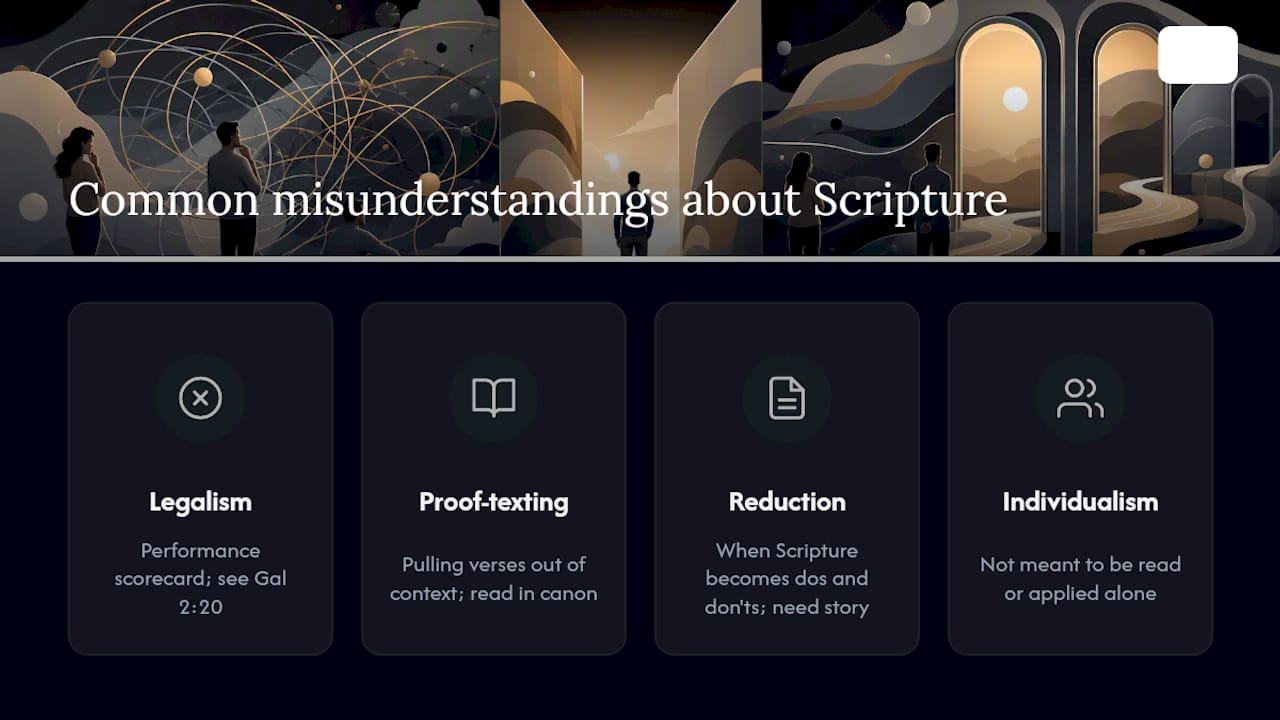
Living by Scripture is one of the most misunderstood phrases in Christian conversation. Four misreadings come up repeatedly, and each one distorts the practice in a different direction.
1. Legalism: Scripture as a performance scorecard. The most common distortion. Legalism treats obedience as the currency you use to purchase God’s approval. The corrective is Galatians 2:20: “I have been crucified with Christ. It is no longer I who live, but Christ who lives in me.” You are not performing for a watching God; you are participating in a life that Christ has already secured. Living scripturally can be genuinely countercultural and costly, but the friction comes from prophetic alignment with God’s Word, not from trying harder to be good enough.
2. Selective proof-texting: using Scripture as ammunition. Pulling a verse out of context to justify a pre-existing position is not scriptural living; it is using Scripture as a ventriloquist’s dummy. The corrective is to read passages in their literary and canonical context, and to hold your interpretation accountable to the community of faith across time.
3. Reduction to rules: missing the narrative. When Scripture becomes a list of dos and don’ts, you have stripped it of its story. The Bible is not a legal code with a few poems attached. It is a unified narrative of creation, fall, redemption, and new creation, and you are a character in that story. Rules without story produce moralism; story without rules produces sentimentality. You need both, held together.
4. Private individualism: the solo Christian. Scripture was never meant to be read alone, interpreted alone, or applied alone. The New Testament assumes a community of believers who read together, correct one another, and bear one another’s burdens (Galatians 6:2). A faith that stays entirely private is missing a dimension the Bible considers non-negotiable.
Pro Tip: When you notice yourself reading Scripture to confirm what you already believe, pause and ask: “What would this passage say to someone whose situation is very different from mine?” That question alone breaks the echo chamber.
A simple, sustainable plan to start living by Scripture
Small steps, taken consistently and held within grace, form deeper habits than ambitious programmes that collapse after three weeks. A rule of life recommends starting with increments as small as ten minutes of silence rather than an hour, precisely because sustainability matters more than intensity at the beginning.
Here is a practical 30–60–90 model:
Days 1–30: Establish one anchor practice. Choose a single daily rhythm: a brief period of Scripture reading followed by prayer. Use a reading plan (YouVersion’s Bible App offers dozens of free options) or simply read one chapter of a Gospel each morning. Write one sentence in a journal about what you noticed. Nothing more.
Days 31–60: Add one relational practice. Find one other person to share what you are reading with, even briefly. A text message, a coffee, a five-minute conversation. This is the beginning of communal formation. Also introduce one weekly Sabbath practice: an hour of rest with no screens and no productivity.
Days 61–90: Add one outward practice. Identify one concrete act of service or generosity each week that flows from what you have been reading. This might be giving financially to something that matters, volunteering locally, or simply being present to a neighbour who is struggling.
Core disciplines to weave in as you grow:
Scripture reading: daily, even briefly. Consistency beats volume.
Prayer: conversational, honest, and unhurried when possible.
Confession and accountability: a trusted person who knows your real life.
Sabbath: one day or portion of a day set apart each week.
Service: regular, embodied giving of your time and resources.
A caution about perfectionism: missing a day is not failure. The performance trap is the very thing scriptural living is meant to dismantle. When you miss a day, return without self-condemnation. That return is itself an act of grace-shaped obedience. For a more detailed guide to deepening your spiritual life, Divergentchurch has practical resources worth exploring.
Why community and mission are essential for scriptural living
You cannot sustain a scriptural lifestyle alone, and the Bible does not expect you to. Individual practice without community leaves you without interpretive safeguards, without the friction that genuine accountability provides, and without the encouragement that comes from watching others live faithfully through difficulty.

Sustained formation requires communal reading, memory of theological tradition, and leadership that models scriptural rhythms. That is not a nice ideal; it is a description of how the early church actually functioned, and how formation has worked across every generation of Christian history.
Different group shapes serve different needs. Here is how the most common ones compare:
Finding a healthy group starts with looking for one where Scripture is read seriously, where people are honest about their struggles, and where the group exists for something beyond itself. A biblical church will have all of these qualities woven into its ordinary rhythms, not just its special programmes.
Key Bible passages that guide Christian living
These passages are not exhaustive, but they form a reliable reading map for anyone wanting to understand the biblical way of life. Return to them often.
Psalm 119:105 — “Your word is a lamp to my feet and a light to my path.” Let Scripture orient your decisions before you make them, not after.
Matthew 5–7 (Sermon on the Mount) — Jesus redefines righteousness from the inside out. Read one section per week and ask what it demands of you concretely.
Romans 12:1–2 — Offer your whole life as worship; let your mind be renewed rather than conformed to surrounding culture.
Galatians 5:22–23 — The fruit of the Spirit is the measure of formation, not religious activity or rule-keeping.
Colossians 3:1–17 — A practical inventory of what to put off and put on; useful as a weekly self-examination.
James 1:22–25 — “Be doers of the word, and not hearers only.” The mirror image: Scripture shows you who you are; obedience is what you do with that knowledge.
Proverbs 3:5–6 — Trust and acknowledgement of God as the posture that precedes wise living.
Micah 6:8 — Do justice, love kindness, walk humbly. Three verbs that summarise the prophetic call to lived faith.
John 15:4–5 — Abide in Christ as the vine; apart from him, formation is impossible. This is the theological ground for every discipline.
Hebrews 4:12 — Scripture is living and active, sharper than any two-edged sword. It does something to you when you read it faithfully.
How do you recognise genuine growth in scriptural living?
Growth in a scriptural lifestyle is rarely dramatic. It tends to show up in small, almost invisible shifts: a quicker return to patience after frustration, a growing discomfort with dishonesty, a deepening desire to pray rather than a duty to tick off. These are the seeds of the fruit of the Spirit described in Galatians 5, and they are more reliable indicators of formation than any attendance record or reading streak.
Observable signs of genuine growth:
Increasing love for people who are difficult to love.
Greater humility: a reduced need to be right or recognised.
Deeper dependence on God in decisions, rather than self-sufficiency.
A more consistent pattern of repentance and return when you fail.
Growing generosity with time, money, and attention.
A natural movement toward service rather than consumption.
Two false measures to watch for. First, attendance alone. Showing up to church or a small group is a good habit, but it is not the same as formation. You can attend faithfully and remain largely unchanged. Second, checklist completion. Finishing a reading plan or a prayer journal is a means, not an end. The question is not “Did I read?” but “Is the reading changing me?”
The corrective in both cases is the same: return to the fruit. Ask the people closest to you whether they see love, joy, peace, patience, kindness, goodness, faithfulness, gentleness, and self-control growing in you. Their answer will be more accurate than your own self-assessment.
Pro Tip: Once a month, re-read Colossians 3:12–17 and ask one trusted person: “Which of these qualities do you see growing in me, and which do you think I still need to work on?” That conversation is worth more than a month of solo journalling.
How Divergentchurch puts scriptural living into practice
Divergentchurch in Canberra has built its rhythms around the conviction that Scripture shapes people in community, not in isolation. The church’s approach is not a programme you attend; it is a set of overlapping practices designed to form disciples across the whole of ordinary life.
A few of the concrete ways this takes shape:
Life Communities are small groups that meet weekly in homes and shared spaces across Canberra. They read Scripture together, pray, share meals, and hold one another accountable to the habits described in this article. Joining one is the single most practical step most people can take toward sustained scriptural formation. You can find a life community that fits your stage of life and neighbourhood.
The Discipleship Hub offers structured resources, short courses, and guided pathways for people who want to go deeper in their faith. It is particularly useful for those in the 30–60–90 plan who want more than a reading plan but are not yet ready for formal theological study.
Kingdom living principles are woven into the church’s teaching and pastoral culture, so that discipleship and kingdom living are not abstract ideals but named, practised rhythms in the community.
From a pastoral vantage point, the people who grow most consistently in scriptural formation at Divergentchurch are not the ones who know the most theology. They are the ones who show up to their life community, stay honest about their struggles, and keep returning to the Word even when it is inconvenient. That pattern is reproducible, and it is open to anyone willing to begin.
A pastoral word on patience and the long road of formation
Most people who want to live scripturally give up too early, not because the practice is too hard, but because they expected faster results. Formation is slow by design. Seeds planted in good soil do not produce fruit overnight, and the same is true of the Word planted in a human life.
The performance trap is real, and it is subtle. You can pursue scriptural living with such intensity that it becomes another arena for self-improvement rather than a posture of surrender to God. When that happens, the remedy is not to try harder; it is to return to grace. Romans 8:1 is always the ground: no condemnation, full acceptance, the Spirit at work in you.
Divergentchurch is here to walk this road with you
Living by Scripture is not something you figure out alone, and you do not have to. Divergentchurch exists precisely for people who want to grow in faith and find a community that takes the Word seriously without turning it into a performance.
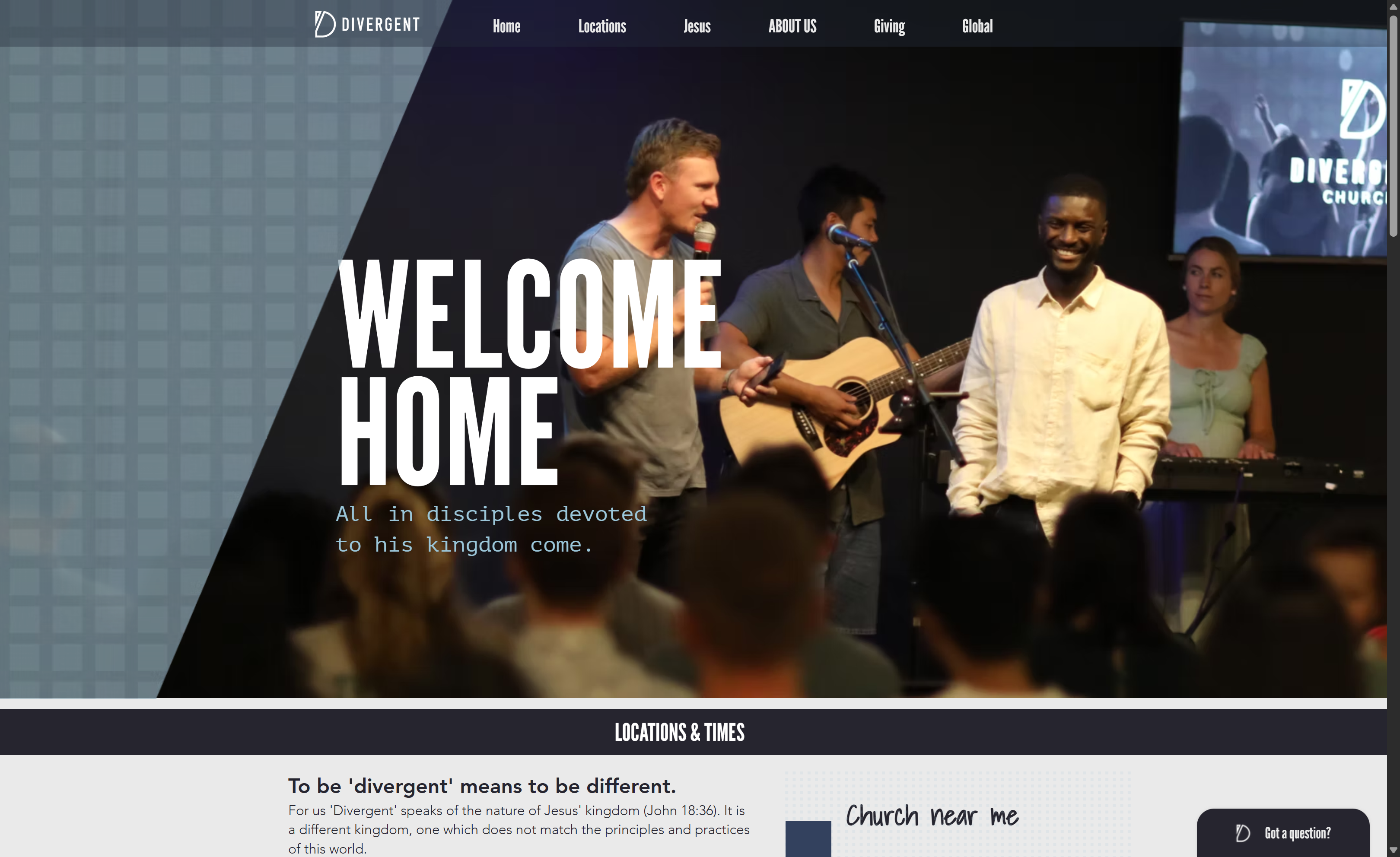
The Discipleship Hub is the best place to start if you want structured support: short courses, guided reading plans, and practical resources built around the habits described in this article. If you are ready for community, Life Communities are open to newcomers at any stage of faith, whether you have been following Jesus for decades or are still working out what you believe. Divergentchurch is a place where questions are welcome, belonging comes before certainty, and the ordinary rhythms of life become the ground where discipleship happens. Reach out through the contact page and someone will get back to you.
Sources
A curated set of resources for anyone wanting to go deeper in the biblical way of life:
Engaging Scripture: Living into God’s Story | Faith Practices Project | Christian Reformed Church
Learning to read the Bible well to form a scriptural imagination | C. Kevin Rowe
Rule of life explained: structuring our lives around grace | The War Cry
How to apply Scripture to everyday life (Biblical answer) | Servants of Grace
Recommended
Comments