
Why Tithing (10%) Is a Spiritual Rhythm That Forms Trust


A tithe is a tenth of what you receive, given first as an act of worship, not payment. Christians today aren’t bound to it as a New Covenant law, but many still practise it as a formative discipline that shapes trust, generosity and a God-centred life. It supports worship, ministry and the care of others.
TL;DR:
Tithing originally involved giving agricultural produce or livestock, with modern practice shifting to voluntary cash donations, usually around ten percent.
The Old Testament presents tithing as a religious act supporting Levites, festivals, and the needy, without imposing a fixed legal amount under the New Covenant.
The New Testament encourages cheerful, proportional giving from the heart without specifying a set percentage, emphasizing trust over legal obligation.
Tithing fosters spiritual discipline, financial order, and a focus on God’s ownership, but critics warn it can be misused or burdensome for low-income households.
Churches vary widely in their teaching on tithing, with some promoting it as divine law and others framing it as wise personal wisdom or heartfelt generosity.
Table of Contents
What is a tithe? The meaning behind the word
The word “tithe” comes from Old English, meaning simply “a tenth.” That basic meaning has never really changed. In Scripture, the tithe is often called “first fruits,” which is the idea of giving God the first and best portion of what you’ve received, before you spend it on anything else.
Historically, this wasn’t cash in an envelope. It was grain, olive oil, wine, or livestock, the actual “increase” of a household’s land and herds, handed over as a portion of the harvest.
Modern churches have adapted the practice while keeping the same principle:
In‑kind giving: the ancient default, tied to agricultural yield.
Monetary tithing: the near‑universal modern form, given as cash, bank transfer, or online giving.
Ten percent as the benchmark: most congregations still measure a tithe against that traditional tenth, even though the Wikipedia entry on tithing notes that modern tithes are voluntary rather than compulsory, unlike some historical practices.
Where does tithing in the Bible begin?
The tithe shows up early, well before it becomes law. Abraham gives a tenth of the spoils of battle to Melchizedek in Genesis 14, decades before Moses receives any commandment about it. That single act tells you something important: tithing predates the Law and reflects a posture of worship rather than a tax imposed from above.
Once Israel is established as a nation, the practice becomes formalised. Leviticus, Numbers, and Deuteronomy lay out detailed instructions for how Israelites were to set aside a tenth of their harvest and livestock.
That tithe had specific, practical purposes:
Supporting the Levites, who had no land inheritance of their own and depended on the tithe for their livelihood.
Funding festival gatherings, which kept worship communal and joyful rather than a private, individual matter.
Caring for the poor, widows, orphans, and foreigners living among the Israelites.
The Christianity walks through these Mosaic allocations in detail. In an agrarian economy, this meant tithing was tied directly to what the land produced that season. There was no fixed dollar figure, only a fixed proportion.
Does the New Testament command a 10 percent tithe?
No. Search the New Testament and you won’t find Jesus or Paul commanding believers to give a fixed 10 percent. What you find instead is a different, arguably harder, standard: cheerful, proportional generosity flowing from a transformed heart.
Paul’s instruction in 2 Corinthians 9:6–7 is the clearest statement of this shift. He tells the Corinthian church to give “as you have decided in your heart, not reluctantly or under compulsion, for God loves a cheerful giver.” No percentage attached. According to GotQuestions’ analysis of Christian tithing, the New Testament simply does not prescribe a fixed legal rate for believers, which is a genuinely significant departure from the Mosaic pattern.
This leaves two broad positions among Christians:
Tithing as helpful discipline: a practical baseline often understood as a tenth, chosen freely rather than imposed by law.
Tithing as legal requirement: a minority view that treats the Old Testament rate as still binding on believers today.
The theological consensus, reflected in sources like GotQuestions’ treatment of tithes and offerings, is that the New Testament removes the Old Covenant’s legal obligation while preserving the tithe’s formative value. Pastors are meant to shape conscience, not enforce a rule.
Why tithing still matters for spiritual formation
Here’s the thing about freedom: it was never meant to leave you formless. Christian freedom isn’t freedom from biblical wisdom, it’s freedom from earning God’s favour, so you’re free to become generous and trusting instead of anxious and self-protective.
Think about Sabbath. Christians aren’t bound by the Old Covenant Sabbath law, yet its rhythm of rest, worship and trust still teaches us something true about a God who provides. Tithing works the same way. Giving a tenth isn’t wise because God only owns ten percent of your income, it’s wise because he owns all of it, and the discipline trains you to remember that every single time you’re paid.
That’s what tithes fund in practice: worship gatherings, pastoral care, teaching, and mission work that a congregation couldn’t sustain through goodwill alone. Pastoral guides on Christian financial stewardship frame this consistently: the discipline itself, not just the dollar figure, is what shapes a generous, God-centred life.
Pro Tip: Set your giving to happen the moment income lands, before it hits your everyday spending account. Tithing after you’ve already budgeted for everything else almost always shrinks to whatever’s left over, which defeats the “first fruits” principle entirely.
How do you actually calculate and give a tithe today?
Working out a 10 percent tithe sounds simple until you hit real-life income. Here’s a practical way through it.
Decide gross or net. Giving on gross income (before tax) reflects the “first fruits” principle most closely. Giving on net (after tax) is common and entirely defensible. Neither is commanded; both are practised widely, and calculators built for exactly this question, like the one from MyTitheCalculator, can help you settle on a consistent method.
Treat irregular income the same way as regular income. A bonus, a freelance invoice, or a tax refund is still increase, so apply the same percentage you use for your regular pay.
Handle one-off gains thoughtfully. Inheritance, a gift, or the sale of an asset don’t fit neatly into “income,” but many Christians tithe on these too, since the principle is about what you’ve received, not just what you’ve earned.
Give the tithe to your local church first. This is where the tithe/offering distinction matters. Ramsey Solutions’ guidance on tithes and offerings recommends treating the tithe as a baseline commitment to your home congregation, with offerings, extra gifts above that baseline, directed to missions, charities, or specific needs as they arise.
If you genuinely can’t reach 10 percent right now, don’t disappear. Talk to your church. Give what you can as a starting discipline, and let it grow as your capacity does. No pastor worth listening to will shame you for financial hardship.
Merriam-Webster’s definition of tithe still centres on “a tenth part,” a reminder that whatever method you land on, the tenth remains the historical and practical anchor point.
How did other cultures practise tithing outside the Bible?
Tithing wasn’t a uniquely Israelite invention. Ancient Near Eastern societies had comparable practices well before or alongside the biblical record. Mesopotamian temples commonly collected a tenth of agricultural produce and livestock to fund priesthoods and temple upkeep, functioning much like a religious tax tied to land productivity.
Ancient Greek and Roman temples also received tenths, or comparable fixed proportions, of war spoils and harvests dedicated to particular deities. In some Greek city-states, a tithe of captured territory’s produce was set aside specifically for temples like the one at Delphi.
This wasn’t limited to the ancient Mediterranean world either. Some form of proportional giving to religious or communal structures shows up across a range of cultures and eras, suggesting the instinct to formally set aside a portion of increase for the sacred or communal good runs deep in human religious life generally.
What sets the biblical tithe apart isn’t the mechanism, a tenth given to a religious institution, but its theological framing. In Israel, the tithe wasn’t primarily about funding a temple bureaucracy. It was about acknowledging that the land itself belonged to Yahweh, and that Israel’s abundance flowed from his provision rather than human effort alone. The practice looked similar to neighbouring cultures; the meaning underneath it was distinct.
Where do denominations disagree on tithing today?
Ask five churches what they believe about tithing and you’ll likely get three different answers. That’s not a crisis of biblical clarity, it reflects a genuine, longstanding theological conversation.
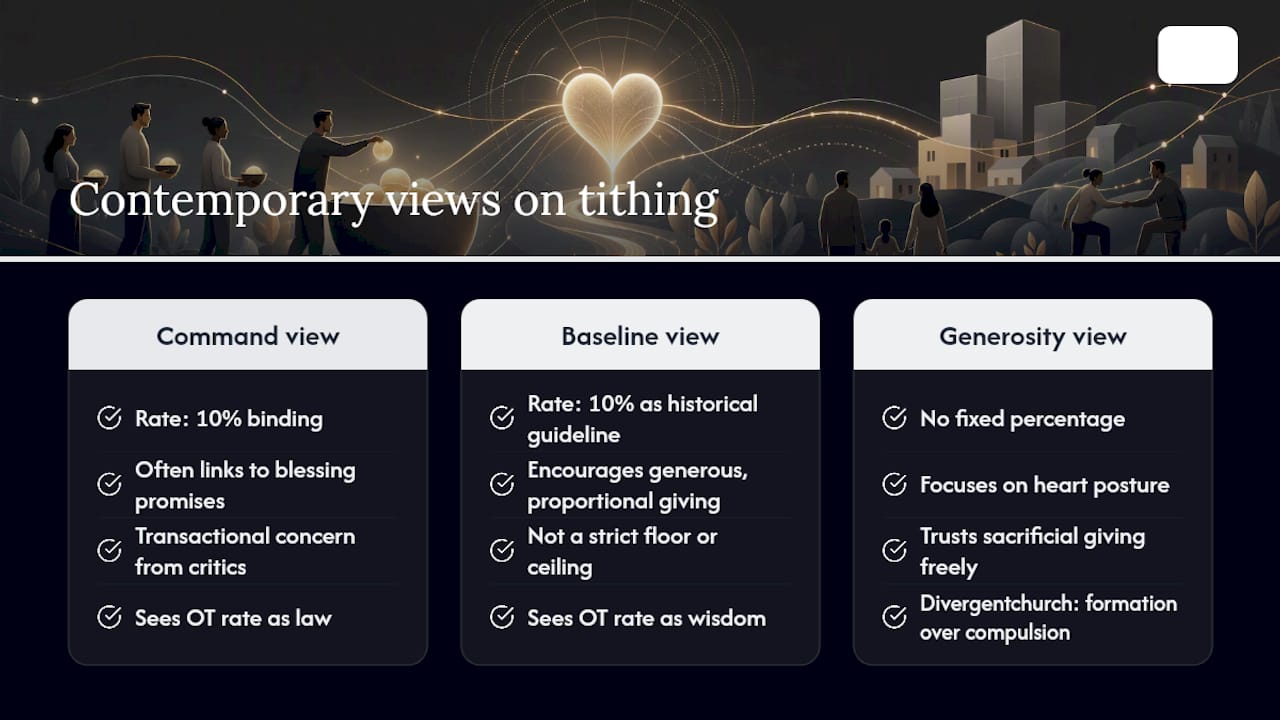
Some traditions, particularly certain Pentecostal and prosperity-influenced streams, treat the 10 percent tithe as a continuing command, sometimes linking faithful tithing to promises of financial blessing. Critics within the broader church push back hard on this framing, arguing it edges toward a transactional view of God that the New Testament actively resists.
Other traditions, many Reformed and Baptist congregations among them, teach tithing as a wise historical baseline rather than a binding law, encouraging members to give generously and proportionally without treating a tenth as a strict floor or ceiling.
A third position, common in newer church movements, avoids specific percentages altogether and teaches generosity as a heart posture, trusting that a transformed disciple will give sacrificially without needing a numerical target.
None of these positions deny that giving matters. The disagreement sits almost entirely on one question: does the Old Covenant’s specific rate carry forward as law, or does it carry forward as wisdom? Divergentchurch lands on the second view, and that conviction shapes how we teach on giving, favouring formation over compulsion.
What are the real benefits and criticisms of tithing?
Tithing has genuine, well-documented upsides, and it attracts genuine, fair criticism too. Both deserve honest treatment.
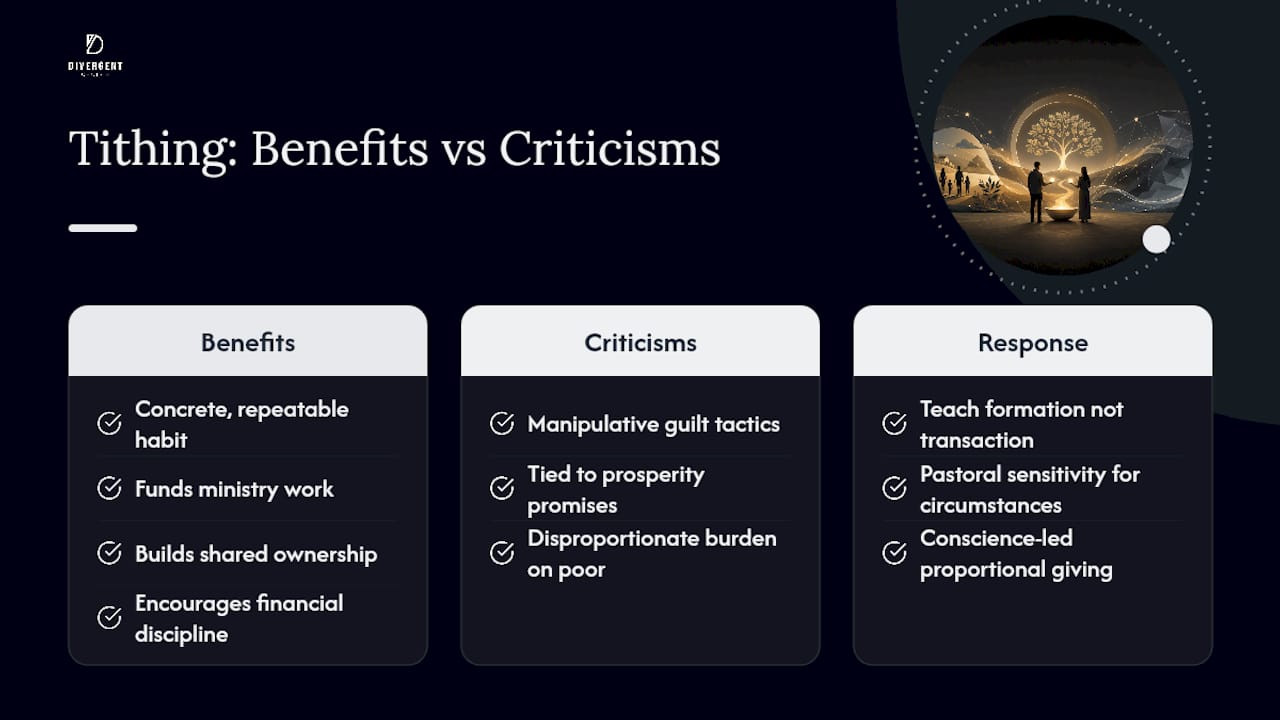
On the benefit side, tithing gives believers a concrete, repeatable habit that counters one of modern life’s strongest pulls, treating money as entirely your own. It funds ministry work that would otherwise depend on unpredictable goodwill, and it builds a shared sense of ownership in a church community’s mission. Consistent tithing also tends to produce broader financial discipline, since a household that budgets generosity first usually manages the rest of its spending more carefully too.
The criticisms are worth taking seriously rather than dismissing. Some churches have used tithing language manipulatively, implying guilt or spiritual failure onto members who can’t give at that level. Others have tied tithing to prosperity promises that Scripture doesn’t actually make. There’s also a fair structural critique: a flat 10 percent affects a low-income household far more severely than a wealthy one, which is part of why proportional, conscience-led giving has gained ground over a rigid percentage rule.
The healthiest response to both sides isn’t to abandon the practice or to enforce it rigidly. It’s to teach tithing as formation rather than transaction, generosity that flows from trust in God’s provision, not fear of missing a quota, and pastoral sensitivity to genuinely different financial circumstances.
How should you talk about tithing with your church?
Raising money questions with church leadership can feel awkward, but it shouldn’t be. A healthy church wants this conversation, not just your contribution.
Start by asking what your church actually teaches, rather than assuming. Some congregations expect a strict tithe; others frame giving entirely around proportional generosity. Knowing the actual teaching saves you from guessing at expectations that may not exist.
If you’re navigating financial hardship, say so directly to a pastor or leader rather than quietly disappearing from giving altogether. Most leaders would rather know and offer grace or practical support than watch someone withdraw out of shame.
In small group or community settings, keep the conversation focused on formation and testimony rather than numbers. Questions like “how has giving shaped your trust in God?” open honest dialogue in a way that “how much do you give?” never will, and they avoid turning generosity into a competitive or shame-inducing topic.
Finally, ask about transparency. A church that can explain clearly how tithes and offerings are handled financially is one worth trusting with your giving, and it’s a fair, reasonable question to ask any leadership team.
A pastoral perspective on tithing today
Here’s what gets lost in most tithing debates: the fight over whether 10 percent is “law” or “legalism” misses the actual point of the practice. Rejecting the law of tithing was never meant to mean rejecting the wisdom behind it. Israel didn’t tithe because God needed a tenth. Israel tithed because a nation that regularly, deliberately hands over its first and best learns something no amount of theological argument can teach on its own, namely that everything already belongs to God.
That’s the frame Divergentchurch teaches from. We’re not interested in guilt-driven giving or percentage policing. We’re interested in forming people who trust God enough to give generously, which is why our teaching sits inside real relationship: life communities and the Discipleship Hub exist precisely to work this out together, not alone with a calculator. If you want to go deeper theologically, our post on money, self and God is a good place to start.
— Josh
Ready to build a generosity rhythm that actually sticks?
Reading about tithing is one thing. Building the habit inside a community that actually talks about money, trust and formation honestly is another thing entirely, and it’s genuinely hard to do alone.

That’s the gap Divergentchurch’s Discipleship Hub is built to close. Instead of leaving you with a spreadsheet and a Bible verse, it puts you inside a rhythm of teaching and relationship where financial formation sits alongside everything else discipleship covers, prayer, character, mission. If community is more your starting point than a structured programme, our life communities are small enough to actually talk about this stuff out loud, with people who won’t judge you for where you’re starting from.
None of this comes with a required contribution. Giving at this church, tithe or otherwise, remains entirely voluntary. If you’re ready to take the next step, find a life community near you or come see what a Sunday with us in Canberra actually looks like.
Sources
Recommended
Comments