
3 Doors Into Christian Life at UC: Chaplains, UC FOCUS and a Local Church


The fastest way into Christian community at the University of Canberra is through three doors already open to you: the UC FOCUS public Bible talk, the Multifaith Centre and its chaplains, and the live listings on UC Events and UCX. Each semester the times and rooms shift, so check the current listing before you go. Pastoral care and professional counselling both exist on campus too, so you are never meant to carry this alone.
TL;DR:
Participating in recurring UC FOCUS Bible talks and frequenting the Multifaith Centre helps build familiarity and meaningful connections over time.
Joining or establishing a Christian group requires attending initial meetings, confirming affiliation with UCX, and booking rooms in advance to ensure continuous activity.
Balancing faith and academics is achievable through time-blocking, maintaining regular attendance, and accepting missed weeks as part of a manageable season.
Volunteering in campus support roles or service projects creates deeper friendships and demonstrates Christian values through practical actions.
Navigating doubts and faith challenges involves staying connected to community and seeking support from chaplains or counselling services when needed.
Table of Contents
Where to meet other Christians at UC
Walking into a room full of strangers takes a particular kind of courage, and the university knows this. UC FOCUS (the UC Fellowship of Christian Uni Students) runs a recurring public Bible talk, usually at lunchtime, with short teaching followed by time to eat and talk. Meetings typically run about an hour around lunchtime, often accompanied by free pizza, providing a natural opportunity to stay and meet others rather than slip away quickly.
Recurring meetings matter more than one-off events because familiarity does the quiet work that a single conversation cannot. You see the same faces, you learn names, and eventually someone remembers your coffee order. UC Events and the UCX event page are the places to confirm exact times, because room bookings and schedules move between semesters and a stale link will send you to an empty room.
A few habits make that first visit count:
Arrive five minutes early and introduce yourself to whoever is setting up, since they are usually the easiest people to talk to.
Ask one specific question about the talk afterwards rather than a generic “how was your week,” since it signals you were actually listening.
Say yes to whatever happens next, whether that is a group chat invite or a coffee the following week.
Come back the next week even if the first visit felt average, because the second visit is where recognition starts.
Small social gestures, a shared pizza box, a walk to the next class together, do more to anchor a new face than the content of any single talk.
What campus chaplaincy offers, and when counselling is the better call
The University of Canberra’s Multi-faith Centre operates under a chaplaincy policy that keeps it deliberately non-proselytising. Chaplains are there to offer pastoral care and a safe space for worship and reflection across traditions, not to push a particular faith on anyone who walks through the door. If a conversation turns toward something specifically Christian, the policy allows chaplains to refer you to a chaplain of your own faith or point you toward a Christian community better suited to that growth.

That distinction is worth knowing before you go in: the Multifaith Centre is a good first stop for pastoral support and a quiet space between classes, but it works best paired with a Christian small group or church for discipleship and teaching.
Some situations call for more than pastoral conversation. Watch for:
Sleep, appetite or mood changes that have lasted more than two weeks.
Thoughts of self-harm or a sense that you cannot cope with daily tasks.
Anxiety that is stopping you from attending classes or assessments.
The Medical and Counselling Centre is open Monday to Friday, 9:00 am to 5:00 pm, excluding public holidays and shutdown periods, and offers psychology services alongside general medical care. Faith and mental health are not competing concerns. Sometimes the most faithful thing you can do is book the appointment.
How to join or start a Christian group at UC
Joining an existing group is simpler than most students expect, and starting one is more achievable than it looks from the outside. Here is the practical sequence:
Attend a meeting first, such as the UC FOCUS Bible talk, before committing to anything formal.
Speak to the club’s officers afterwards and ask how membership and ongoing involvement actually work.
Check the group’s status against the UCX affiliation and membership rules to confirm it is officially affiliated rather than informal.
If no Christian group exists that fits your need, use the same UCX rules to register a new society, which requires enrolled students as officers and a short constitution.
Coordinate room bookings through UC Events or the Multifaith Centre early, since clashing times are the most common reason new groups lose momentum.
The UCX rules define eligible organisers as currently enrolled students, and the paperwork is lighter than it sounds: a constitution, a committee list, and confirmation of affiliation status. Skipping this step is the most common mistake, since an informal group that assumes it is affiliated can lose access to rooms and funding without realising it.
Pro Tip: Book your room through UC Events before you advertise your first meeting, since a confirmed time and place will do more for turnout than any poster.
Balancing academic responsibilities and Christian faith at UC
Assignments do not pause for Bible talks, and neither should your faith pause for assignments. The tension is real, but it is manageable with a little honesty. Tell your small group or Bible talk leader when assessment periods are heaviest, most are students themselves and will understand a week or two of reduced attendance far better than silence.
Time-blocking helps more than willpower does. Treat a weekly gathering the same way you treat a tutorial: put it in your calendar before the week fills up, rather than deciding each Wednesday whether you feel like going. Students who protect one fixed point of community each week tend to find the rest of their faith practice, prayer, reading, reflection, easier to sustain, because they are not starting from zero every time.
Grace matters here too. A semester where you miss three Bible talks because of a heavy assignment load is not a spiritual failure, it is a season. What matters is returning to the rhythm once the pressure eases rather than letting one missed week become a permanent drift. Faith at university is rarely a straight line, and the goal is not perfect attendance but a pattern you keep returning to.
Opportunities for Christian service and volunteering at UC
Serving others is one of the more reliable ways to turn acquaintances into friends, and university life offers more openings for this than students usually notice. UC FOCUS and similar groups often need help setting up chairs, cooking for the weekly social time, or welcoming first-time attendees, small, practical tasks that put you shoulder to shoulder with people rather than across a table from them.
The Multifaith Centre occasionally hosts cross-faith events or student support initiatives where volunteers are welcome regardless of which tradition they come from, which can be a gentle way to serve the wider campus while living out your own convictions. Student-run welfare drives, peer mentoring programmes and orientation week volunteering are other avenues worth asking about through UCX-affiliated clubs.
Service does not need to be elaborate to matter. Turning up early to help carry pizza boxes or staying back to stack chairs says more about your character than a polished testimony ever could, and it is often where the deepest friendships on campus actually start.
Maintaining Christian values in a diverse university environment
UC brings together students from a wide mix of backgrounds, beliefs and convictions, and that diversity is not a threat to your faith so much as a daily invitation to practise it with integrity. Living out Christian values here looks less like arguing a point and more like consistency: showing up honestly, treating people with respect regardless of what they believe, and letting your actions carry more weight than your opinions.
Disagreement is inevitable in tutorials, share houses and group assignments, and it does not need to become conflict. Curiosity tends to open more doors than correction does. Ask genuine questions about what others believe before explaining your own, and you will usually find people more willing to hear you out.
The Multifaith Centre’s own posture, welcoming multiple traditions without pressuring anyone, is a useful model for how to hold your convictions firmly while sharing space generously with people who see the world differently. That balance, firm belief and genuine respect, is harder to fake than it sounds, but it is also the thing most likely to make your faith credible to the people around you.
Finding Christian community beyond campus
Campus groups are a strong starting point, but they run on semester rhythms, which means they pause over summer, winter breaks and exam periods. A local church fills that gap and offers continuity that a student club, by its nature, cannot. Canberra has a number of churches within easy reach of UC, and connecting with one gives you a community that does not reset every February.

One option is a local Canberra church focused on forming disciples and building authentic community that extends beyond Sunday mornings into everyday life and relationships. For students who want a fuller picture of how university groups and local churches fit together, this guide to finding Christian community in Canberra and this overview of Christian life across the city are worth a read.
If mental health concerns sit alongside your faith questions, and that overlap is common during university, resources like this practical guide to recognising depression can help you understand when professional counselling is the right next step alongside pastoral support.
Navigating challenges to faith during university life
University life has a way of testing convictions you assumed were settled. Lecturers who dismiss faith outright, flatmates who find your beliefs strange, and late nights spent wondering whether any of it still makes sense, these are not signs that something has gone wrong, they are simply part of what it means to hold a conviction in a place built to question everything.
The students who come through this season with their faith intact are rarely the ones who avoided the hard questions. They are the ones who kept showing up to community even when they were not sure what they believed that week. Isolation is what turns a doubt into a drift. A regular Bible talk, a chaplain’s office, or a small group gives you somewhere to bring the question instead of carrying it alone.
It helps to remember that doubt and faith have coexisted throughout Christian history, and university is simply where that tension becomes personal for the first time for many students. Staying connected, even imperfectly, matters more than having every answer sorted before Friday.
Starting out: what I’d tell a first-year
Friendship on a transient campus forms slower than you expect, and that is normal, not a sign you are doing something wrong. Most people you meet in week one will not become close friends, and that is fine. Commit to showing up to the same group twice before deciding whether it fits, since the second visit is where things usually start to click. And if a week feels heavier than it should, use the chaplaincy or the Medical and Counselling Centre. Asking for help is not a detour from faith, it is part of it.
— Josh
How Divergent Church can help you go deeper
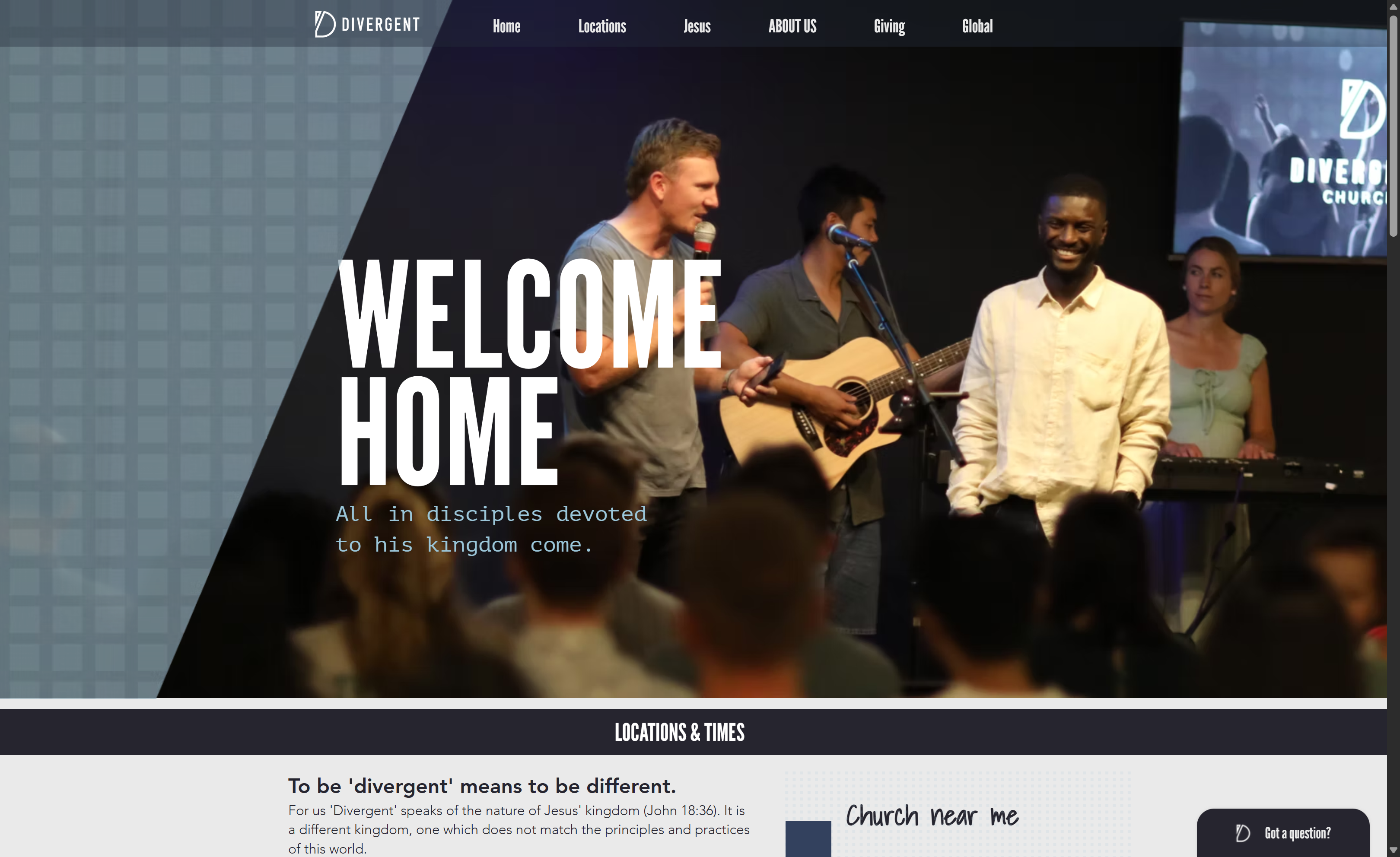
Campus groups give you a weekly rhythm during semester, and Divergent Church offers a way to keep building on that rhythm year round, through ongoing discipleship and a presence in the city that does not pause for exam block. If you are looking for a space to run a student catch-up, a small group or a committee meeting, our Auditorium, Seminar Room and Board Room are available to book. It is one more door alongside the ones already open to you on campus, not a replacement for them.
FAQ
Is UC better than ANU?
The two universities serve different strengths, UC leans toward applied and professional degrees while ANU is known for research-intensive programmes, and “better” depends on what you are studying rather than any single ranking. For Christian community specifically, both campuses host active student groups, so the stronger question is which campus culture and course suit you.
What religion is Scott Morrison?
Scott Morrison, a former Australian Prime Minister, is a practising Christian associated with Pentecostal churches. His public comments on faith have drawn attention to how Christian belief intersects with Australian political life.
Has Australia had an atheist prime minister?
Yes, Julia Gillard, who served as Prime Minister, publicly identified as an atheist while in office. Australia’s political leadership has included a mix of religious and non-religious figures across its history.
What is the most Christian state in Australia?
Definitions vary depending on which census measure is used, and state-by-state religious affiliation figures shift with each census cycle. Rather than naming a single state, it is more useful to know that Christian communities and churches exist in every Australian capital, including Canberra.
How do I find a Christian group at UC this week?
Check the live UC Events listing for the public Bible talk run by UC FOCUS, which includes current times and rooms. You can also confirm details through the UCX event page before you go.
Sources
Recommended
Comments