
Four Scriptures That Ground Bible Authority for Christians in Canberra


Bible authority is the claim that Scripture, as God’s revealed word, carries the right to teach, correct, and shape the belief and conduct of God’s people. Christians across traditions ground this claim in 2 Timothy 3:16, which describes all Scripture as “God-breathed.” What follows unpacks the terms, the texts, and the disagreements that give this claim its depth.
TL;DR:
The debate over biblical inerrancy centers on whether Scripture is free of all errors or only reliable for faith and salvation, affecting how churches handle scientific and historical questions.
Verses like 2 Timothy 3:16, Matthew 28:18, John 10:35, and Psalm 19:7 provide different foundations for asserting Scripture’s authority, with nuances in how they are interpreted.
The Chicago Statement on Biblical Inerrancy and Dei verbum reflect contrasting modern efforts to define Scripture’s authority as either fully without error or primarily salvific and trustworthy.
Effective interpretation relies on understanding genre, original context, and community-based discernment, rather than isolated reading or literalism.
Practical application involves reading whole books, engaging in community study, and holding core doctrines firmly while approaching secondary matters with charity.
Table of Contents
What does bible authority actually mean?
Ask ten Christians what “biblical authority” means and you will get ten overlapping but distinct answers. That is not confusion for its own sake. It reflects genuine theological weight carried by a handful of related but different terms, and confusing them is where most kitchen-table arguments about the Bible go wrong.
Inspiration refers to the belief that God, through the Holy Spirit, moved human authors to write Scripture so that what they wrote carries divine origin and authority. Inerrancy goes a step further, claiming the Bible is without error in everything it teaches, not just matters of faith and morals. Infallibility is a narrower, older claim: Scripture will not fail or mislead in what it intends to teach for faith and salvation, whether or not every incidental detail meets modern standards of precision. The Chicago Statement on Biblical Inerrancy treats infallibility as flowing from inerrancy, describing Scripture as “infallible divine authority” without error in all its teaching. Other traditions hold infallibility without going as far as full inerrancy, which is where a lot of the public confusion starts.
Where you land on these terms shapes how you answer the bigger question: who has the final say in interpreting Scripture?
Sola scriptura (a Reformation principle) holds that Scripture alone is the final, sufficient authority for faith and practice, though tradition and reason still inform how it’s read.
Magisterial authority, held by the Catholic Church, teaches that Scripture and sacred tradition together, interpreted through the Church’s teaching office, carry authority.
Communal discernment models, common in some Protestant traditions, place weight on the gathered church and the Spirit’s ongoing work alongside the text.
This article will not attempt a full history of how the biblical canon was assembled, nor a verse-by-verse defence of every contested passage. The goal is narrower and more useful: giving you a clear map of what “biblical authority” claims, where it comes from, and how thoughtful Christians apply it without turning every disagreement into a crisis of faith.
What Bible verses support scriptural authority?
Four passages carry most of the weight in this conversation, and each one does a slightly different job.
2 Timothy 3:16–17 is the anchor text. Paul writes that “all Scripture is God-breathed and is useful for teaching, rebuking, correcting and training in righteousness, so that the servant of God may be thoroughly equipped for every good work.” Note what this verse actually claims: not scientific precision, not historical exhaustiveness, but functional sufficiency. Scripture is presented as adequate for forming a life of righteousness, which is a moral and formational claim before it is a scientific one.
Matthew 28:18 records Jesus saying, “All authority in heaven and on earth has been given to me.” This verse grounds biblical authority Christologically. Scripture carries authority because it testifies to and comes from the risen Christ, who holds ultimate authority himself. Some traditions read this as the foundation beneath every other authority claim in the New Testament.
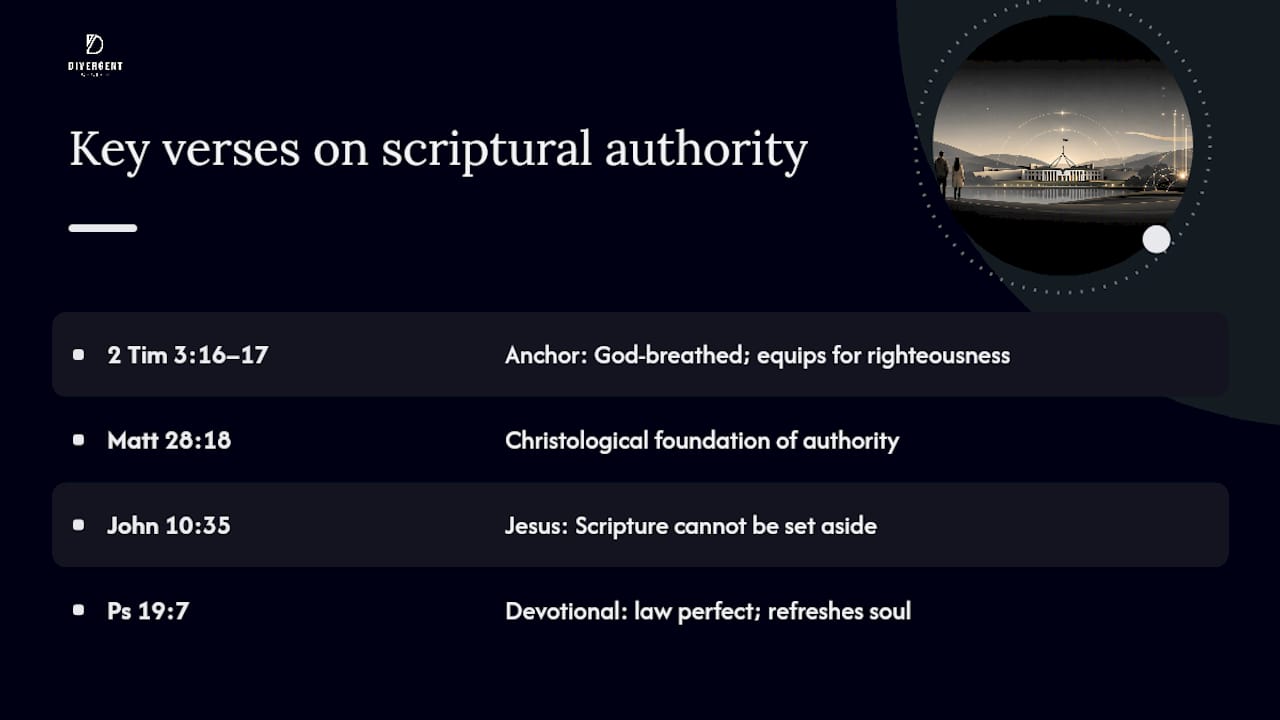
John 10:35 has Jesus saying “Scripture cannot be set aside,” used in a debate about His own identity. It is a brief but pointed statement, often cited to show Jesus himself treated the Hebrew Scriptures as binding and reliable.
Psalm 19:7 declares “the law of the Lord is perfect, refreshing the soul.” This is poetic, devotional language, not a doctrinal statement, and reading it that way avoids stretching it further than it was meant to go.
A quick word on how these functions get grouped: 2 Timothy 3:16 lists four things Scripture does: teaching (positive instruction), reproof (exposing error), correction (restoring what has gone wrong), and training in righteousness (ongoing formation). That fourfold pattern shows up constantly in how churches structure preaching and discipleship.
Interpretation of these verses varies. A strict literalist reading treats “God-breathed” as implying word-for-word dictation. A more common evangelical position, drawing on scholarly summaries of the inerrancy debate, holds that God worked through the personalities and styles of human authors, so inspiration and human authorship sit together rather than in tension. A phenomenological reading recognises that biblical writers described the natural world in the everyday language of their time, which is not the same as making false scientific claims. Genre matters enormously here: treating a psalm’s poetry the same way you’d treat a historical narrative in Kings produces the kind of false dilemmas that fuel a lot of unnecessary doubt.
How do theologians argue for Scripture’s authority?
The competing theological positions on this question are not just academic hair splitting. They shape how a church preaches, how it handles doubt, and how it responds when Scripture seems to conflict with a scientific finding or a difficult historical question.
Plenary verbal inerrancy. This is the position formalised by the Chicago Statement, which affirms that inspiration extends to the very words of the original manuscripts, not just the general ideas, and that Scripture is without error across everything it teaches, including history and cosmology where it touches on them. Proponents argue this is the only position that protects Scripture from being trimmed down by whichever cultural pressure is fashionable at the time.
Infallibility without full inerrancy. Some theologians affirm that Scripture never fails in its purpose of leading people to salvation and faithful living, while remaining more cautious about extending that guarantee to every incidental historical or scientific detail. This is closer to the language Vatican II eventually adopted, and it appeals to those who want a high view of Scripture without getting tangled in debates over ancient chronology or textual variants.
Scripture as witness to the Word. A neo-orthodox emphasis, associated loosely with Karl Barth, holds that the Bible is not itself identical with divine revelation but becomes the Word of God as the Spirit speaks through it to the reader. This view takes Scripture with total seriousness while resisting the idea that authority is a property inherent in the ink and paper alone.
The practical stakes are real. A congregation holding strict inerrancy will often treat apparent contradictions as puzzles to be solved through careful exegesis. A congregation leaning toward infallibility-for-salvation will be more comfortable holding some questions loosely while still preaching Scripture as fully trustworthy for faith and life. Neither position, held honestly, treats the Bible as merely a human book of wisdom.
What are the Chicago Statement and Dei verbum?
Two documents dominate any serious conversation about how modern Christians have formalised their view of Scripture, and both emerged from specific historical pressures rather than out of nowhere.
The Chicago Statement on Biblical Inerrancy (1978). Drafted by a gathering of evangelical scholars, it affirms Scripture as “infallible divine authority” and states plainly that the Bible is “without error or fault in all its teaching.” The statement was a direct response to what its framers saw as a drift toward theological liberalism within evangelicalism, and it remains the reference point most conservative Protestant churches cite when defining their doctrine of Scripture.
Dei verbum (1965), the Second Vatican Council’s Dogmatic Constitution on Divine Revelation. It teaches that Scripture “teaches firmly, faithfully, and without error that truth which God wanted to put into the sacred writings for the sake of our salvation.” That phrasing is deliberate. It ties inerrancy to salvific truth rather than asserting blanket precision on every historical or scientific detail the biblical authors touch on, giving the Catholic Church room to affirm high authority for Scripture while engaging historical criticism differently than strict inerrantists do.
Both documents arrived in the 20th century for similar reasons. As historical analysis of the inerrancy debate shows, formal doctrinal statements about Scripture’s reliability became necessary largely as responses to modernist biblical criticism and shifting intellectual currents from the late 19th century onward. Before then, high views of Scripture were assumed rather than formally defined. The pressure to define terms precisely came from outside, which is worth remembering next time someone treats these documents as if they’d existed unchanged since the apostles.
How should Christians interpret and apply the Bible?
Believing Scripture is authoritative answers one question and immediately raises another: authoritative interpreted how, and by whom?
Sound interpretation, or hermeneutics, starts with basic questions any careful reader asks of any ancient text. What genre is this? A parable, a genealogy, and an apocalyptic vision all require different reading strategies. What was the original context, audience, and occasion? What did the original words mean in Hebrew, Aramaic, or Greek, before translation choices layered in centuries of English connotation? Ignoring these questions is how well-meaning readers end up building entire doctrines on a single verse ripped from its setting.
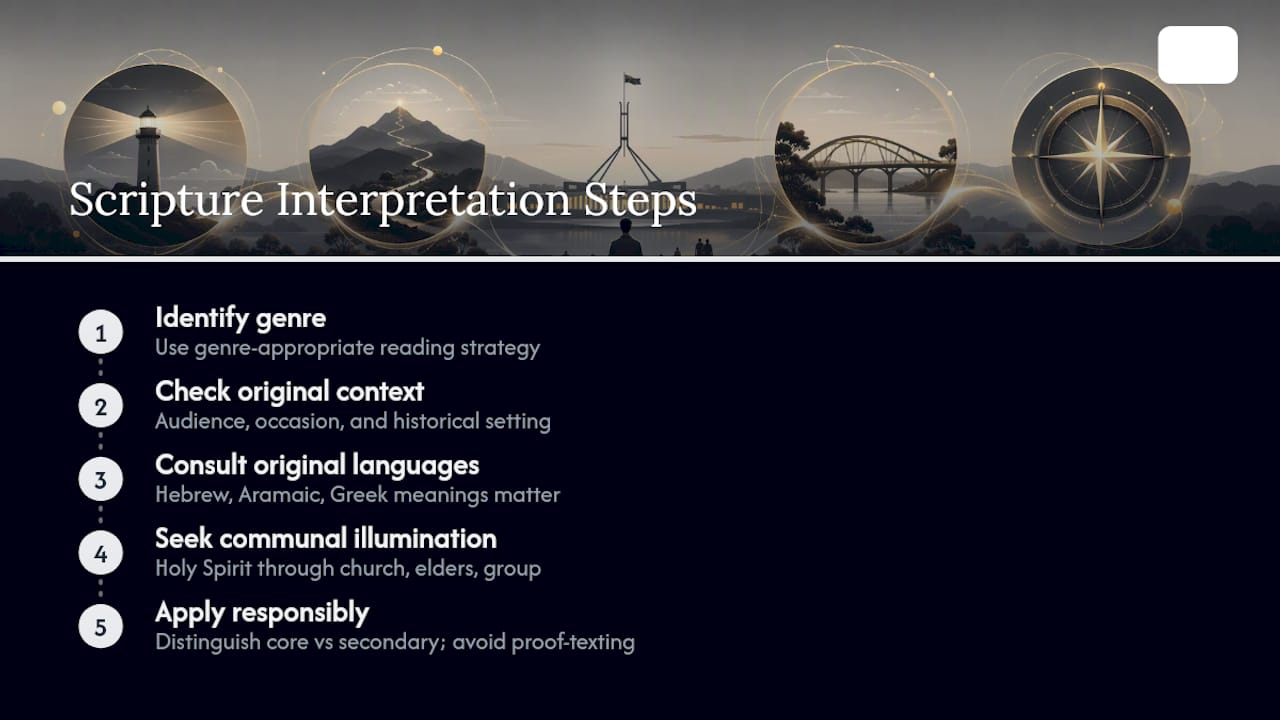
Most traditions also hold that the Holy Spirit plays an active role in illumination, helping readers grasp and apply what the text means, and that this happens most reliably in community rather than in isolation. A solo reader with a concordance and strong opinions has produced no shortage of doctrinal error throughout church history. Communal discernment, whether through a denomination’s teaching office, a local church’s elders, or a trusted study group, acts as a check against reading Scripture purely through the lens of personal preference.
Pro Tip: When a passage seems to contradict science or history, ask first whether you’re reading poetry as if it were a lab report, or a first-century idiom as if it were a modern claim. Genre and authorial intent resolve more “contradictions” than any apologetics debate ever will.
Two safeguards matter in practice. First, distinguish core doctrine (the resurrection, salvation by grace, the nature of God) from secondary or disputed matters (specific end-times timelines, some worship practices) and hold the second category with more humility than the first. Second, use consistent exegetical method rather than picking whichever interpretation supports a conclusion you already wanted. This shows up constantly in pastoral counselling, where a verse taken out of context can do real harm, and in preaching, where the discipline of working through whole books of the Bible rather than cherry-picking verses tends to produce healthier congregations over time.
What difference does biblical authority make in daily life?
Doctrine that never touches daily life is just theory. Holding Scripture as authoritative changes concrete things about how a church operates and how individual believers order their days.
Preaching shaped by a high view of Scripture tends to prioritise exposition, working through what a text actually says, over topical talks built around whatever theme is trending. Discipleship follows the same logic: rather than treating faith formation as a motivational add-on, churches that take Scripture’s authority seriously build study, memorisation, and application into the regular rhythm of community life, not just Sunday mornings.
How a congregation holds these convictions also shapes its posture toward science, history, and public debate. A community that understands genre and authorial intent, per the Gospel Coalition’s treatment of inerrancy and precision, tends to engage scientific findings without panic, because it was never claiming Genesis 1 functions as a modern geology textbook in the first place. Communities that conflate inerrancy with maximal literalism sometimes find themselves at needless odds with well-established findings, which does nobody’s faith any favours.
For congregations navigating internal disagreement over how Scripture should be read, pastoral guidance on the authority of the Bible consistently points toward the same practice: hold core doctrine firmly, hold secondary matters with charity, and prioritise the practices that form character over doctrinal point-scoring.
If you want to move from theory to practice, a few steps help:
Read whole books of the Bible in context rather than isolated verses pulled from concordance searches.
Join a study group where interpretation gets tested against other readers, not just your own instincts.
Ask what a passage meant to its original audience before asking what it means for you.
Hold disputed secondary matters loosely while treating core doctrines as non-negotiable.
Let scriptural living shape ordinary decisions, not just Sunday convictions.
How Divergent Church puts scriptural authority into practice
We did not arrive at our conviction about Scripture as an abstract doctrinal position first and a lived practice second. At Divergent Church, the order runs the other way. We’re a community shaped by Scripture, and that shaping happens in the ordinary rhythms of life in Canberra, not just in a Sunday sermon slot.
That looks like study groups where people wrestle honestly with a text before reaching for a tidy answer. It looks like sermon preparation that works patiently through a book of the Bible rather than jumping between disconnected topics chosen for their appeal. And it looks like our formation programmes through the Discipleship Hub, where new believers and long-time Christians alike are invited to build habits of reading, prayer, and accountability rather than treating faith as a one-off decision.
Canberra is a transient city, full of students, public servants on short postings, and people between chapters of life. We meet plenty of people asking hard, honest questions about whether the Bible can really be trusted, and we would rather sit with those questions than paper over them. If that describes where you’re at, our reflection on whether the Bible can be trusted is a reasonable place to start.
None of this requires a hard sell. If you’re in Canberra or Queanbeyan and curious what a Scripture-shaped community actually looks like up close, our facilities are open for groups wanting a space to gather. The Auditorium runs at $70 per hour, the Seminar Room at $50 per hour, and the Board Room at $25 per hour, all bookable through our online booking page.
Where to read more on biblical authority
For readers wanting primary sources rather than secondhand summaries, start with the Chicago Statement on Biblical Inerrancy itself, then Ligonier Ministries’ accessible walkthrough of the statement’s theological commitments. For the distinction between inerrancy and infallibility explained without jargon, Logos’ primer is a solid entry point, and the UT Austin piece on the history of inerrancy debates offers useful historical context for how these positions developed.
A closer look at why the inerrancy debate gets overheated
Most people arguing about biblical authority online are not actually disagreeing about Scripture. They are disagreeing about precision, and nobody has said so out loud.
The inerrantist wants to protect Scripture from being quietly edited down by cultural fashion, one uncomfortable passage at a time. That instinct is not paranoia. Church history is full of examples where “reinterpreting” a text was really just a polite word for abandoning it. The infallibilist, meanwhile, is trying to protect something else: the credibility of the Christian faith among people who have watched well-meaning believers insist on a wooden literalism that the text itself was never trying to claim, and then watched those same believers quietly walk away from faith when the literalism collapsed under scrutiny.
Both instincts are worth taking seriously, and I think the sharpest error in this whole conversation is treating it as a binary between “trusts the Bible” and “doesn’t trust the Bible.” That framing flatters nobody and helps nobody. The more honest question is: what is this particular text actually claiming, in its own genre, for its own original audience, and does my reading of it hold that claim with the same weight the author intended? A psalm claiming God is my rock is not making a geological argument, and treating it as one does not honour the text. It diminishes it.
What gets underestimated in most popular treatments of this topic is how much heavy lifting genre and authorial intent do in resolving supposed contradictions, long before you need to reach for more sophisticated harmonisation arguments. The Gospel Coalition’s point about phenomenological language deserves far more airtime in everyday church conversation than it gets, because it defuses a huge share of the “gotcha” objections raised against Scripture’s reliability. The doctrine that actually matters for daily discipleship is not whether you can win an argument about inerrancy’s outer edges. It’s whether the church takes seriously that Scripture forms character, corrects error, and equips people for a life that looks like Christ’s.
— Josh
Sources
FAQ
What are the four types of authority in the Bible?
Christian theology commonly identifies Scripture’s authority as functioning through teaching, reproof, correction, and training in righteousness, drawn directly from 2 Timothy 3:16. These four functions describe what Scripture does rather than separate sources of authority.
What is the Bible’s authority based on?
Christians ground the Bible’s authority in the claim that it is divinely inspired, or “God-breathed,” and therefore carries God’s own authority in matters of faith and life. Traditions differ on whether that authority stands alone (sola scriptura) or works alongside church tradition and teaching offices, as in the Catholic understanding reflected in Dei verbum.
What does the Bible say about human authority and submission?
Scripture addresses authority in multiple contexts, including civil government, church leadership, and family relationships, generally calling believers to respect legitimate authority while ultimately submitting to God’s authority above all. Matthew 28:18 anchors all human and spiritual authority in Christ, who declares he holds “all authority in heaven and on earth.”
Is the Bible infallible or inerrant, and what’s the difference?
Infallibility means Scripture will not fail or mislead in what it teaches about faith and salvation, while inerrancy makes the stronger claim that Scripture contains no errors of any kind, including historical and scientific details, in its original manuscripts. Some traditions, including the Catholic Church through Dei verbum, affirm a form of infallibility tied specifically to salvific truth without committing to the fuller claims of strict inerrancy.
How do interpretation and the Holy Spirit relate to biblical authority?
Most traditions hold that the Holy Spirit illuminates Scripture’s meaning for readers, but this happens most reliably through careful hermeneutical method and communal discernment rather than solitary reading alone. Attending to genre, original context, and language remains essential even when believers trust the Spirit’s guiding role in interpretation.
Recommended
Comments