
Start Living Your Calling: 10 Bible Verses for Purpose in Australia


Ten verses carry most of the weight when believers ask what scripture says about purpose: Jeremiah 29:11, Ephesians 2:10, Romans 8:28, Psalm 139:13–16, Ecclesiastes 3:1, Colossians 3:23, Philippians 2:13, 1 Peter 4:10, Matthew 5:13–16, and Proverbs 16:9. Below you’ll find a quick-reference list, short reflections that tie the verses together into one coherent picture of calling, and simple practices for prayer, Bible reading, and everyday decisions. Scripture treats purpose less as a puzzle to solve than an invitation to answer.
TL;DR:
Purpose unfolds across seasons, so your calling may change over time, and different seasons still carry meaningful purpose.
God’s plans remain valid even when circumstances seem confusing or impractical, and small, faithful acts reveal your purpose.
Ordinary work, when done for God, is a genuine expression of purpose, regardless of how significant or humble the task appears.
Discovering purpose involves relationship with God first, then recognizing the good works already prepared for you in everyday life.
Small steps, like reading a verse daily or sharing honestly with others, steadily build clarity and action toward your calling.
Table of Contents
Quick reference: the best Bible verses for purpose
Copy these, bookmark them, or read them slowly one at a time. Each carries a short takeaway so you can see straight away why it belongs on a list of scripture about purpose.
Jeremiah 29:11 — “For I know the plans I have for you, plans to prosper you and not to harm you, to give you hope and a future.” Written to exiles who felt abandoned, it’s a promise that God’s intentions for you outlast your current circumstances.
Ephesians 2:10 — “For we are God’s handiwork, created in Christ Jesus to do good works, which God prepared in advance for us to do.” You were made, on purpose, for particular good works.
Romans 8:28 — “And we know that in all things God works for the good of those who love him.” Purpose doesn’t require every season to make sense while you’re in it.
Psalm 139:13–16 — David describes being knit together in the womb, “fearfully and wonderfully made.” Purpose starts with being known, not with achievement.
Ecclesiastes 3:1 — “There is a time for everything, and a season for every activity under the heavens.” Your purpose is allowed to look different at 25 than it does at 55.
Colossians 3:23 — “Whatever you do, work at it with all your heart, as working for the Lord.” Ordinary work becomes an act of purpose when the audience shifts.
Philippians 2:13 — “For it is God who works in you to will and to act in order to fulfil his good purpose.” The desire to find purpose is itself evidence God is already at work in you.
1 Peter 4:10 — “Each of you should use whatever gift you have received to serve others.” Purpose is discovered through use, not just reflection.
Matthew 5:13–16 — Jesus calls disciples salt and light, people whose ordinary presence changes the flavour and visibility of a room.
Proverbs 16:9 — “In their hearts humans plan their course, but the Lord establishes their steps.” Planning matters, but purpose is a partnership, not a solo project.
Two more worth carrying: Isaiah 43:1 (“I have called you by name; you are mine”) for identity, and 2 Timothy 1:9 for the idea that your calling predates your performance.
What these verses build together: a biblical picture of purpose
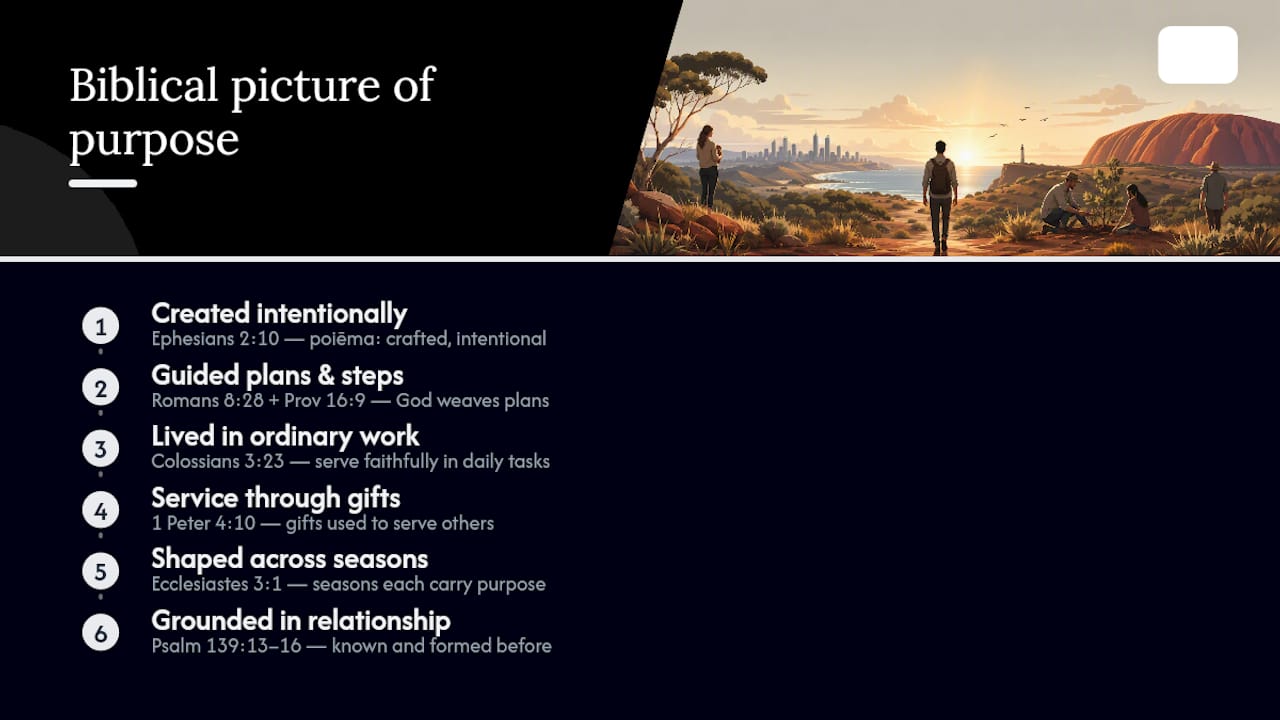
Read individually, these verses feel like scattered comfort. Read together, they form a sequence: you were made on purpose, for purpose, and that purpose unfolds across seasons rather than arriving fully formed.
Created for good works. Ephesians 2:10 uses the Greek word poiēma, meaning something crafted or composed. The BibleHub commentary on Ephesians 2:10 notes this implies intentional design rather than accidental assembly. You aren’t a blank slate hunting for meaning. You’re a completed work who still has to walk into the specific good works God prepared in advance. That distinction matters practically. It means purpose is less about inventing something new and more about noticing what’s already been placed in front of you.
God’s plans hold even when the path doesn’t make sense. Romans 8:28 doesn’t promise that every event feels good. It promises that God weaves outcomes toward good for those who love him. Paired with Proverbs 16:9, this becomes a theology of partnership: you plan, God establishes the steps, and the two aren’t in competition.
Purpose lived through ordinary work. Colossians 3:23 refuses to separate “sacred” purpose from a Monday at the office or a load of washing. If the audience is God, the task carries weight regardless of its size. This is where 1 Peter 4:10 fits: purpose is exercised through gifts given to serve others, not hoarded for private satisfaction.
Purpose has seasons. Ecclesiastes 3:1 releases the pressure to land on one static calling by age thirty. Bible Gateway’s rendering of Ecclesiastes 3:1 frames purpose as time bound. A season of study, a season of raising children, a season of quiet recovery. All can carry genuine purpose without needing to look identical to the season before it. Psalm 139:13–16 anchors this seasonal view in something unchanging: you were known and formed before any of those seasons began.
Scripture, on balance, frames purpose as fundamentally relational. The clearest short answer to “why am I here” isn’t a job title or a five-year plan. It’s to know God, and everything else, vocation, service, relationships, flows from that starting point.
How to actually use these verses this week
Reading a verse once rarely settles anything. Using it does.
Five minutes a day. Pick one verse from the list above and read it slowly each morning for a week before checking your phone. Ask one question: what does this ask of me today?
A journalling prompt that repeats. Write the verse out by hand, then finish this sentence: “If I believed this were true today, I would…” Do this for the same verse three days running before moving to the next.
A 30 day meditation. Work through all ten verses above roughly once every three days across a month, noting which one keeps resurfacing in your thinking. That recurrence is often worth paying attention to.
Try these prayer prompts tied to specific verses: pray Jeremiah 29:11 when you need hope about a future that feels uncertain. Ask through Ephesians 2:10 for clarity about which “good work” is right in front of you this month. Bring Romans 8:28 into prayer when a season doesn’t make sense yet. Use Philippians 2:13 to thank God for the desire itself, since that desire is evidence he’s already working.
Pro Tip: Purpose rarely gets clearer in isolation. Invite a friend to read one verse with you this week and simply ask, “What did you notice?” Two people processing the same verse almost always surface something one person alone would miss.
Small, low barrier steps count. Mention what you’re wrestling with to one trusted person. Try serving once this week somewhere small. Join a life community for a single session before deciding whether it’s for you.
A pastoral note from Josh on walking this out
I’ve spent years walking alongside people who ask this exact question, often at exactly the moment their plans have fallen apart. What I keep seeing is that Ephesians 2:10 stops being theory the moment someone joins a small group or a discipleship pathway. “Walking in” prepared good works rarely happens through private reflection alone. It happens when someone hands you a task slightly too small to be dramatic and slightly too real to ignore. For deeper reading on this, see our reflections on how faith helps discover your calling and the purpose and power of ordinary work.
What the conventional advice on purpose gets wrong
Most popular writing on purpose treats it like a hidden object you have to find before your life can properly start. That framing creates anxiety, not clarity, and it isn’t what the ten verses above actually teach when you read them together.
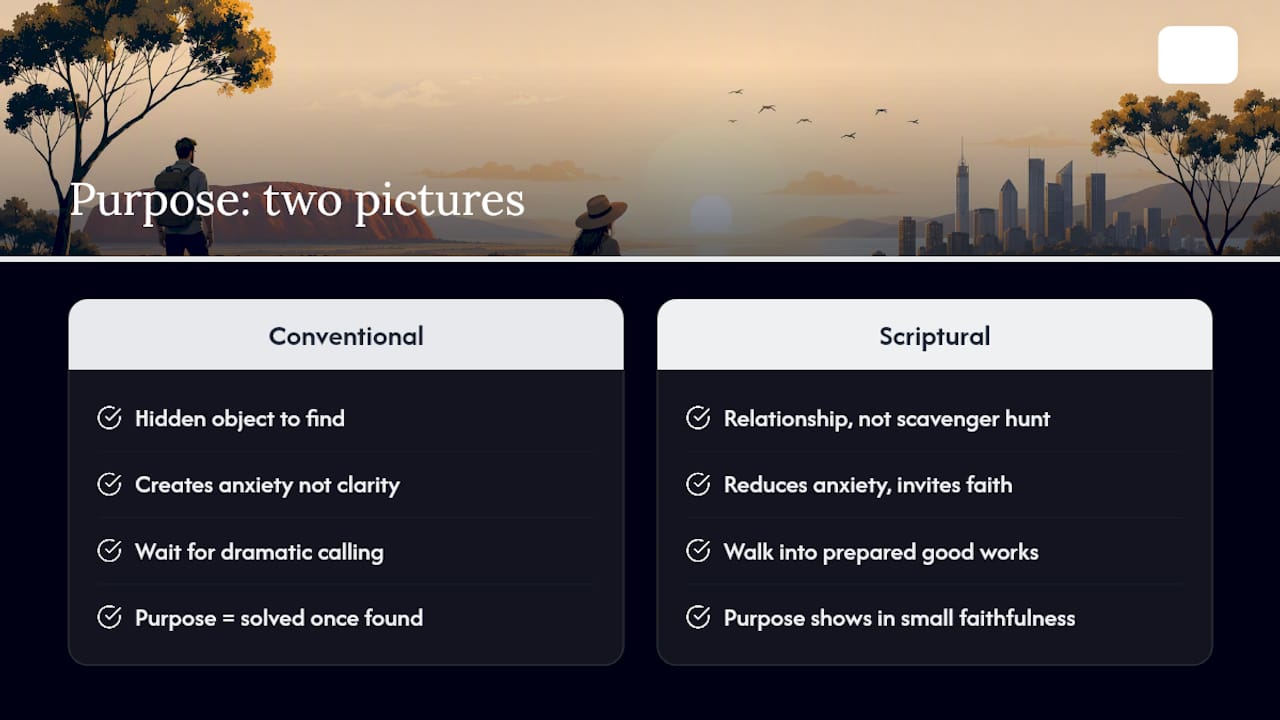
Scripture’s picture is closer to a relationship than a scavenger hunt. Ephesians 2:10 says the good works are already prepared. Your job is to walk into them, not manufacture them from nothing. That’s a genuinely different posture. It means the person waiting for a single dramatic calling before they’ll commit to anything is often waiting for the wrong signal. Small, faithful, unglamorous obedience, Colossians 3:23’s ordinary work, 1 Peter 4:10’s quiet use of a gift, is usually where purpose actually shows up first.
If you take one thing from this list, let it be Ecclesiastes 3:1. Purpose has seasons. The pressure to have it all figured out by a certain age isn’t biblical, it’s cultural. Start smaller than you think you need to: one verse, one honest conversation, one act of service this week.
— Josh
Take the next step with Divergent Church’s Discipleship Hub
Reading these verses alone will only take you so far. Divergent Church’s Discipleship Hub exists for exactly this next stretch: scripture-centred study, guided prayer, and a community that will ask you the follow-up questions a list of verses can’t.
Life communities meet locally in Canberra and Queanbeyan, designed for people wanting to explore Ephesians 2:10 or Romans 8:28 with others rather than alone. If leadership and vocation are part of what you’re wrestling with, Lead Like Jesus offers a more focused pathway. Whichever fits, the honest next step is small: visit the Discipleship Hub, find a life community near you, and bring one verse from this list with you to the first conversation.
Sources
Recommended
Comments