
Explaining Christian community: a guide for seekers


If you have ever sat in a church service feeling surrounded by people yet somehow alone, you are not imagining things. Explaining Christian community is not simply a matter of describing Sunday gatherings or weekly programmes. It goes much deeper than that, and the gap between what people expect and what they actually experience is wider than most churches care to admit. 77% of churchgoers report significant relationships within their church, yet far fewer intentionally build friendships beyond it. For those in Canberra exploring faith, this guide is for you.
Table of Contents
Key Takeaways
Point | Details |
Christian community explained | Christian community is rooted in biblical fellowship called koinonia, involving shared life, teaching, meals, and prayer. |
Modern challenges | Western culture’s focus on individualism makes authentic Christian community difficult but not impossible. |
Core principles | Biblical fellowship balances essential doctrine, liberty in non-essentials, and love in all things. |
Community benefits | Christian community strengthens faith, character, accountability, and combats loneliness. |
Action steps | Building real community requires embracing imperfection, vulnerability, and intentional engagement locally. |
What is christian community according to the bible
The word that shapes everything here is koinonia, a Greek term meaning fellowship, shared life, and mutual participation. It is not a polite exchange of pleasantries after a service. Koinonia describes deep, covenantal connection between believers who share not just belief, but their whole lives, resources, struggles, and hope. That distinction changes everything about how we understand Christian community.
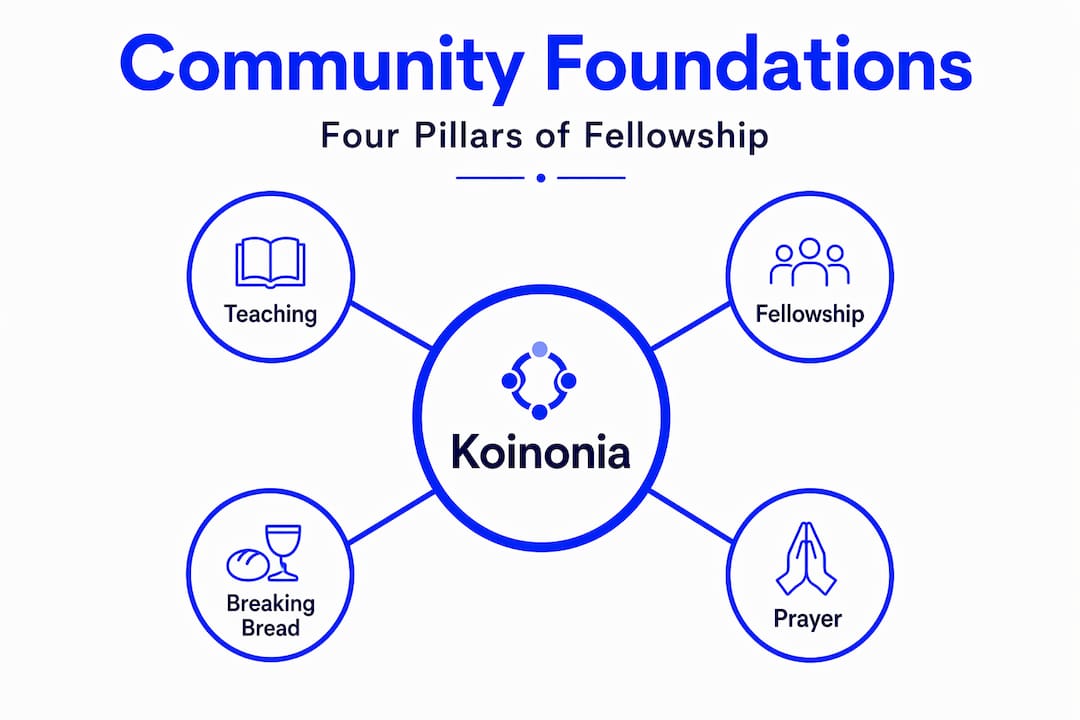
The clearest picture of koinonia in action appears in Acts 2:42-47, where the early church devoted themselves to four core practices. These were not programmes or events they attended. They were daily rhythms woven into shared life.
The four practices of early Christian community:
Apostles’ teaching: Grounding the community in Scripture and doctrine, forming a shared understanding of who Jesus is and what his kingdom means
Fellowship (koinonia): Actively sharing life, resources, burdens, and joy with one another beyond the meeting space
Breaking of bread: Sharing meals and celebrating communion together, acts that cultivated intimacy and remembrance
Prayer: Crying out to God collectively, aligning the community’s heart with God’s purposes
These four elements are not a historical curiosity. They are the architecture of authentic community, then and now.
Practice | What it looks like in community | What it is not |
Apostles’ teaching | Bible study, discipleship conversations | Passive sermon attendance |
Fellowship (koinonia) | Shared meals, bearing one another’s burdens | Casual Sunday small talk |
Breaking of bread | Communion, table fellowship | A catering arrangement |
Prayer | Gathered intercession and corporate worship | Private spiritual habit only |
Understanding the power of biblical fellowship requires accepting that community is relational, mutual, and covenantal. It is not a service you consume; it is a life you share. Now that we know the biblical roots, let us explore how this looks in practice.
Why christian community feels difficult today
Here is something worth sitting with honestly. If Christian community is so life-giving, why does it feel so elusive? The answer is not simply that people are too busy. It runs much deeper into the assumptions Western culture has quietly installed in all of us.
Western culture conditions individuals to see themselves as the ultimate authority on their own lives, making authentic Christian community genuinely counter-cultural. We are trained to form relationships that serve our preferences and exit them when they become costly. Biblical community demands the opposite.
“Christian fellowship requires the decentring of the self. It asks us to hold others’ interests alongside our own, to remain when things are hard, and to let the lives of others genuinely shape ours. That is profoundly countercultural.”
This is not a Canberra-specific problem. But Canberra’s particular rhythm of transient populations, driven university culture, and professional mobility makes it harder still. People arrive, form cautious connections, and move on before roots deepen. Recognising these community challenges in Canberra matters because it helps you set realistic, grace-filled expectations for what connection actually requires.
Why authentic fellowship is difficult in modern culture:
Provisional relationships are normalised; commitment feels risky
Individualism frames dependence on others as weakness
Busyness crowds out the unhurried time community requires
Digital connection offers the feel of closeness without its cost
Conflict or discomfort prompts exit rather than repair
Understanding this cultural context helps us appreciate the biblical principles that govern fellowship.
Principles and practices for authentic christian fellowship
There is a phrase, often attributed to the reformer Philip Melanchthon, that serves as one of the most grounding frameworks in understanding Christian fellowship: “In essentials, unity; in non-essentials, liberty; in all things, charity.” Biblical fellowship is governed by this principle, and it is far more nuanced than it first sounds.
Essential doctrines (unity required):
The nature of God: Father, Son, and Holy Spirit
The divinity and resurrection of Jesus Christ
Salvation by grace through faith
The authority of Scripture
These are not negotiable in Christian community. They form the shared foundation without which koinonia has nothing to stand on.
Non-essentials (liberty required):
Worship style and musical preferences
Differing convictions about spiritual gifts
Views on creation timelines or end-times theology
Cultural and lifestyle expressions of faith
Category | Attitude required | Why it matters |
Essential doctrine | Unity | Shared foundation of identity |
Non-essential conviction | Liberty | Room for conscience and growth |
All interactions | Charity (love) | Preserves relationship across difference |
These principles of unity and charity keep communities from fragmenting over secondary matters while maintaining the integrity of core belief. Where many communities fail is by either enforcing uniformity on non-essentials or offering so little theological grounding that there is nothing of substance to unite around.
Pro Tip: When you encounter someone in your faith community who holds a different view on a secondary issue, treat it as a discipleship opportunity rather than a threat. Charity in practice means staying in the room, asking questions, and letting love hold what doctrine cannot.
With these principles clear, let us see how Christian community strengthens faith practically.
How christian community transforms lives and faith
The importance of Christian community is not simply theological. It is deeply practical, and its absence leaves visible wounds. Christian community strengthens faith, sharpens character, protects against spiritual drift, and pushes back against the crushing weight of isolation that defines so much of modern life.
Here are ten concrete ways authentic community transforms you:
Sharpens your faith through regular dialogue with others who take Scripture seriously
Provides accountability when you are tempted to compromise your values quietly
Offers practical support during illness, grief, financial pressure, or crisis
Models what grace looks like when you see others forgive and remain
Corrects blind spots you cannot see in your own character or theology
Gives your gifts purpose by placing you in relationships that need what you carry
Celebrates your milestones with genuine joy, not performance
Prays for you specifically, not vaguely, because they actually know your story
Anchors you when life transitions threaten to unravel your faith
Reminds you of who God says you are when you have forgotten
This matters especially for new believers navigating the often disorienting early seasons of faith. Without a community, the journey quickly becomes isolating and intellectually rootless.
Pro Tip: Stop waiting for deep relationships to form naturally. Seek out one or two consistent, real connections in your faith community and invest in them deliberately. Surface-level fellowship at scale is no substitute for genuine shared life with a few.
The right community does not just make faith more enjoyable. It makes it sustainable. After seeing why community matters, let us address some common misunderstandings and how to start building it authentically.

Overcoming misconceptions and building authentic community in Canberra
One of the most persistent misconceptions about what is Christian community is that it is essentially an enhanced social programme. Shared meals, Sunday connection time, friendly conversation after service. All of that is good, but none of it is koinonia.
Authentic community is often messy and involves conflict as part of shared life, not a social club free of tension. If your community never experiences conflict, it is more likely avoiding depth than achieving harmony. Real shared life produces friction because real people carry wounds, differences, and varying levels of spiritual maturity.
Common misconceptions unpacked:
“Fellowship means no conflict” — In fact, navigating conflict together is fellowship
“Community happens automatically when you attend church” — It requires intentional investment beyond attendance
“Good community means everyone agrees” — Unity in essentials does not mean uniformity
“You need to have it all together before you belong” — Belonging precedes maturity, not the other way around
Practical steps for building authentic community:
Pray for specific people in your community by name, not just generally
Practise vulnerability by sharing something real, not polished
Serve someone in your community without announcing it or seeking recognition
Join a small group and commit to it for a season, not just until it feels comfortable
Invite someone to your table, your suburb, your ordinary week
For those in Canberra, building strong local church community begins in the ordinary spaces, not the special events. Your neighbourhood, your campus, your workplace are all mission fields for practising community beyond services.
Pro Tip: The next time you feel like leaving a community because it has disappointed you, ask honestly whether you are seeking a comfortable social environment or genuine shared life. Sometimes the friction is exactly where growth is happening.
With these clarified, here is a unique perspective on why this matters deeply today.
A deeper look: why authentic christian community is worth the effort
Let us be honest about something most articles on this topic will not say plainly. You will not find a perfect Christian community in Canberra. You will not find one anywhere. The search for an idealised group where everyone is mature, welcoming, theologically sharp, and relationally healthy is a search that will keep you perpetually on the outside looking in, never actually belonging anywhere.
Conflict is not a sign of failure but a natural feature of authentic community focused on shared participation in grace. The communities that have shaped disciples most profoundly are not the ones that avoided difficulty. They are the ones that stayed together through it.
What we have seen at Divergent Church, in the rhythms of Canberra life, is that the seeds of real transformation are planted not in the highlight moments but in the ordinary ones. The meal shared after a hard week. The honest conversation that runs longer than anyone planned. The person who shows up when you did not ask them to. These are not footnotes to community. They are the thing itself.
Embracing community’s challenges rather than retreating from them is how faith actually matures. A community that navigates tension with grace, that names sin without condemning the sinner, that forgives repeatedly and remains, is displaying something the world genuinely cannot manufacture. That is the power of imperfect community as a prophetic witness.
Pro Tip: When a community disappoints or frustrates you, bring it to God before you bring it to your exit plan. What looks like a reason to leave is often an invitation to grow.
Faith-based community support is not a programme or an amenity. It is an expression of the kingdom. And it is worth every uncomfortable, grace-requiring moment.
Connecting with christian community in Canberra through Divergent Church
If this article has stirred something in you, a longing for something more than Sunday attendance, a genuine desire to find belonging and grow in faith, we want you to know that Divergent Church exists for exactly this. We are not simply a gathering. We are a community shaped by Scripture, centred on Jesus, and expressed through everyday life across Canberra.

Whether you are brand new to faith or returning after time away, we have practical next steps designed to help you find your place. Our Life Communities are small groups meeting throughout Canberra where real relationships form around shared faith and ordinary life. Our Discipleship Hub provides resources to help you grow theologically and relationally. And if you are simply wondering where to begin, our next steps pathway is the right place to start. Come as you are. You belong here.
Frequently asked questions
What does the Greek word koinonia mean in christian community?
Koinonia means fellowship or shared life, pointing to deep mutual commitment among believers that goes well beyond casual friendship or polite church attendance.
Why is christian community difficult to experience today?
Western culture emphasises individualism and provisional relationships, which directly conflict with the self-sacrificial, committed nature of biblical fellowship, making authentic connection feel genuinely costly and counter-cultural.
Is conflict a sign that a christian community is not healthy?
No. Conflict is natural in authentic Christian community and, when navigated with grace and honesty, is an opportunity for deeper shared life and genuine spiritual growth rather than evidence of failure.
How can I find authentic christian community in Canberra?
Engage intentionally with a local church and its small groups, such as those offered at Divergent Church Canberra, and invest consistently in sharing real life, not just attending events, with a handful of people over time.
Recommended
Comments