
How to connect with Jesus: a guide for Canberra


Many people in Canberra quietly wonder how to connect with Jesus but feel unsure where to begin. Maybe you have sat with that question for months, or maybe something in you has just started stirring. Either way, you are not alone, and you are not too late. This guide walks you through practical, grounded steps for building a relationship with Jesus, from the very first prayer through to joining a community that walks alongside you. Faith is not reserved for those who have it all figured out. It is accessible, right now, wherever you are.
Table of Contents
Key Takeaways
Point | Details |
Start with acceptance | Connecting with Jesus begins by accepting Him and opening your heart sincerely. |
Consistent prayer matters | Regular, honest prayer, even just a few minutes daily, strengthens your connection. |
Community supports growth | Joining groups like Alpha or Discipleship Explored helps deepen faith through shared learning. |
Draw near to God | As you intentionally seek God, He promises to draw near to you, encouraging perseverance. |
Connection is a habit | Building a relationship with Jesus relies on consistent communication, not just feelings. |
Starting your personal connection with Jesus
The foundation of developing a personal connection with Jesus is not a formal ceremony or a perfect theological statement. It is simply a decision to open your heart to Him and begin spending time in His presence. As one personal relationship guide puts it, the relationship begins with accepting Him and spending time with Him through prayer and Bible reading. That is the whole seed of it.
What makes this so approachable is that there is no script required. You do not need to have eloquent words or a detailed understanding of doctrine before you can begin. Jesus consistently invited ordinary people into His presence, fishermen and tax collectors, the doubting and the grieving. You fit.
Here is how to take those first steps:
Acknowledge Jesus honestly. Tell Him where you are, what you are carrying, and that you want to know Him. Sincerity matters far more than polish.
Set aside a few minutes each morning. Even five minutes of quiet reflection or a simple spoken prayer plants a seed of habit.
Open a Gospel. Start with the book of John. Read one passage slowly and let it sit with you through the day.
Pay attention to the world around you. Nature, conversations, unexpected moments of clarity — these are all spaces where God speaks.
Get some guidance. If you are new to this, our become a Christian guidance is a solid, honest resource for the Canberra context.
Pro Tip: Do not wait until you feel “ready” to pray. The act of turning toward Jesus, even hesitantly, is itself the beginning of the relationship.
Understanding Jesus in daily life starts with paying attention. As you read and pray, you will begin to notice His fingerprints on ordinary moments. That attentiveness grows with practice, not with perfection.
Deepening your connection through prayer and scripture
With a personal foundation in place, the next step is to deepen your relationship by practising prayer and scripture study. This is where connecting spiritually with Jesus moves from a single decision into a living, breathing rhythm.

Prayer does not have to be complicated. One of the most freeing things Jesus ever taught was this: go into your room, close the door, and pray to your Father who is unseen (Matthew 6:6). That image, a private, unhurried conversation without an audience, is exactly what prayer in Christian teaching encourages. Consistency matters far more than performance.
A practical structure many people find helpful is the ACTS framework:
Adoration: Begin by focusing on who Jesus is, not what you want from Him.
Confession: Be honest about where you have fallen short. This is not about guilt; it is about clearing the air.
Thanksgiving: Name specific things you are grateful for. Specificity matters here.
Supplication: Bring your requests, your fears, and your hopes.
The Lord’s Prayer in Matthew 6:9-13 is Jesus’ own model for ways to pray to Jesus, and it follows a similar arc. Use it as a map, not a script. Read it slowly. Notice how it moves from worship to surrender to trust.
For scripture study, here is a rhythm that works:
Choose one passage per day rather than reading large chunks at speed.
Ask three questions: What does this say about God? What does this say about people? What does this invite me to do or believe?
Write down one sentence of response in a journal.
Return to the same passage the following day and notice what is new.
Pro Tip: Pair your scripture reading with a short prayer beforehand, asking the Holy Spirit to open your understanding. The Bible read with expectation lands differently than the Bible read as an obligation.
How to hear Jesus’s voice is one of the most common questions people ask. The honest answer is that it rarely sounds like a thunderclap. More often, it comes through a passage of scripture that feels impossibly relevant, a conversation that shifts something in you, or a persistent sense of prompting you cannot quite shake. Learning to recognise that voice takes time, but it grows as you practise listening.
Building faith through community and discipleship
Having learnt to pray and study scripture alone, involving yourself in community and discipleship offers deeper support and connection. No seed flourishes without soil, and for followers of Jesus in Canberra, community is that soil.
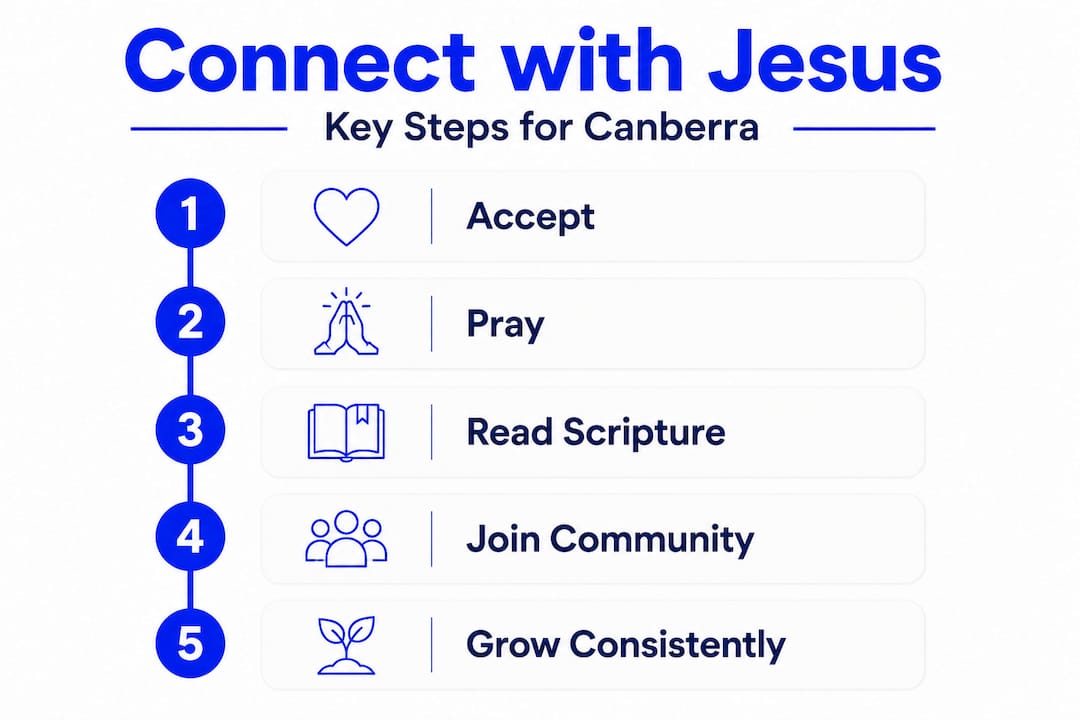
Spiritual isolation is one of the most common reasons people’s faith stalls. When you are only ever processing your questions alone, doubts tend to calcify rather than resolve. Community creates space for honest conversation, for people further along to speak into your life, and for you to speak into theirs.
Two excellent discipleship pathways worth knowing about:
Alpha: An 8 to 11 week course run by churches across Australia that creates a safe, discussion-based environment for exploring faith. Each session involves a shared meal, a short video, and open conversation. No question is off limits.
Discipleship Explored: An 8-session Bible study journeying through Philippians, opening each week with a film and followed by group discussion. It is designed for people who already have some faith but want to go deeper.
Feature | Alpha | Discipleship Explored |
Length | 8 to 11 weeks | 8 sessions |
Focus | Introduction to Christian faith | Deeper study of Philippians |
Format | Meal, video, discussion | Film, group Bible study |
Best for | Those exploring faith | Those strengthening faith |
Cost | Free | Low cost |
Strengthening faith in Christ through community is not about attending one more meeting. It is about finding people who are honest about their own journey and committed to yours. That kind of belonging changes things.
Pro Tip: If you are nervous about joining a group, attend once with no obligation to return. Most people who show up once come back, not because the programme is slick, but because the welcome is real.
You can explore structured discipleship pathways through Divergent Church’s discipleship hub, which is built specifically for people in the Canberra context.
Common challenges and how to overcome them
Even with a clear path, challenges arise. Let us explore the common obstacles people face when trying to connect with Jesus, and practical ways to keep growing.
Every person who has pursued faith seriously has encountered a season of dryness. Prayers feel flat. Scripture feels remote. The warmth you felt early on has cooled. This is not a sign that something is wrong with you or that God has moved. It is a normal part of spiritual growth, and the way through it is usually not to feel more, but to keep showing up.
James 4:8 offers a foundational promise here:
“Draw near to God and He will draw near to you.”
This reciprocal nearness principle is not a pressure tactic. It is an invitation. You take one step, and God meets you. The feelings may not come immediately, but the closeness is real.
Other practical ways to move through dry seasons:
Try a prayer walk. Take your conversation with Jesus outside. Moving through Canberra’s parks or around the lake whilst praying can unlock a different kind of attentiveness.
Start a prayer journal. Write to Jesus as you would write to a close friend. Over time, you will have a record of where He has moved.
Serve somewhere. Showing up for others often reconnects you to your own faith in unexpected ways.
Return to community. If you have drifted from a group, go back. Accountability is not about judgement; it is about having someone who notices when you are absent.
You can also work through honest questions about faith with tools like these discipleship questions, which are designed to help you articulate where you are and where you want to go.
Finding peace through Jesus during hard seasons is not about manufacturing calm. It is about trusting that the One who calmed the storm is still present, even when the waves are high.
Why building a connection with Jesus is more about consistency than emotion
Here is something that most articles on this topic will not say plainly: waiting for an emotional experience before you invest in your faith is one of the most common reasons people never really grow.
We live in a culture that prizes feeling. We want our faith to feel alive, electric, certain. And sometimes it does. But the followers of Jesus who sustain their faith across decades are not the ones who had the most dramatic encounters. They are the ones who turned up on the ordinary Tuesday mornings, read their Bible when it felt like nothing was happening, and prayed when the silence was heavy.
Building a relationship with Jesus works the same way as any meaningful relationship. It thrives on regular communication, shared time, and a decision to stay present even when feelings fluctuate. You would not abandon a marriage because you felt neutral one morning. You would not withdraw from a friendship because a conversation was unremarkable. Sustained connection is built in the small, repeated acts of showing up.
Practitioners who endure spiritually focus less on engineering dramatic moments and more on building a consistent communication channel through regular prayer and scripture. That is the deeper truth. Emotion is a gift when it comes, but it is a poor foundation when it is the only thing you are building on.
This reframe actually reduces a lot of unnecessary frustration. When you stop treating a flat prayer time as evidence of spiritual failure and start treating it as a faithful deposit into a relationship, everything shifts. You can explore how to keep that momentum alive through discipleship growth questions that help you reflect honestly on where your faith is heading.
How Divergent Church Canberra supports your journey with Jesus
If you are in Canberra and ready to move from reading about faith to living it alongside others, Divergent Church exists for exactly this moment in your journey. We are a community shaped by Scripture and centred on Jesus, present in the rhythms of this city — its universities, neighbourhoods, and workplaces.

Our discipleship hub brings together practical resources for every stage of spiritual growth. If you are just beginning to follow Jesus, the Follow Jesus programme provides structured teachings and genuine community connection to help you build a strong foundation. And if you are looking for the kind of smaller, relational space where honest conversations happen, our Life Communities are where seeds planted in private start to grow in the company of others. Whatever stage you are at, there is a place for you here. Come as you are.
Frequently asked questions
What is the first step to connect with Jesus?
The first step is to accept Jesus into your heart and open yourself to a relationship through honest prayer and reflection. As one guide on relationship with Jesus notes, the relationship begins with accepting Him and choosing to spend time with Him through prayer and Bible reading.
How often should I pray to connect with Jesus?
Consistency matters more than length, and starting with just a few minutes each day builds lasting habits. As one beginner’s prayer guide notes, starting small and growing from there is far more sustainable than sporadic long sessions.
What if I don’t feel close to Jesus sometimes?
Feeling distant is a normal part of faith, not a sign of failure. James 4:8 offers a clear assurance: when you draw near to God, He draws near to you, so keep seeking even when feelings are quiet.
Can joining a group help me connect with Jesus?
Yes, absolutely. Alpha’s safe, discussion-based courses and Discipleship Explored’s structured group Bible study sessions both provide communities where you can ask honest questions and grow in your relationship with Jesus alongside others.
Recommended
Comments