
Church small groups: a practical guide for leaders


Start with a clear purpose, recruit a small team of leaders, run a pilot over several weeks, then open sign-ups to the whole church. That sequence, simple as it sounds, is what separates a thriving small group ministry from a well-intentioned idea that never quite gets off the ground.
Your first steps today:
Write a one-sentence purpose statement for your groups (discipleship, care, outreach, or life stage)
Identify a few relationally warm, spiritually mature people to lead pilot groups
Set a pilot start date several weeks from now and block the training weeks before it
Choose a low-friction sign-up method (a visual online group finder beats an email list every time)
Book a brief leader orientation before the pilot launches
ChurchRaise notes that a church small group typically consists of a small number of people meeting regularly to share life, study Scripture, pray and build accountability. Divergentchurch’s Life Communities in Canberra follow exactly this pattern, and the steps below give you a replicable framework to do the same.
Table of Contents
How do you launch a church small group ministry step by step?
How do you pilot, evaluate and scale groups without losing purpose?
How should small groups handle pastoral care and confidentiality?
How do you build diversity and inclusivity into your small group?
Divergentchurch’s Life Communities and Discipleship Hub are ready to help you
How do you launch a church small group ministry step by step?
A well-run launch follows a clear sequence: purpose before people, people before programme. Skipping steps here is where most ministries stumble.
1. Clarify your purpose
Before you recruit a single leader, write down why your church is starting groups. Is the primary goal discipleship, pastoral care, outreach, or connecting people around a shared life stage? Clarifying purpose up front prevents groups from drifting into mere social clubs and keeps every conversation anchored in spiritual formation.
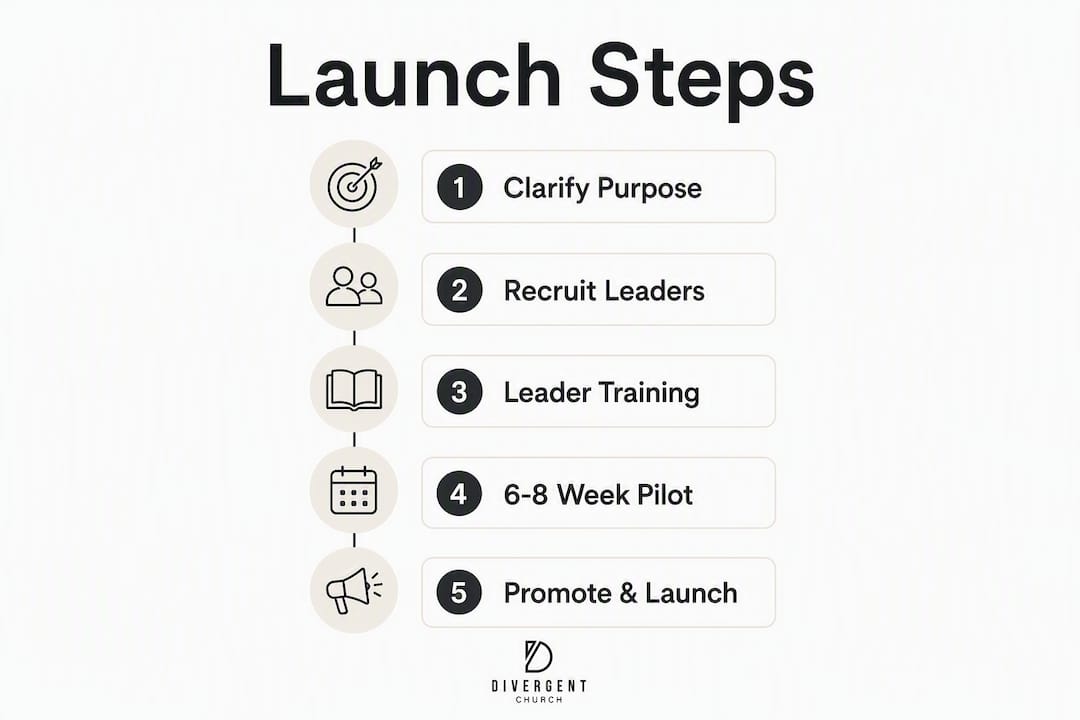
2. Recruit leaders before launch
Identify a small group of people who are relationally warm, spiritually mature, and teachable. You are not looking for finished products; you are looking for faithful people willing to grow. Recruit them personally, one-to-one, rather than through a stage announcement.

3. Run a training sequence over several weeks
Cover these topics across your training weeks:
The leader’s role: facilitator, not expert
Meeting format and how to run a discussion
Pastoral care basics and when to refer
Safeguarding expectations and your church’s policy
Group covenant and confidentiality
Multiplication mindset from day one
Practical leader preparation works best when it is short and focused: conversation guides, simple facilitation scripts and basic pastoral care training rather than extended academic instruction.
4. Run a 6–8 week pilot
Starting with one or two pilot groups before scaling lets you learn contextually, build culture and create reusable training patterns. The pilot is not a soft launch; it is a learning laboratory.
Pilot milestones:
Week 1: first meeting, group covenant signed
Week 3: mid-pilot leader check-in with your pastor or coach
At the end of the pilot period: evaluation meeting with leaders; review attendance, depth of sharing and newcomer integration
5. Promote and launch widely
Run a few Sundays of stage promotion, set a clear sign-up deadline, and offer a visual online group finder with filters for time, neighbourhood and topic. A single-click join option significantly increases conversions compared with email or phone sign-ups.
Evaluation checklist at pilot end:
Did attendance stay consistent across the pilot?
Were members sharing honestly, or staying surface-level?
Were newcomers welcomed and integrated?
Is there a natural apprentice leader emerging?
Are leaders healthy and not burning out?
Pro Tip: Place a “help me find a group” placement option alongside the self-select finder. Some people know they want community but feel paralysed choosing. A short questionnaire that places them removes that barrier entirely.
What do effective small group leaders actually do?
New leaders commonly fear they must be Bible scholars. The reality is that being a faithful facilitator and honest about not having all the answers builds more trust than polished answers ever could. A group where the leader says “I don’t know, let’s look at that together” is a group where people feel safe to be honest.
The leader’s core mindset
Your role is to create space, not fill it. Ask questions, listen well, and resist the urge to answer your own questions. The Holy Spirit does the forming; you do the facilitating.
A healthy meeting rhythm
Every meeting benefits from a consistent shape: welcome and fellowship, a centring moment (worship or prayer), Scripture discussion, application, and closing prayer. Consistency builds trust because people know what to expect.
Question patterns that open conversation
Move from observation to interpretation to application:
Observation: “What stands out to you in this passage?”
Interpretation: “What do you think that means for the original audience?”
Application: “Where does this challenge or encourage you this week?”
Personal: “Is there something here you want to pray about together?”
Prepare several questions but expect to use only a few. A good discussion rarely needs all of them.
Handling silence, dominant voices and conflict
Silence is not failure. Count to ten before jumping in; someone is usually gathering courage to speak. For dominant voices, try: “That’s helpful, thank you. Who hasn’t had a chance to share yet?” For conflict, name the tension calmly and redirect: “There’s clearly something real here. Let’s hold that with respect for each other.”
Watch for red flags: a member who goes quiet suddenly, signs of crisis, or a pattern of one person dominating every week. These are pastoral moments, not facilitation problems.
Pro Tip: Set a simple leader boundary: end every meeting on time, even if the conversation is rich. Ending 10–15 minutes early allows informal connection to happen naturally, and it honours people’s lives outside the group.
What should a small group meeting agenda look like?
Effective small group gatherings consistently include four elements: a centred/worship time, the Word (Scripture discussion), prayer, and fellowship. The proportions shift depending on your group’s purpose, but all four belong in every meeting.
Why each element matters:
Worship/centring: Shifts the group’s attention from the week’s noise to God’s presence. Even two songs or a short reading does this.
The Word: Scripture is the shared authority that keeps discussion from becoming opinion exchange.
Prayer: Moves application from intellectual to relational with God.
Fellowship: The informal connection before or after is where trust actually forms.
Two reproducible agenda templates
Template | Total Time | Fellowship | Word/Discussion | Prayer | Best For |
Discussion-focused | 60 min | 10 min | 35 min | 15 min | Midweek groups, busy seasons |
Worship/discussion/fellowship | 90 min | 20 min | 40 min | 15 min | Home groups, deeper community |
60-minute discussion-focused agenda:
0–10 min: Welcome, name tags (early meetings), icebreaker
10–45 min: Scripture discussion (observation, interpretation, application)
45–55 min: Prayer in pairs or as a group
55–60 min: Announcements, next week’s passage
90-minute worship/discussion/fellowship agenda:
0–20 min: Informal fellowship, food, arrival
20–30 min: Worship (2–3 songs) or a centring reading and short prayer
30–65 min: Scripture discussion with application questions
65–80 min: Group prayer, including personal requests
80–90 min: Informal close, connection time
Australian-context icebreakers:
“What’s one thing you’re looking forward to this week?”
“Where did you grow up, and what do you miss about it?”
“What’s the best meal you’ve had in Canberra recently?”
Lifeway recommends clear pre-meeting communication, name tags for early meetings, and a group covenant to set expectations from the first gathering.
What size and model works best for church small groups?
A church small group typically consists of 8 to 12 people who meet regularly for conversation, Scripture, prayer and accountability; starting with pilot groups of 6–8 allows for meaningful discussion and leader development.
Meeting frequency trade-offs:
Weekly: Builds depth and consistency fastest; suits discipleship-focused groups and people in a life transition.
Fortnightly: More accessible for busy families and professionals; suits interest-based or topical groups.
Seasonal semesters: Works well for outreach-focused groups or newcomer groups with a defined start and end point.
Common group models
Life communities are the backbone of most healthy church small group ministries. Mixed in age and background, they meet around shared geography or life stage and aim for long-term discipleship and mutual care. This is the model Divergentchurch uses in Canberra.
Topical interest groups gather around a shared interest (parenting, finances, creative arts) and are excellent entry points for people exploring faith. They lower the barrier to belonging.
Pastoral care groups are smaller (4–6 people) and more intentional, often formed around a specific need or season. They require a more experienced leader.
Outreach-focused groups are designed to be open and inviting, with a short commitment window and a clear next step for participants. They work best when paired with a clear pathway into a longer-term group.
The “80% rule” is a useful prompt: when a group reaches 80% of its comfortable capacity, it is time to start preparing for multiplication rather than waiting until the group feels full. That preparation begins with identifying an apprentice leader early.
How do you recruit, screen and train small group leaders?
Recruit leaders before you need them. The worst time to find a leader is when a group is already forming and you are scrambling for someone to run it.
Who to recruit first
Look for people who are relationally warm, spiritually maturing, and genuinely teachable. They do not need to be the most theologically trained person in the room. Recruit a small team of leaders before your pilot, and aim to have one leader for every several people you expect to place in groups.
Short screening checklist:
Can they commit to the full pilot period and training?
Are they currently growing in their own faith (regular Scripture engagement, prayer, community)?
Do they handle conflict and difference with grace?
Are they willing to be coached and to multiply the group eventually?
Have they completed your church’s safeguarding training?
Training outline (4–6 weeks)
Week 1: The leader’s identity and calling; facilitation vs. teaching
Week 2: Meeting format, question writing, and discussion skills
Week 3: Pastoral care basics: listening well, when to refer, boundaries
Week 4: Safeguarding expectations (in line with Australian safeguarding standards; refer leaders to your church’s safeguarding policy for specifics)
Week 5: Group covenant, confidentiality, and handling conflict
Week 6: Multiplication mindset; introducing an apprentice from day one
For deeper reading on leadership roles and expectations, Divergentchurch’s own resources offer a grounded starting point.
Ongoing support
A simple support rhythm of monthly leader huddles and one coach assigned per 5–7 leaders maintains leader health and reduces group plateauing. A quick leader health check at each huddle: “How are you personally? How is the group? Is anyone you’re concerned about?”
Pro Tip: Pair every new leader with a more experienced one for the first pilot. Shadowing a healthy group for two weeks is worth more than three training sessions.
How do you pilot, evaluate and scale groups without losing purpose?
The pilot is where culture is made. Run it tightly, evaluate honestly, and resist the pressure to scale before the model is working.
Pilot timeline (several weeks)
Pre-launch (weeks 1–2): Recruit and train leaders; finalise group placements; communicate clearly with participants.
Launch (week 3): First meetings; group covenants signed; leaders debrief with coach after week one.
Mid-pilot check (week 5): Brief survey to members; leader huddle to share observations and adjust.
Evaluation (week 8): Full debrief with leaders; review feedback; decide which groups continue, which need reshaping.
Feedback form topics to cover:
Do you feel you belong in this group?
Are you growing spiritually through the discussions?
Is the leader clear and welcoming?
Are the logistics (time, location, length) working for you?
Would you invite a friend to this group?
Growth tactics that reduce friction
A visual group finder with neighbourhood, time, and topic filters, paired with a placement questionnaire for those who want help choosing, keeps momentum from stalling at the sign-up stage. Stage invitations from the senior pastor carry particular weight; pastoral endorsement signals that groups are central to church life, not optional extras.
Multiplication: when and how
Introduce the multiplication expectation from day one and train an apprentice leader early. A group is ready to multiply when it consistently has 10–12 members and an apprentice who has been leading portions of the meeting for several weeks. Frame multiplication as a celebration, not a split: “We’ve grown so much that we get to plant a new group.”
For practical guidance on church leadership structures that support scaling, Divergentchurch’s resources offer a clear framework.
How Divergentchurch runs Life Communities in Canberra
Divergentchurch’s Life Communities are the primary expression of small group ministry in Canberra, designed to move discipleship out of Sunday and into the rhythms of everyday life: homes, neighbourhoods, workplaces, and university campuses.
How the model works in practice:
Groups of a moderate size meet weekly or fortnightly in homes across Canberra and Queanbeyan
Leaders are recruited relationally and trained through a focused pre-launch sequence before each new semester
Promotion runs through Sunday gatherings, personal invitations, and an online sign-up pathway
New members are placed through a combination of self-selection and a brief placement conversation with a pastor
Leaders are supported through regular huddles and a coaching structure that keeps no leader isolated
The approach is shaped by a conviction that the local church is not primarily a Sunday event but a community formed through shared life. Life Communities are where that conviction becomes concrete.
Leaders wanting direct support can access training materials, discussion guides and downloadable templates through the Divergentchurch Discipleship Hub, or connect with the Life Communities team directly through the Life Communities page.
How do you integrate new members into existing groups?
Welcoming someone into an established group requires intentionality. A group that has been meeting for months has its own language, rhythms, and inside references. A new member can feel invisible without a deliberate welcome.
Assign a specific member (not just the leader) to be a “welcome buddy” for the first two to three meetings. That person sits with the newcomer, explains the group’s rhythm, and checks in after the first gathering. It is a small act that carries significant weight.
Clear pre-meeting communication matters too: send a welcome message before the first meeting with the address, what to bring, and what to expect. Name tags for the first few meetings remove the awkwardness of forgotten names. Revisit the group covenant when a new member joins so they understand the shared expectations from the start.
For deeper thinking on welcoming newcomers well, Divergentchurch’s newcomer guide offers practical, tested steps.
How should small groups handle pastoral care and confidentiality?
Small groups surface real life. People share grief, marriage strain, health fears, and faith doubts in ways they rarely do on a Sunday morning. That vulnerability is a gift, and it requires careful stewardship.
Confidentiality should be named explicitly in the group covenant: what is shared in the group stays in the group, with one clear exception. If a member discloses something that suggests risk of harm to themselves or others, the leader has a responsibility to involve a pastor or appropriate authority. Make this exception clear from the start so it is not a surprise when it matters.
Pastoral boundaries protect both the leader and the member. A small group leader is not a counsellor. When a member’s need exceeds what the group can hold, the leader’s role is to connect them with a pastor or professional, not to carry that weight alone. Monthly leader huddles are the right place to raise these situations with a coach.
A written group covenant covering attendance, confidentiality, food, and childcare expectations reduces leader burnout and gives a framework for healthy boundaries. Revisit the covenant every few months to keep it alive rather than a forgotten document from the first meeting.
How do you build diversity and inclusivity into your small group?
A group that only reflects one demographic is a group that has stopped growing. Canberra’s population is genuinely diverse: university students, public servants, young families, migrants, and long-term residents all sit within reach of most churches. Life-stage groups have their place, but the richest discipleship often happens across difference.
Practically, this means recruiting leaders who reflect the diversity you want to see, not just the majority culture of your congregation. It means choosing discussion questions that do not assume a shared cultural background. It means being explicit that questions are welcome and that belonging does not require having everything figured out.
For groups that include people from different cultural backgrounds, slow down on idiom-heavy questions and allow more time for reflection. Not everyone processes at the same pace or in the same way. A question that lands immediately for one person may need ten minutes of quiet for another to engage with honestly.
Divergentchurch’s Canberra context, with its transient population and university presence, makes this particularly relevant. Engaging younger adults and people new to faith requires a posture of genuine curiosity rather than assumed shared experience.
Key takeaways
A thriving small group ministry begins with a clear purpose, trained leaders, and a tight pilot before you scale to the whole church.
Point | Details |
Purpose before programme | Write a one-sentence group purpose before recruiting anyone; it prevents social-club drift. |
Pilot first, then scale | Run a 6–8 week pilot with 1–2 groups before launching widely; it builds culture and reusable patterns. |
Leaders need ongoing support | Assign one coach per 5–7 leaders and run monthly huddles to keep leaders healthy and groups growing. |
Low-friction sign-up matters | A visual group finder with a single-click join option converts more people than email or phone sign-ups. |
Divergentchurch’s Life Communities | Divergentchurch runs Life Communities in Canberra using this exact model; resources are available through the Discipleship Hub. |
Small groups are worth the risk
There is a temptation, especially for leaders who have seen groups fail before, to over-engineer the process. To wait until the training is perfect, the resources are polished, and the timing is ideal. But the kingdom rarely waits for perfect conditions.
What I have seen, again and again, is that the groups which form people most deeply are not the ones with the best curriculum. They are the ones where the leader showed up faithfully, asked honest questions, and created enough safety for people to be real with each other and with God. That is not a programme. That is a posture.
The practical steps in this guide matter. The timeline, the training, the covenant, the coaching structure — all of it reduces unnecessary friction and protects leaders from burning out. But underneath all of it is a simpler conviction: that Jesus forms people in community, and that your willingness to gather a handful of people around Scripture and prayer is an act of genuine faith.
Start small. Start imperfect. Start soon.
Divergentchurch’s Life Communities and Discipleship Hub are ready to help you
If you are a church leader in Canberra or Queanbeyan looking to start or strengthen your small group ministry, Divergentchurch offers something most guides cannot: a local, tested model you can walk into rather than build from scratch.
The Discipleship Hub holds leader training materials, discussion guides, and downloadable templates built for the Australian context. The Life Communities page gives you a direct pathway to connect with the Divergentchurch team, find an existing group, or explore what leader training looks like in practice. For those ready to go deeper, the Lead Like Jesus pathway offers a structured leadership development track designed for small group leaders who want to grow in both character and competence.
Reach out through the Life Communities page to book a coaching conversation or find out when the next leader training session runs.
Useful sources and further reading
How to Launch and Lead a Small Group | Cru — Practical guidance on leader preparation, content selection, and the relational investment that makes groups work. A solid starting point for new leaders.
Building an Intentional Small Group Ministry | The Episcopal Church — A thorough framework covering roles, group formation processes, and the marks of an effective small group. Useful for ministry coordinators designing a whole-church structure.
Church Small Groups: How to Start, Grow, and Manage Groups That Last | ChurchRaise — Covers group size guidance, sign-up tactics, leader support rhythms, and multiplication principles. Practical and well-organised.
How to Start a Small Group Ministry from Scratch | Tend — Focused on the early stages: pilot approach, leader training format, and building culture before scaling. Particularly useful for churches launching groups for the first time.
How to Get a New Small Group Off to a Good Start | Lifeway — First-meeting best practice, group covenant guidance, and meeting rhythm benchmarks. Practical and immediately applicable.
How to Start a Small Group Bible Study | GrowChurch — Covers the four-part meeting structure and how to run interactive Scripture discussion rather than a lecture format.
Small Group Leadership Collection | InterVarsity — A curated library of tools for leaders at every stage, from gathering a group to equipping it for outreach. Particularly strong on life-stage group dynamics.
Discipleship Hub | Divergentchurch — The primary local resource for Canberra-based leaders: training materials, discussion guides, and downloadable templates built for the Australian context.
Life Communities | Divergentchurch — The direct sign-up and contact point for Divergentchurch’s small group model in Canberra and Queanbeyan.
How to Deepen Personal Connection with God Daily | Jeffrey Sean McDonnell — Practical daily spiritual disciplines that small groups can adapt into shared prayer rhythms and personal formation exercises between meetings.
Recommended
Comments