
How to participate in church missions: a practical guide


Participating in church missions is defined as the active engagement of believers in God’s redemptive work, locally and globally, through evangelism, service, prayer, and cross-cultural ministry. Rooted in the Great Commission (Matthew 28:19–20), mission participation is not reserved for full-time missionaries. It belongs to every disciple. Whether you are considering joining church missions for the first time or looking to deepen your involvement, the pathways are more varied and accessible than most people realise. Divergentchurch in Canberra embodies this truth, treating mission not as a programme but as the everyday expression of a community shaped by Scripture and centred on Jesus.
What are the different types of church mission opportunities?
Mission service pathways are classified into three broad categories: short-term (weeks to two years), mid-term (one to three years), and long-term or career missions. Each demands a different level of preparation, financial support, and personal commitment. Understanding where you fit is the first step toward meaningful involvement.
Short-term mission trips usually last less than 10 days, with teams of 10–15 people focusing on evangelism or community support. That compact format makes them the most accessible entry point for people exploring mission for the first time. Mid-term roles often involve language learning, community development, or leadership training in a specific region.
Long-term or career missions require the deepest commitment. They typically involve relocating, raising ongoing financial support, and embedding within a local culture for years. Not everyone is called to that path, and that is perfectly fine. The body of Christ needs people at every level of involvement.
Mission type | Typical duration | Key focus areas | Participation requirements |
Short-term | Under 10 days | Evangelism, community service | Basic training, church endorsement |
Mid-term | 1–3 years | Leadership, development | Extended training, support team |
Long-term | Career length | Church planting, discipleship | Full preparation, ongoing support |
Local outreach | Ongoing | Neighbourhood service, prayer | Available immediately |
Prayer and giving | Ongoing | Intercession, financial support | No travel required |
Pro Tip: When evaluating a mission trip, ask whether the organisation partners with local staff who already understand the cultural context. Sustainable impact depends on those existing relationships, not just the energy your team brings.
What essential preparation do you need before joining church missions?
Preparation is where most people underestimate the work involved. Effective mission participation requires spiritual readiness, practical training, and the active support of your local church community before you ever board a plane or knock on a neighbour’s door.
The standard minimum age for independent mission participation is 18, though some organisations allow 17-year-olds who will turn 18 before the trip begins. Younger participants can still engage through church-run local outreach programmes under adult supervision. Age requirements exist to protect both the participant and the communities being served.
Cross-cultural mission is a collective calling involving the entire church community, not just the individual. This means consulting your pastor or church leadership before applying to any mission organisation. Their endorsement is not a formality. It is a theological statement that your church is sending you, not just permitting you to go.
Practical preparation steps include:
Pray and discern your calling with trusted mentors and church leaders over several weeks or months.
Attend an information session run by a reputable mission organisation to understand expectations and costs.
Complete cultural training relevant to the region you will serve, including basic language phrases and local customs.
Gather travel documentation early: passport, visas, vaccinations, and travel insurance.
Build a support team of people who will pray for you and contribute financially during your preparation and time on the field.
Engage in fundraising coaching, which many mission organisations provide as part of their preparation resources.
Pro Tip: Engage your church community early in the process. When your congregation knows your mission story, they become your most committed prayer partners and financial supporters. Early involvement builds the accountability that sustains you through the hard moments.
Step-by-step process to participate actively in church missions
Active participation follows a clear arc from initial calling through to long-term engagement. The steps below apply whether you are preparing for a short-term trip or exploring a longer commitment.
Discern your calling. Spend time in prayer and Scripture. Talk with your pastor, a mentor, or a trusted elder. Calling is rarely a dramatic moment. It is usually confirmed through community.
Research mission opportunities. Look at inspiring mission ideas that match your gifts and availability. Consider local outreach as well as international trips.
Submit your application. Most organisations require a written application, references from church leadership, and an interview. Treat this process seriously. It is part of your formation.
Complete required training. Training covers spiritual preparation, cultural sensitivity, team dynamics, and practical logistics. Do not skip or rush this phase.
Prepare financially and spiritually. Raise your support, build your prayer team, and set aside time for personal reflection and Scripture reading in the weeks before departure.
Serve on the field. Participate fully in team activities, follow the lead of local partners, and remain humble. You are a guest in someone else’s community.
Debrief and stay engaged. Return with stories, not just photos. Share what you experienced with your church. Continue supporting the work through prayer and giving.
The difference between short-term and long-term participation is not just duration. It is depth of preparation, level of cultural integration, and the ongoing nature of relationships built.
Feature | Short-term participation | Long-term participation |
Duration | Under 10 days to 2 years | Career length |
Preparation time | Weeks to months | 1–2 years |
Cultural integration | Surface to moderate | Deep and sustained |
Financial support | One-off fundraising | Ongoing support team |
Relationship depth | Introductory | Embedded and relational |
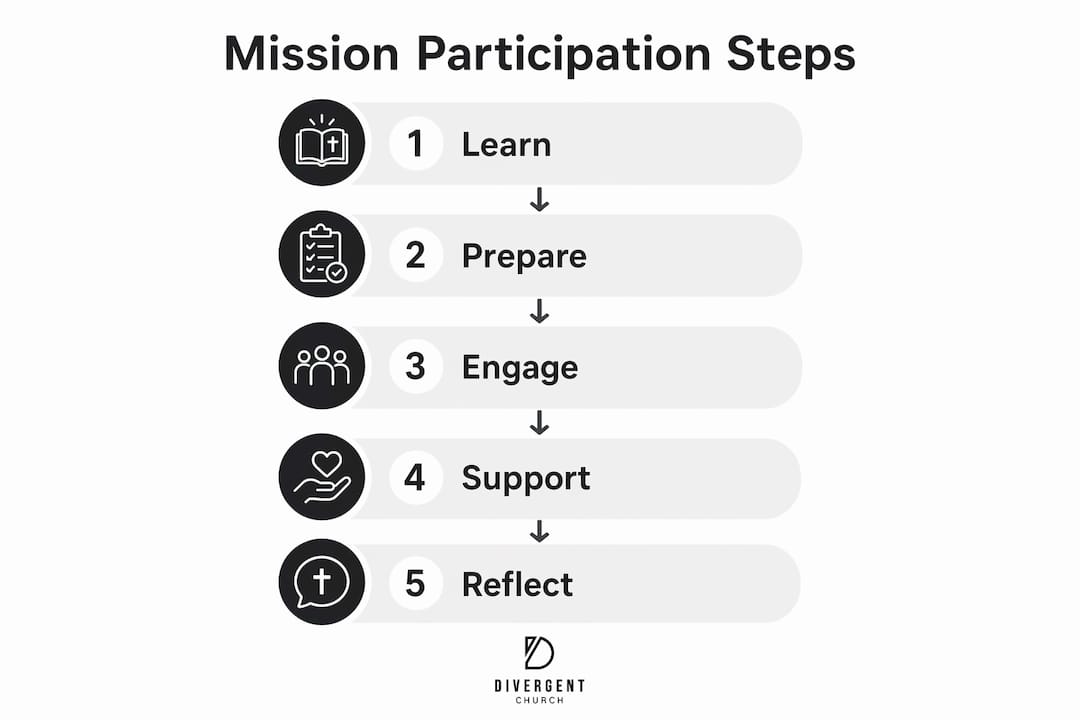
Church involvement step by step is a process that rewards patience. Each stage of preparation shapes you as much as it prepares you for the field.
How do you overcome common challenges in church mission participation?
The most common reason mission participation stalls is insufficient preparation, not lack of desire. People feel called, apply quickly, and then struggle with fundraising, cultural shock, or the absence of a support structure back home. These challenges are predictable and preventable.
Local church leadership plays a critical role in simplifying planning and maintaining clear communication, especially for families and groups. When communication is timely and itineraries are kept clear, participation rates rise and dropout rates fall. Complexity is the enemy of commitment.
Non-travelling church members can participate significantly through prayer, fundraising, and logistical support. This is not a consolation prize. Intercessory prayer and financial giving are the foundations that make field work possible. Mission is a whole-church effort, and the person praying at home is as much a part of the team as the person on the ground.
Best practices for overcoming common mission challenges:
Start fundraising early. Give your support team at least three months to respond. Rushed fundraising produces stress and shortfalls.
Recruit a volunteer support team using clear, personal communication. Generic mass emails rarely produce committed supporters.
Prioritise partnerships with long-term local staff who understand the cultural context and community needs. Avoid new short-term projects that lack sustainability.
Debrief thoroughly after returning. Unprocessed experiences lead to disillusionment. Schedule a debrief session with your pastor or a mentor within two weeks of returning.
Invite the whole church into the story. Share updates, prayer points, and outcomes publicly. This builds a culture of mission across the congregation, not just among those who travel.
Understanding how to volunteer at church in practical ways is the foundation for everything that follows in mission participation.
What I have learned about mission that most guides miss
There is a tendency in Christian circles to treat mission trips as spiritual highlights, the peak experiences of a faith life. I understand that impulse. The first time you sit across from someone in a different country and share the hope you carry, something shifts in you permanently. But I have come to believe that framing mission as a peak experience is one of the most limiting things we do to it.
The most transformative mission I have witnessed has not happened on a two-week trip to Southeast Asia. It has happened in the ordinary rhythms of a local church community that decided to take its neighbourhood seriously. Seeds planted in a Canberra university common room, conversations in a workplace, a meal shared with someone who has no community. That is mission too, and it does not require a passport.
What I tell anyone considering getting involved in church outreach is this: start with your local church. Not because international mission is less important, but because the habits of attentiveness, service, and sacrifice that make you effective overseas are formed right where you are. A missional church does not export mission. It lives it daily and then extends it outward.
The other thing most guides miss is the importance of returning well. The field experience is formative, but what you do with it when you come home determines whether it bears lasting fruit. The missionaries I most respect are not those who went once and told the story forever. They are the ones who came back, stayed connected, kept giving, and eventually went again. Mission is not an event. It is a posture.
— Josh
Divergentchurch and your next step in mission
Divergentchurch exists within the rhythms of Canberra, its universities, workplaces, and neighbourhoods, and mission is woven into the fabric of how we live together. If you are ready to move from curiosity to commitment, there are clear pathways to help you take that step.
The Discipleship Hub is the central resource for spiritual growth and mission preparation at Divergentchurch. It connects you with teaching, community, and practical tools that form you as a disciple before, during, and after any mission involvement. You can also explore Next Steps to find the right entry point for your season of faith. Our Life Communities are small groups where mission is not a topic on an agenda but a shared way of life, and they are open to anyone ready to belong to something real.
FAQ
What does participating in church missions actually involve?
Participating in church missions means engaging in God’s work through evangelism, service, prayer, or financial support, locally or internationally. It includes short-term trips, local outreach, and ongoing support roles for those who cannot travel.
How old do you need to be to join a mission trip?
The standard minimum age for independent mission participation is 18. Some organisations allow 17-year-olds if they turn 18 before the trip begins, and younger participants can engage through supervised local outreach programmes.
Can I participate in missions without travelling overseas?
Church members who cannot travel can participate significantly through prayer, fundraising, and logistical support. These roles are not secondary. They are the foundation that makes field work possible.
How do I find church mission opportunities near me?
Start by speaking with your pastor or church leadership, as mission is a corporate calling of the church body. From there, connect with reputable mission organisations that align with your church’s values and your personal gifts.
How long does it take to prepare for a mission trip?
Preparation for a short-term trip typically takes several weeks to a few months and includes training, fundraising, and cultural preparation. Long-term mission preparation can take one to two years and involves deeper formation and support-team building.
Key takeaways
Effective mission participation requires preparation, community, and sustained engagement across every role, from the field to the prayer room.
Point | Details |
Mission has multiple pathways | Short-term, mid-term, long-term, and local outreach all count as genuine mission participation. |
Preparation is non-negotiable | Spiritual readiness, cultural training, and church endorsement are required before any mission involvement. |
The whole church participates | Prayer, giving, and logistical support are as vital as field work, making mission a whole-church effort. |
Local partnerships determine impact | Sustainable mission depends on working with long-term local staff who understand the community. |
Returning well matters | Debriefing, staying connected, and continuing to give after a trip determines whether the experience bears lasting fruit. |
Recommended
Comments