
Why Christian beliefs matter: faith, identity, and hope

Christian beliefs are the foundational framework through which followers of Jesus understand identity, purpose, suffering, and moral life. Understanding why Christian beliefs matter goes beyond religious habit or cultural tradition. It reaches into the deepest questions every person asks: Who am I? Why am I here? What happens when I suffer? The answers Christianity offers are not vague comfort. They are grounded in specific doctrines, historical events, and a relational God who acts first. This article examines the significance of Christian faith across personal formation, existential hope, theological distinctives, and community life.
Why Christian beliefs matter for personal identity
Christian beliefs provide a stable identity framework rooted in absolute, God-given truth rather than shifting cultural opinion. This matters because belief shapes psychology, worldview, and the way a person treats others. When your sense of self is anchored in something unchanging, you are far less likely to collapse under social pressure or personal failure. Identity formed by Christian conviction is not fragile.

The formation of that conviction rarely happens in isolation. Over half of evangelicals cite their parents as the primary spiritual influence for their initial faith experience. That statistic reveals something profound: faith is caught as much as it is taught. Children who watch parents live with integrity, compassion, and trust in God absorb a worldview before they can articulate it.
Christian belief also shapes character in specific, measurable ways. Consider what the New Testament calls the “fruit of the Spirit” in Galatians 5: love, joy, peace, patience, kindness, goodness, faithfulness, gentleness, and self-control. These are not personality traits. They are the natural outworking of a life genuinely shaped by Christian conviction. Belief, in this sense, is not merely intellectual assent. It is a living orientation that forms who you become over time.
Anchored identity: Belief in a God who defines human worth prevents identity from being hostage to performance or approval.
Moral formation: Christian convictions produce consistent ethical behaviour grounded in love rather than self-interest.
Compassion toward others: Seeing every person as made in God’s image changes how you treat strangers, enemies, and the marginalised.
Generational transmission: Lived faith in the home is the single most powerful vehicle for spiritual formation across generations.
Pro Tip: If you are exploring faith for the first time, pay attention to how Christians around you actually live, not just what they say. Authentic lived faith is the most compelling evidence for its truth.
Does the resurrection really change anything?
The resurrection of Jesus is the hinge on which all Christian hope turns. Belief in the resurrection offers existential certainty that suffering and death are not the final reality. That is not wishful thinking. It is a claim about a historical event with documented witnesses, and it reframes every experience of loss, grief, and failure.
Paul’s letter to the Romans captures this with startling clarity. He writes that suffering produces endurance, endurance produces character, and character produces hope. That sequence only makes sense if the resurrection is real. Without it, suffering is simply suffering. With it, suffering becomes the very ground in which hope takes root.
“If the resurrection is true, then nothing is wasted. Every tear, every trial, every moment of endurance is being woven into something permanent. The resurrection does not remove suffering from the story. It guarantees that suffering is not the end of the story.”
This hope is not passive. It actively changes how believers engage with difficulty. People who hold a resurrection-grounded hope report greater resilience in grief and a stronger sense of life purpose. The resurrection makes endurance rational, not merely admirable. It gives believers a reason to keep going when circumstances offer none.
How does Christianity differ from other worldviews?
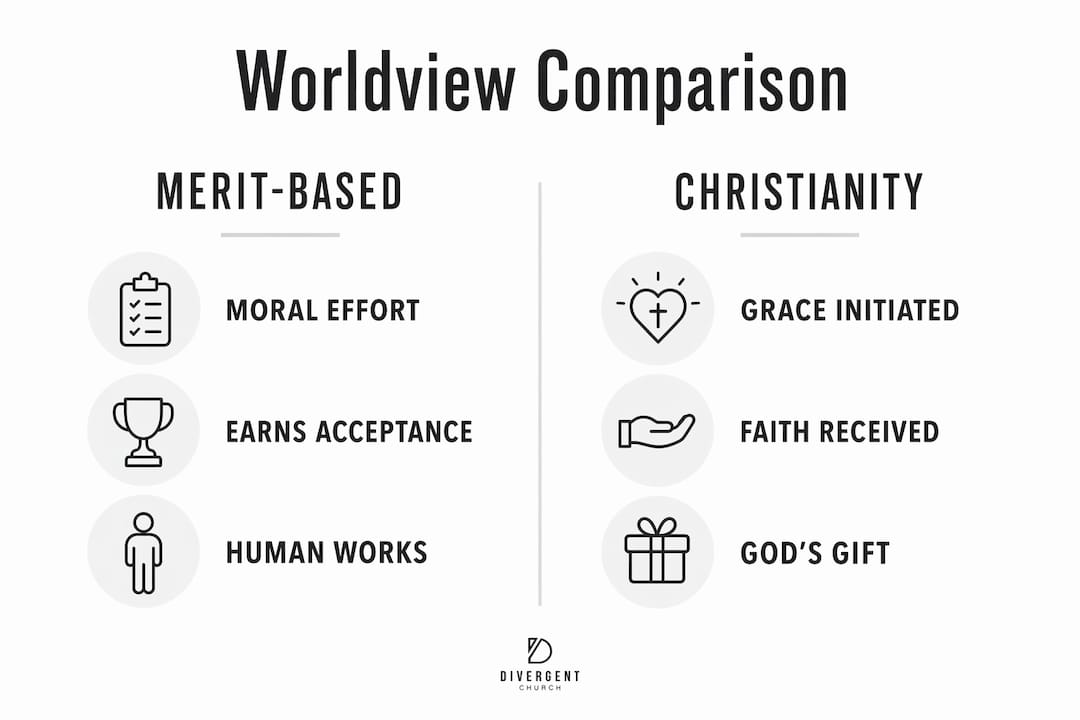
Christianity’s most distinctive feature is its direction of grace. God initiates grace and faith receives it. This reverses the logic of every merit-based religious system, where human effort earns divine acceptance. In Christianity, the gift is already given. Faith is the open hand that receives it, not the ladder that climbs toward it.
The Councils of Nicaea and Chalcedon defined two doctrines that remain central to Christian belief: the Trinity and the hypostatic union. The Trinity teaches that God exists as Father, Son, and Holy Spirit, three persons sharing one divine nature. The hypostatic union teaches that Jesus is fully God and fully human, not a mixture of the two, but both completely. These are not abstract puzzles. They explain why Jesus can be both the perfect sacrifice and the sympathetic high priest who understands human suffering from the inside.
The table below compares the core logic of salvation across three broad worldview categories.
Worldview category | Basis of acceptance | Human role |
Merit-based religion | Moral achievement or ritual performance | Earn acceptance through effort |
Secular humanism | Self-defined meaning and personal virtue | Create your own worth |
Christianity | Grace given freely by God | Receive the gift through faith |
Salvation by grace through faith alone is the theological claim that separates Christianity most sharply from other frameworks. Good works matter in Christianity, but they are the fruit of salvation, not its cause. This distinction is not a technicality. It changes the entire emotional texture of a person’s relationship with God, from anxious striving to grateful receiving.
What is the practical impact of Christian faith on society?
Christian beliefs shape behaviour in ways that extend well beyond Sunday gatherings. Lived faith reflected in ethics sustains durable social and community projects, from hospitals and schools to food banks and reconciliation programmes. The values Christianity produces, including love, financial stewardship, and integrity, are not incidental. They flow directly from core doctrines about human dignity and God’s ownership of all things.
Christian community plays a vital role in nurturing faith through shared worship, Scripture, and mutual love. The church is not simply a service provider. It is the covenant people of God, embodying doctrine through communal life. When that community functions well, it becomes one of the most powerful forces for social good in any city.
The practical outworking of Christian conviction in society follows a clear pattern:
Love of neighbour: The command to love others as yourself produces concrete acts of service, advocacy, and care for the vulnerable.
Financial integrity: Stewardship theology teaches that money belongs to God, which produces generosity and accountability rather than hoarding or corruption.
Truthfulness: A belief in a God who is truth creates cultures of honesty in workplaces, families, and public life.
Care for the marginalised: The prophetic tradition in Scripture consistently calls believers to defend the poor, the widow, and the stranger.
Long-term commitment: Christian conviction sustains effort over decades, not just seasons, because it is grounded in eternal purpose rather than short-term reward.
Pro Tip: If you want to see the impact of Christian faith on a community, look at what a church does with its money and who it serves. Theology always shows up in practice.
Communities like Divergentchurch in Canberra embody this by existing within the rhythms of the city, including its universities, workplaces, and neighbourhoods, and by treating church diversity as a strength rather than a complication. Faith expressed through everyday relationships is the most credible witness Christianity has.
Key takeaways
Christian beliefs matter because they provide a coherent, evidence-grounded framework for identity, hope, and ethical life that no secular worldview fully replicates.
Point | Details |
Identity anchored in truth | Belief in God-given worth prevents identity from collapsing under cultural pressure or personal failure. |
Resurrection as living hope | The resurrection makes suffering meaningful and endurance rational, not merely admirable. |
Grace reverses merit logic | Christianity’s grace-first model distinguishes it from every merit-based religious or secular framework. |
Faith shapes community | Christian conviction produces love, integrity, and stewardship that sustain durable social good. |
Lived faith forms the next generation | Parental example is the most powerful vehicle for spiritual formation across generations. |
Faith is not inherited furniture
I have spent years watching people treat Christian belief like inherited furniture. They keep it because it was there when they arrived, not because they have ever tested its weight. That approach produces a faith that cannot hold anything heavy, and life will always eventually get heavy.
The most resilient believers I know are the ones who have done what might be called forensic faith. They have examined the evidence for the resurrection, wrestled with the problem of suffering, and come out the other side with conviction rather than mere habit. That kind of faith holds. It does not require certainty about every question. It requires honest engagement with the evidence that exists.
C.S. Lewis described Christian beliefs as a lens that illuminates all of reality, making suffering and human dignity understandable in ways that no other framework can. I find that description accurate. When I look at the world through the lens of a God who is both just and gracious, who entered history in Jesus, and who raised him from the dead, things that were previously incoherent begin to make sense. That is not a small claim. It is the most significant claim a person can examine.
If you are exploring faith right now, bring your scepticism with you. Christian belief is not threatened by honest questions. It is strengthened by them.
— Josh
Grow in faith with Divergentchurch
Divergentchurch exists to help people in Canberra move from curiosity about Christian belief to genuine, grounded faith. Whether you are asking your first questions or looking to go deeper, there are real resources and real people ready to walk with you.
The Discipleship Hub is the best place to start. It brings together teaching, formation resources, and pathways for growth in one place. For those who want relational community alongside learning, Life Communities offer small group connection rooted in Scripture and everyday life. If you are ready to take a concrete next step, the Next Steps page will show you exactly where to begin.
FAQ
What are the core Christian beliefs?
The core Christian beliefs include the Trinity, the full humanity and divinity of Jesus, salvation by grace through faith, and the bodily resurrection of Jesus. The Councils of Nicaea and Chalcedon defined these doctrines as the standard of orthodox Christian faith.
Why does faith matter more than good works in Christianity?
Christianity teaches that salvation is received by grace through faith, not earned through moral effort. Good works are the natural result of genuine faith, not the basis for God’s acceptance.
How does Christian belief shape a person’s identity?
Christian belief anchors identity in God-given worth rather than performance or cultural approval. This produces psychological stability and a consistent moral character over time.
Can Christian faith be grounded in evidence?
Yes. A forensic approach to faith examines historical evidence for the resurrection and the reliability of Scripture. Confident conviction is possible even with unanswered questions, and that kind of faith proves far more resilient than inherited tradition alone.
How does Christian belief affect community life?
Christian community nurtures faith through shared worship, Scripture, and mutual love, and it produces practical social goods like generosity, integrity, and care for the vulnerable.
Recommended
Comments