
One Chapter a Day: How to Read the Bible for Beginners


Start with a Gospel, Mark or Luke works well, or a short book like James, Philippians, or Ruth. Read one chapter a day, no more. Before you open the page, pray briefly; after you close it, write down one thing you noticed and one way to live it out, then pray again. That five-minute rhythm matters more than any plan you choose.
TL;DR:
Using a short, manageable book like James or Ruth can help beginners see the full story within weeks without feeling overwhelmed.
A consistent habit involves praying, reading aloud, noting observations, and reflecting on practical applications within ten minutes daily.
Choosing a flexible reading plan, such as multi-bookmark or catch-up enabled schedules, helps maintain progress during busy or irregular periods.
Reading different genres requires distinct approaches, with narrative and epistles needing contextual understanding and poetry requiring metaphor awareness.
Engaging in community through local classes or discussion groups sustains long-term Bible habits and deepens understanding beyond solo reading.
Table of Contents
How do I start reading the Bible today?
You don’t need a theology degree or a shelf of commentaries to begin. You need a readable translation, a notebook, something to mark your page, and ten to twenty quiet minutes, whether that’s the kitchen table before the house wakes up or the bus ride into the city.
Beginners are usually pointed toward the Gospel of Matthew or Luke, or a short, self-contained book such as James, Philippians, or Ruth. Each works because you can finish it in weeks, not years, and see the whole shape of the story.
Here’s the routine, start to finish:
Pray for two minutes, asking simply to understand what you read.
Read one chapter, slowly, out loud if you can.
Write one observation, a detail, a repeated word, a question.
Write one application, something concrete for today.
Close with a short prayer of thanks or request.
Pro Tip: Keep your notebook open to a fresh page before you start reading, not after. Deciding in advance where you’ll write forces you to actually write, rather than closing the Bible and telling yourself you’ll remember it later.
Which Bible reading plan actually fits your life?
Plenty of structured plans exist, and the right one depends on how much time you have and whether you’re chasing completion or depth.
The classic one-year canonical plan takes you Genesis to Revelation in the order the books appear. It’s tidy and familiar, but Leviticus in week three trips up a lot of new readers. A chronological plan reorders events by when they actually happened, which helps the Old Testament’s history make more sense, while blended plans mix a Psalm or Gospel passage into every day’s Old Testament reading so you’re never stuck in one mood for too long.
If a rigid daily target feels like pressure rather than help, try the multi-bookmark approach: keep five bookmarks running at once, one each in the Pentateuch, Psalms, the Gospels or Acts, the Epistles, and the Prophets, and read a short portion from each. Some readers stretch this into a two-year plan with built-in weekend catch-up days.
To choose:
Want the satisfaction of finishing? Pick a one-year canonical or chronological plan.
Short on time or prone to guilt spirals when you fall behind? Choose a plan with catch-up days built in.
Craving variety over completion? Run the multi-bookmark system instead.
Devotional reading, inductive study, or S.O.A.P: what’s the difference?
These aren’t competing methods so much as different depths of the same activity.
Devotional reading is the simplest: read a passage slowly, let it speak to your day, and respond in prayer. It’s heart-first, and it’s exactly where most people should begin.
The inductive method goes deeper. It runs in three stages:
Observation: what does the text actually say? Note repeated words, contrasts, and structure.
Interpretation: what did this mean to its original audience?
Application: what does that meaning require of you now?
S.O.A.P. is inductive study’s daily-friendly cousin: Scripture (write out the verse), Observation (what stands out), Application (what will you do), Prayer (respond to God directly). It fits neatly into that ten-minute window without feeling rushed.
Pro Tip: Once devotional reading feels too thin, don’t jump straight to a full inductive workbook. Try S.O.A.P. for two weeks first. It’s the natural bridge between reading for comfort and reading for understanding.
When you finish a short book, consider a topical study (tracing one theme, like forgiveness, across several passages) or a character study (following one person’s arc, like Peter’s, from failure to leadership).
How do you build a Bible reading habit that actually lasts?
Most people don’t quit because the Bible is hard. They quit because the habit was never anchored to anything.
Attach your reading window to something you already do daily, coffee, the commute, the last five minutes before bed, so you’re not relying on willpower alone.
Set up your bookmarks before you need them. The multi-bookmark system (Pentateuch, Psalms, Gospels or Acts, Epistles, Prophets) keeps dense stretches from stalling your whole practice, since you’re never locked into just one book.
Journal every session, even one line. Note questions you can’t answer yet; they become a running list of things to research or ask someone about later.
Find one other person, a friend, a small group, a discipleship partner, and set a simple check-in, even a fortnightly text asking “what did you read this week?”
None of this needs to be elaborate. A habit that survives a busy month is worth more than an ambitious plan that collapses in week two.
How do you interpret the Bible without missing the point?
Genre changes everything about how a passage should be read. Treat a psalm like a legal document, or a proverb like a promise, and you’ll misread both.
Narrative (Genesis, Ruth, Acts): read for plot and character, not isolated moral lessons.
Poetry (Psalms, Song of Songs): expect metaphor and emotional exaggeration, not literal precision.
Prophecy: read for the original audience’s crisis before you read for future prediction.
Epistles (Romans, Philippians): read as real letters solving real first-century problems.
Apocalyptic (Revelation, parts of Daniel): expect symbolic imagery, not a coded newspaper.
Understanding these literary styles is the single biggest lever for reading accurately.
The most common pitfall is pulling one verse out and building a belief on it while ignoring the paragraph around it. A close second is skipping the historical setting entirely and assuming the text was written directly to you, rather than to a first-century church or an ancient Israelite audience, with something to say to you through them.
Which tools help you go deeper once you’ve started reading?
Translation matters less than consistency, but it still matters. Pick a version you’ll actually pick up: the NIV and NLT read easily for beginners, while the ESV and NASB stay closer to the original word order for study. Read the same passage in two translations occasionally; the differences often reveal exactly where a word is doing heavy lifting.
Bible Gateway’s reading plans offer free, structured schedules across every major approach.
The Vyrse app lets you read multiple translations side by side with a built-in glossary, useful when a word choice trips you up.
Blue Letter Bible’s daily reading plans track your progress automatically.
A beginner-friendly study Bible or one-volume commentary is worth consulting only after you’ve read a whole book straight through once or twice. Commentaries answer questions you haven’t asked yet if you reach for them too soon.
What gives Divergentchurch’s approach to Scripture credibility?
Divergentchurch’s teaching, including Josh’s writing on scriptural living, treats daily reading as a practice worked out in real community, not a private hobby. Josh’s teaching on scriptural living treats daily reading as a practice worked out in real community, not a private hobby.
Locally, Divergentchurch’s Discipleship Hub and Life Communities exist precisely to help people learn these habits alongside others, rather than working them out alone. Locally, Divergentchurch’s Discipleship Hub and Life Communities exist precisely to help people learn these habits alongside others, rather than working them out alone.
Why reading Scripture is formation, not a checklist
I’d rather see someone read three verses slowly and pray them back to God than tick off a chapter they didn’t absorb. The goal isn’t information; it’s knowing Christ better through the practice. Start gently, and let it become relationship, not homework.
— Josh
Where to go next if you want guided support
Reading alone works for a season, but most people stick with it longer inside community. Divergentchurch’s Discipleship Hub exists for exactly that: a practical, guided space where newcomers learn reading habits, ask the questions a solo reader can’t answer alone, and build the S.O.A.P. or inductive rhythm covered above with someone walking alongside them. It isn’t a lecture series. It’s structured, but relational, and paced for people who’ve never opened a study Bible before.
If you’d rather start smaller, our Life Communities groups read and discuss Scripture together in ordinary homes across Canberra and Queanbeyan, which suits anyone who wants accountability without a formal course.
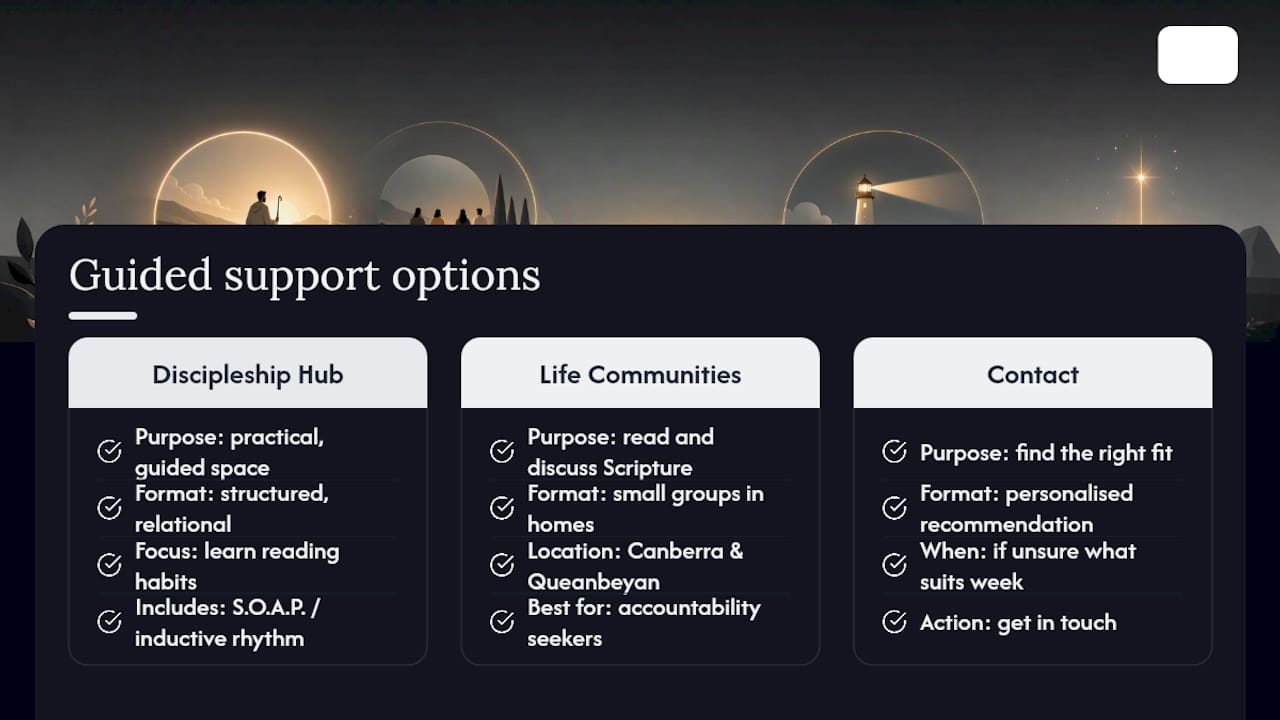
Neither is the only path in. If you want to know what fits your week, get in touch and we’ll point you to the right starting spot.
Sources
Recommended
Comments