
Non-Denominational Church Meaning: What It Is and Isn't

Updated: Nov 12

A non-denominational church is a Christian congregation that has no formal membership of a denomination such as the Anglican, Uniting, Baptist or Catholic churches. In Australia the term generally means the church is either a fully independent congregation or one loosely connected with other churches that hold similar doctrine, according to SBS Cultural Atlas. It does not mean the church has no beliefs, no leaders or no accountability. This guide explains what the label says, what it leaves unsaid, and which questions help you look past it to the church itself.
TL;DR
Non-denominational means no formal denominational affiliation. People in these churches usually call themselves simply Christians, not Lutheran or Anglican.
It describes who a church answers to structurally, not what it believes. Doctrine, worship style and leadership vary widely from one church to the next.
Independent does not mean unaccountable. Churches registered as charities in Australia still sit under the ACNC’s rules, and many independent churches choose to join voluntary networks.
Interdenominational is a different thing: a ministry built with representation from several denominations.
The label tells you less than a conversation with the leaders will. Ask about beliefs, governance, finances and how the church cares for people.
Table of Contents
What “non-denominational” actually means
The word is easiest to read in two halves. A denomination is a recognised family of churches with a shared name, history, doctrine and, usually, some shared structure. Non-denominational simply says: this church is not part of one of those families.
SBS Cultural Atlas notes that members of non-denominational churches typically identify themselves simply as Christians rather than reaching for a denominational label. That is the heart of it. The church places its identity in Jesus and in Scripture, and not in a tradition with a head office.
A few things follow from that:
Local decision-making. The congregation and its leaders usually decide on matters of teaching, staffing, property and mission themselves.
Flexibility. Without a denominational rulebook, a church can adapt its gatherings to its city, whether that is a university precinct, a suburb or a mix of public servants and students.
Variety. Because there is no central body setting a standard, two non-denominational churches can feel very different. One may be quietly traditional, another contemporary and charismatic.
That last point is why the phrase can mislead. It is a statement about structure, not a statement of belief.
A short word on what a denomination is
To see what a church is stepping outside of, it helps to see what a denomination offers. Protestant churches are usually interdependent, working with other churches within their denomination while remaining self-governing. So even inside a denomination, the local church is rarely just a branch office.
Denominations typically provide:
a shared statement of faith or creed
a process for training and recognising ministers
a way to resolve disputes between a church and its leaders
shared resources, camps, missions and sometimes property arrangements
Some movements sit in the middle. The Churches of Christ in Australia, for instance, operate as a federation of autonomous, regionally based conferences in which local churches keep significant independence within a collaborative structure. So the line between “denominational” and “independent” is a spectrum more than a wall.
There is also a curious finding from research in the United States: a study from the Hartford Institute found that 75% of denominational church members do not think of themselves in terms of a denominational identity. It is a 1999 American study, so treat it as a pointer and not a picture of Australia today. Still, it suggests that many people sitting in denominational pews already live much as non-denominational Christians do.
What non-denominational does not mean
It does not mean “no leadership”
The idea that a church without a denomination has nobody in charge is a common misunderstanding. Most Protestant churches have members who act as leaders and coordinators, though structures vary. Some independent churches are led by a board of elders. Others have a senior pastor with an advisory team. Others use a mixture.
If you want to understand the options, our guides to types of church leadership and the role of elders in church walk through how these models work and what Scripture says about them.
It does not mean “no accountability”
In Australia, many churches are registered charities, and the Australian Charities and Not-for-profits Commission (ACNC) explains that Responsible People, generally board or committee members or trustees, govern a charity and make decisions about how it is run.
The ACNC’s Governance Standards ask registered charities to retain their charitable character, operate lawfully, and operate accountably and responsibly. One detail matters for churches in particular: a registered Basic Religious Charity does not need to comply with the Standards. That is a reason to ask a church directly how it governs itself, instead of assuming the regulator does the checking for you.
The ACNC also says it does not set a minimum number of Responsible People, but it considers that more than one generally supports transparency and accountability. A church with a single Responsible Person may need to give further evidence about financial controls, conflicts of interest and related-party remuneration. In plain terms: a healthy church of any label has more than one set of eyes on its decisions and its money.
It does not mean “disconnected”
Many independent churches choose to belong to networks of mutual support. FIEC Australia states that each church in its fellowship governs its own life and doctrine, is primarily responsible for leading its own ministry and mission, and manages its own finances, resources and property. Yet its perspective is that independence should not be confused with isolation: a church can govern itself while still practising interdependence and fellowship with others.
MFI Australasia offers another example. It describes itself as a nondenominational fellowship of ministers, formed to give independent churches accountability, connection and training. The point is not to recommend any one network. It is that “non-denominational” churches and leaders often belong to voluntary relationships, and a good question to put to any church is who its leaders answer to.
Non-denominational vs denominational: a side-by-side view
Question | Denominational church | Non-denominational church |
Formal affiliation | Belongs to a named denomination | None, or only loose ties to like-minded churches |
Who sets doctrine | The denomination’s statement of faith, with local application | The local church and its leaders |
Leadership training | Usually through denominational colleges or processes | Varies: a local pathway, a network or an independent college |
Property and finances | Often shaped by denominational rules | Usually managed by the local church |
Accountability | Built into the denominational structure | Depends on the church’s own board, networks and legal structure |
How members describe themselves | Often by denomination name | Usually simply as Christians |
Neither column is automatically better. A denomination can offer stability, history and a clear process when things go wrong. An independent church can offer nimbleness and a strong local focus. Both can drift from healthy practice, and both can be wonderfully faithful. What matters is the actual church in front of you.
Non-denominational vs interdenominational
These two words sound alike, and people often swap them. They describe different things. One explanation puts it this way: a non-denominational ministry has no relationship or regard for denominationalism, whereas an inter-denominational ministry is set up with equitable representation of all the denominations that support it.
In practice, a campus Christian group or a community outreach run jointly by Anglican, Baptist and Pentecostal churches would be interdenominational. A single congregation that meets under its own name with no denominational parent would be non-denominational.

What do non-denominational Christians believe?
There is no single answer, because there is no single governing body. Most non-denominational churches in Australia hold to historic, mainstream Christian beliefs: one God in three persons, the authority of Scripture, salvation through Jesus Christ, and the call to follow him in daily life. Some are charismatic and expect the gifts of the Spirit in their gatherings. Others are more reserved in style. If you want to understand one of those streams, our piece on what it does and doesn’t mean to be a Pentecostal church is a good place to begin.
The only reliable way to know is to read a church’s published statement of faith and then ask questions. Here are the ones worth asking.
Questions to ask any church
What do you believe about Jesus, Scripture and salvation? Look for clear, unembarrassed answers.
Who leads this church, and who do those leaders answer to? You want to hear about a board, a team or a wider network, not a single unchecked voice.
How is money handled and reported? Healthy churches are open about this. Our reflection on generosity in church explains why giving is meant to be free and willing, not pressured.
How do you care for people in difficulty? Ask about pastoral care, safeguarding and how concerns are raised.
How can I take part without being put on the spot? A good church lets you watch, ask and come at your own pace.
If you are weighing up a church as a place to belong and not just to attend, you may also find it helpful to read about finding a Christian accountability partner, because lasting faith is rarely lived alone.
Why people choose non-denominational churches
People arrive at these churches by different roads. Some grew up in a denomination and left after a disappointing season. Others have never been to church and want a place with no assumed background. Others are simply new to a city and found a congregation near their work or study.
An Australian academic paper on relational authenticity observes that independent community churches have arisen amid declining church numbers, as people seek safe spaces for authentic relationships and faith beyond imposed metanarratives. That matches what many readers tell us: they are not hunting for a brand, they are hoping for honest community and room to ask real questions.
There are honest cautions, too:
Less external oversight. Without a denominational body, the quality of governance rests heavily on the local leaders. Ask the governance questions above.
Variable training. Pastors may have formal theological education or they may not. It is fair to ask.
Theological drift. With no central creed, a church’s teaching can shift over time. A published statement of faith is a good anchor.
None of these are reasons to avoid independent churches. They are reasons to look closely, as you would with any community you are about to give your time and trust to.
Our perspective
We understand why the label draws attention. People are tired of boxes. But we have found that “non-denominational” answers only one question, which is about structure. It does not tell you whether a church is hospitable, whether its teaching is rooted in Scripture, or whether its leaders are humble and accountable.
At Divergent Church in Canberra we are committed to forming disciples of Jesus and to building authentic, missional community in the life of the city. That is what we would put first when anyone asks what we are about: Scripture, Jesus at the centre, and a life that is lived out on Monday as much as on Sunday. Canberra is a city of universities, workplaces, neighbourhoods and people who are here for a season. A church in that setting has to be relational and welcoming of the stranger, or it is not much of a church at all.
So when you visit any church, ours or another, we would encourage you to weigh three things above the label:
The Jesus it presents. Is he at the centre, or is he a footnote to a programme?
The people it forms. Do they grow in love, honesty and service?
The way it is led. Are decisions made openly, with more than one voice and clear accountability? You can read how we approach this on our governance page.
The apostle Paul reminds the Corinthians that one plants, another waters, but God gives the growth. We take that as a call to humility. No church, whatever its name, is the whole body. Each is one part of the bride that Christ is beautifying, and we would rather be known for faithfulness than for a tag.
— Jay
Visiting a church for the first time
If you have never been to church, the unknown can feel bigger than it is. A few practical thoughts apply to almost any congregation, denominational or not:
You can simply walk in. Most churches expect first-time visitors and are glad to see them. You are not obliged to speak to anyone or to give anything.
Arrive a few minutes early. It lets you find a seat, see how the room works and say hello if you wish.
Expect singing, a message from the Bible and some prayer. The style varies, but these are the common ingredients.
Ask your questions afterwards. Churches that welcome honest doubt are usually the healthiest ones.
Look at the wider life of the church. Is there something beyond Sunday, such as small groups, service in the city or ways to belong during the week? Our guide to volunteering at church in Canberra shows what that can look like.
A church that cares for people also cares about the whole person. We have written about how Canberra churches can support young people’s wellbeing in youth mental health and ACT rules, which is the kind of practical question worth asking wherever you go.
Spaces for gathering in the city
Part of being a church in the middle of Canberra is sharing the space we have. Our rooms are available to community groups, studies, meetings and events. The rates we publish are $70 per hour for the Auditorium, $50 per hour for the Seminar Room and $25 per hour for the Board Room. You can see each room and book through our online booking page, or explore our Function & Events Centre in Canberra City if you are planning something larger.
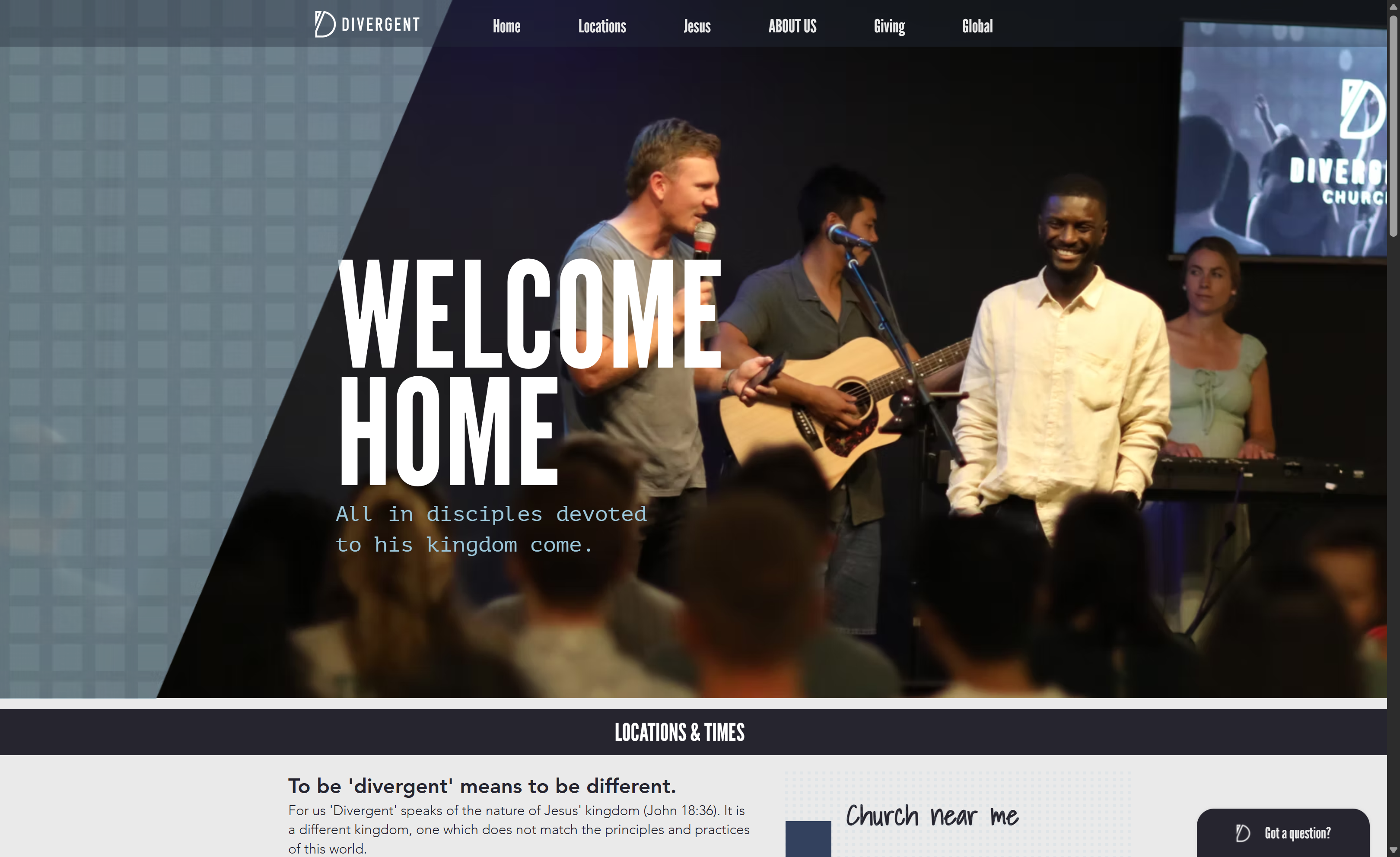
If you would simply like to meet us, to ask a question about faith or to see what a Sunday looks like, start from our home page. Nobody will put you on the spot.
Frequently asked questions
What is a non-denominational church?
It is a Christian church with no formal ties to a denomination such as the Anglican, Baptist or Uniting churches. In Australia it may be a fully independent congregation or one loosely connected with churches of similar doctrine. Members usually describe themselves simply as Christians.
Is a non-denominational church the same as an interdenominational one?
No. A non-denominational ministry stands apart from denominational structures altogether, while an interdenominational ministry is formed with representation from the denominations that support it. One is independent. The other is a partnership across traditions.
Does non-denominational mean there are no rules or leaders?
No. Non-denominational churches usually have leaders, and many are registered charities with Responsible People who govern the organisation. Some also join voluntary fellowships, such as FIEC Australia, for connection and accountability. Ask any church how its leaders are held accountable.
What is the difference between non-denominational and denominational churches?
A denominational church belongs to a recognised family of churches with shared doctrine and structures. A non-denominational church makes those decisions locally. Some groups fall between the two: the Churches of Christ in Australia, for example, are a federation of autonomous conferences.
Can I just turn up to a non-denominational church?
Yes, in nearly every case. Visitors are normal and welcome, and you do not have to speak or give anything. If you want to know more first, send the church a message and ask what a typical gathering involves.
Sources
Recommended
Comments