
Practical church service tips for leaders and volunteers

Updated: Sep 21

Practical church service tips are actionable strategies that improve the flow, timing, and engagement of worship gatherings. A well-run service is not an accident. It is the fruit of deliberate preparation, clear communication, and a team that understands its role. Whether you lead worship, coordinate volunteers, or preach, the quality of your preparation shapes the congregation’s capacity to encounter God. Divergentchurch, rooted in Canberra’s rhythms of university life, workplaces, and neighbourhoods, has found that the most Spirit-led gatherings are also the most carefully prepared ones.
1. Practical church service tips: start with a clear timing framework
Service timing is the backbone of a well-ordered gathering. A 75-minute service typically allocates 3–5 minutes for welcome, 15–20 minutes for worship, 3–5 minutes for offering, 25–40 minutes for the sermon, 5–10 minutes for communion, and 5–7 minutes for a closing song and benediction. That structure gives every element its proper weight without one segment cannibalising another.
Build a 5–10 minute buffer into your schedule. Overruns happen, and a buffer lets your team absorb them without visible panic or rushed endings.
Assign one person as the dedicated timekeeper for every service.
Use agreed hand signals or earpiece cues to alert the speaker when time is running short.
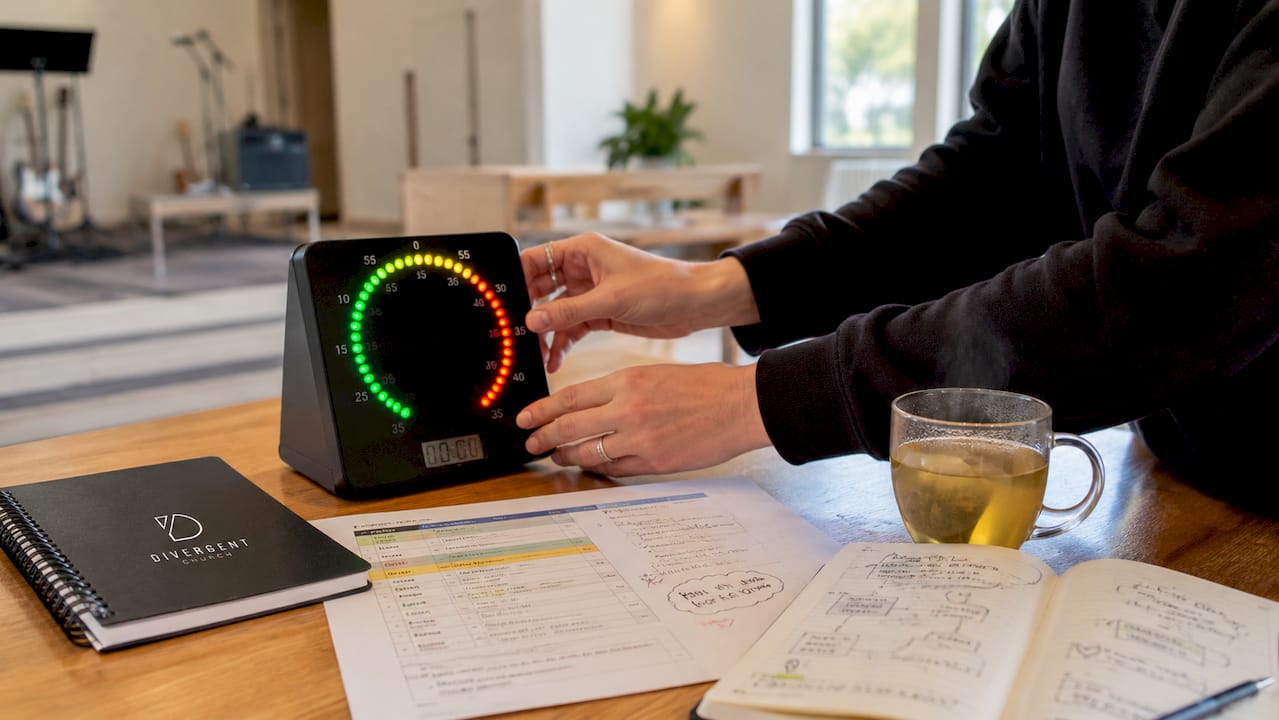
Place a countdown timer at the front of house, visible to stage leaders but concealed from the congregation.
Pro Tip: Use a colour-coded timer system: green means on track, yellow means tighten up, and red means wrap now. This keeps the speaker informed without interrupting the flow.
2. Send the worship setlist at least three days before rehearsal
Rehearsal time is precious. Sending the setlist at least three days before rehearsal means volunteers arrive knowing their parts. That shifts the rehearsal from a learning session into a refining session, which is where real worship preparation happens.
Include keys, tempos, and reference tracks in every setlist you send. When musicians can listen and practise at home, they arrive confident. Confidence in the room frees the team to focus on feel, dynamics, and the spiritual arc of the set rather than scrambling to remember chord changes.
Pro Tip: Create a shared digital folder for each service week. Drop the setlist, chord charts, and reference tracks in one place so every volunteer can access everything without chasing you for files.
3. Prioritise the hardest songs first in rehearsal
Energy is highest at the start of rehearsal. Use that window to tackle difficult songs while the team is fresh and focused. Leaving complex arrangements until the end of a two-hour rehearsal guarantees sloppy execution and frustrated volunteers.
Once the hard material is covered, move to run-throughs of the full set in order. This is where you listen for the emotional arc, the dynamic shifts, and the moments of congregational invitation. A set that sounds technically correct but emotionally flat will not carry people into genuine worship.
4. Build your worship set around a clear thematic arc
A worship set is not a playlist. Planning with 10–16 song options and narrowing to 3–5 songs that build toward a God-centred, climactic moment creates genuine flow and congregational engagement. Use a simple 1–5 energy scale to map the emotional arc from call to worship through to corporate celebration.
Thematic coherence matters as much as musical quality. When the opening song, the sermon passage, and the closing response all speak to the same truth, the congregation experiences the service as a unified encounter rather than a series of disconnected segments. Embed a central motif throughout prayers, songs, and reflections to create a coherent worship experience.
5. Audit your songs for biblical clarity and singability
Not every song that is popular belongs in your service. Song audits that test for biblical clarity, singability, and congregational connection keep your worship theologically grounded and accessible. A song that requires a trained vocalist to navigate is not a congregational song. It is a performance.
Study the theology of every song you introduce. Connect its lyrics explicitly to scripture so you can teach the congregation what they are singing and why it matters. This practice deepens worship authenticity and prevents the gradual drift toward songs that sound spiritual but say very little.
6. Define and rehearse every transition
Transitions between service segments are one of the top factors impacting service quality and congregational engagement. Most teams rehearse songs but neglect the moments between them. That is where services fall apart.
“Technical friction during transitions, such as unmuted microphones or dead air, is the primary cause of service disengagement. Assigning and rehearsing transition responsibilities specifically is the most direct remedy.”
Define every transition in your service order. Assign ownership to a named person, whether that is the worship leader, the tech director, or a stage manager. Then rehearse those transitions as deliberately as you rehearse songs. A congregation that experiences a smooth, unhurried move from worship into the Word is far more ready to receive what comes next.
7. Use clear communication protocols across your teams
Coordinated cues between tech, worship, and pastoral teams prevent the technical distractions that break congregational focus. Agreed language like “standby lighting” and “go lights” removes ambiguity and keeps everyone moving together. Without this, each team operates on its own assumptions, and the gaps show.
Hold a brief pre-service huddle with all team leads. Five minutes of aligned expectations prevents thirty minutes of visible confusion. This is servant leadership in practice: you serve the congregation by serving your team well before the service begins.
Pro Tip: Use a shared communication app or in-ear monitor system so tech, worship, and pastoral teams can speak in real time without walking across the stage mid-service.
8. Design your physical environment with intention
Soft, warm lighting fosters contemplation and signals to the congregation that this is a space set apart for something meaningful. Harsh fluorescent lighting communicates function, not worship. The physical environment shapes the congregation’s posture before a single word is spoken.
Seating arrangement carries equal weight. Semicircle or arc configurations encourage eye contact and a sense of community, which matters particularly in diverse congregations. Lighting and seating signal hospitality and inclusiveness, and that welcome is felt before the worship leader steps onto the stage.
Arrive early enough to adjust lighting before the congregation enters.
Check that all screens, microphones, and instruments are tested and ready 30 minutes before the service.
Prepare a contingency plan for technology failure: know which elements can continue without amplification or projection.
9. Balance familiar and fresh worship elements
Congregations need the comfort of familiar songs to sing with confidence and the renewal of fresh material to grow. A set that is entirely new creates anxiety. A set that never changes creates passivity. The balance is intentional, not accidental.
Introduce one new song per month at most, and teach it explicitly before using it in a full worship set. Play it during pre-service music, explain its biblical basis from the front, and give the congregation time to learn it before asking them to sing it in worship. This approach respects the congregation’s role as participants, not spectators. For more on engaging diverse congregations, the principle of accessibility applies directly to song selection.
10. Shepherd your volunteer team, not just the service
The worship leader’s role is shepherding rather than personal expression. A team that feels seen, prepared, and valued will serve with greater freedom and faithfulness. Soliciting feedback from trusted volunteers after each service prevents blind spots and builds a culture of honest, growth-oriented reflection.
Church volunteers carry the service in ways that leaders often do not see: the sound technician who catches a feedback loop before it hits, the usher who spots a visitor and makes them feel at home, the musician who holds the tempo steady when the worship leader loses the beat. Invest in these people. Their preparation is your preparation. You can also structure volunteer registration to make onboarding and scheduling far less burdensome for your team.
Key takeaways
Effective church service planning requires timing discipline, rehearsal preparation, and deliberate transition management working together as a unified system.
Point | Details |
Timing framework | Use a 75-minute structure with a 5–10 minute buffer and a colour-coded countdown timer. |
Rehearsal preparation | Send setlists with keys, tempos, and reference tracks at least three days before rehearsal. |
Transition ownership | Assign and rehearse every transition specifically, not just the songs surrounding it. |
Environment design | Use warm lighting and arc seating to signal welcome and foster congregational focus. |
Team shepherding | Invest in volunteers through feedback, clear communication, and pre-service huddles. |
What I have learned about preparation and the Spirit
There is a tension that every church leader feels: the desire to leave room for the Spirit and the responsibility to prepare well. I used to think these were in opposition. Experience has taught me they are not.
The most Spirit-filled services I have been part of were also the most carefully prepared. When the team knows the plan, they can respond to the unexpected without panic. When transitions are rehearsed, the congregation stays present rather than watching the team scramble. Preparation is not a cage for the Spirit. It is the ground from which genuine worship grows.
The role of leadership in church is ultimately about creating conditions for others to encounter God. That means doing the unglamorous work: sending the setlist on Thursday, running the transition twice in rehearsal, checking the lighting before anyone arrives. These acts of faithfulness are seeds planted in the soil of the gathering. You may not see them bear fruit in the moment, but the congregation feels them.
Prioritise communication above all else. A team that communicates well before the service runs well during it. And a service that runs well creates space for the Word to land, for worship to rise, and for the kingdom to be made visible in Canberra and beyond.
— Josh
Divergentchurch resources for your church service planning
Building a well-ordered, Spirit-led service takes more than tips. It takes a community of leaders who are growing together in faith and skill.
Divergentchurch has developed resources specifically for church leaders and volunteers who want to deepen their preparation and lead with greater confidence. The Discipleship Hub brings together leadership development tools, practical church planning guides, and discipleship frameworks grounded in Scripture. For those called to lead teams and shape gatherings, the Lead Like Jesus programme offers a formation pathway built on the servant leadership model of Jesus himself. These resources are designed for the Canberra context but carry principles that apply wherever you gather.
FAQ
How long should a typical church service run?
A well-structured church service runs approximately 75 minutes, with a 5–10 minute buffer built in to manage overruns without disrupting the congregation.
How far in advance should I send the worship setlist?
Send the worship setlist at least three days before rehearsal, including keys, tempos, and reference tracks, so volunteers arrive prepared rather than learning parts on the day.
What is the most common cause of service disengagement?
Technical friction during transitions, such as dead air or unmuted microphones, is the primary cause of congregational disengagement and is best addressed by assigning and rehearsing transition responsibilities specifically.
How do I balance familiar and new songs in a worship set?
Introduce no more than one new song per month, teach it explicitly before using it in a full worship set, and always anchor new material alongside familiar songs the congregation can sing with confidence.
How can I improve communication between tech, worship, and pastoral teams?
Hold a five-minute pre-service huddle with all team leads, use agreed cue language, and consider a shared communication system so every team moves together without visible confusion during the service.
Recommended
Comments