
Role of forgiveness in church: what Christians need to know

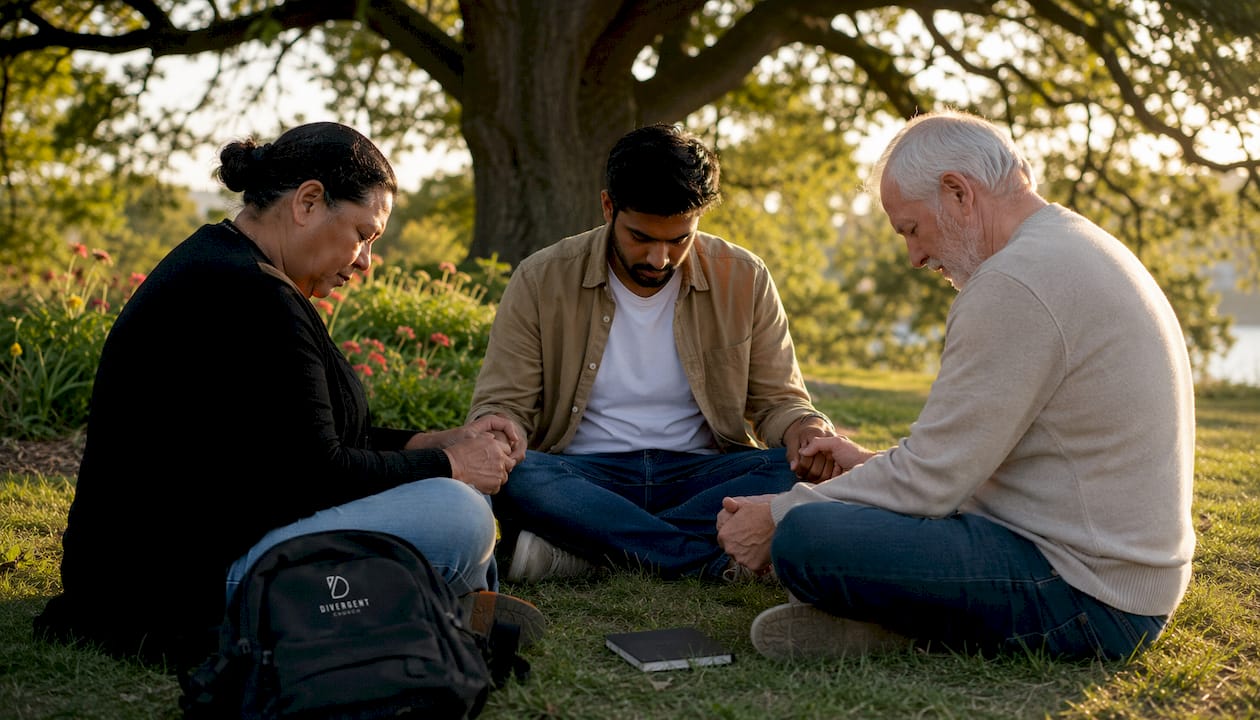
Forgiveness is the church’s central practice of mercy. It restores broken relationships, witnesses the gospel of grace to a watching world, and frees believers from the corrosive weight of resentment. The role of forgiveness in church life is not peripheral — it is woven into the very fabric of what it means to follow Jesus together.
Forgiveness is both a gift received from God and a command extended to others (Ephesians 4:32).
Unresolved bitterness fractures congregations, undermines discipleship, and weakens the church’s witness to the kingdom.
Forgiveness and reconciliation are related but distinct: you can extend forgiveness even when reconciliation is not safe or possible.
Safeguarding always comes first: forgiveness must never be used to silence survivors or bypass justice.
Your next step: If a broken relationship is weighing on you, bring it to God in prayer today and consider speaking with a pastor or trusted leader about a path forward.
Table of Contents
What does the Bible say about forgiveness in church?
Scripture does not treat forgiveness as optional. From the Psalms to the letters of Paul, the call to forgive is grounded in what God has already done for us in Christ. The Greek word aphiemi, often translated “forgive,” carries the sense of letting go — releasing a debt, a grievance, or a claim. That image shapes everything the New Testament says about how believers treat one another.
Passage | Context | What it teaches the church |
Matthew 6:14–15 | The Lord’s Prayer | Our willingness to forgive others is connected to our experience of God’s forgiveness |
Matthew 18:15–17 | Church discipline | A structured, relational process for addressing sin and pursuing restoration |
Luke 17:3–4 | Repeated offences | Forgiveness is to be extended even when someone wrongs you multiple times |
Colossians 3:13 | New life in Christ | “Bear with each other and forgive one another … as the Lord forgave you, so also forgive” |
Ephesians 4:31–32 | Community life | Put away bitterness; be kind, compassionate, forgiving one another |
Psalm 103:12 | God’s character | God removes our sins “as far as the east is from the west” — the model for our own release |
1 Corinthians 13:5 | Love in community | Love “keeps no record of wrongs” — forgiveness is the practical expression of love |
Matthew 6:14–15 is often the passage that unsettles people most. Jesus links our forgiveness of others to God’s forgiveness of us — not as a transaction, but as evidence that we have truly received grace. BibleProject’s reading of this passage notes that Jesus is describing the posture of a heart genuinely transformed by mercy, not a works-based condition for salvation.
Taken together, these passages paint a consistent picture: forgiveness in the church is grace in motion. It flows from what God has done, it shapes how believers relate to one another, and it refuses to let resentment have the final word.
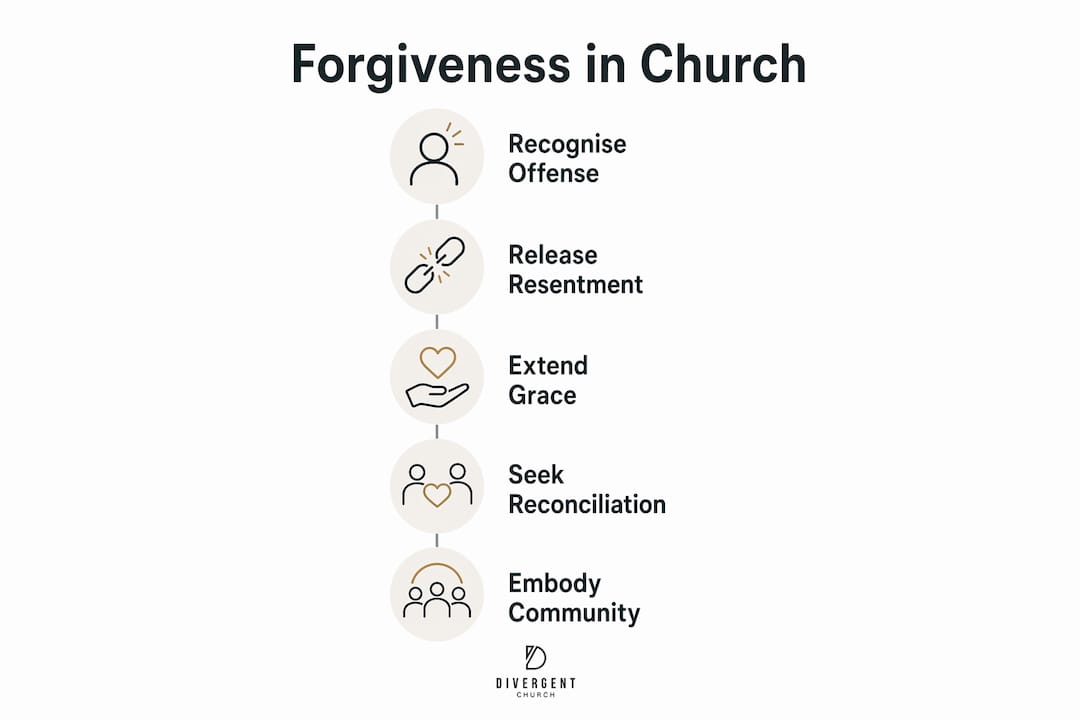
Forgiveness versus reconciliation: why the difference matters
One of the most pastorally important distinctions in forgiveness teachings in church is the difference between forgiving someone and reconciling with them. Conflating the two causes real harm, particularly for people who have been seriously hurt.
Forgiveness and reconciliation are distinct: forgiveness is an internal release of resentment, a decision to no longer hold a debt against someone. Reconciliation is the mutual restoration of a relationship, and it typically requires repentance, changed behaviour, and rebuilt trust. You can extend forgiveness unilaterally. Reconciliation takes two.
Dimension | Forgiveness | Reconciliation |
Definition | Internal release of resentment and the debt owed | Mutual restoration of relationship and trust |
Prerequisites | A decision of the will, empowered by the Spirit | Repentance, accountability, and changed behaviour |
Goal | Freedom from bitterness; honouring God’s command | Restored relationship and renewed community |
Timeframe | Can begin immediately; deepens over time | Often a longer process requiring demonstrated change |
Can it be one-sided? | Yes — Christians are called to extend it even when the other party is absent or unrepentant | No — it requires genuine participation from both parties |
Christians are called to extend forgiveness even when reconciliation is not safe or possible. A survivor of abuse, for example, may genuinely forgive their abuser before God while maintaining firm boundaries and never resuming contact. That is not a failure of forgiveness. It is wisdom.
Forgiveness frees the one who forgives; it does not automatically restore the relationship.
Reconciliation should never be pressured before repentance and safety are established.
Leaders should be careful not to frame a survivor’s reluctance to reconcile as spiritual immaturity.
Pastoral accompaniment helps people distinguish between the two and move at a healthy pace.
Why forgiveness shapes the health of your whole congregation
Forgiveness is not just a personal spiritual discipline. It is the connective tissue of healthy church community. When it is practised well, congregations become places of genuine safety, honest accountability, and credible witness. When it is absent, bitterness takes root and spreads.

The theological framing offered by Miroslav Volf is worth sitting with here. Volf describes forgiveness as condemning the fault but sparing the doer — a posture that refuses to collapse a person into their worst act while still naming the wrong clearly. The church, on this reading, becomes an “imagined community” where costly forgiveness is itself a public witness to the gospel. A congregation that forgives well is not just healthier internally; it is proclaiming something about the kingdom of God to the city around it.
Research links unforgiveness to higher physiological stress responses, including elevated cortisol, disrupted sleep, and increased risk of depression. The spiritual and the physical are not separate here. A congregation shaped by forgiveness is one where people can genuinely heal.
Practically, this plays out in several ways. Restored relationships after conflict make congregations safer and more honest. Pastoral care improves when leaders model vulnerability and repentance. Church unity in Canberra and elsewhere depends on communities that have learned to address grievance without fracturing. And the church’s mission impact is amplified when the watching world sees disciples who actually love one another through difficulty.
Pro Tip: If your congregation is navigating a significant conflict, consider inviting a trusted external pastor or mediator to facilitate early conversations — an outside voice reduces the risk of entrenched positions and helps both parties feel heard.
How to practise forgiveness: steps for individuals and churches

Forgiveness is a process, not a single event. Pastoral guidance and restorative practices often take considerable time and preparation. The steps below are a framework, not a formula.
For individuals
Acknowledge the hurt honestly. Minimising what happened does not help. Name the wrong clearly before God, without exaggeration or self-justification.
Bring it to prayer. Ask the Spirit to give you what you cannot manufacture on your own. Forgiveness is a gift of God; believers draw capacity to forgive from being forgiven by Christ.
Make a decision of the will. Forgiveness begins as a choice before it becomes a feeling. Commit to releasing the debt, even if the emotion follows slowly.
Seek a trusted conversation. Where it is safe and appropriate, speak with the person who hurt you, or with a pastor or counsellor who can help you prepare.
Establish boundaries where needed. Forgiveness does not require you to place yourself back in harm’s way. Healthy limits protect both parties.
Revisit and renew. Forgiveness often needs to be re-chosen as memories resurface. This is normal, not failure.
For congregations
Corporate forgiveness requires structure and pastoral leadership. A restorative process typically moves through these stages:
Stage | Who is involved | Typical actions |
Acknowledgement | Affected parties, pastoral leader | Name the harm; create a safe space for truth-telling |
Accountability | Offending party, church leadership | Honest admission of wrong; no minimising or deflecting |
Apology and reparation | Offending party | Genuine apology; practical steps to address harm where possible |
Accompaniment | Pastoral team, trusted community | Ongoing support for both parties through the process |
Restoration | Both parties, community | Gradual re-integration where safe; renewed relationship or clear boundaries |
Restorative justice practices fit naturally with Christian forgiveness: hearing stories, accountability, apology, reparation and mutual restoration are often necessary for deep healing. Churches that skip straight to “restoration” without the earlier stages tend to paper over wounds rather than heal them.
Corporate practices worth building into church life include confession liturgies in worship, small-group accountability structures, and regular pastoral check-ins for people navigating conflict. The power of church community is most visible precisely when it holds people through the hard work of forgiveness.
Pro Tip: Pastors, pace the process. Expecting a congregation to move from acknowledgement to restoration in a single meeting is both unrealistic and harmful. Allow weeks or months between stages, and check in privately with each party before moving forward.
Pastoral cautions: justice, safety and responding to abuse
Forgiveness must never become a tool for silencing survivors or protecting perpetrators. This is one of the most urgent pastoral cautions in the church’s forgiveness teachings, and it cannot be stated too plainly.
Pastoral experts warn that unbalanced teaching on forgiveness can create destructive expectations for survivors. When a church prioritises reconciliation over safety, or pressures a victim to forgive quickly so that community harmony can be restored, it causes compounding harm. Good pastoral practice links forgiveness teaching with justice and genuine survivor support.
Practical guidelines for ministers and lay leaders:
Never pressure a survivor to forgive on a timeline set by others. Forgiveness is between them and God; the pace is theirs.
Safeguarding comes before reconciliation. If someone is at risk of ongoing harm, the immediate priority is safety, not relational restoration.
Involve statutory authorities when required. In Australia, mandatory reporting obligations apply to certain categories of harm involving children and vulnerable adults. If you are unsure of your obligations, contact your state’s child protection authority or seek legal advice.
Refer to professional support. Pastoral care is not a substitute for counselling, legal advice, or police involvement where these are warranted. Pastoral counselling can be a valuable complement to professional support, particularly in relational and marriage crises.
Do not conflate institutional reputation with gospel witness. Covering up harm to protect a church’s image is the opposite of the gospel.
Cheap or pressured forgiveness is harmful. Bonhoeffer’s critique of cheap grace applies directly here: offering forgiveness without repentance, accountability, or discipline is not mercy. It is a failure of love toward both the survivor and the offender.
This article provides general pastoral and theological information, not legal or professional advice. For your specific situation, please consult a qualified counsellor, legal professional, or your state’s relevant statutory authority.
Christ, mercy and the church’s witness: a theological frame
The capacity to forgive does not originate in human willpower. That is one of the most liberating truths in the whole of Christian theology. Forgiveness is a gift of God, made possible by the cross of Christ and sustained by the ongoing work of the Holy Spirit in the believer’s life.
“We love because he first loved us.” — 1 John 4:19
The same logic applies to forgiveness. We forgive because we have been forgiven. The cross is not merely the inspiration for our forgiveness; it is its source. As 1517’s Christocentric framing puts it, believers draw their capacity to forgive from being forgiven by Christ and empowered by the Spirit — not from moral effort alone.
Miroslav Volf, Desmond Tutu, and Dietrich Bonhoeffer each approached forgiveness from different contexts — post-war Europe, post-apartheid South Africa, and the theology of grace — yet they converge on a shared conviction: forgiveness is costly, it is communal, and it is a form of witness. Tutu’s work with the Truth and Reconciliation Commission demonstrated that truth-telling and forgiveness can coexist, and that genuine healing requires both. Volf’s Exclusion and Embrace remains one of the most theologically rigorous treatments of forgiveness as public witness available to the church today.
For pastors, this theological grounding shapes everything: it means patience with the pace of repentance, humility about the limits of discipline, and confidence that the Spirit is at work even when the process is slow. The church does not manufacture forgiveness. It creates the conditions for the Spirit to do what only the Spirit can.
Australian resources and how Divergentchurch can help
If you are navigating forgiveness in your own life or congregation, you do not have to work through it alone. There are real, local resources available to you.
Divergentchurch resources:
Discipleship Hub — structured pathways for spiritual formation, including study on grace, mercy and community life.
Life Communities — small groups in Canberra and Port Macquarie where forgiveness, accountability and belonging are practised in everyday relationships.
Life Community Resources — study guides and pastoral support materials for group leaders working through forgiveness and reconciliation topics.
Next Steps — the practical starting point for connecting with a pastor, joining a group, or getting support.
Can I come back to church? — a pastoral guide for those who have been hurt and are wondering whether there is a way back.
Australian support bodies:
Safe Ministry Australia — training and safeguarding resources for churches across Australia.
Blue Knot Foundation — specialist support for adult survivors of complex trauma, including church-related harm (blueknot.org.au).
1800RESPECT — national counselling and support for those experiencing family, domestic, or sexual violence (1800respect.org.au).
Australian Christian Churches and Anglican Church of Australia both publish safeguarding frameworks and mandatory reporting guidance for church leaders.
For unresolved resentment in marriage or close relationships, faith-based counselling services can provide structured, biblically informed support.
Suggested small-group study passages: Matthew 18:15–35 (the parable of the unmerciful servant), Luke 15 (the prodigal son), Colossians 3:12–17, and Ephesians 4:25–32.
Key takeaways
Forgiveness in the church is a Spirit-empowered practice of releasing resentment, rooted in the cross of Christ, that heals individuals, restores community, and witnesses the gospel to the world.
Point | Details |
Forgiveness is commanded and empowered | Scripture calls believers to forgive as God forgave them; the Spirit provides what willpower alone cannot. |
Forgiveness and reconciliation are not the same | You can extend forgiveness unilaterally; reconciliation requires repentance and safety from both parties. |
Unforgiveness harms the whole congregation | Bitterness fractures community, weakens witness, and research links it to measurable physiological stress responses. |
Safeguarding must come before reconciliation | Never pressure survivors to forgive on a timeline; involve statutory authorities and professional support where needed. |
Divergentchurch offers pastoral support | Life Communities, the Discipleship Hub, and pastoral care at Divergentchurch provide structured, biblically grounded help for those navigating forgiveness. |
A pastor’s note
Forgiveness is one of the most beautiful and one of the most difficult things the gospel asks of us. It is beautiful because it reflects the very heart of God — a God who, at great cost to himself, chose mercy over condemnation. It is difficult because the wounds that require forgiveness are often real, deep, and slow to heal.
What I want you to know is this: you are not expected to manufacture forgiveness on your own. The Spirit of God is at work in you, and the community of faith is meant to walk alongside you. Whether you are carrying a grievance that has been with you for years, or you are a leader trying to shepherd a congregation through a painful conflict, there is a path forward. It is not always quick. It is not always tidy. But it is real, and it is possible.
If you are in Canberra or Port Macquarie and you need someone to talk to, our pastoral team at Divergentchurch would love to hear from you. You are welcome here, exactly as you are.
Divergentchurch: a community shaped by grace
Forgiveness is not just a topic we write about at Divergentchurch. It is something we are learning to live together, in Life Communities across Canberra and Port Macquarie, in discipleship relationships, and in the everyday rhythms of a church shaped by Scripture and centred on Jesus.
If you are ready to go deeper, the Discipleship Hub offers structured pathways for spiritual formation that include grace, mercy, and community life. If you want to work through forgiveness in the context of a small group, our Life Communities are the place to start. And if you simply need to talk with someone, our Next Steps page will connect you with a pastor or a community that can walk with you.
You do not have to carry this alone. Come and see what it looks like to be a people shaped by the forgiveness of Jesus.
Useful sources and further reading
Scripture references used in this article:
Matthew 6:14–15; Matthew 18:15–17; Luke 17:3–4
Colossians 3:12–13; Ephesians 4:31–32
Psalm 103:12; 1 Corinthians 13:5; 1 John 4:19
Theological and pastoral reading:
Resource | Author / Body | Why it is useful |
Exclusion and Embrace | Miroslav Volf | Rigorous theological treatment of forgiveness as public witness |
The Cost of Discipleship | Dietrich Bonhoeffer | Foundational critique of cheap grace and pressured forgiveness |
No Future Without Forgiveness | Desmond Tutu | Truth and reconciliation in practice; forgiveness alongside justice |
Common Questions Christians Ask About Forgiveness | The Gospel Coalition | Accessible pastoral Q&A on biblical forgiveness |
Can Forgiveness Help Heal a Hurting Church? | Homiletic & Pastoral Review | Restorative justice and church healing processes |
Forgiveness and Reconciliation After Abuse | Anglican Church in Europe | Safeguarding-informed pastoral guidance |
Australian support and safeguarding:
Blue Knot Foundation: blueknot.org.au
1800RESPECT: 1800respect.org.au
Safe Ministry Australia: safeministry.com.au
Divergentchurch pastoral support and Life Communities
Recommended
Comments