
Role of testimony in church: a guide for leaders

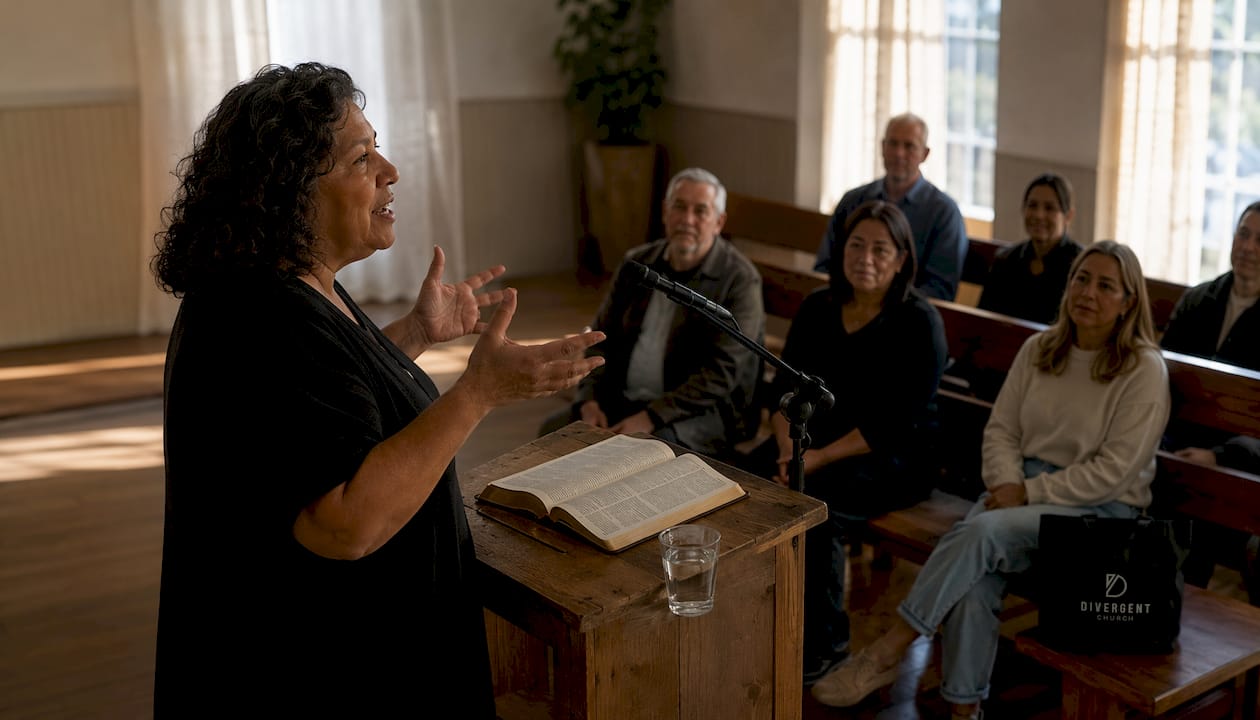
Personal testimony in church publicly worships God, builds the congregation’s faith, and opens a door for those who don’t yet know Jesus. That is the whole shape of it, held in three directions:
Up — testimony worships God by recounting His faithfulness, naming what He has done in a specific life.
In — testimony builds the body, strengthening the faith of every person listening and deepening the bonds of community.
Out — testimony witnesses to those outside the faith, offering a relational and personal invitation into the gospel story.
Every testimony, however brief or unpolished, should point back to Christ and Scripture. The story is never ultimately about the teller.
Table of Contents
What does Scripture say about testimony?
The practice of public testimony is not a modern invention or a cultural add-on. It runs through the bones of both Testaments. In Hebrew, the word 'edut (עֵדוּת) carries the sense of a solemn witness or declaration, often tied to the act of remembering and proclaiming what God has done. The Psalms are saturated with it. Psalm 78 opens with a deliberate call to tell the next generation “the praiseworthy deeds of the Lord, his power, and the wonders he has done” (Psalm 78:4). That is testimony as communal spiritual memory, passed down through generations so that faith does not evaporate with the people who first experienced it.
In the New Testament, the Greek word martyria (μαρτυρία) means witness or testimony, and it carries weight. The apostles are repeatedly described as martyres, witnesses, not because they had an opinion about Jesus but because they had seen, heard, and touched the risen Lord. First John 1:1–4 is perhaps the most concentrated expression of this:
“That which was from the beginning, which we have heard, which we have seen with our eyes, which we have looked at and our hands have touched — this we proclaim concerning the Word of life.” (1 John 1:1)
John is not writing theology in the abstract. He is testifying. The proclamation flows from encounter, and the purpose is explicitly communal: “so that you also may have fellowship with us” (1 John 1:3). Testimony, in John’s framing, is the mechanism by which lived experience and written Word are joined, and by which community is formed around that shared encounter with Christ.
Acts uses martyria language throughout to describe the apostolic mission. When Paul stands before King Agrippa in Acts 26, he does not deliver a philosophical argument. He tells his story — his life before, the blinding light on the Damascus road, the commission he received. The result? Agrippa says, “Almost thou persuadest me to be a Christian” (Acts 26:28). Personal witness grounded in biblical testimony has always been one of the primary instruments through which the gospel moves from one heart to another.
Why does testimony matter for individuals and the church?
The benefits of testimony are not merely emotional or relational. They are formative, missional, and deeply practical. Here is how they play out across three levels.

For the individual sharing
Speaking a testimony forces a kind of spiritual clarity that private reflection rarely produces. When you articulate what God has done, you are required to decide what you actually believe. Research into testimony practice confirms that bearing testimony is formative, not merely declarative — the act of speaking deepens conviction and strengthens spiritual habit. Testimony is not a static recital of a conversion moment. It is an ongoing, active discipline that grows as people practise it.
Clarifies personal belief and theological understanding.
Builds resilience by rehearsing God’s faithfulness in past seasons.
Develops confidence in articulating faith to others outside the church.
For the congregation
When personal stories are shared with care and structure, they create common ground and convert familiar strangers into genuinely connected members. Narrative theology links story-sharing directly to community development. A congregation that hears one another’s stories builds cultural memory — a shared sense of what God has been doing among them — and that memory becomes a resource for discipleship and encouragement in hard seasons.
Encourages those whose faith is struggling by showing God at work in ordinary lives.
Builds trust and vulnerability across generational and cultural lines.
Creates a discipleship catalyst: listeners are often moved to reflect on their own story.
For those outside the faith
In post-modern contexts, personal stories open doors that formal truth claims sometimes cannot. People who are sceptical of institutional religion are often genuinely curious about a neighbour’s lived experience. Testimony sidesteps defensive barriers and creates relational interest in faith. This is why testimony is one of the most effective tools in a missional church framework — it is evangelism that does not feel like a sales pitch.
Where does testimony fit in church life?
Testimony belongs in more places than most leaders realise. The format and tone shift depending on the setting, but the function remains consistent.

Corporate worship services. A brief, structured testimony (90 seconds to two minutes) can be woven into a Sunday gathering before or after a sermon series theme. It grounds abstract doctrine in a real life and prepares the congregation to receive the Word with expectation.
Baptism services. The baptism testimony is perhaps the most natural and theologically rich form of public witness. The candidate narrates their journey to faith, and the gathered church celebrates what God has done. This is sacramental testimony at its most powerful — word and water together.
Small groups and Life Communities. The intimate setting of a small group is the ideal low-stakes environment for people to practise sharing their story before they are ever asked to do so publicly. Vulnerability is easier when the audience is eight people who already know your name.
Prayer and thanksgiving segments. Short “God moments” shared at the opening of a prayer meeting — a sentence or two about an answered prayer or a moment of grace — build a culture of gratitude and attentiveness to God’s activity.
Outreach and discovery sessions. Alpha-style courses and seeker events are natural homes for testimony. A personal story shared by a host or participant can lower the temperature in a room and make the gospel feel accessible rather than threatening. In these settings, faith-based community support and testimony often work together, particularly when stories of healing and restoration are shared.
Cultural sensitivity matters here. Different traditions and communities carry testimony differently. The historical Black Church, for example, has long practised testimony as a rich communal discipline that resists individualistic modernity and nurtures theological hospitality. Leaders in multicultural Australian congregations should honour the depth of these traditions rather than flatten them into a single format.
How do you structure a testimony that actually works?
Two models serve most church contexts well. Use the four-part structure for longer shares (three to five minutes) and the five-point model for brief, two-to-three minute slots.
The four-part structure
Context (life before) — Who were you, and what was life like before your encounter with Jesus? Keep this brief; it sets the scene without dwelling in the past.
Turning point — What happened? Describe the moment or season when you encountered Christ, heard the gospel, or experienced God’s intervention. Be specific.
What changed — What is different now? Name concrete evidence of transformation: a relationship restored, a fear released, a new sense of purpose, a community found.
Present call — What do you now trust or do because of this? This forward-looking close keeps the testimony from being purely retrospective and invites the listener into their own response.
The five-point model (for 2–3 minute shares)
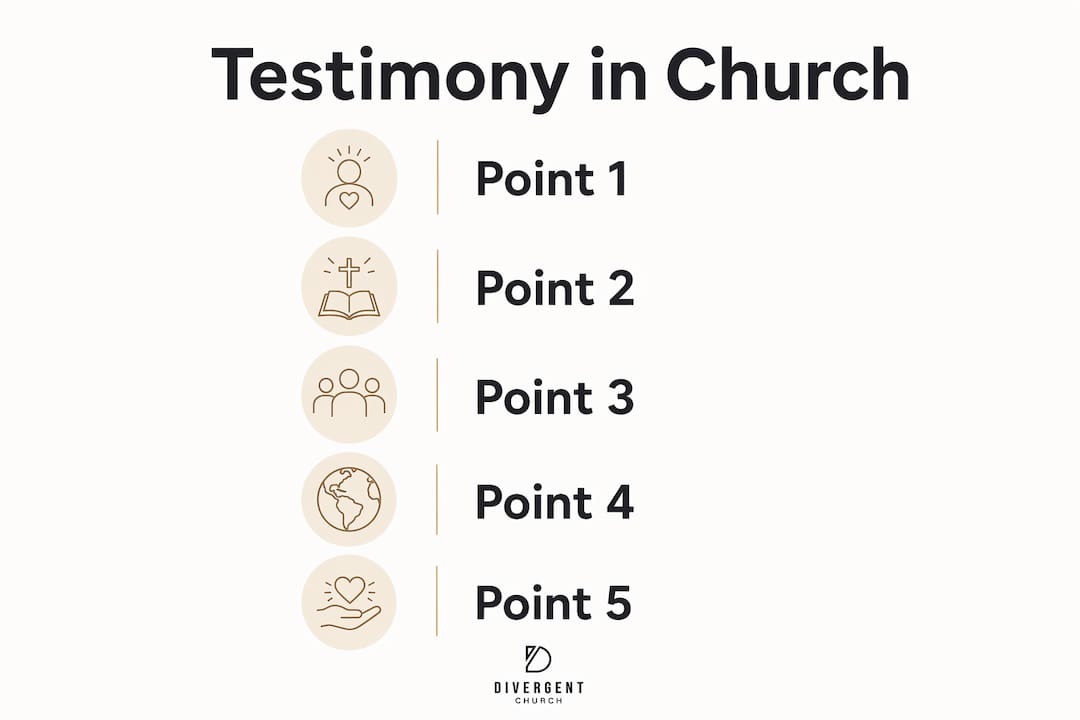
One sentence: who I was before.
One sentence: what I heard or experienced.
One sentence: what I decided or did.
One sentence: what changed as a result.
One sentence: what I am trusting God for now.
Use the five-point model in small groups, outreach events, or whenever someone has limited time. It is easy to memorise and easy to coach.
Sample testimony (60–90 seconds)
“Growing up, I always believed in God in a vague sort of way, but faith felt like something for other people. A few years ago, a friend invited me to a church gathering and I heard the gospel explained clearly for the first time. I remember sitting there thinking, ‘This is actually about me.’ I gave my life to Jesus that night. Since then, the anxiety that had defined my twenties has genuinely loosened its grip. I still have hard days, but I am not carrying them alone. I am learning to trust that God is present even in the ordinary stuff of life.”
Timing guidance
Setting | Ideal length |
Corporate Sunday service | 90 seconds to 2 minutes |
Baptism testimony | 2–4 minutes |
Small group sharing | 3 minutes |
Outreach or discovery event | 2–3 minutes |
Social media or digital clip | 60–90 seconds |
Preparation checklist:
Write it out in full first, then practise speaking it naturally.
Read it aloud and time yourself.
Remove anything that makes you the hero of the story; keep Jesus central.
Ask a trusted leader or friend to listen and give feedback.
End with something that points forward, not just backward.
Pro Tip: Coach people to avoid jargon. Phrases like “I was convicted” or “I felt led” are meaningful inside the church but opaque to a seeker. Ask: “Would your non-Christian neighbour understand every word of this?” If not, rephrase it.
Dos and don’ts for leaders overseeing testimony
Good testimony culture does not happen by accident. It is built through consistent coaching, clear expectations, and pastoral attentiveness.
What to encourage
Coach Jesus-centred telling. Every testimony should ultimately point to the character and work of Jesus, not to the teller’s spiritual achievement. Leaders must keep testimony subordinate to biblical exposition — stories illuminate the gospel; they do not replace it.
Set time limits and hold them. Unlimited testimony time almost always produces a handful of voices who dominate and many who never speak. A two-minute limit is a gift to the congregation and to the speaker.
Model vulnerability first. Leaders who share their own incomplete, ongoing stories give permission for everyone else to do the same. If the pastor only ever testifies from a place of resolution, the congregation will assume that messy, in-progress faith does not qualify.
Provide preparation help. Offer the four-part or five-point template in writing. Give people a week’s notice. Pair first-time sharers with a mentor who can listen to a practice run.
What to avoid
Avoid therapeutic counselling during testimony time. If someone reveals deep pain, grief, or trauma in a public setting, the response should be warm, brief, and followed by a private pastoral conversation — not an impromptu counselling session in front of the congregation.
Avoid triumphalism. Testimonies that present faith as a guaranteed path to health, wealth, or resolved circumstances misrepresent the gospel and alienate those whose experience does not match.
Don’t let testimony replace exposition. Testimony is a complement to the preached Word, not a substitute. The story points to Scripture; Scripture gives the story its meaning.
Addressing shame-induced perfectionism
Research into testimony practice found that shame-induced perfectionism silences people when leaders fail to explicitly validate incomplete and ongoing stories. Many people believe their testimony is not dramatic enough, not resolved enough, or not spiritual enough to share. Leaders must name this directly and often: a story of God’s faithfulness in an ordinary week is as valid as a dramatic conversion narrative.
Pro Tip: Create low-stakes practice environments — a small group, a baptism preparation night — before ever asking someone to share publicly. The first testimony is always the hardest.
Safeguarding note
When someone shares a testimony that reveals significant pastoral need (mental health struggles, family breakdown, addiction, abuse), a leader should follow up privately within 24 hours. Have a clear referral pathway to qualified counsellors or support services. Consent matters: never share someone’s story in another context without their explicit permission.
How to gather and preserve testimonies well
A testimony shared once and forgotten is a missed opportunity. With a simple workflow, churches can build a living archive of God’s faithfulness that serves discipleship, outreach, and community memory for years.
Gathering checklist:
Invite — identify someone with a story worth sharing and extend a personal, specific invitation (not a general call from the front).
Coach — provide the four-part or five-point template and offer a practice conversation.
Record — capture a brief video or audio recording with the person’s knowledge and agreement.
Consent — obtain written consent specifying how the recording will be used (internal only, website, social media, or all three).
Edit lightly — trim for length and clarity; do not alter the substance or voice of the story.
Schedule — place the testimony in a service, small group, or digital channel with intention, not as filler.
A simple workflow: one designated person (a discipleship coordinator or small group leader) holds the invitation and coaching role. Recordings live in a shared, password-protected folder. Consent forms are stored alongside each file. Review the archive annually and identify stories that could serve a specific sermon series, outreach season, or church anniversary.
Privacy is non-negotiable. Store recordings only with explicit permission. Offer anonymised sharing as an option for people whose stories involve sensitive circumstances. Never use a testimony in a public or digital context without confirming the person is still comfortable with that use.
Short clips (60–90 seconds) work well for social media and church newsletters. Longer versions suit small-group discussion prompts or anniversary reels. A curated collection of testimonies, revisited at a church’s five or ten-year milestone, becomes a profound act of communal worship.
How Divergentchurch integrates testimony in Canberra
Divergentchurch in Canberra offers a grounded, local example of how testimony can be woven into the rhythms of a contemporary Australian church without becoming performative or programmatic.
Within Life Communities (small groups), testimony sharing is a regular, low-pressure practice. Members are invited to share “God moments” — brief, specific observations of God’s faithfulness in the past week or season. This keeps testimony from being reserved for dramatic conversion stories and normalises the practice of noticing and naming God’s activity in ordinary life.
At baptism services, candidates are coached through the four-part structure in advance. A leader meets with them, listens to a practice run, and helps them shape their story so it is clear, Christ-centred, and appropriately brief. The result is testimonies that genuinely move the congregation rather than ones that meander or overwhelm.
What has worked at Divergentchurch:
Leader modelling — pastoral staff share their own ongoing, unresolved stories, not just polished retrospectives.
Short time limits — two-minute caps in corporate settings keep testimony accessible and protect the flow of gathered worship.
Integration into discipleship pathways — testimony is not an isolated event but part of how disciples are formed and how the church’s story is told.
Pilot in small groups first — new practices are trialled in Life Communities before being introduced to the full congregation.
Other churches can adapt this approach by starting small: introduce a “God moment” segment in one small group for a month, gather feedback, then expand. Measure success not by the number of testimonies shared but by the quality of follow-up conversations they generate and the number of people who feel equipped to share their own story.
Key takeaways
Testimony in church is most effective when it is Jesus-centred, structurally supported, and practised first in small groups before moving to corporate settings.
Point | Details |
Three core directions | Testimony worships God (up), builds the body (in), and witnesses to outsiders (out). |
Biblical grounding | Rooted in Hebrew 'edut and Greek martyria, testimony joins lived experience to Scripture. |
Use a template | The four-part structure or five-point model gives speakers a clear, coachable framework. |
Guard against perfectionism | Leaders must explicitly validate messy, ongoing stories to prevent shame-induced silence. |
Divergentchurch approach | Pilot testimony in Life Communities first; coach, record with consent, and integrate into discipleship pathways. |
Why testimony is worth the risk
There is a temptation, particularly in theologically careful churches, to treat testimony as a liability. What if someone says something theologically imprecise? What if a story becomes about the person rather than about Christ? These are real concerns, and they deserve real safeguards. But the answer is not silence.
The early church was built, in part, on the testimony of ordinary people who had encountered the risen Jesus and could not stop talking about it. The apostles were not polished communicators by the standards of their day. They were witnesses. And the witness of a changed life, offered humbly and pointed toward Christ, remains one of the most compelling arguments for the gospel that any congregation can make.
What I have seen, again and again, is that the churches most reluctant to make space for testimony are often the ones most hungry for the kind of community that testimony builds. The vulnerability of one person’s story gives others permission to be known. And being known, in the context of a community shaped by Scripture and centred on Jesus, is one of the primary ways disciples are formed.
The risk is worth taking. Start small. Coach well. Keep Christ central. And watch what God does with the seeds planted in honest, ordinary words.
Divergentchurch in Canberra: your next step
If you are part of a church in Canberra and you want to see testimony become a living, formative practice in your community, Divergentchurch has resources to help you get started.
The Discipleship Hub offers practical training materials for church members and leaders, including guidance on how to coach and structure testimony within small groups and corporate gatherings. If you are looking for a community where this kind of authentic, story-shaped discipleship is already happening, Life Communities are the natural starting point — small groups meeting across Canberra where testimony is part of the rhythm, not a special event. For those who are newer to faith or still exploring, the Discover Jesus pathway is a low-pressure space where personal stories and honest questions are genuinely welcome. Reach out to Divergentchurch and take the next step toward a community where your story matters.
Useful sources and further reading
These sources underpin the claims and frameworks in this article. Each is worth exploring for deeper study or ministry planning.
1 John 1:1–4 — The foundational New Testament text on testimony as proclamation arising from encounter. Essential for any biblical study of witness language.
Psalm 78:1–7 — A Psalm of communal testimony and intergenerational faith transmission. Useful for preaching on why testimony matters across generations.
Acts 26:1–29 — Paul’s testimony before King Agrippa. A masterclass in personal witness that is Christ-centred, specific, and missionally effective.
Your church needs more time for personal testimonies — 9Marks — Practical, theologically grounded case for integrating testimony into corporate church life. Includes safeguards and structural suggestions for leaders.
The practice of testimony — Alban Institute — Explores how integrating testimony into small groups and seasonal rhythms makes it sustainable and formative. Includes a congregational case study.
Recovering the art of testimony — DMin project — Research-based study of testimony in the historical Black Church tradition. Addresses shame-induced perfectionism and the importance of validating incomplete stories.
Faith and testimony — biblical Q&A — Accessible overview of the biblical roots of testimony, covering both Hebrew and Greek terms and their theological significance.
The importance of testimony — Psephizo — Examines testimony as a missional tool in post-modern contexts, with attention to how personal stories open doors that formal arguments often cannot.
Can I Get a Witness? — Ohio Link thesis — Academic study of testimony in the Baptist tradition as a community-building and discipleship practice. Useful for leaders wanting a research-backed framework.
The Role of Testimonies in Christian Faith and History — DivineNarratives — Historical overview from the early church through to contemporary digital testimony. Good background reading for leaders wanting to situate the practice in church history.
Transforming lives through community — A case study in how testimony and faith-based community support work together in pastoral care and recovery contexts.
Recommended
Comments