
Make the Sermon on the Mount Change You: Study Prompts and Practices


The Sermon on the Mount (Matthew 5–7) is Jesus’ summary teaching about the kingdom of God, describing the character and conduct of those who belong to it. It runs across three chapters and stands as the longest recorded speech attributed to Jesus in the New Testament. Its core themes are the Beatitudes, radical love and forgiveness, the fulfilment of the Law, and a discipleship that moves from private conviction to public life. Jesus is not handing down new rules so much as calling for a transformed heart that shows itself in how you actually live.
TL;DR:
The Beatitudes describe those already belonging to God’s kingdom as blessed, focusing on inward humility and divine flourishing rather than external virtue.
Jesus emphasizes that believers are already salt and light, and their impact should be visible through peacemaking, honesty, and generosity, not effort alone.
Jesus fulfills the Law by intensifying its motives, addressing anger, lust, and revenge at their roots, moving from external rules to internal righteousness.
Authentic prayer, exemplified by the Lord’s Prayer, is private and relational, prioritizing trust and seeking God’s kingdom over performative acts.
Building life on obedience rather than mere hearing is essential, with practical steps like practicing one Beatitude and examining motives for daily spiritual growth.
Table of Contents
Understanding the Beatitudes and what “blessed” really means
How does the Sermon on the Mount address prayer and hypocrisy?
Why is the mountain setting significant in Matthew’s Gospel?
Sermon on the Mount vs. Sermon on the Plain: what’s different?
A Divergent Church reflection: reading the sermon for discipleship today
Understanding the Beatitudes and what “blessed” really means
The Beatitudes open the sermon as kingdom announcements, not a checklist of virtues to earn your way in. The Greek word behind “blessed,” makarios, points to a deep, divine flourishing rather than the fleeting happiness we usually mean by the word. BibleProject frames the Beatitudes as descriptions of who already belongs to God’s kingdom, not conditions you have to satisfy first.
Jesus names people who look weak by worldly standards and declares them blessed anyway.
The poor in spirit, who know their need of God
Those who mourn, and those who stay meek rather than grasping for control
Those who hunger for righteousness and extend mercy to others
The pure in heart and the peacemakers
Those persecuted for doing what is right
Matthew groups these sayings in triads, a literary pattern that BibleProject’s guide to the sermon notes was designed to help oral communities memorise and pass on Jesus’ teaching. Luke’s Sermon on the Plain preserves a shorter, four-blessing version, which tells you Matthew shaped his account for a particular audience and purpose.
Pro Tip: Read the Beatitudes as a mirror, not a to-do list. Ask which one describes where you actually are right now, not which one you wish described you.
What do salt and light mean in the Sermon on the Mount?
Straight after the Beatitudes, Jesus turns from identity to impact. “You are the salt of the earth” points to preservation and flavour. In a world without refrigeration, salt stopped decay and made food worth eating. “You are the light of the world” points to visibility. A lamp on a stand cannot help but be seen.
Both images describe function, not effort. You do not become salt or light by trying harder. You already are, if you belong to the kingdom, and the question is whether that reality shows.
Salt that has lost its saltiness is useless, a warning against a faith with no discernible difference
Light hidden under a bowl defeats its own purpose
Both images point outward to peacemaking, honesty, and generosity that others can actually see
That is a practical test for anyone reading the sermon for personal formation. Does your life season the room, or blend into it?
What are the antitheses in Matthew 5?
The “you have heard it said… but I say to you” pattern runs through Matthew 5:17–48, and it is easy to misread as Jesus loosening the Law. He says the opposite. He came to fulfil it, and fulfilling it means going deeper than behaviour into motive. Six representative antitheses carry this pattern:
Anger is treated with the same seriousness as murder, because both destroy relationship at the root.
Lust is treated with the same seriousness as adultery, because desire, not just action, corrupts fidelity.
Divorce is restricted, protecting the vulnerable party in a culture where it could be used carelessly.
Oaths are replaced with simple truthfulness, so a person’s plain word is enough.
Revenge (“an eye for an eye”) is replaced with non-retaliation, breaking cycles of harm.
Love for enemies replaces love only for neighbours, extending mercy past its comfortable limits.
Scholars describe this as intensification rather than abolition. Jesus reinterprets the Law’s language to address the heart and the relationship, not just the visible act. That single shift, from external compliance to internal righteousness, is arguably the sermon’s most demanding idea.
How does the Sermon on the Mount address prayer and hypocrisy?
Matthew 6 turns to religious practice, and Jesus is blunt about performance. Giving, praying, and fasting done for an audience earn only the audience’s applause, not God’s attention. Private devotion, done where no one is watching, is what he calls genuine.
At the centre of this section sits the Lord’s Prayer, which functions as the model prayer for everything Jesus has just taught about authentic faith.
It opens by addressing God as Father, establishing relationship before request
It asks for God’s kingdom and will to be done, echoing the sermon’s opening theme
It asks for daily bread, forgiveness, and protection from temptation, in that order
This leads directly into Jesus’ teaching on worry: do not fret over food or clothing, because seeking God’s kingdom first reorders every other priority. Trust and practice are meant to sit together, not separately.
How should you apply the Sermon on the Mount today?
The sermon closes with three sharp images, and each one forces a decision rather than an opinion. The narrow gate contrasts with the wide, easy road most people default to. False prophets are known by their fruit, not their claims. The wise builder digs down to rock; the foolish one settles for sand and loses everything when the storm comes.
Jesus is not asking for admiration. He is asking for obedience that costs something. A few practical steps make that concrete for personal or group study:
Pick one Beatitude and try living it deliberately for a week, then journal what got hard.
Examine motives before actions, especially around giving, prayer, or public recognition.
Practise a regular rhythm of confession and reconciliation with someone you have wronged or who has wronged you.
Offer hospitality to someone outside your usual circle, echoing the sermon’s push past comfortable love.
Read Matthew 7:24–27 aloud before starting any new commitment, as a check on whether you are building on rock.
Pro Tip: Habits form faster in groups than alone. If you’re studying this with others, agree on one shared practice for the week rather than five individual ones. Consistency beats ambition here.
Why is the mountain setting significant in Matthew’s Gospel?
Matthew places this teaching on a mountain deliberately, echoing Moses receiving the Law on Sinai. The setting signals transformation, not replacement. Jesus is not a second law-giver adding rules. He is the one Torah was always pointing toward.
The sermon’s three-part structure reflects this care: the Beatitudes as an opening announcement, the main body covering law, prayer, and relationships, and a closing call to respond. Triadic groupings and chiastic patterns run throughout, built for memorisation in a culture that carried teaching by ear, not by page. Structure is not decoration here. What sits at the centre, the Lord’s Prayer, is what Matthew wants you to weigh most heavily.
Sermon on the Mount vs. Sermon on the Plain: what’s different?
Luke’s Gospel records a shorter, parallel teaching known as the Sermon on the Plain, and comparing the two sharpens what makes Matthew’s version distinct. Luke’s version (Luke 6:17–49) contains four blessings and four corresponding woes, delivered to a mixed crowd on level ground rather than a mountainside. Matthew’s nine Beatitudes carry no matching woes, and the setting itself carries theological weight that Luke’s flatter geography does not.
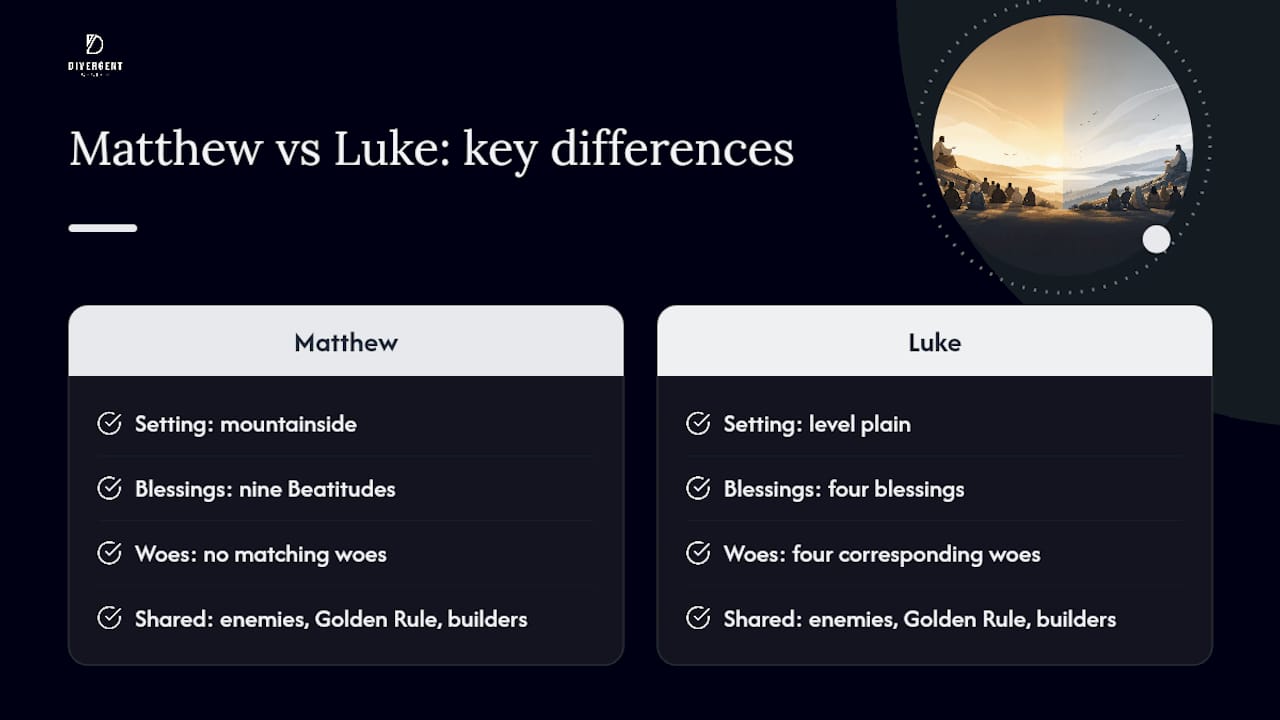
The content overlaps substantially. Both include teaching on loving enemies, the Golden Rule, and the wise and foolish builders as a closing image. Both push against surface-level righteousness toward something more demanding. Scholars generally read the two as either separate occasions where Jesus reused core material for different audiences, or as two evangelists shaping one tradition to serve different theological aims. Matthew, writing largely to a Jewish audience, leans into the new Moses motif and law fulfilment. Luke, writing more broadly, foregrounds economic reversal and social justice through his blessings and woes pairing.
Neither version cancels the other out. If you are studying Matthew 5–7 for personal formation, Luke’s parallel is worth a side read, not as a contradiction to resolve, but as a second angle on the same demanding teaching. The differences tell you what each writer wanted their community to hear most urgently.
A Divergent Church reflection: reading the sermon for discipleship today
Divergent Church holds discipleship as something lived, not just studied, and the Sermon on the Mount was never meant to stay on the page. Three questions work well for personal reflection or a small group: Which Beatitude names your current season honestly? Where is your prayer life more performance than trust? What would obedience cost you this week, and are you willing to pay it? For structured next steps, Divergent Church’s discipleship pathway is a practical place to keep going.
— Josh
Further reading and primary sources
Start with the text itself: Matthew 5–7 in any reliable Bible translation. For guided study, BibleProject’s free guide walks through structure and themes section by section. Bible Gateway’s explainer covers scope and context concisely, and Britannica’s entry situates the sermon within Christian ethics more broadly.
If you’re gathering a small group for this kind of study, Divergent Church’s Seminar Room is set up for exactly that kind of focused discussion, and bookings run through the venue booking page.
Sources
FAQ
What are the main points of the Sermon on the Mount?
The main points are the Beatitudes, the call to be salt and light, Jesus fulfilling the Law by addressing motive rather than just behaviour, authentic prayer modelled in the Lord’s Prayer, and a closing call to build your life on obedience rather than mere hearing. Together these themes describe God’s kingdom and its ethic of righteousness.
What are the three major sections of the Sermon on the Mount?
Guides commonly divide the sermon into three parts: the Beatitudes as an opening announcement of kingdom identity, the main body covering the Law, prayer, and relationships, and a closing section that calls the listener to respond and act.
What are some interesting facts about the Sermon on the Mount?
It’s the longest recorded speech by Jesus in the New Testament, spanning Matthew chapters 5 through 7. It contains some of Christianity’s best known sayings, including the Beatitudes, the Lord’s Prayer, and the Golden Rule, all gathered in one continuous teaching.
What two important things can you learn from Jesus’ sermon on the mountain?
First, that kingdom belonging is about inward character, humility, mercy, purity of heart, not outward performance. Second, that genuine faith always becomes visible, expressed through salt-and-light influence, honest prayer, and obedience that looks like building on rock rather than sand.
Recommended
Comments