
Spiritual Disciplines Without Legalism: Four Week Rule to Start

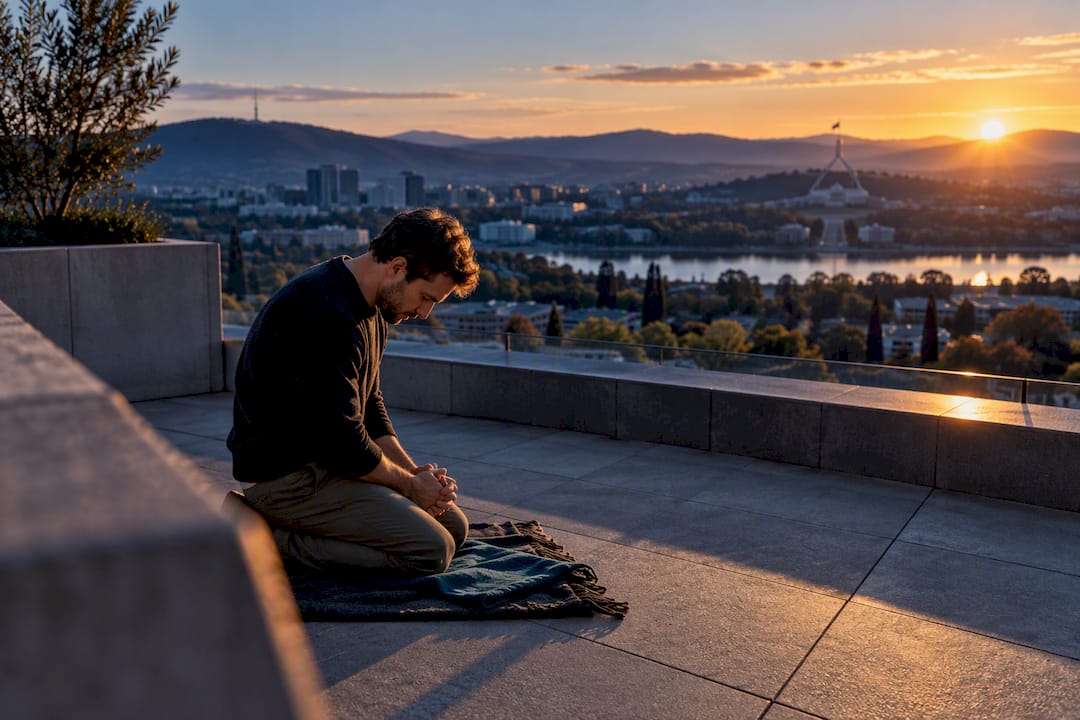
Spiritual disciplines are intentional practices found throughout Scripture that position us to receive God’s grace rather than earn it. They are the means by which God nurtures faith in us, not a scoreboard for spiritual performance. Prayer, Scripture reading, and worship sit at the heart of this life, each one training the heart to abide in Christ (John 15:4).
TL;DR:
Practicing small, manageable steps like a daily prayer or weekly worship builds lasting spiritual habits and prevents burnout.
Building a rule of life around two key anchors—one daily and one weekly—creates sustainable rhythms that foster ongoing grace.
Focusing on community, mentorship, and corporate worship strengthens disciplines and supports resilience against legalism and isolation.
A proper rule is flexible, revisited regularly, and tailored to your season, ensuring practices serve to draw you closer to Christ rather than become performance.
Core biblical disciplines include prayer, Scripture reading, worship, fasting, and Sabbath, with an emphasis on their role as relationship, not performance tools.
Table of Contents
What is the biblical basis for spiritual disciplines?
Jesus modelled the rhythms we’re invited to follow long before anyone wrote a book about them. He withdrew to solitary places to pray, often before dawn (Mark 1:35). He fasted for forty days in the wilderness before His ministry began (Matthew 4:2). He kept the rhythm of the Sabbath and the synagogue even while claiming authority over both (Luke 4:16). None of this was performance. It was the pattern of a Son who depended on His Father, and it’s the pattern He invites disciples into.
Paul continues this thread with direct exhortation rather than mere example. He tells the Thessalonians to “pray without ceasing” (1 Thessalonians 5:17) and urges Timothy to devote himself to the public reading of Scripture (1 Timothy 4:13). The early church, in Acts 2:42, is described as devoted to the apostles’ teaching, fellowship, the breaking of bread, and prayer. Four disciplines, one sentence, and a community that took all four seriously enough to be defined by them.
It helps to separate commanded duties from voluntary disciplines. Scripture commands love, obedience, and gathered worship (Hebrews 10:25). Many specific practices, like a daily prayer journal or a particular fasting schedule, are voluntary structures believers adopt to obey those commands consistently. Desiring God frames spiritual disciplines as practices God uses as means of grace: not tools that manufacture holiness, but channels through which He nurtures it. Dallas Willard pushed this further, distinguishing the “floor” of commanded minimums from the rule of life that scaffolds grace above it.
This scaffolding language explains why the Rule of Life tradition has endured for centuries, from the monastic communities of the early church to the Wesleyan “means of grace” and into contemporary discipleship. A rule was never a legal code. It was a rhythm, something monks and modern disciples alike return to when they need order restored to a scattered life.
Three markers separate discipline from duty:
Duties are commanded of every believer everywhere (worship, obedience, love).
Disciplines are the personal structures we build to walk those duties out consistently.
Both exist to draw us toward Christ, not to prove our worth to Him.
What are the core spiritual disciplines?
Different traditions group these practices differently. Renovaré organises disciplines into inward, outward, and corporate categories, a framework that helps balance private devotion with public service and shared worship. Below is a consolidated list drawing on that structure and on Cru’s practical summary of core disciplines.
Prayer. Ongoing conversation with God, modelled by Jesus in Luke 11:1 and commanded in 1 Thessalonians 5:17. Suits almost everyone, though introverts often find it a natural starting point.
Scripture reading. Regular engagement with the Bible as spiritual food (Matthew 4:4). GotQuestions calls it the foremost discipline because every other practice depends on it.
Scripture study. Slower, deeper wrestling with a text, following Ezra’s example of setting his heart to study the law (Ezra 7:10). Fits those who process faith analytically.
Scripture memorisation. Storing God’s Word in the heart to guard against sin (Psalm 119:11). Especially valuable for those in seasons without much reading time, like new parents or shift workers.
Meditation. Slow, reflective dwelling on truth day and night (Psalm 1:2). Helps anyone whose mind races, giving it one fixed point to return to.
Worship. Corporate and private ascription of worth to God (John 4:24). Extroverts often thrive in gathered worship; introverts may need private worship to balance it.
Fasting. Voluntary abstinence that sharpens spiritual hunger, as Jesus assumed His disciples would practise (Matthew 6:16-18). Requires medical care for anyone with health conditions.
Silence and solitude. Deliberate withdrawal, following Jesus’s own pattern of retreat (Mark 1:35). Often hardest, and most necessary, for people in caring or public-facing roles.
Confession and accountability. Honest disclosure of sin within trusted relationship (James 5:16). Fits anyone tempted to isolate when struggling, which is most of us.
Fellowship and service. The Acts 2:42 pattern of devoted community, expressed through practical care for others. Suits those who process faith relationally rather than solitarily.
Generosity. Cheerful, proportionate giving as an act of worship (2 Corinthians 9:7).
Sabbath. A full rhythm of rest that trusts God with the work left undone (Exodus 20:8-11). Non-negotiable for anyone in ministry, caregiving, or high-stress work.
How do you build a rule of life around these practices?
A personal rule of life is simply a written pattern of practices, reviewed regularly, that brings order to discipleship instead of leaving it to chance. The Order of the Ascension describes a good rule as realistic, variable, and periodically revisited, not an exhaustive list of demands you’ll abandon within a fortnight. Building one starts with honest self-assessment: where is your spiritual life thin right now? Prayer? Community? Rest? Choose two or three practices that address that gap rather than trying to adopt all twelve disciplines at once.
A workable rhythm usually has three layers:
Daily anchors: a fixed prayer time, five minutes of Scripture reading before the phone comes out, or a single memory verse reviewed on the commute.
Weekly anchors: gathered worship, one evening of Sabbath rest, and a fellowship meal or small group.
Seasonal anchors: a week of fasting or solitude tied to Lent, Advent, or a personal season of decision.
A four-week starter plan keeps this concrete. Week one, add one daily anchor, ten minutes of prayer or Scripture, nothing more. Week two, keep that anchor and add one weekly corporate practice, such as attending a small group or a Sunday gathering with intention rather than habit. Week three, introduce a short discipline you’ve never tried, perhaps a half-day of silence or a single day of fasting. Week four, review what stuck, what felt forced, and adjust the rule accordingly. The C.S. Lewis Institute’s short-term challenges work on the same principle: brief, accountable windows build consistency faster than open-ended resolutions ever do.
Pro Tip: Pick one daily anchor and one weekly corporate practice before you touch anything else. A rule with two solid pillars will outlast a rule with ten fragile ones.
For readers wanting a fuller runway beyond the first month, our guide to deepening your spiritual life walks through the next stage of building sustainable rhythms.
How do you avoid legalism and burnout in your practices?
Legalism creeps in quietly. One clear sign is measuring your standing with God by whether you completed the checklist, rather than by Christ’s finished work. Another is resentment: if your prayer time has started to feel like punching a clock, something has drifted. The Spiritual Habits Project makes the pastoral point plainly: these habits exist to be life-giving, not a performance review God runs on your behalf.
Burnout shows up differently but comes from the same root, usually an overloaded rule with no Sabbath and no community check. A rule built entirely around private disciplines, prayer, fasting, solitude, with no fellowship or accountability, will eventually collapse under its own isolation.
Three corrective steps tend to work:
Simplify the rule. Cut it to the two anchors that matter most and rebuild from there.
Reintroduce Sabbath and community. Rest and relationship are disciplines too, and they’re often the first ones cut under pressure.
Seek spiritual direction. A trusted mentor or pastor can see blind spots you can’t see in yourself.
Some seasons call for pausing a practice altogether, chronic illness, new parenthood, grief, or vocational overload, rather than pushing through it. A rule of life is meant to serve you in the season you’re in, not the season you wish you were in.
How does Divergent Church put these disciplines into practice?
Formation happens less through programs and more through rhythm. Small groups build weekly fellowship around Scripture and prayer, giving members a place to be known rather than just counted. Sunday gatherings function as a fixed weekly anchor, the kind of corporate worship the early church treated as non-negotiable in Acts 2:42.
One-to-one mentoring adds the accountability piece many disciplines need to stick. A rule of life rarely survives alone; it survives in relationship.
Small-group rhythms built around Scripture, prayer, and honest confession.
Sunday gatherings as a weekly worship anchor.
Mentoring relationships for accountability and spiritual direction.
Explore more through our discipleship hub or our list of Christian habits to strengthen daily faith.
Where can you go for further study?
Desiring God: a clear theological framing of disciplines as means of grace.
Renovaré: the inward, outward, and corporate categories used across this guide.
Order of the Ascension: a practical rule of life template and review structure.
Spiritual Habits Project: pastoral guidance against legalism.
Cru: a practical starter list of ten core disciplines.
What actually matters most in this conversation?
Most guides to spiritual disciplines read like productivity manuals with Bible verses attached. That’s the gap worth naming: disciplines aren’t a system for optimising your spiritual output, they’re a relationship structure. The conventional advice tends to front-load the list, prayer, fasting, silence, memorisation, service, and leave the reader to figure out sequencing alone. That’s backwards.
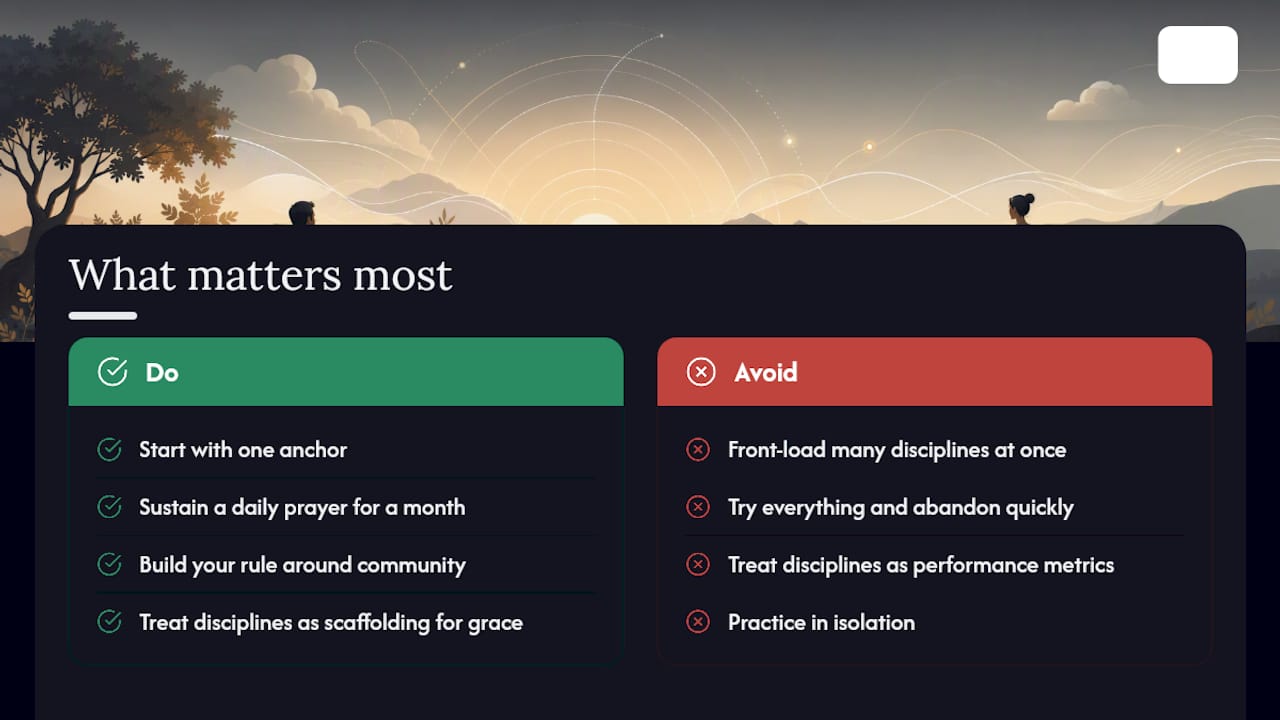
Start with one anchor, not twelve. A daily prayer habit sustained for a month will teach you more about grace than a week of trying everything Scripture mentions and abandoning most of it by Thursday. The rule of life tradition survived for centuries precisely because it resists the modern instinct to do more, faster. It asks instead for less, sustained.
If you take one thing from this guide, let it be this: disciplines are scaffolding for grace, not proof of it. Build your rule around community, not just private devotion. A discipline practised in isolation rarely lasts. One practised alongside a small group, a mentor, or a Sunday gathering usually does.
— Josh
Sources
FAQ
What are the 12 spiritual disciplines?
There’s no single fixed list of twelve, but a common consolidated set includes prayer, Scripture reading, Scripture study, memorisation, meditation, worship, fasting, silence and solitude, confession and accountability, fellowship, service, generosity, and Sabbath. Different traditions group and number these differently, though the core practices stay consistent across most lists.
What spiritual disciplines are mentioned in the Bible?
Scripture names prayer (1 Thessalonians 5:17), fasting (Matthew 6:16-18), Scripture engagement (1 Timothy 4:13), fellowship and the breaking of bread (Acts 2:42), Sabbath rest (Exodus 20:8-11), and generosity (2 Corinthians 9:7) as recurring practices among believers. Jesus himself modelled solitude and prayer throughout the Gospels, particularly in Mark 1:35.
What are the five spiritual disciplines?
Five commonly highlighted disciplines are prayer, Scripture reading, worship, fasting, and fellowship, often treated as a practical entry point before adding practices like solitude or memorisation. Cru’s list of core disciplines follows a similar practical grouping.
Who are the 12 disciples?
This question sometimes gets confused with spiritual disciplines, but it actually refers to Jesus’s twelve apostles: Peter, Andrew, James, John, Philip, Bartholomew, Matthew, Thomas, James son of Alphaeus, Thaddaeus, Simon the Zealot, and Judas Iscariot (Matthew 10:2-4). Their calling and formation under Jesus is itself a model for how spiritual disciplines are meant to shape a disciple over time.
Recommended
Comments