
Step-by-step church membership: a biblical guide


Becoming a church member follows four clear steps: attend an introductory or membership class, meet with church leadership, affirm the church’s statement of faith, and make a public or formal commitment such as signing a membership covenant. Scripture grounds this path in the body imagery of 1 Corinthians 12 and the mutual encouragement of Hebrews 10:24–25, both of which picture local belonging as something intentional, not accidental. At Divergentchurch in Canberra, this process is called the Next Steps pathway, and it is designed to move you from curious visitor to committed disciple. To begin, speak with a welcome host this Sunday or register through Next Steps.
Pro Tip: Before your first membership class, write down two things: the moment faith became real for you, and one way you hope to serve the community. That preparation will make every conversation with church leadership feel natural rather than nerve-wracking.
Table of Contents
What does each step of the membership process look like?
Most church membership pathways share four to five core steps, and the practical shape of each one matters as much as the sequence.
Attend regularly. Show up consistently, not just once. Relational engagement through small groups and serving usually precedes formal membership and makes the covenant feel like belonging rather than paperwork. Aim for multiple Sundays before approaching leadership.
Complete a membership class or orientation. This is where you learn the church’s theology, vision, and expectations. Classes typically run across a few sessions and cover the statement of faith, governance, and discipleship pathways. For Canberra readers, the church involvement process at Divergentchurch includes a structured Next Steps orientation.
Meet with a pastor or elder. Church leaders describe this meeting as a pastoral conversation, not an interrogation. They want to hear your salvation story and understand where you are spiritually. Bring a brief testimony (two minutes is plenty), your baptism record if you have one, and any questions about the church’s beliefs.
Affirm the statement of faith or covenant. You will be asked to read and agree with the church’s core doctrinal commitments. A typical covenant includes mutual promises: you commit to participation, giving, and submission to teaching; the church commits to pastoral care, sound doctrine, and accountability.
Make a public commitment and begin onboarding. This is the moment the congregation welcomes you formally, often during a Sunday gathering. Onboarding then connects you to a small group, a serving team, or a discipleship track.
Checklist for your pastoral meeting:
A short, two-minute testimony covering your conversion and current faith
Baptism certificate or record (if applicable)
Name of your previous church (if transferring)
Two or three questions about the church’s vision or doctrine
Openness to discussing spiritual gifts and where you might serve
Pro Tip: Structure your testimony in three beats: life before faith, the moment of turning, and what following Jesus looks like now. Keep it under two minutes. Leaders are not looking for a polished speech; they are listening for a genuine story.
What are the common membership requirements across traditions?
Core requirements recur across nearly every evangelical tradition, even when the specific process varies.
Profession of faith in Jesus Christ as Lord and Saviour
Baptism (by immersion in many evangelical churches, or prior baptism accepted by transfer)
Regular attendance over a defined period
Agreement with the statement of faith and church covenant
Completion of a membership class (required in most structured pathways)
Variations across traditions are significant. Some churches require a congregational vote to receive new members; others leave the decision with elders or pastors. Baptism requirements differ too: many evangelical and Baptist-heritage churches require believer’s baptism by immersion, while others accept any prior Christian baptism or welcome members by statement of faith alone.
Situation | Typical pathway | Usual timeline |
Never baptised, new believer | Membership class → pastoral meeting → baptism → covenant | as little as eight weeks |
Baptised elsewhere, transferring | Transfer letter or statement of faith → pastoral meeting → covenant | four to six weeks |
Baptised, no transfer letter | Verbal reaffirmation of faith → pastoral meeting → covenant | four to six weeks |
Long-term attender, not yet a member | Membership class → pastoral meeting → covenant | four to six weeks |

Churches commonly offer membership by baptism, by transfer, or by statement of faith, and timelines shift depending on which track applies to you.
Pro Tip: If you were baptised at another church, track down your baptism certificate before your first meeting with leadership. A simple email to your previous church’s office is usually all it takes, and it can shorten the process by several weeks.
Is baptism required for church membership?
The direct answer: baptism is required in many evangelical traditions, but the form and timing vary, and most churches have a clear path for those not yet baptised.
“Having been buried with him in baptism, in which you were also raised with him through faith in the powerful working of God, who raised him from the dead.” Colossians 2:12 (NASB)
Baptism is the outward sign of an inward reality. For churches that hold to believer’s baptism, it is not a hurdle placed before membership but a declaration of the same faith that membership expresses. If you were baptised as a believer in another church, bring evidence of that baptism. Most churches will accept it without requiring you to be baptised again. If you have never been baptised, the pastoral meeting is the right moment to raise it. Your pastor will walk you through what believer’s baptism means and help you schedule it, often as part of a Sunday gathering so the whole congregation can witness it.
In Australia, most churches schedule baptisms monthly or quarterly. Contact the church office at least four to six weeks before your preferred date to allow time for preparation and a brief testimony review.
Pro Tip: If you are unsure whether your prior baptism qualifies, simply ask your pastor during the membership meeting. The question is welcomed, not awkward, and the answer will clarify your path forward.
How do transfers and letters of good standing work?
Coming from another church is one of the most common situations in Australia’s transient population, particularly in a city like Canberra where students, public servants, and Defence personnel move frequently.
A letter of good standing (sometimes called a transfer letter) is a short document from your previous church confirming that you were a member in good standing, your baptism details, and any relevant ministry involvement. It is not a legal document; it is a pastoral courtesy that helps your new church welcome you with confidence.
What a transfer letter typically includes:
Your full name and previous membership dates
Confirmation of baptism (date, mode, and location if known)
A brief note on your standing and character from the previous pastor
Contact details for the issuing church
Documents that speed the process:
Baptism certificate or record
Previous membership certificate or letter
Pastoral reference (a phone call or email from your previous pastor works too)
If your previous church has closed or you have lost contact with it, a verbal reaffirmation of faith during the pastoral meeting is the standard alternative. Churches offer multiple pathways precisely because life is not always tidy. Expect a transfer process to take several weeks; joining by statement of faith alone is often quicker.
Why does church membership matter biblically and pastorally?
Membership is a formal status for governance and accountability, but its roots are theological before they are administrative.
“Now you are the body of Christ and individually members of it.” 1 Corinthians 12:27 (NASB)
Paul’s body imagery is not metaphor for the sake of poetry. It describes a real, interdependent community where every person has a function, and where the absence of one member diminishes the whole. Hebrews 10:24–25 adds the relational dimension: “Let us consider how to stir up one another to love and good works, not neglecting to meet together.” Membership is the structure that makes that stirring possible.
Pastoral reasons for formal membership include:
Accountability: Members know who is shepherding them and who they are accountable to.
Care: Pastors can only truly care for people they know are part of the flock.
Stewardship: Giving, serving, and decision-making all flow more faithfully within a committed community.
Doctrinal unity: Agreeing to a statement of faith protects the congregation from drift.
In incorporated churches, members are the primary stakeholders. They hold voting rights and share responsibility for the church’s direction and integrity. Membership is not bureaucracy; it is the structure through which the kingdom is built with accountability. For a deeper look at why membership matters, Divergentchurch has written on this directly.
How does Divergentchurch run its membership pathway?
Divergentchurch in Canberra has designed its membership pathway to be relational from the first step, reflecting the conviction that belonging precedes formal commitment.
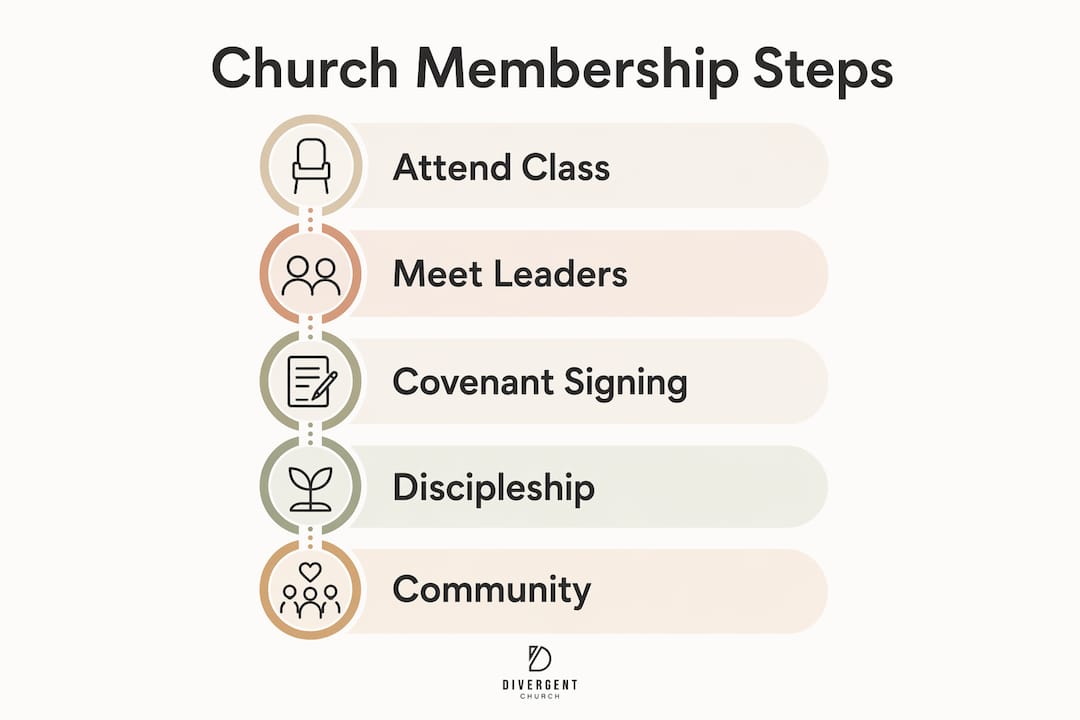
Attend a Sunday gathering and connect with the community over several weeks.
Register for Next Steps, Divergentchurch’s orientation experience, which introduces the church’s vision, theology, and community rhythms.
Complete the membership class, where you explore the church’s statement of faith, covenant commitments, and discipleship pathways.
Meet with a pastor or elder for a pastoral conversation covering your faith story, baptism status, and how you hope to contribute.
Sign the membership covenant and be welcomed publicly into the congregation, then connect with a Life Community or serving team.
A sample membership covenant at Divergentchurch reflects mutual commitments:
Members commit to: regular attendance, financial generosity, participation in a Life Community, submission to pastoral teaching, and care for one another.
The church commits to: sound biblical teaching, pastoral care, prayer, equipping for ministry, and accountability in love.
The discipleship pathway does not end at the covenant signing. Divergentchurch connects new members to its Discipleship Hub and Life Communities so that membership becomes the beginning of active formation, not the finish line.
To start, visit the Next Steps page or speak with a welcome host after any Sunday gathering at Divergentchurch in Canberra.
Key takeaways
Membership is a mutual covenant: you commit to the community, and the community commits to you. The four steps from attendance to public commitment can be completed in as little as eight weeks.
Point | Details |
Start with attendance | Show up consistently for two to four Sundays before approaching leadership about membership. |
Complete the membership class | Every tradition requires some form of orientation; it covers theology, covenant, and expectations. |
Prepare your testimony | A two-minute faith story covering conversion and current discipleship makes the pastoral meeting natural. |
Clarify your baptism status | Bring a certificate if you have one; if not yet baptised, raise it in the pastoral meeting. |
Divergentchurch next step | Register for Next Steps at Divergentchurch in Canberra to begin the membership pathway today. |
Membership is a door, not a destination
There is a temptation to treat church membership as the goal, as though signing a covenant completes something. In my view, that framing misses what membership is actually for. The covenant is not the destination; it is the door. What lies beyond it is a community that knows your name, a pastor who prays for you by name, and a congregation that will show up when life gets hard.
The organised membership pathway exists to move people from casual attendance into active discipleship, and the goal is spiritual maturity, not a tidy membership roll. What I find most striking about the churches that do this well is that they treat the pastoral meeting as a genuine conversation rather than a gatekeeping exercise. They are not checking boxes; they are listening for a person. That posture changes everything.
If you are sitting on the edge of this decision, wondering whether the process is worth it, consider what you are actually being invited into. Not an institution. Not a programme. A body, in the Pauline sense: interdependent, purposeful, and alive. Membership is how you say, formally and publicly, that you are part of it.
To arrange a casual conversation with a pastor or Next Steps host at Divergentchurch, simply introduce yourself after a Sunday gathering or reach out through the church’s website.
Ready to take your next step at Divergentchurch?
Divergentchurch in Canberra offers a clear, relational path from first visit to full membership, without the institutional distance that makes some church processes feel cold. The Next Steps pathway is built for real people in a transient city: students, newcomers, and long-term residents who are ready to move from attending to belonging.
Whether you are brand new to faith or transferring from another church, the process is the same: show up, connect, and let the community meet you where you are. From there, join a Life Community to build relationships that carry you through the week, or explore the Discipleship Hub for resources that deepen your faith at your own pace.
To begin, visit divergentchurch.com/next-steps or speak with a welcome host after any Sunday gathering in Canberra. The first conversation costs nothing and opens everything.
Useful sources and further reading
The following resources support the steps and principles covered in this guide. Use them to deepen your understanding or as conversation starters with your pastor.
Scripture passages: 1 Corinthians 12 (body of Christ imagery); Hebrews 10:24–25 (mutual encouragement and gathering); Colossians 2:12 (baptism and faith)
Membership process overview: Church membership 101: How to join a church — a practical summary of the common four-step pathway used across traditions
Step-by-step joining guide: How to join a church: a step-by-step guide for new members — covers baptism options, transfer pathways, and statement-of-faith admission
Pastoral membership design: Church membership made simple: a practical guide for pastors — explains the governance and discipleship rationale behind formal membership
Membership process steps: 4 steps for a membership process — church-leader perspective on pastoral interviews and discipleship intent
Governance and stakeholder role: How does someone become a church member? — explains voting rights and the incorporated church structure
Divergentchurch Next Steps: divergentchurch.com/next-steps — the starting point for membership at Divergentchurch in Canberra
Downloadable templates: Ask your pastor or the Divergentchurch office for a membership covenant template and a sample transfer letter. Both are straightforward documents that you can review before your pastoral meeting, so the conversation is focused on relationship rather than paperwork.
Recommended
Comments