
The importance of local church for community and growth

Updated: Sep 9

The local church is defined as the gathered, covenanted community of believers who meet, serve, and live together within a specific place. Its importance extends far beyond Sunday worship. Research from the Wheatley Institute and the Heritage Foundation confirms that regular church participation links to better mental health, lower mortality, and stronger social bonds. Divergentchurch, based in Canberra, embodies this reality: a community shaped by Scripture, expressed through everyday relationships and mission. This article explains why the local church remains one of the most significant institutions in modern society, and how you can experience its full benefit.
How does the local church impact mental and physical health?
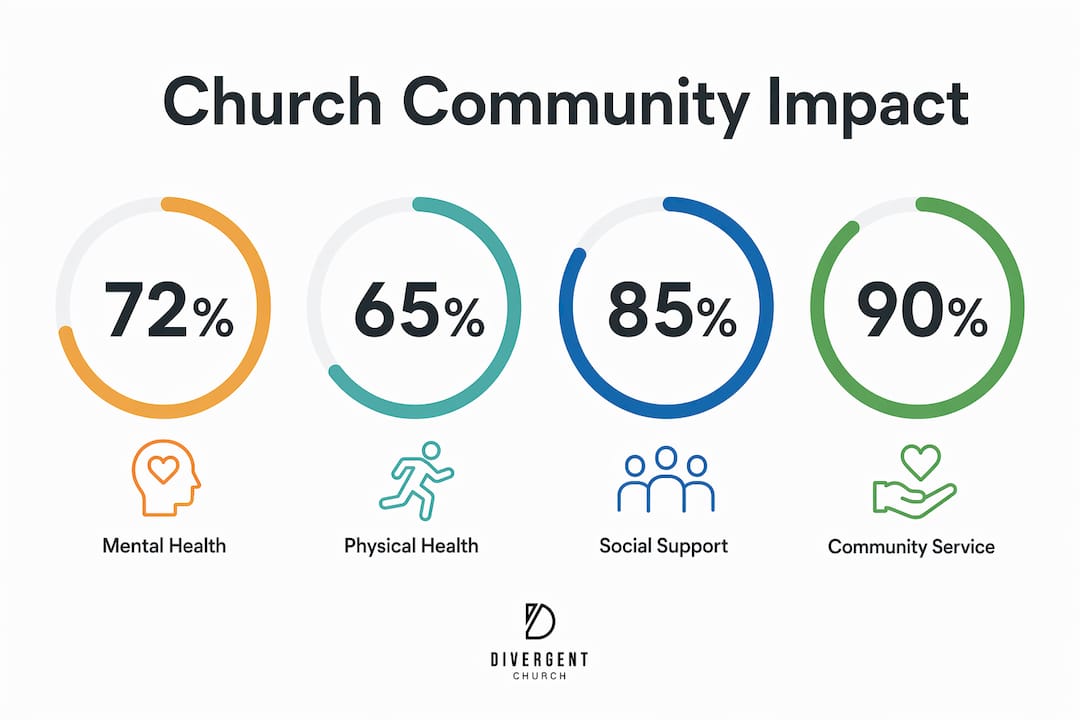
Religious involvement overwhelmingly correlates with better mental health. The Wheatley Institute reports that positive mental health associations outnumber negative ones by nearly 10 to 1 across 961 positive versus 101 negative studies. That ratio is not a marginal finding. It represents one of the most consistent patterns in social science research on human wellbeing.
Physical health follows a similar pattern. The same body of research shows that positive physical health findings outnumber negative ones by 7 to 1, with lower rates of cardiovascular disease and cancer among regular attenders. The mechanism is not simply that healthy people attend church. Studies control for prior health status and still find the benefit holds.

The Heritage Foundation’s 2026 Index of Culture and Opportunity adds a social dimension. Frequent religious attenders show greater generosity, lower rates of illicit drug use, and lower mortality than their non-attending peers. These outcomes appear across age groups, including adolescents, which suggests the benefits begin early and compound over time.
What makes these findings remarkable is their specificity to religious community. Joining a sports club or a book group does not produce the same results. The combination of shared belief, ritual, accountability, and transcendent purpose appears to be the active ingredient.
Pro Tip: Occasional attendance produces some benefit, but the research consistently shows that committed, weekly participation is where the strongest health and social outcomes appear. Treat attendance as a practice, not an event.
What unique social and spiritual functions does the local church serve?
The local church is the only institution that simultaneously offers community, ritual, meaning, and purpose within a local setting. No other organisation combines these elements as effectively within a neighbourhood or city. That is not a sentimental claim. It reflects a structural reality about what the church does that other institutions simply do not attempt.
Think of the local church as a spiritual greenhouse. Seeds of faith, character, and compassion are planted through Scripture, nurtured through relationships, and brought to fruit through service. The greenhouse metaphor matters because growth requires the right conditions: light, soil, water, and time. A local church provides all four in the form of worship, community, teaching, and shared life over years.
Virtual church experiences cannot replicate this. Biblical fellowship requires tangible, accountable community beyond digital content. Watching a sermon online is valuable, but it does not produce the mutual accountability, the shared meal, or the late-night phone call from someone who actually knows your name. Physical presence is not incidental to church. It is constitutive of it.
The spiritual and social functions a local church provides include:
Worship and ritual: Regular, embodied practices that orient life around what matters most
Discipleship: Intentional formation of character through Scripture, teaching, and mentorship
Belonging: Deep, covenanted relationships that persist through difficulty and change
Pastoral care: Support during grief, illness, crisis, and transition
Mission: A shared purpose that extends beyond the congregation into the city
Intergenerational connection: Relationships across age groups that are rare in modern life
Research confirms that religious attendance causally improves meaningfulness, purpose, forgiveness, and relational repair. These are not vague spiritual feelings. They are measurable outcomes that shape how people live, relate, and recover from hardship.
Pro Tip: Moving from attendance to belonging requires intentionality. Show up consistently, join a small group, and serve in one area. Belonging is not given. It is built through repeated, mutual investment.
How does the local church impact the wider community?
The local church does not exist for itself. Its mission is directed outward, toward the neighbourhood, the city, and the world. Engaged congregations retain members better and provide significant societal benefits, according to the Lake Institute on Faith and Giving. That symbiotic relationship between internal health and external impact is one of the church’s most distinctive features.
Churches run food banks, refugee support programmes, after-school tutoring, addiction recovery groups, and aged care visits. These are not peripheral activities. They are expressions of the church’s core conviction that love of neighbour is inseparable from love of God. Local nonprofits and churches often partner to strengthen communities in ways that government programmes alone cannot replicate.
The table below compares the community contributions of a local church against other common social organisations.
Community function | Local church | Sports club | Civic organisation |
Spiritual formation | Yes | No | No |
Crisis pastoral care | Yes | Rarely | Rarely |
Social outreach programmes | Yes | Occasionally | Yes |
Intergenerational community | Yes | Rarely | Sometimes |
Shared moral framework | Yes | No | Sometimes |
Long-term relational accountability | Yes | Rarely | Rarely |
The local church’s role in society extends beyond what any single column in that table captures. It forms people who then go into workplaces, schools, and neighbourhoods as agents of care and justice. The congregation is not the end point. It is the training ground.
Divergentchurch in Canberra lives this out by existing within the rhythms of the city: its universities, workplaces, and transient population. The church does not ask the city to come to it. It goes to the city, planting seeds of kingdom life in ordinary places.
What are practical ways to engage with a local church?
Finding the right local church begins with clarity about what you are looking for. Theology, community culture, and geographic proximity all matter. Visiting several churches before committing is wise, but indefinite church shopping becomes its own obstacle to belonging. At some point, you plant yourself.
Active engagement looks different from passive attendance. The power of church community grows through participation, not observation. Serving in a practical role, joining a small group, and attending mid-week gatherings all accelerate the process of genuine belonging. These are not optional extras. They are the means by which the church becomes your community rather than a service you consume.
Common challenges for newcomers include feeling invisible in large gatherings, not knowing how to connect, and carrying a consumer mindset that evaluates church like a product. Shifting from consumer to committed member is the single most important mindset change a newcomer can make. It means accepting that belonging requires giving, not just receiving.
Practical steps for deeper engagement:
Attend consistently for at least three months before evaluating whether a church is the right fit
Introduce yourself to a leader or greeter on your second or third visit
Join a small group or life community to move beyond Sunday anonymity
Serve in one area, whether that is hospitality, music, children’s ministry, or outreach
Read and reflect on Scripture during the week to connect Sunday teaching to daily life
Be honest about your questions and doubts. Healthy churches welcome them
Divergentchurch’s Life Communities are designed precisely for this transition. They are small, relational groups that meet across Canberra’s neighbourhoods and campuses, providing the kind of deep community connection that Sunday gatherings alone cannot offer.
Pro Tip: Approach your first six months in a church as a season of giving rather than evaluating. Serve before you feel ready. The sense of belonging almost always follows the act of commitment, not the other way around.
Key takeaways
The local church is irreplaceable as a community institution because it uniquely combines spiritual formation, social belonging, pastoral care, and outward mission in ways no other organisation does.
Point | Details |
Health benefits are real | Religious involvement links to lower cardiovascular risk, better mental health, and reduced substance use. |
Virtual church is not enough | Physical, accountable community produces outcomes that digital content alone cannot replicate. |
Church serves the whole city | Engaged congregations contribute to societal good through outreach, care, and neighbourhood presence. |
Belonging requires commitment | Moving from attendance to membership means serving, joining small groups, and investing relationally. |
Mindset shift is the key | Approaching church as a committed member rather than a consumer unlocks its deepest benefits. |
Why I believe the local church is still the most important room you can walk into
I have watched people arrive at church carrying genuine loneliness, quiet desperation, and a hunger they could not name. What strikes me, every time, is how the local church meets them at a level that nothing else in modern life quite reaches. Not therapy, not a gym, not a community garden. Those things are good. But the church operates in a different register entirely.
What I have come to see is that the local church functions as a spiritual economy. It does not deplete you. When you serve, give, pray, and show up for others, something is replenished rather than spent. That is counterintuitive in a culture that treats time as a scarce resource to be protected. But the people I know who are most alive, most grounded, and most generous are almost always deeply embedded in a local church.
The covenanted community matters more than most people realise before they experience it. Knowing that people will show up for you in a crisis, that someone will pray with you on a Tuesday, that your life is genuinely known by others: these are not small things. They are the architecture of a meaningful life. The church, at its best, builds that architecture one relationship at a time.
My honest encouragement is this: do not wait until you feel ready or until you find the perfect church. Walk in, stay long enough to be known, and let the community form you. The seeds planted in that room grow in ways you will not fully see for years.
— Josh
Divergentchurch: a community worth belonging to
Divergentchurch in Canberra is built for exactly the kind of belonging this article describes. It is not a Sunday service you attend and forget. It is a community shaped by Scripture, centred on Jesus, and expressed through everyday life across the city.
The Discipleship Hub offers structured pathways for spiritual growth, whether you are new to faith or have been walking with Jesus for years. Life Communities meet across Canberra’s neighbourhoods, giving you a smaller, relational space to go deeper. If you are ready to move from curiosity to commitment, Divergentchurch is a community worth planting yourself in.
FAQ
What is the importance of local church for mental health?
Religious involvement links to better mental health outcomes, with positive associations outnumbering negative ones by nearly 10 to 1 across major studies. Regular attendance specifically correlates with lower suicide risk, better stress coping, and reduced substance use.
Can I get the same benefits from watching church online?
Online content provides teaching but not the accountable, physical community that produces the deepest benefits. Biblical fellowship requires tangible presence, mutual accountability, and shared life that digital formats cannot replicate.
How does the local church benefit the wider community?
Local churches run outreach programmes, partner with nonprofits, and form people who serve as agents of care in workplaces and neighbourhoods. Engaged congregations consistently contribute to societal good beyond their own membership.
How long does it take to feel like you belong at a church?
Belonging typically develops over months of consistent attendance, small group participation, and serving. Research on social integration suggests that committed involvement, not passive attendance, is what produces genuine belonging.
Why join a local church rather than a community group?
The local church uniquely combines spiritual formation, ritual, pastoral care, intergenerational relationships, and shared mission. No other community organisation offers that combination within a covenanted, accountable community.
Recommended
Comments