
What does a healthy church community look like?


A genuinely healthy church community is one of the most transformative things a person can be part of. But what does healthy church community look like in practice? Many people assume a warm welcome and a full car park are enough evidence. They’re not. True church health runs deeper than friendliness. It shows up in how people grow, how they love one another through hard seasons, and whether disciples are actually being formed. This article explores the spiritual, relational, and biblical markers that distinguish a thriving church from one that merely appears active on the surface.
Table of Contents
Key takeaways
Point | Details |
Discipleship is the measure | Church health is revealed by growth across spiritual domains over time, not attendance numbers. |
Relational depth matters | Genuine fellowship prioritises caring relationships and consistent follow-up, not institutional busyness. |
Scripture must be the foundation | Healthy churches are guided by God’s Word in their community life, leadership, and mission. |
Warmth alone is not enough | Friendly environments without discipleship pathways produce superficial community, not transformation. |
You can actively contribute | Individuals who seek accountability, join small groups, and engage beyond Sundays shape church health. |
What does healthy church community look like spiritually?
Most conversations about church health start with atmosphere. People ask: is it welcoming? Does it feel alive? Those questions matter, but they’re only the beginning. The deeper question is whether the community is forming disciples who are genuinely growing in Christlikeness over time.
Lifeway Research’s 2026 work identifies eight discipleship signposts that, when tracked as a trajectory rather than a snapshot, reveal the true health of a church:
Bible engagement: Regularly reading, studying, and applying Scripture to daily life
Obeying God and denying self: Aligning personal choices with God’s will, even at personal cost
Serving God and others: Actively contributing to the needs of those inside and outside the church
Sharing Christ: Speaking openly about faith with people who don’t yet know Jesus
Exercising faith: Trusting God in concrete, sometimes risky, decisions
Seeking God: Maintaining a committed personal prayer and worship life
Building relationships: Cultivating intentional, spiritually encouraging friendships
Living unashamed: Publicly identifying with Jesus without embarrassment or compromise
What makes this framework so useful is its emphasis on trajectory. A healthy church shows growth across all eight domains over months and years. A programme-heavy church that isn’t producing movement in these areas may be busy without being fruitful.
Research reveals a striking pattern among regular churchgoers. People score highest in seeking God, with an average of 78.5, but drop to just 54.8 in sharing Christ. That gap tells an important story. Many believers have cultivated a private, devotional faith but have not yet made the outward turn toward mission.
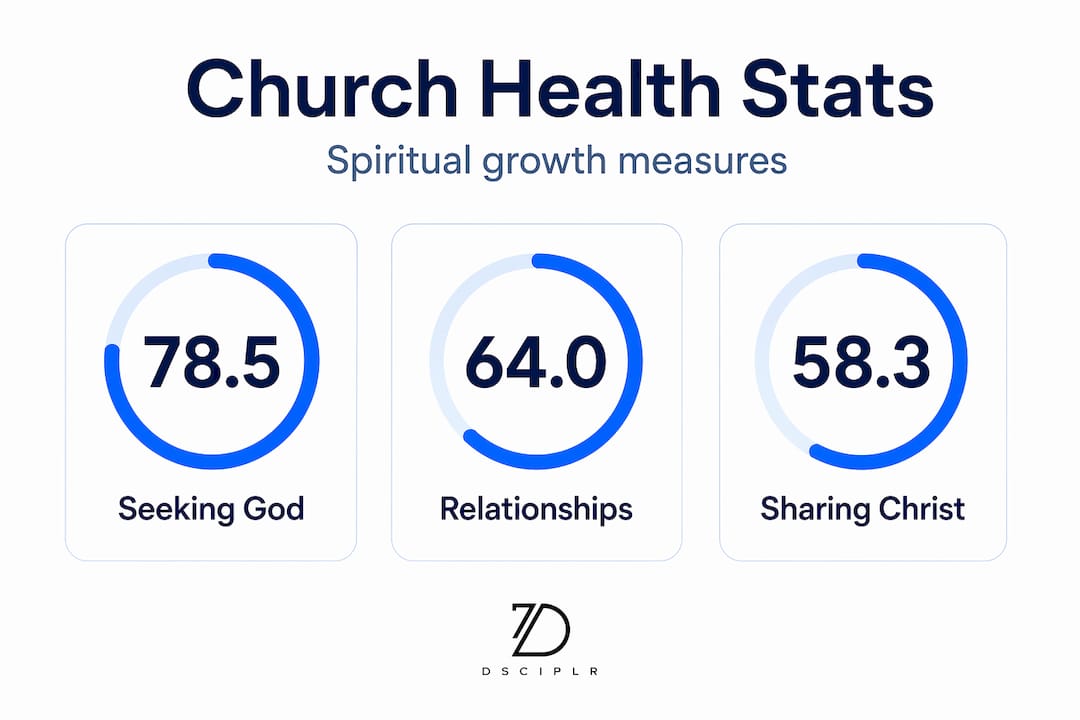
Discipleship signpost | Average score |
Seeking God | 78.5 |
Building relationships | 64.0 |
Sharing Christ | 54.8 |
Pro Tip: When you visit a church, don’t just ask whether it feels friendly. Ask whether people there are growing. Are conversations happening about faith, obedience, and mission? Those conversations are seeds of a genuinely healthy community.
Healthy churches don’t leave discipleship to chance. They present clear growth pathways that help people know where they are spiritually and what the next step looks like. Formation by design, not accident, is one of the clearest characteristics of a healthy church.
Relational signs of a thriving church
What makes a church community strong is not just what happens in the service. It’s what happens in the car park after, in a text message on a Tuesday, or in a lounge room when someone’s life is falling apart. The relational texture of a church is where its true health becomes visible.

Healthy church community exhibits genuine love expressed through warmth in relationships, commitment to prayer for one another, and faith-filled, encouraging language. These are not peripheral. They are core indicators. You can sense when a community prioritises people over programmes.
When members care for one another as a primary concern rather than treating relationships as secondary to institutional activity, the whole community strengthens. People stay. People heal. People grow.
Consider visitor retention. It may sound like a business metric, but it reveals something profound about relational health. Healthy churches retain visitors not through slick systems but through genuine, repeated relational contact. A single warm greeting on Sunday is not enough. What follows, a personal message, an invitation to coffee, a remembered name the following week, is where real community begins.
Look for these relational signs when you’re exploring whether a church is genuinely healthy:
People remember your name after the first visit
Conversations move beyond small talk into real life and real faith
There is visible care in moments of difficulty, grief, or struggle
Prayer for one another is personal and specific, not just formulaic
New people are genuinely welcomed into existing friendships rather than kept at the edges
Pro Tip: The quality of a church’s follow-up culture tells you more than the quality of its Sunday service. A follow-up culture built on genuine relational intent, not task management, is one of the clearest signs of authentic community.
The contrast between a friendly church and a truly healthy one is the difference between warmth that stops at the door and warmth that keeps showing up. One feels good. The other changes lives.
Biblical and doctrinal foundations of church health
Every other marker of church health rests on this one. The clearest sign of a healthy church is its dependence on and guidance by the Word of God. When Scripture shapes the culture, the conversations, the leadership, and the mission of a church, everything else tends to fall into place.
This is not simply about doctrinal correctness, though that matters deeply. It’s about whether the Bible is functionally alive in the community. Are people reading it together? Is it shaping how decisions are made? Are leaders equipping the congregation to engage with it themselves, rather than creating dependence on the pastor as sole interpreter?
Balanced church health integrates biblical foundations, authentic fellowship, discipleship growth, and leadership equipping. None of these elements can be removed without weakening the whole.
Here is how Scripture-centredness shows up practically in a healthy church:
Teaching that applies biblical truth to everyday life, not just theological concepts in abstract form
Leaders who model personal Scripture engagement, not just preach from it
Small groups that study the Bible together and reflect on how it reshapes their lives
A culture where hard questions are welcomed and explored through Scripture rather than deflected
Decision-making processes, whether personal or corporate, that are explicitly grounded in biblical wisdom
Element | Unhealthy expression | Healthy expression |
Scripture | Quoted occasionally, rarely applied | Shapes culture, community, and decisions |
Leadership | Controls and manages | Equips and empowers disciples |
Doctrine | Abstract and academic | Lived, practised, and relationally embedded |
Mission | Internal focus only | Outward and Christ-centred |
Church revitalisation begins with assessment. Like a GPS that tells you your current location before charting a course, understanding where a community stands spiritually and relationally is the foundation for any genuine renewal. Healthy churches are willing to ask honest questions for church health because they care more about growth than appearance.
How to recognise and cultivate healthy church community
Knowing the characteristics of a healthy church is one thing. Knowing how to find one, or help build one, is another. Whether you’re visiting churches for the first time or you’ve been part of a community for years, here are concrete ways to recognise and contribute to genuine church health.
Look for growth conversations. Healthy churches don’t shy away from asking each other hard discipleship questions. If people around you are talking about where they’re growing, what they’re struggling with spiritually, and how they’re applying Scripture, that is a sign of a vibrant church culture.
Seek out a small group or Life Community. Sunday gatherings are important, but the elements of a successful church community are most visible in smaller, consistent relational contexts. Small groups are where accountability, prayer, and genuine friendship actually take root.
Ask about the discipleship pathway. A healthy church can tell you clearly what growth looks like and how they support it. If a church has no answer to that question, or if the answer is only about attending more services, that’s worth noting.
Engage beyond the Sunday service. Healthy church community is expressed through everyday life. Shared meals, serving together in the neighbourhood, praying for each other throughout the week: these are the practices that form people over time.
Offer accountability as well as seek it. You contribute to church health by showing up with honesty and inviting others into honest conversation. Sharing faith outwardly and engaging in accountability conversations are growth areas for most believers, but they’re also the areas where the most transformation happens.
Pay attention to how newcomers are treated over time. Do people follow up? Are visitors integrated into community, or left to find their own way? Your own attentiveness to new faces is a practical way to strengthen the relational health of your church.
Pro Tip: Don’t wait until you feel fully settled before contributing. The benefits of a healthy church community are multiplied when everyone takes small ownership. Introduce yourself to someone new this Sunday. It seeds something larger than you know.
My honest take on what healthy church really means
I’ve spent years exploring what genuine Christian community looks like, and the single biggest misconception I encounter is this: people think that if a church feels warm, it is healthy. Those aren’t the same thing.
I’ve seen communities that were extraordinarily friendly but hadn’t thought about discipleship pathways in years. The warmth was real, but it wasn’t connected to growth. People were loved, but they weren’t being formed. And eventually, when life got difficult or questions got hard, there wasn’t enough depth to hold them.
What I’ve found actually works is the combination of genuine warmth and intentional structure. Not programmes for their own sake, but clear pathways that help people understand what spiritual growth looks like and how the community supports it. Warmth without structure produces community that feels good but doesn’t transform. Structure without warmth produces religion without life. The tension between the two is worth holding carefully.
The other thing I’ve learned is that retention, specifically how a church treats people in their second and third visits, reveals more about its health than anything else. A church that follows up, that remembers, that invites, that draws people into existing friendships rather than leaving them on the edges: that church is building something that lasts.
Don’t settle for a community that only makes you feel welcome. Find one that helps you become more like Jesus.
— Josh
Experience authentic community at Divergent Church
If this article has stirred something in you, and you’re wondering what it would look like to step into a genuinely healthy, discipleship-oriented community, Divergent Church in Canberra exists precisely for that reason.
At Divergentchurch, we don’t believe church is simply a Sunday event you attend. It’s a community you belong to, shaped by Scripture, expressed through relationships, and sent into the rhythms of everyday city life. Our Discipleship Hub offers intentional pathways for spiritual growth, built around the same discipleship signposts the research confirms are markers of genuine health. Our Life Communities are small groups where real fellowship happens, where people pray together, share life, and grow in faith through every season.
If you’re ready to take a next step, whether you’re new to faith, returning to church, or simply looking for deeper community, explore our next steps page and find where you belong.
FAQ
What does a healthy church community look like?
A healthy church community shows consistent growth in discipleship, genuine relational depth, Scripture-centred teaching, and outward mission. It is measured by trajectory across spiritual domains over time, not attendance or atmosphere alone.
What are the key characteristics of a healthy church?
Key characteristics include Bible engagement, serving others, sharing Christ, seeking God, building authentic relationships, and a clear discipleship pathway. These signposts, when growing over time, indicate genuine church health.
How can you tell if a church is truly thriving?
Look for honest growth conversations, meaningful follow-up with visitors, small group involvement, and leaders who equip rather than control. A thriving church connects relational warmth with intentional discipleship structure.
Why is warmth alone not enough for church health?
Superficial warmth without structured discipleship pathways produces friendly environments that lack transformation. True health requires warmth to be connected to ongoing spiritual formation across all discipleship domains.
How do small groups contribute to a healthy church?
Small groups are the primary context where genuine fellowship, accountability, and spiritual growth occur beyond Sunday services. They are where the relational and discipleship elements of a healthy church become lived experience rather than aspiration.
Recommended
Comments