
What is baptism? The biblical meaning explained
- Josh

- 1 hour ago
- 10 min read
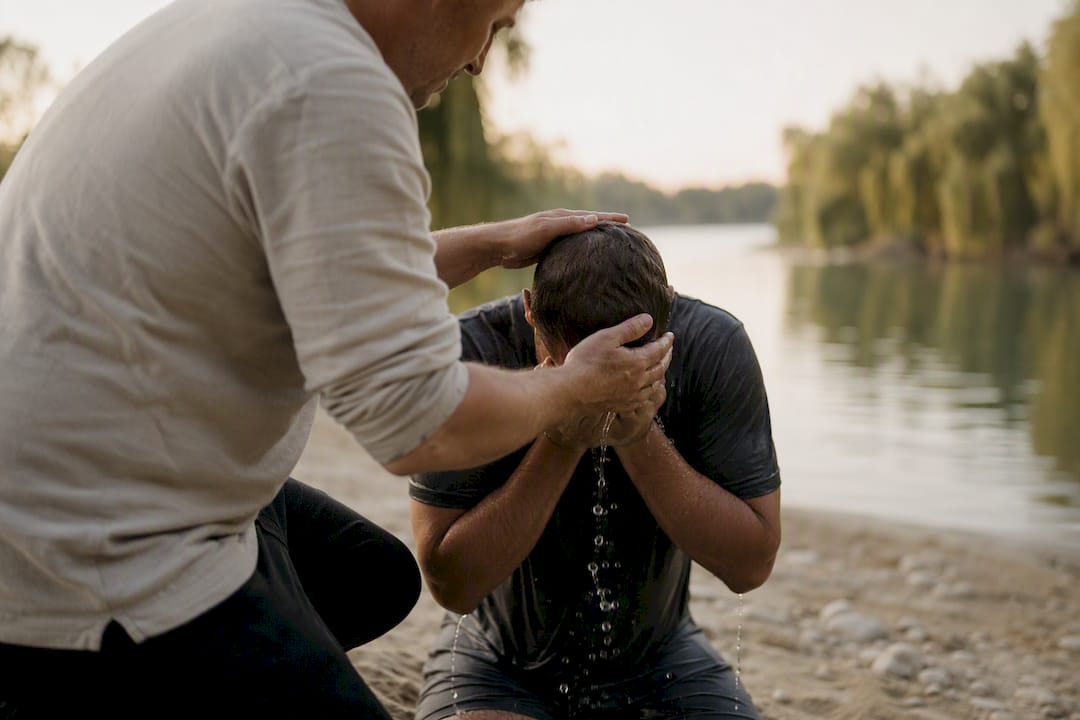
Baptism is a Christian rite of initiation in which a person is immersed in, poured with, or sprinkled by water in the name of the Father, the Son, and the Holy Spirit. It is the outward sign of an inward reality: union with Christ’s death and resurrection, cleansing from sin, and public entry into the church. This is not a private ritual with a hidden meaning. It is a visible, physical act carrying enormous theological weight, and Scripture treats it as one of the defining markers of Christian identity.
What it is: a water rite performed with the Trinitarian words
What it means: union with Christ, forgiveness, and church membership
Where it comes from: commanded in Matthew 28:19 and explained across the New Testament
Who says so: reference works like Britannica and biblical scholarship confirm this consistent core
Key Takeaways
Baptism is the water rite, performed with the Trinitarian words, that visibly marks a believer’s union with Christ’s death and resurrection and their entry into the church.
Point | Details |
Definition anchors the rest | Baptism uses water and the Trinitarian formula to signify union with Christ and church entry. |
Symbolism runs deep | It pictures death and resurrection, washing from sin, and incorporation into the body of Christ. |
Modes vary, meaning doesn’t | Immersion, affusion, and aspersion express the same core reality through different physical forms. |
Water doesn’t save on its own | Baptism is a sign and seal of grace received through faith, not a mechanical guarantee of salvation. |
Traditions differ on mechanism | Catholic, Orthodox, and Protestant churches diverge on whether baptism itself conveys grace or symbolises it. |
Table of Contents
What baptism symbolises: union, washing, and belonging
Baptism is not decoration on top of faith. It pictures something that has actually happened, or is beginning to happen, in a believer’s life.
The clearest image comes from Paul, who tells the Roman church that “we were buried therefore with him by baptism into death, in order that… we too might walk in newness of life” (Romans 6:3-4). Going under the water pictures dying with Christ. Coming up pictures rising with him. It’s a physical re-enactment of the gospel itself, not a metaphor invented later by theologians.
Three further threads run through this symbolism:
Washing and forgiveness. Paul writes that those baptised into Christ have “put on Christ” (Galatians 3:27), language of being clothed in a new identity, sins covered and set aside.
Incorporation into the church. “For in one Spirit we were all baptised into one body” (1 Corinthians 12:13). Baptism is never purely individual. It marks entry into a community.
A redemptive pattern stretching back through Scripture. Israel passing through the Red Sea and Noah’s family surviving the flood both prefigure the same shape: judgement passed through, life on the other side. BibleProject traces this pattern carefully, showing baptism isn’t an isolated New Testament invention but the payoff of a much older biblical story.
Pro Tip: If you’re trying to explain baptism to a friend who isn’t religious, skip the theology terms first. Start with the picture: going under water like going into a grave, coming up like walking out of one. The meaning follows naturally from there.
Biblical basis: the New Testament passages that define baptism
The command itself comes from Jesus: “Go therefore and make disciples of all nations, baptising them in the name of the Father and of the Son and of the Holy Spirit” (Matthew 28:19). This single verse gives baptism its Trinitarian shape and ties it directly to the mission of making disciples, not just adding members.
The book of Acts shows the pattern in action, repeatedly linking baptism to a prior response of repentance and faith:
Peter tells the Pentecost crowd to “repent and be baptised… for the forgiveness of your sins” (Acts 2:38).
The Ethiopian official is baptised the moment he professes belief, with no delay and no separate ceremony (Acts 8:36-38).
Paul’s letters add the theological depth. Baptism is described as being “buried with him” and “raised with him” (Colossians 2:12), directly connecting the rite to resurrection life rather than mere ritual observance.
Peter later draws a striking parallel: Noah’s family was saved “through water,” and baptism now “corresponds to this… not as a removal of dirt from the body but as an appeal to God for a good conscience” (1 Peter 3:20-21). That phrase, “not as a removal of dirt,” matters enormously. The New Testament writers were already correcting the idea that water itself does the spiritual work. Crossway’s summary of key baptism verses collects these passages together and shows how consistently they point past the water to what it represents.
Modes and terms: immersion, affusion, aspersion, and trine practice
Different churches practise baptism differently, and the vocabulary can be confusing if nobody explains it plainly.
Immersion: the candidate is fully or partially submerged in water. This matches the root meaning of the Greek word most closely; Strong’s lexicon defines βάπτισμα as “immersion, submersion,” and Britannica notes the Greek root baptizein means “to plunge or immerse.”
Affusion: water is poured over the head, often three times.
Aspersion: water is sprinkled on the forehead, common where large groups or infants are baptised.
Trine baptism: water applied three times, once for each person of the Trinity. This practice appears as early as the Didache, a first or second century church manual, showing it was already standard practice within a generation or two of the apostles.
None of these modes are arbitrary. Immersion tends to emphasise the symbolic drama of death and resurrection most vividly. Pouring and sprinkling often reflect a more sacramental theology, where the sign itself conveys grace rather than dramatising an event. Neither approach is treating water as unimportant. They’re placing the emphasis in different places.
If you’re attending a service, expect either a font at the front of the church, a dedicated pool, or in some traditions, an outdoor location like a river or the sea.

Infant baptism versus believer’s baptism: who should be baptised, and when
This is where denominations genuinely part ways, and it’s worth understanding both positions rather than assuming one is obviously correct.
Infant baptism rests on covenant theology: children of believing parents are treated as included in God’s covenant community, much as Old Testament children received circumcision. Household baptisms in Acts (entire families baptised together) are often cited in support, though careful reading of those passages shows the dominant New Testament pattern still links baptism tightly to personal faith, so the household examples need nuance rather than a simple proof-text reading.
Believer’s baptism holds that repentance and faith must come before baptism, following the consistent Acts pattern where people believe first and are baptised immediately after.
When families are uncertain, most pastors recommend a conversation before a decision. This isn’t a topic to settle by tradition alone.
Churches supporting either model typically offer preparation classes, mentoring, or a baptism class so candidates and families understand what they’re committing to, not just what they’re doing.
What happens during a baptism service
A typical service follows a recognisable shape across most traditions, drawing on liturgical patterns described by churches like the Archdiocese of Brisbane: a welcome, a Scripture reading, a profession of faith or vows, the water action itself accompanied by the words “I baptise you in the name of the Father, and of the Son, and of the Holy Spirit,” then prayer and a formal welcome into the church.
Expect variation in setting: a font, a purpose built pool, or occasionally an outdoor body of water.
Sponsors or godparents may take vows on behalf of an infant, or stand alongside an adult candidate as witnesses.
The Trinitarian words themselves are non-negotiable across almost every tradition. They’re the theological anchor of the whole act.
Pro Tip: If you’re preparing to be baptised, bring a change of clothes and a towel if immersion is involved, arrive early to meet whoever’s leading the service, and write down one sentence about why you want to be baptised. You’ll likely be asked to share it.
Preparing for baptism: Divergent Church’s next steps
At Divergent Church, baptism isn’t treated as a finish line. It’s a starting point for a life of discipleship, part of a longer path that keeps unfolding through community, mentoring, and everyday faith.
Talk with a minister about your story and what’s led you to this decision.
Join a Life Community or small group so baptism connects to real relationships, not a single Sunday event.
Spend time in honest prayer and repentance beforehand; preparation matters more than performance.
Read why water baptism matters for a deeper look at how we understand the rite locally.
Baptism, understood this way, becomes the doorway into church membership and ongoing growth, not an isolated ceremony.
Does baptism save you, or does it point to something else?
This is the question that causes the most anxiety, and it deserves a direct answer: baptism does not save you by the act of water touching skin. It’s a sign and seal of grace already at work through faith, not a mechanical transaction that earns salvation on its own. The Gospel Coalition’s New City Catechism puts it plainly, describing baptism as pointing to Christ’s completed work rather than accomplishing salvation independently.
Peter’s own words guard against the opposite error too. He specifically clarifies that baptism is “not as a removal of dirt from the body but as an appeal to God for a good conscience” (1 Peter 3:21). The apostle who commanded baptism in Acts 2:38 is the same writer correcting any reader tempted to treat the water as magic.
This means two errors are equally worth avoiding. One treats baptism as optional decoration, something you can skip if you feel spiritually mature enough already. The New Testament never presents it that way. Every conversion account moves toward baptism as the expected next step, not an optional extra. The other error treats the water itself as the active ingredient, as though the ceremony works regardless of what’s happening in the heart of the person receiving it.
Faith and baptism belong together in the New Testament pattern. Neither substitutes for the other, and separating them for too long creates exactly the confusion this question keeps raising.
How baptism developed in the early church
The earliest Christians didn’t invent baptism from nothing. They inherited a practice already familiar from Jewish ritual washing and John the Baptist’s ministry in the Jordan, then filled it with new meaning centred on Christ’s death and resurrection.
Within a generation, the practice had already developed structure. The Didache, a church manual likely written in the late first or early second century, gives detailed instructions: baptise in running water if possible, but pouring is acceptable if none is available, and always in the threefold name of the Trinity. This tells us two things. Immersion was the preferred default, and the early church was pragmatic enough to allow other modes when circumstances demanded it.
By the second and third centuries, baptismal preparation had become more formal. Candidates, often adult converts, went through periods of instruction called catechesis, sometimes lasting years, before their baptism at Easter. Baptism was increasingly tied to specific moments in the church calendar and accompanied by additional rites, anointing with oil, laying on of hands, that later traditions developed into more elaborate sacramental theology.
What stayed constant across this development was the core: water, the Trinitarian words, and a public act marking someone’s entry into the Christian community. The elaboration came later. The essential shape was there from the very beginning.
How Catholic, Orthodox, and Protestant traditions understand baptism differently
Beyond the debates over mode and timing, the traditions diverge on a deeper question: what does baptism actually do?
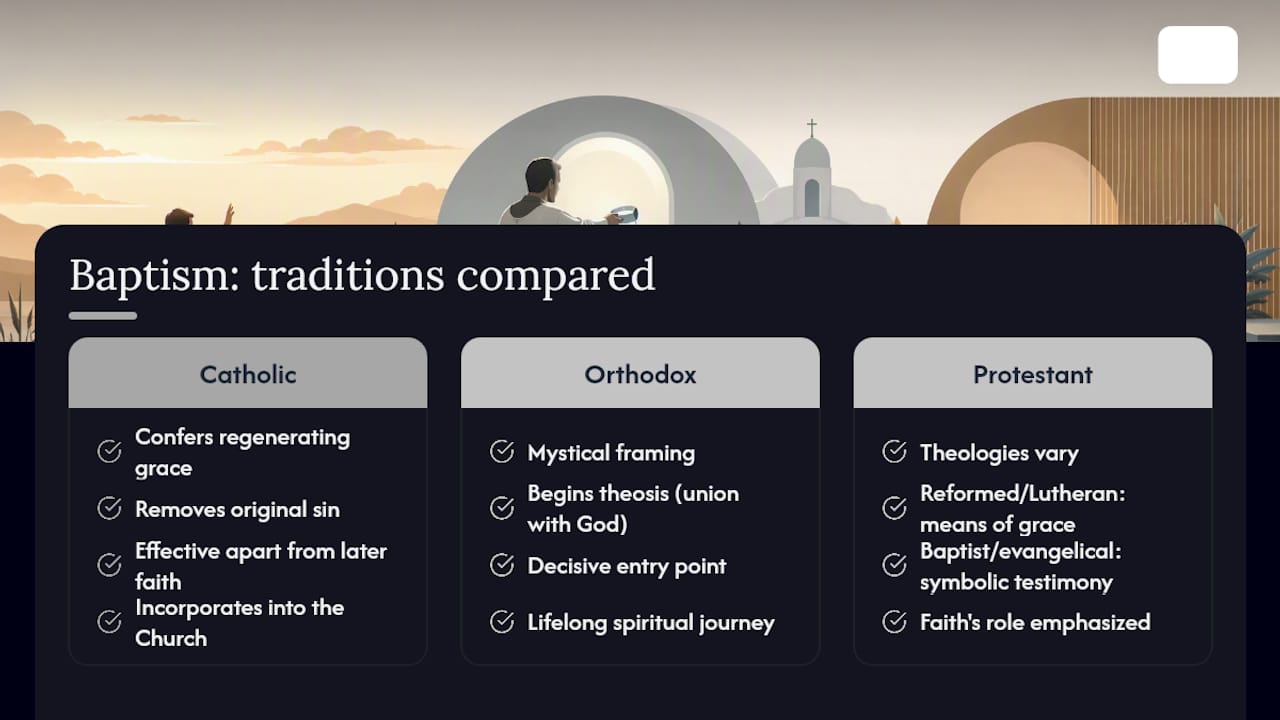
Catholic theology generally holds that baptism confers regenerating grace directly, removing original sin and incorporating the person into the life of the church in a way that has real spiritual effect independent of later faith (particularly relevant for infants). Orthodox theology holds something similar but frames it more mystically, as the beginning of theosis, the lifelong process of being united with God, with baptism as the decisive entry point into that journey.
Protestant traditions split further among themselves. Reformed and Lutheran churches tend to retain strong sacramental language, seeing baptism as a genuine means of grace tied to God’s promises, while still insisting faith must eventually own what baptism signifies. Baptist and many evangelical traditions treat baptism primarily as a symbolic and testimonial act, an obedient response to faith already present, rather than a means that itself conveys grace.
None of these traditions treat baptism as unimportant. They disagree, sometimes sharply, about the mechanism connecting the visible water to the invisible work of the Spirit. Readers coming from a religious background will often recognise their tradition’s instinct in one of these camps immediately.
Baptism, Christian identity, and belonging to a community
Baptism does something sociologically as well as theologically: it makes faith visible and communal rather than private and internal. Someone can believe quietly for years, but baptism is the moment that belief becomes public record, witnessed by others, remembered by name.
This is why the New Testament consistently ties baptism to the body, not just the individual. Paul’s language in 1 Corinthians 12:13, being baptised “into one body,” reflects a community identity that comes attached to the personal one. You don’t simply become a Christian at your own baptism. You become part of a specific, visible people.
Practically, this shows up as a foundation for church membership, participation in communion, and often serves as the recognised entry point for deeper involvement, small groups, discipleship pathways, and leadership responsibility down the track. Baptism gives a church community a shared reference point: a day everyone can point back to and say, this is when you joined us.
Why clarity matters more than tribal debate
The conventional advice on baptism usually starts with the wrong question: which mode is correct, or which denomination has it right. That’s not where the New Testament starts, and it’s not where a reader confused about baptism should start either.
What the evidence actually supports is simpler and more useful. Baptism is a sign pointing to something real, faith and union with Christ, not a mechanism that operates independently of the heart. Get that straight first, and the denominational debates become far less threatening, because they’re arguments about how best to picture a shared truth rather than disagreements about the gospel itself.
Where most explainers fall short is treating mode as the main event. It isn’t. The words spoken, the community witnessing, and the faith being professed carry more weight than whether the water covered someone entirely or touched their forehead. If you’re preparing for baptism, prioritise the conversation with your minister and your own honesty before God over researching which tradition’s font looks most authentic.
Readers deserve clarity here, not a scoreboard of who’s doing it properly.
— Josh
Sources
Recommended
Comments