
The Great Commission: meaning, mission, and how to live it

The Great Commission is Jesus Christ’s final command to His disciples, recorded in Matthew 28:16–20, calling every believer to go and make disciples of all nations. It is not a suggestion tucked away at the end of a Gospel. It is the defining mission of the Church, spoken by the risen Jesus with all authority in heaven and on earth behind it.
“All authority in heaven and on earth has been given to me. Go therefore and make disciples of all nations, baptising them in the name of the Father and of the Son and of the Holy Spirit, teaching them to observe all that I have commanded you. And behold, I am with you always, to the end of the age.” — Matthew 28:18–20 (ESV)
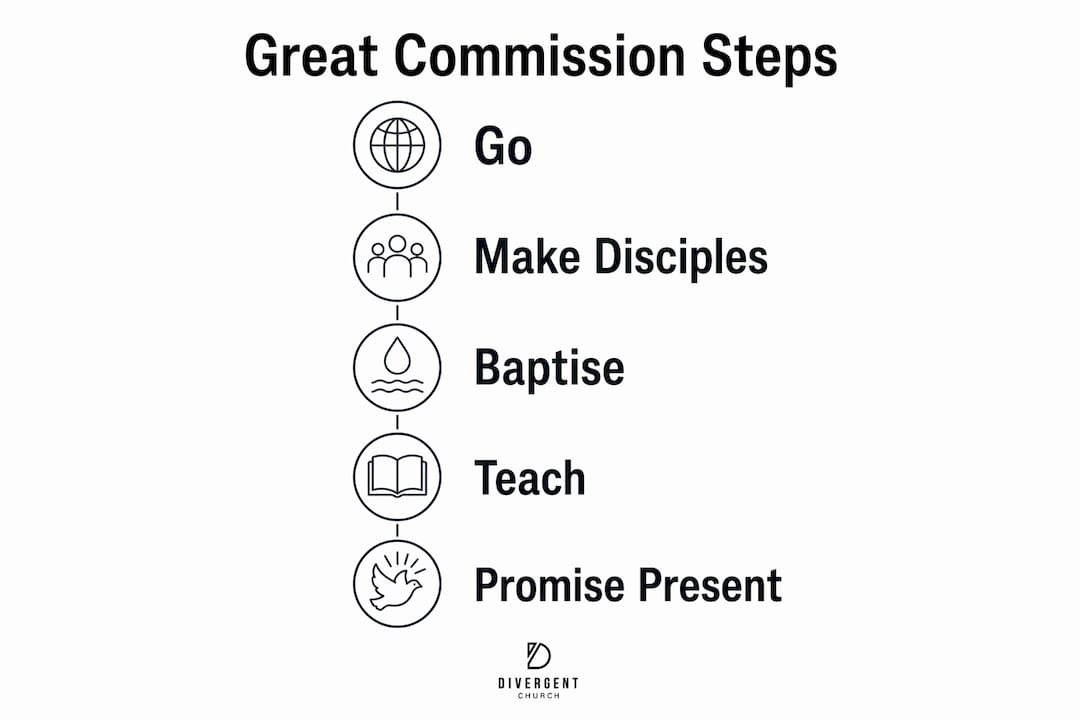
Four actions shape this commission: go, make disciples, baptise, and teach. Jesus closes with a promise that anchors the whole thing. He will be present with His people, not just for a season, but to the very end of the age.
What is the Great Commission, and what does it actually mean?

The word “commission” carries the weight of an official mandate. Jesus, having conquered death and risen from the grave, gathers His eleven disciples on a mountain in Galilee and speaks with the full authority of heaven behind Him. This is His parting word, His overriding instruction, the mission He leaves His followers to carry forward.
In the original Greek, only one verb is imperative: mathēteusate, meaning “make disciples.” The other three actions, going, baptising, and teaching, are participles. They describe how the central command gets carried out, not separate tasks to tick off a list. Disciple-making is the heartbeat. Everything else serves it.
Each command deserves a closer look:
Go. This is not a call reserved for overseas missionaries. Going happens in your street, your workplace, your university campus. The commission assumes movement, a posture of reaching outward rather than waiting for people to come to you.
Make disciples. The primary imperative. A disciple is someone who receives instruction, follows Jesus’ example, clings to His sacrifice, and lives to do His work. Making disciples means intentionally leading people into that kind of life.
Baptise in the name of the Father, Son, and Holy Spirit. Baptism is the public initiation into the Christian faith, a declaration of belonging to the Triune God. The trinitarian formula here is significant. It grounds the commission in the full nature of God.
Teach them to obey. This is not a one-off lesson. It is ongoing formation, helping people grow in obedience to everything Jesus commanded. Discipleship is a lifelong process, not a single event.
“Make disciples is the primary command of the Great Commission. Going, baptising, and teaching are the means by which we fulfil the command to make disciples.” — GotQuestions.org
The relational depth of this commission is striking. Jesus is not describing a programme. He is describing a way of life, seeds planted in real relationships, growing over time into something that looks like the kingdom of God.
Why is the Great Commission so significant in Christian faith?
It is called the Great Commission for good reason. This is the definitive mission statement for every follower of Jesus, the final word of the risen Lord before His ascension. No other command carries quite the same weight of finality and scope.
The theological foundation runs deep. Jesus speaks from the authority of His resurrection. Death has been defeated. All authority in heaven and on earth now belongs to Him, and from that position of total sovereignty, He commissions His people. The mission is not driven by human ambition or institutional momentum. It flows from the lordship of Christ.
The Holy Spirit is central to this. Acts 1:8 sits alongside Matthew 28 as part of the same commission: “You will receive power when the Holy Spirit has come upon you, and you will be my witnesses in Jerusalem and in all Judea and Samaria, and to the end of the earth.” The Holy Spirit empowers believers for mission, convicts hearts, and sustains the work across generations. Without Him, the commission is an impossible task.
The commission is also fundamentally relational. It aims to lead people into a lasting relationship with Jesus through baptism and obedience, not merely to transfer information or grow attendance numbers. That relational quality is what makes it lifelong. Disciple-making cannot be rushed or outsourced. It happens in the ordinary rhythms of life, over meals, in conversations, through shared struggle and shared joy.
How do you fulfil the Great Commission in Australia today?

The commission belongs to every believer, not only to pastors or vocational missionaries. Going happens in everyday settings, in workplaces, neighbourhoods, university campuses, and sporting clubs across Australia. The question is not whether you have been sent. The question is whether you are paying attention to where you already are.
Practical ways to live this out include:
Share your story. Testimony is one of the most natural forms of witness. Telling someone what Jesus has done in your life is going, in the most personal sense.
Invest in one person. Disciple-making is not a crowd activity. It often starts with one intentional relationship, meeting regularly, reading Scripture together, praying, asking honest questions.
Participate in baptism. Whether you are being baptised or witnessing someone else’s, baptism is a communal act of commission. It marks the beginning of a disciple’s public journey.
Teach what you know. You do not need a theology degree to share what Jesus has taught you. Passing on what you have received is the essence of the teaching command.
Lean on the Holy Spirit. Mission attempted in your own strength runs dry. The Spirit gives wisdom, opens doors, and prepares hearts before you even arrive.
Australian churches have taken this seriously in creative ways. Missions organisations working across remote communities, campus ministries at universities like the Australian National University, and local church plants in growing suburbs all reflect the commission at work in this country. The neighbours to nations framing captures it well: the scope is global, but it starts next door.
Pro Tip: Use the 15 discipleship questions from Divergentchurch as a practical starting point for intentional one-on-one conversations. Good questions open doors that a sermon never could.
How Divergentchurch lives out the Great Commission in Canberra
Divergentchurch is a Jesus-centred, mission-focused community with locations in Canberra and Port Macquarie. The church exists within the rhythms of the city, its universities, workplaces, and transient population, seeking to help people find genuine Christian community, grow in faith, and live with purpose. That is not a tagline. It is the Great Commission expressed in a specific postcode.
Discipleship at Divergentchurch is not confined to Sunday gatherings. It happens in Life Communities, small groups where people share meals, study Scripture, and carry each other’s burdens. It happens in mentoring relationships, in conversations after church, in the ordinary moments where faith becomes visible. The spiritual community that forms around shared mission is itself a witness to the watching city.
“We are not simply a Sunday gathering, but a community shaped by Scripture, centred on Jesus, and expressed through everyday life, relationships, and mission.” — Divergentchurch
The Holy Spirit’s role is taken seriously here. Dependence on the Spirit is not a theological footnote at Divergentchurch. It is the posture from which mission flows. Canberra is a city of transient residents, students, and public servants, people who often arrive without roots and leave before they have grown any. The commission in that context demands patience, presence, and a willingness to invest in people who may not stay long. Seeds planted in Canberra grow in places Divergentchurch will never see.
The historical context behind the Great Commission
Jesus delivered the Great Commission in the weeks following His resurrection, before His ascension into heaven. The setting is a mountain in Galilee, a region Jesus had ministered in extensively, and the audience is the eleven remaining apostles. Matthew’s account places this moment as the culmination of his entire Gospel, the point toward which the whole narrative has been building.
The commission has deep roots in the Hebrew Scriptures. Evangelical Christian theology has long understood it as a restatement and expansion of God’s covenant with Abraham in Genesis 12:3, where God promised that all nations would be blessed through Abraham’s offspring. The Great Commission is the fulfilment of that promise taking shape through the risen Christ and His Spirit-empowered community.
Historically, the early church took the commission seriously and rapidly. The book of Acts traces the geographic expansion Jesus outlined in Acts 1:8: from Jerusalem (Acts 1–7), through Judea and Samaria (Acts 8–12), and out to the ends of the earth (Acts 13–28). Within a generation, communities of disciples had formed across the Roman Empire, a movement driven not by political power but by witness, baptism, and teaching.
How does Matthew 28 compare with the commission in other Gospels?
The Great Commission appears across all four Gospels and Acts, each account adding a different dimension to the whole picture.
Mark 16:15–18 emphasises proclamation: “Go into all the world and preach the gospel to all creation.” Where Matthew focuses on making disciples through teaching and baptism, Mark stresses the urgency of proclamation to every person.
Luke 24:46–49 grounds the commission in the fulfilment of Scripture. Jesus opens the disciples’ minds to understand the Law, the Prophets, and the Psalms, then sends them out as witnesses, promising the Father’s gift of power from on high. Luke’s version is explicitly tied to repentance and forgiveness of sins proclaimed in Jesus’ name to all nations.
Acts 1:8 functions as Luke’s second account of the commission, this time with a geographic roadmap: Jerusalem, Judea and Samaria, and the ends of the earth. The Holy Spirit’s empowerment is front and centre here, making Acts 1:8 the commission’s operational blueprint.
Taken together, these accounts are not contradictory. They are complementary. Matthew provides the structure, Mark the urgency, Luke the scriptural grounding, and Acts the Spirit-powered strategy for how it all unfolds.
What are the theological implications of the Great Commission?
The commission carries profound theological weight on several fronts. First, it is a Trinitarian statement. Baptism in the name of the Father, Son, and Holy Spirit is not a formula to recite mechanically. It is an initiation into relationship with the Triune God, the fullest possible expression of who God is.
Second, the commission assumes the resurrection. Jesus speaks with all authority because He has conquered death. A dead teacher cannot commission anyone. The Great Commission is only intelligible in light of Easter morning.
Third, it redefines the people of God. The scope is “all nations,” the Greek panta ta ethnē, meaning every ethnic and cultural group on earth. This is a decisive break from a geographically and ethnically bounded covenant community. The Church is, by definition, a global, multiethnic body.
Finally, the promise of Jesus’ presence, “I am with you always, to the end of the age,” is a theological anchor. The commission is not abandoned to human effort. The risen Christ accompanies His people in the work, which is why the mission’s success does not ultimately depend on strategy or resources.
What are the main challenges in interpreting the Great Commission?
Not every Christian reads the commission the same way, and the disagreements are worth taking seriously.
One long-standing debate concerns scope. Was the commission given only to the original apostles, or does it extend to all believers in every generation? Evangelical theology has consistently held the latter, reading the commission as a directive to the whole Church across time, not a one-time assignment to eleven men in Galilee.
A second tension involves method. Some traditions have prioritised proclamation evangelism, preaching the gospel publicly and calling for immediate response. Others emphasise presence and service, living among communities over long periods and allowing witness to emerge from relationship. Both find support in the New Testament, and the healthiest approaches hold them together.
A third controversy surrounds the relationship between social justice and evangelism. Does fulfilling the commission require addressing poverty, injustice, and suffering, or is it primarily about spiritual conversion? The Lausanne Movement, which has shaped evangelical missiology significantly, has argued that word and deed belong together, that proclaiming the gospel and serving human need are not competing priorities.
Finally, the commission as a lifelong command rather than a completed task challenges comfortable Christianity. It is easy to treat it as something professionals do on behalf of the rest of the Church. The text does not allow that reading.
Key takeaways
The Great Commission is Jesus’ authoritative, lifelong mandate to every believer: make disciples of all nations by going, baptising, and teaching, sustained by His presence and the power of the Holy Spirit.
Point | Details |
Source and authority | Matthew 28:16–20 records Jesus’ final command, spoken with all authority in heaven and on earth. |
Core imperative | “Make disciples” is the only imperative verb; going, baptising, and teaching describe how it happens. |
Trinitarian foundation | Baptism in the name of the Father, Son, and Holy Spirit initiates people into relationship with the Triune God. |
Every believer’s call | The commission belongs to all Christians, lived out in workplaces, neighbourhoods, and everyday relationships. |
Empowered by the Spirit | Acts 1:8 makes clear that the Holy Spirit provides the power and presence needed to carry the mission forward. |
Divergentchurch’s Discipleship Hub is a practical starting point if you want to go deeper in living out the commission, whether you are new to faith or looking to invest more intentionally in others.
Recommended
Comments