
Why church planting matters for faith and community


Church planting is the intentional establishment of new congregations, and it is the single most effective strategy for growing the body of Christ and renewing existing churches. Theologian Tim Keller identifies church planting as the most crucial strategy for city-wide spiritual growth. The importance of church planting reaches beyond organisational expansion. It is a kingdom act, a missional necessity, and a prophetic statement that the gospel is for every neighbourhood, culture, and generation. For church leaders and individuals alike, understanding why church planting matters is the foundation for faithful, fruitful mission.
Why church planting matters: the biblical foundation
Church planting is not a modern growth tactic. It is a direct expression of the Great Commission. In Matthew 28:19–20, Jesus commands his disciples to “go and make disciples of all nations, baptising them in the name of the Father and of the Son and of the Holy Spirit.” That command is not fulfilled by maintaining existing gatherings. It requires planting new ones.
The Apostle Paul modelled this with extraordinary clarity. Across the book of Acts, Paul planted churches in Antioch, Corinth, Ephesus, Philippi, and Thessalonica, each one contextualised to its city and culture. He did not simply visit and preach. He established communities of disciples who would carry the gospel forward. That pattern is the blueprint for gospel ministry in every generation.
The theological significance of church planting rests on several pillars:
Kingdom expansion: Each new church is a local expression of God’s kingdom breaking into a specific neighbourhood or people group.
Incarnational mission: Like Jesus taking on flesh to dwell among us, church plants take on local culture to make the gospel accessible and real.
Disciple multiplication: The Great Commission is not just about converts. It is about forming disciples who form more disciples, which requires new communities to hold them.
Obedience to Scripture: Church planting is not optional for a church that takes the New Testament seriously. It is the natural outworking of a community shaped by the mission of God.
Divergentchurch in Canberra holds this conviction at its core. The church exists not simply as a Sunday gathering but as a community shaped by Scripture and expressed through everyday life, relationships, and mission across the city.
Does church planting actually grow the church numerically?
The research is clear. New churches baptise approximately 13 people per 100 members, compared to just 3 per 100 in older, established congregations. That is a baptism rate more than four times higher. The significance of that gap is profound. It means new churches are not simply reshuffling existing Christians. They are reaching people who were not previously connected to any faith community.
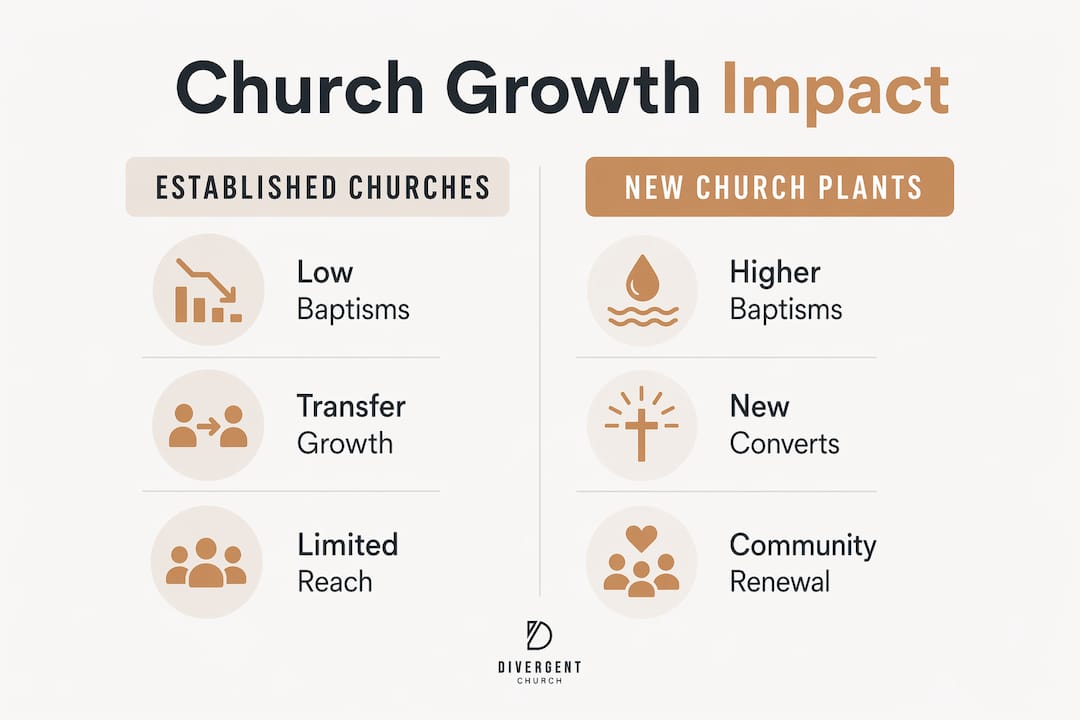
Established churches tend to grow by transfer rather than conversion. New plants reach unchurched people and those who have drifted from faith, creating genuine gospel outreach rather than member redistribution. This is the missional necessity at the heart of church planting significance.
The numbers also reveal an urgent need. 715 Southern Baptist Convention churches closed in 2024 alone. That scale of closure means the church cannot simply maintain what exists. New plants are required to sustain and grow the overall mission.
Growth indicator | Established churches | New church plants |
Baptisms per 100 members | ~3 | ~13 |
Primary growth source | Transfer growth | Conversion growth |
Relational engagement | Programme-driven | Relationship-driven |
Community reach | Existing networks | Unchurched and disconnected |
Relational health is a key driver of this growth. Building relational infrastructure in churches increased attendance by 23% and giving by 28% over 18 months. New church plants are naturally wired for this kind of relational depth because they begin with small, committed communities rather than inherited programmes.
Pro Tip: If you are part of a church considering planting, prioritise relational infrastructure from day one. Assign people to care for one another before you build any formal programme. The relationships will sustain the community long after the excitement of launch fades.
Church planting also renews the churches that send planters. Sending members to plant new churches provides renewal opportunities for the sending church and prevents stagnation. The act of releasing people for mission reorients a congregation toward its true purpose.
How does church planting develop leaders?
Church planting is one of the most effective environments for developing leaders. In an established church, leadership roles are often filled. In a new plant, every person is needed. That necessity creates ownership, and ownership creates growth.

Church plants foster leadership development by requiring members to take genuine responsibility for the community’s health and mission. People who might sit passively in a larger congregation find themselves leading small groups, welcoming newcomers, or coordinating outreach. That participation is formative. It shapes disciples who are active rather than passive.
Church plants also function as what Tim Keller describes as research and development laboratories for the wider church. Church plants act as testing grounds for ministry methods that established churches may consider too risky to attempt. A new congregation can experiment with worship forms, outreach models, and community structures without the weight of institutional expectation. The lessons learned feed back into the broader body of Christ.
Organic leadership discovery: People step into roles they never knew they had the capacity for, simply because the need is present and the community is small enough to notice them.
Contextual innovation: New plants can shape their gatherings around the specific rhythms of their neighbourhood, whether that is a university campus, a suburban street, or a city workplace.
Multiplication mindset: Leaders formed in a church plant carry a multiplication instinct. They have seen a church begin from nothing, so they believe it can happen again.
Pro Tip: Church planting leaders should intentionally name and release emerging leaders early. Do not wait until someone is fully formed. Give people responsibility before they feel ready. That is how the Apostle Paul developed Timothy.
Understanding the role of church in society beyond Sunday gatherings is central to this leadership vision. Church planting trains leaders who see their whole life as the mission field.
Why church planting builds vibrant, diverse communities
Church planting builds communities that established churches often cannot reach. The reasons for church planting in this area are both cultural and relational.
Church planting movements succeed because they tailor the gospel to specific cultural and linguistic contexts. When a church is planted within a particular community, whether that is a migrant community, a student population, or a working-class neighbourhood, it speaks the language of that community in every sense. The worship, the relationships, and the rhythms of community life reflect the people it serves.
This contextualisation is not compromise. It is faithfulness. The gospel has always taken root most deeply when it is expressed through the cultural soil of the people receiving it.
The impact of church planting on community building includes:
Relational depth: New plants create pathways for people at all life stages to connect deeply, preventing the disengagement that larger, programme-heavy churches can produce.
Cultural accessibility: Multicultural and multilingual church plants make the gospel genuinely accessible to communities that existing churches may not reach.
Neighbourhood presence: A church plant embedded in a specific suburb or precinct becomes a genuine neighbour, not just an institution people drive to on Sundays.
Meeting unmet needs: New churches often identify and respond to social needs in their area with a speed and creativity that larger institutions cannot match.
Divergentchurch exists within the rhythms of Canberra, its universities, workplaces, and neighbourhoods, seeking to help people find genuine church community and grow in faith. That presence is itself a form of church planting conviction. The church that is truly missional does not wait for the city to come to it.
Church planting models range widely, including house churches, ethnic congregations, and campus churches, allowing flexibility for mission in every context. This diversity of expression is a strength, not a weakness. It reflects the breadth of the kingdom of God.
A healthy church also strengthens the relational fabric of the people within it. Research shows that church community supports marriages and families by providing consistent relational accountability and care. Church plants, with their relational focus, are particularly well placed to offer this kind of support from the very beginning.
Church diversity within a planted congregation also enriches the faith of every member. When people from different backgrounds worship together, they encounter a fuller picture of the God who made them all.
Key takeaways
Church planting is the most effective strategy for reaching unchurched people, developing leaders, and renewing the wider body of Christ across every culture and community.
Point | Details |
Biblical mandate | Church planting is the direct outworking of the Great Commission in Matthew 28:19–20. |
Higher conversion rates | New churches baptise at more than four times the rate of established congregations. |
Leadership development | Church plants create organic leadership growth by requiring genuine ownership from members. |
Community contextualisation | Plants reach specific cultures and neighbourhoods that existing churches often cannot access. |
Renewal for sending churches | Sending members to plant new churches reinvigorates the mission focus of the whole congregation. |
Church planting is closer to the heart of God than we often admit
There is something I keep returning to when I think about why church planting matters. It is not primarily a strategy. It is a posture. It is the posture of a community that believes the gospel is genuinely good news for people who have not yet heard it, and that is willing to go to them rather than waiting for them to arrive.
I have watched church planting revitalise faith in people who had grown comfortable with a Christianity that asked very little of them. When you are part of something being built from the ground up, you cannot be passive. You are needed. That necessity is, I think, one of the most spiritually formative experiences a believer can have.
The challenges are real. Church planting is costly in time, energy, and resources. There are seasons of discouragement when growth is slow and the vision feels distant. But I have seen, again and again, that the communities formed in those difficult early seasons carry a depth of commitment and love that is genuinely rare.
What strikes me most is this: church planting is not just about the new church. It is about what happens to the people who plant it. They become more prayerful, more dependent on God, more attentive to the people around them. Seeds planted in faith do not just grow outward. They grow the planter too.
— Josh
How Divergentchurch supports church planting and discipleship
Divergentchurch in Canberra is committed to forming disciples who live with purpose and mission in the city. If you are exploring what it means to plant a church, lead a community, or simply grow deeper in faith, the resources at Divergentchurch are built for exactly that.

The Discipleship Hub brings together training, community, and practical tools for leaders and individuals who want to engage seriously with church planting and missional living. Whether you are at the beginning of your faith or ready to lead others, there is a place for you to grow. You can also explore leadership training designed to equip leaders for missional church contexts. Divergentchurch exists to help you take your next step in faith and community.
FAQ
What is church planting?
Church planting is the intentional process of establishing a new congregation in a specific community or context. It is the primary means by which the Great Commission is fulfilled across new populations and cultures.
Why do new churches grow faster than established ones?
New churches baptise approximately 13 people per 100 members, compared to 3 per 100 in older congregations. They grow faster because they are structured around relationships and conversion rather than maintaining existing membership.
How does church planting benefit the sending church?
Sending members to plant a new church renews the mission focus of the sending congregation and prevents organisational stagnation. The act of releasing people for mission reorients the whole community toward its purpose.
Can church planting reach multicultural communities?
Church planting movements succeed specifically because they contextualise the gospel to local cultures and languages. Ethnic congregations, multilingual plants, and neighbourhood churches each reflect the diversity of the kingdom of God.
How does church planting relate to discipleship?
Church planting and discipleship are inseparable. New churches create environments where every member is needed, which produces active disciples rather than passive attenders. Leadership and faith grow together in the planting process.
Recommended
Comments